
投资银行

Search documents
高盛:尽管鲍威尔放鹰,仍将12月降息作为基准预测
Hua Er Jie Jian Wen· 2025-11-04 03:04
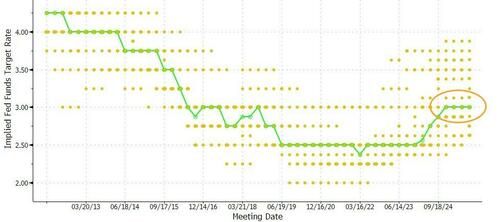
Core Viewpoint - The Federal Reserve Chairman Jerome Powell's statements after the October meeting surprised the market, but Goldman Sachs maintains its baseline forecast for a 25 basis point rate cut in December due to the ongoing cooling of the labor market [1][2][7] Group 1: Federal Reserve's Position - Goldman Sachs expects that even if the government shutdown ends next week, the incremental data available before the December meeting is likely to be weak, supporting the case for a rate cut [2][4] - Powell's hawkish signals after the meeting indicated that monetary policy is not on a preset path, and committee members have differing views on the pace of rate cuts, which caught the market off guard [2][3] - The dot plot from September suggests that most committee members view rate cuts as the default option, with no signs of improvement in the labor market [3] Group 2: Economic Data and Employment - The government shutdown is expected to negatively impact employment data, with delayed resignation data affecting the October employment report and potentially the November data as well [4] - The reliability of the data as a signal will be diminished due to the government shutdown, complicating the Fed's decision-making process [4] - Goldman Sachs believes that betting on a rate cut in December will prove to be a good opportunity, but suggests waiting for a better entry point due to the lack of immediate catalysts for a market reversal [4] Group 3: Future Policy Outlook - Looking beyond 2025, Goldman Sachs emphasizes that the policy path will be more dispersed with numerous intersecting factors [5] - The recent announcement by Amazon regarding layoffs due to AI highlights that, despite productivity improvements, the labor market may weaken while economic growth remains strong, potentially leading to lower neutral interest rates [5] - Although the market has stabilized around a terminal rate of approximately 3%, Goldman Sachs notes significant uncertainty surrounding this level [5]


2025新三板借壳前瞻:新规下的资本跃迁机遇与策略重构
Cai Fu Zai Xian· 2025-11-04 02:57
Core Insights - The article discusses the transformation of the New Third Board's backdoor listing market in 2025, highlighting the shift from formal reviews to substantive value assessments by regulators [2][9] - It emphasizes the importance of integrating industry insights with investment banking expertise to identify and support quality small and medium-sized enterprises (SMEs) in their capital market strategies [2][8] Group 1: Market Evolution - In 2025, the New Third Board's backdoor listing market will focus on the sustainable operational capabilities and industry positioning of enterprises rather than just financial metrics [2][9] - The volume of backdoor listings in the New Third Board increased by 37% year-on-year, with the average execution cycle reduced to 5.2 months [1][2] Group 2: Ideal Candidates for Backdoor Listings - Three types of enterprises are identified as most suitable for considering backdoor listings in 2025: 1. Technology-driven SMEs with high R&D investment and significant patent barriers [3] 2. Key players in the supply chain with over 30% market share in niche sectors [3] 3. Traditional industries undergoing digital transformation, demonstrating verifiable efficiency improvements [3] Group 3: North Shark Capital's Approach - North Shark Capital has developed a unique "three-step" service system to combine industry resources with investment banking experience [4][8] - The first step involves selecting targets based on industry structure, technological barriers, and substitution risks to ensure long-term capital value [5] - The second step utilizes data-driven analysis to design transaction structures that match the stability and health of the enterprise's supply chain [6] - The third step includes pre-planning capital pathways for 12-24 months post-listing, covering key actions like targeted issuance and IPO connections [7] Group 4: Competitive Advantages - North Shark Capital's unique advantage lies in its shareholder ecosystem, which includes supply chain finance, industrial investment, and technology platforms, creating a comprehensive support system for listed companies [8] - Post-listing, companies can quickly access a network of industrial clients and low-cost financing solutions based on supply chain data [8] - The firm has demonstrated success in helping companies achieve significant growth in order volumes shortly after backdoor listings [8] Group 5: Future Trends - The New Third Board's backdoor listing market in 2025 will see increased specialization, with financial advisors lacking industry backgrounds gradually exiting the market [9] - Data-driven platforms like Jingxin Chain Tong will become standard in capital services, enhancing the integration capabilities of listed companies [9] - The ability to integrate and create value post-listing will become a critical measure of a capital institution's strength [9]
美股财报季迎两大潜在风险
第一财经· 2025-11-04 00:36
2025.11. 04 本文字数:1953,阅读时长大约3分钟 作者 | 第一财经 樊志菁 在上周最忙业绩披露期结束后,美股本轮新财报季已经过半。机构统计显示,本季度市场业绩超额收 益较历史均值有所下降,与此同时,考虑到目前的估值水平,美联储的政策立场的微妙前景可能带来 潜在的逆风。 高盛:业绩利好反馈不佳 威尔逊在周一发布的报告中表示:"我们认为这是一个未被充分关注的趋势,且预计该趋势将持续至 2026年,推动主要指数与次要指数的盈利贡献范围不断扩大。与往常一样,股市已先于共识预测者 察觉到这一变化。" 事实上,当前财报季的一大亮点是企业营收表现远超预期:截至目前,标普500指数成分股营收同比 增长2.3%,是历史平均增速的两倍。由此看来,企业盈利层面整体呈现乐观态势。贸易担忧情绪的 缓解也对市场信心起到提振作用。但威尔逊及其团队也承认,股市可能面临一些短期风险。 尽管第三季度财报季表现亮眼,但市场并未对此给予充分的回报。 高盛整理的数据显示,业绩超预期的个股在财报发布后,尽管股价在业绩超出分析师预测后仍会上 涨,但其涨幅已低于历史水平。相对标普500指数的超额收益率中位数仅为32个基点。而在过去,这 类个 ...


乘势 • 谋新 | 2025年中金公司年度投资策略会
中金点睛· 2025-11-04 00:07
Core Insights - The article discusses the upcoming CICC Annual Investment Strategy Conference 2025, highlighting key speakers and topics that will be addressed during the event [1][3]. Group 1: Conference Overview - The conference will take place from November 12 to 14, 2025, at the Beijing Kerry Hotel [1]. - Notable speakers include Wang Shuguang, Vice Chairman and President of CICC, and Liu Shijun, Chief Advisor of the China Council for International Cooperation on Environment and Development [1][3]. Group 2: Economic Outlook - The conference will feature discussions on macroeconomic outlooks for China and the United States, led by Zhang Wenlang, Managing Director of CICC Research [5]. - Topics will also cover A-share market outlook, Hong Kong and overseas market perspectives, and asset outlooks [5]. Group 3: Sector-Specific Insights - The agenda includes sessions on various sectors such as real estate, fixed income, REITs, and quantitative investment strategies for 2026 [6][10]. - Specific sessions will focus on new supply dynamics in industries like automotive, photovoltaic, and energy [8]. Group 4: Technological Innovations - The conference will explore advancements in AI and its implications for infrastructure and intelligent robotics [9][11]. - Discussions will also cover the integration of AI in various applications and the emergence of new materials [12][40]. Group 5: Consumer Trends - The event will address new consumer trends, emphasizing quality of life and innovative consumption patterns [9][55]. - Topics will include the evolution of service chains, brand operations, and the rise of consumer robots [9]. Group 6: Financial Sector Developments - Insights into the wealth management industry post-fee reform and the development of a multi-layered REITs market will be presented [10]. - The conference will also discuss the opportunities and challenges presented by RWA in empowering the real economy [10].

高盛上调对中国出口增速预期
Zhong Guo Xin Wen Wang· 2025-11-03 10:07
高盛上调对中国出口增速预期 高盛研究团队预测,人民币国际化可能在未来几年显著加速。预计随着高新技术制造业竞争力提升以及 人民币国际化加速,中国股市将表现领先,人民币对美元汇率将会升值。到2028年中国经常账户顺差与 国内生产总值(GDP)之比将接近5%,考虑到中国经济的庞大体量,这将是相对于全球GDP的历史新高。 广告等商务合作,请点击这里 上述报告还认为,10月份发生的两个重大事件——《中共中央关于制定国民经济和社会发展第十五个五 年规划的建议》对外公布和中美经贸团队通过吉隆坡磋商达成成果共识,发出的信号方向一致,即中国 将进一步提升先进制造业竞争力并进一步提振出口。 本文为转载内容,授权事宜请联系原著作权人 由此,高盛研究团队上调了对中国出口增速的预期,预计未来几年中国出口量将每年增长5%至6%,获 得更多全球市场份额并推动整体经济扩张。(完) 中新经纬版权所有,未经书面授权,任何单位及个人不得转载、摘编或以其它方式使用。 关注中新经纬微信公众号(微信搜索"中新经纬"或"jwview"),看更多精彩财经资讯。 来源:中国新闻网 编辑:郭晋嘉 中新社北京11月3日电 (记者 夏宾)中新社记者3日从高盛集团获 ...
高盛:升中金公司(03908)目标价至25.1港元 维持“买入”评级
Zhi Tong Cai Jing· 2025-11-03 09:27
智通财经APP获悉,高盛发布研报称,维持中金公司(03908)H股"买入"评级,目标价由22.9港元升至 25.1港元。该行予A股"中性"评级,目标价由42.03元人民币升至46.05元人民币。 中金公布2025年第三 季度业绩,净收入和净利分别为80亿元和22亿元人民币(下同),较该行预期分别高出9%和6%。各业务 板块表现基本符合预期,惟投资银行业务收入表现亮眼,达13亿元,较该行预期大幅高出45%。该行预 期投资者关注焦点将集中于公司对2026年资本市场展望;投行收入强劲增长的驱动因素,尤其香港业务 及交易落实速度;成本控制指引。 该信息由智通财经网提供 ...

高盛:升中金公司目标价至25.1港元 维持“买入”评级
Zhi Tong Cai Jing· 2025-11-03 09:22
高盛发布研报称,维持中金公司(601995)(03908)H股"买入"评级,目标价由22.9港元升至25.1港元。 该行予A股"中性"评级,目标价由42.03元人民币升至46.05元人民币。 中金公布2025年第三季度业绩,净收入和净利分别为80亿元和22亿元人民币(下同),较该行预期分别高 出9%和6%。各业务板块表现基本符合预期,惟投资银行业务收入表现亮眼,达13亿元,较该行预期大 幅高出45%。该行预期投资者关注焦点将集中于公司对2026年资本市场展望;投行收入强劲增长的驱动 因素,尤其香港业务及交易落实速度;成本控制指引。 ...
OPEC+宣布明年暂停增产后,大摩火速上调油价预期!
Hua Er Jie Jian Wen· 2025-11-03 07:09
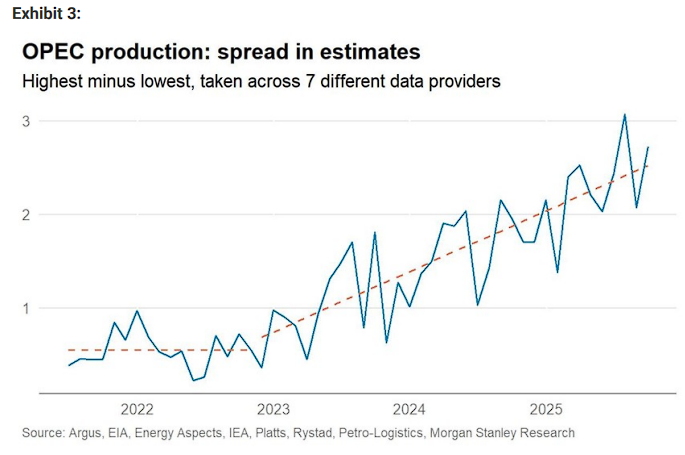
Core Insights - OPEC+ has announced a pause in production growth until Q1 2026, which has prompted Morgan Stanley to adjust its Brent crude oil price forecast from $57.50 to $60 per barrel, signaling a reduction in market volatility [1][2][4] - The pause in production growth is seen as a proactive measure by OPEC+ to stabilize the market, rather than a significant change in actual production levels [2][3] - Morgan Stanley believes that the combination of OPEC+'s intervention and new sanctions on Russian oil by the US and EU will support Brent oil prices in the near term [4][3] OPEC+ Production Strategy - OPEC+ plans to increase production by 137,000 barrels per day in December, consistent with previous months, but will pause growth from January to March due to seasonal demand factors [2] - The decision to pause is typical for the first quarter, which is usually a seasonally weak period for oil demand, reflecting a cautious approach by oil-producing countries [2] Market Dynamics and Price Forecast - Morgan Stanley's analysts assert that the perception of OPEC+ operating in an "autopilot" mode has been disrupted by this pause, indicating that the organization is still responsive to market conditions [3] - The firm anticipates a significant oversupply in the global oil market in 2026, particularly in the first half, but believes OPEC+'s intervention will mitigate downward price risks [3][4] - The forecast suggests that Brent oil prices could rise to $65 per barrel by the second half of 2027 as global demand begins to consume excess inventories [4] Discrepancies in Production Data - There is a notable gap between OPEC+'s production quotas and actual output, with discrepancies reported to exceed 2.5 million barrels per day, complicating the assessment of OPEC+'s effectiveness [6][9] - Morgan Stanley's analysis indicates that actual production growth has been minimal despite quota increases, suggesting that remaining production capacity may be limited [9][10]
高盛:中金第三季投行业务收入表现亮眼 上调AH股目标价
Xin Lang Cai Jing· 2025-11-03 07:01
Group 1 - The core viewpoint of the article indicates that China International Capital Corporation (CICC) reported a net income and net profit of 8 billion yuan and 2.2 billion yuan for the third quarter, exceeding Goldman Sachs' expectations by 9% and 6% respectively [1] - The performance across various business segments was generally in line with expectations, but the investment banking segment showed remarkable revenue growth, reaching 1.3 billion yuan, which was significantly above Goldman Sachs' forecast by 45% [1] - Investors are expected to focus on the company's outlook for the capital markets in 2026, the driving factors behind the strong growth in investment banking revenue, particularly in Hong Kong, and the speed of transaction execution [1] Group 2 - The report highlights the importance of cost control guidance, especially considering potential recruitment increases due to a shortage of personnel in the industry [1] - Goldman Sachs maintains a "Buy" rating for CICC's H-shares, raising the target price from 22.9 HKD to 25.1 HKD, while assigning a "Neutral" rating for A-shares with a target price increase from 42.03 CNY to 46.05 CNY [1]
大行评级丨高盛:中金第三季投行业务收入表现亮眼 上调AH股目标价
Ge Long Hui· 2025-11-03 06:53
Core Viewpoint - Goldman Sachs reported that China International Capital Corporation (CICC) achieved net income and net profit of 8 billion yuan and 2.2 billion yuan in the third quarter, exceeding the bank's expectations by 9% and 6% respectively [1] Financial Performance - The performance across various business segments was generally in line with expectations, but investment banking revenue was particularly strong, reaching 1.3 billion yuan, which was significantly above the bank's forecast by 45% [1] Future Outlook - The bank anticipates that investor focus will shift towards the company's outlook for the capital markets in 2026, driven by the robust growth in investment banking revenue, especially in Hong Kong operations and the speed of transaction execution [1] - Key considerations include cost control guidance, potential recruitment increases due to workforce shortages, and details on capital allocation and leverage usage [1] Ratings and Target Prices - The bank maintains a "Buy" rating for H-shares, raising the target price from 22.9 HKD to 25.1 HKD; for A-shares, a "Neutral" rating is given with the target price increased from 42.03 CNY to 46.05 CNY [1]