
高技术制造业

Search documents
研究与试验发展(R&D)经费投入稳定增长投入强度较快提升
Guo Jia Tong Ji Ju· 2025-10-09 01:21
Core Insights - The total R&D expenditure in China for 2024 is projected to exceed 3.6 trillion yuan, marking an 8.9% increase from the previous year, indicating a stable growth trend in R&D investment [2] - China ranks second globally in R&D expenditure, following the United States, and has a higher growth rate than major economies [2] - The R&D expenditure intensity (R&D expenditure as a percentage of GDP) is 2.69%, up by 0.11 percentage points from the previous year, reflecting a faster increase than the average since the 14th Five-Year Plan [2] R&D Expenditure Breakdown - In 2024, R&D expenditures from enterprises, government research institutions, and higher education institutions are 28,211.6 billion yuan, 4,231.6 billion yuan, and 3,065.5 billion yuan respectively, with growth rates of 8.8%, 9.7%, and 11.3% [3] - Enterprises contribute over 75% of total R&D funding, with a contribution rate of 77.1% to the overall growth of R&D expenditure [3] - High-tech manufacturing and equipment manufacturing sectors show R&D expenditure growth rates of 10.2% and 10.5%, respectively, outpacing the overall growth rate [3] Basic Research Investment - Basic research funding reached 250.09 billion yuan, with a growth rate of 10.7%, while applied research and experimental development funding grew by 17.6% and 7.6% respectively [4] - The proportion of basic research funding in total R&D expenditure is 6.88%, the highest in history, with government research institutions and universities contributing significantly to this growth [4] Fiscal Support and Tax Incentives - National fiscal science and technology expenditure for 2024 is 12,629.2 billion yuan, a 5.3% increase from the previous year, focusing on basic research and scientific research facilities [5] - Tax incentives for R&D have led to a 16.7% increase in the number of enterprises benefiting from R&D expense deductions and a 25.5% increase in the amount of expenses claimed compared to 2021 [5] Regional Development and Innovation - R&D expenditures in eastern, central, western, and northeastern regions of China are 23,773.0 billion yuan, 6,582.1 billion yuan, 4,759.8 billion yuan, and 1,211.9 billion yuan respectively, all showing significant growth [7] - Key regions like Beijing, Shanghai, and Guangdong have R&D expenditures exceeding 5,000 billion yuan, highlighting their role as innovation hubs [7] - The Yangtze River Economic Belt and Yellow River Basin regions also show robust R&D expenditure growth, indicating effective regional collaboration in innovation [7]
连续回升!9月制造业PMI为49.8%
Mei Ri Jing Ji Xin Wen· 2025-10-08 13:38
Core Insights - The September Purchasing Managers' Index (PMI) for China indicates a slight improvement in economic output, with the manufacturing PMI at 49.8%, up 0.4 percentage points from the previous month, while the non-manufacturing business activity index decreased to 50.0%, down 0.3 percentage points [1][2] Manufacturing Sector - The manufacturing PMI has shown a continuous recovery, with a production index of 51.9%, up 1.1 percentage points, reaching a six-month high, and a new orders index of 49.7%, up 0.2 percentage points [2] - Factors contributing to the recovery include seasonal improvements, the implementation of consumer loan subsidies, and a more active domestic capital market, which has boosted market confidence [2][3] - The prices of major raw materials have decreased, with purchasing prices down 0.1 percentage points to 53.2% and factory prices down 0.9 percentage points to 48.2% [3] - Key manufacturing sectors such as equipment manufacturing, high-tech manufacturing, and consumer goods are expanding, with PMIs of 51.9%, 51.6%, and 50.6% respectively, all above the manufacturing average [3] Non-Manufacturing Sector - The non-manufacturing business activity index fell to 50.0%, with the service sector index at 50.1%, both indicating a decline [4][5] - The drop in service sector activity is attributed to the seasonal effects post-summer and the timing of the Mid-Autumn Festival, which has delayed consumer activities [4][5] - Despite the overall decline, sectors such as postal, telecommunications, and financial services remain in a high-growth zone with indices above 60.0% [5] Construction Sector - The construction business activity index is at 49.3%, showing a slight increase of 0.2 percentage points, but still below the expansion threshold [6] - The construction activity is weak, particularly in civil engineering and housing, indicating a need for improved project coordination and funding [6] - Recent data shows a 9.0% month-on-month increase in housing transactions in 30 major cities, and a 14.4% increase in land transactions, reflecting typical seasonal patterns [6]
科学客观看待我国当前经济发展态势(习近平经济思想指引下的中国经济专论)
Ren Min Ri Bao· 2025-10-01 22:11
Group 1 - The overall sentiment regarding China's current economic situation is optimistic, with a belief in its resilience and potential for future growth [1][5] - Economic indicators such as growth, employment, prices, and international balance of payments are performing well, with China's economic growth rate in the first half of the year significantly higher than most economies [1][3] - Exports have shown strong resilience, with an export growth rate of 6.9% in the first eight months, particularly in new energy vehicles and integrated circuits, which saw growth rates exceeding 20% [1][3] Group 2 - Innovation is highlighted as a key driver of development, with significant advancements in core technologies and the emergence of notable tech products, including AI applications and robotics [2][5] - The transition from old to new economic drivers is accelerating, with high-tech manufacturing growth outpacing overall industrial growth, and a steady increase in the share of modern service industries [2][5] - The green and low-carbon transition is making progress, with a continued decline in energy consumption per unit of GDP, contributing to a more sustainable economic development [2] Group 3 - There are recognized risks and challenges in the current economic environment, including external uncertainties and domestic demand weaknesses, particularly in consumption [3][4] - Despite these challenges, the government is focused on maintaining economic stability and ensuring the well-being of the population, with real disposable income growth outpacing economic growth [3][4] - Measures have been taken to address food and energy security, with successful grain production and stable electricity supply during peak demand [3] Group 4 - Economic transformation is not uniform, with disparities across regions and industries, leading to varied experiences among different economic entities [4] - Industries that effectively utilize technology, such as AI, are seeing significant improvements in employee compensation, while traditional sectors like real estate are facing challenges [4] - The government aims to address these disparities through reforms and policies to ensure broader access to economic benefits [4] Group 5 - Looking ahead, China's economy has substantial potential driven by factors such as a strong workforce, significant R&D investment, and a complete industrial system [5] - The country maintains a high level of R&D personnel and expenditure relative to GDP, indicating a robust foundation for future innovation [5] - The leadership and institutional advantages of the socialist system are seen as critical for ensuring stable and sustainable economic growth [5]
我国经济总体产出扩张略有加快
Jing Ji Ri Bao· 2025-10-01 05:31
Economic Overview - In September, the manufacturing Purchasing Managers' Index (PMI) was 49.8%, an increase of 0.4 percentage points from the previous month, marking two consecutive months of increase [1] - The non-manufacturing business activity index was 50.0%, a decrease of 0.3 percentage points from the previous month, while the composite PMI output index rose to 50.6%, up 0.1 percentage points [1] Manufacturing Sector - Manufacturing production activities accelerated, with the production index at 51.9%, up 1.1 percentage points from the previous month, remaining in the expansion zone for five consecutive months [1] - The new orders index for manufacturing was 49.7%, an increase of 0.2 percentage points, indicating a stabilization in market demand [1] - The new export orders index was 47.8%, up 0.6 percentage points, reflecting a narrowing decline in export demand [1] Industry Performance - In September, the PMI for equipment manufacturing, high-tech manufacturing, and consumer goods industries were 51.9%, 51.6%, and 50.6% respectively, all significantly above the manufacturing average [2] - Large enterprises showed stable growth with a PMI of 51.0%, while small enterprises improved slightly with a PMI of 48.2%, up 1.6 percentage points [2] Future Outlook - The average PMI for the manufacturing sector in Q3 was 49.5%, indicating a slight recovery compared to Q2 and the same period last year [3] - Expectations for manufacturing activities are positive, with a production and operation expectation index of 54.1%, up 0.4 percentage points, suggesting improved market outlook [2][3] - The non-manufacturing business activity index remained stable at 50%, indicating steady performance in the sector [3] Financial Sector - The financial sector's business activity index rose above 60%, with new orders also increasing, indicating strong support for the real economy [4] - The telecommunications and software services sectors maintained high business activity indices, reflecting ongoing growth in new economy sectors [4] Policy and Demand - There is an expectation for macroeconomic policies to be strengthened in Q4, which may boost market confidence and demand [5] - Seasonal factors such as holidays and promotional events are anticipated to enhance consumer demand in the coming months [3][5]
9月综合PMI产出指数为50.6% 经济总体产出扩张略有加快
Ren Min Ri Bao· 2025-10-01 01:12
Group 1 - In September, the Manufacturing Purchasing Managers' Index (PMI) was 49.8%, an increase of 0.4 percentage points from the previous month, indicating a slight acceleration in overall economic output [1] - The Production Index for manufacturing reached 51.9%, up 1.1 percentage points, marking a six-month high, suggesting active manufacturing production [1] - Key industries such as equipment manufacturing, high-tech manufacturing, and consumer goods showed PMIs of 51.9%, 51.6%, and 50.6% respectively, all above the manufacturing average, indicating robust supply and demand [1] Group 2 - The Production and Business Activity Expectation Index for manufacturing was 54.1%, up 0.4 percentage points, reflecting positive market outlook among manufacturers [2] - The Non-Manufacturing Business Activity Index was 50.0%, down 0.3 percentage points, indicating stability in the non-manufacturing sector, while the Service Sector Index remained in the expansion zone at 50.1% [2] - Certain sectors like postal, telecommunications, and financial services maintained high business activity indices above 60.0%, while sectors closely related to consumer spending, such as dining and entertainment, fell below the critical point [2] Group 3 - Overall, September's macroeconomic indicators showed a stable improvement, with multiple positive factors contributing to increased market vitality [3] - Looking ahead to the fourth quarter, macroeconomic policies are expected to be intensified, providing new momentum and confidence to the market [3]
我国经济总体产出扩张略有加快 制造业采购经理指数连续2个月上升
Jing Ji Ri Bao· 2025-09-30 21:59
Economic Overview - In September, the manufacturing Purchasing Managers' Index (PMI) was 49.8%, an increase of 0.4 percentage points from the previous month, marking two consecutive months of increase [1] - The non-manufacturing business activity index was 50.0%, a decrease of 0.3 percentage points from the previous month, indicating stability in the non-manufacturing sector [1] - The comprehensive PMI output index rose to 50.6%, up 0.1 percentage points from the previous month, suggesting a slight acceleration in overall economic output [1] Manufacturing Sector - Manufacturing production activities accelerated, with the production index at 51.9%, up 1.1 percentage points from the previous month, remaining in the expansion zone for five consecutive months [1] - The new orders index for manufacturing was 49.7%, an increase of 0.2 percentage points from the previous month, indicating a stabilization in market demand [1] - The new export orders index was 47.8%, up 0.6 percentage points from the previous month, reflecting a narrowing decline in export demand [1] New Growth Drivers - In September, the PMIs for equipment manufacturing, high-tech manufacturing, and consumer goods were 51.9%, 51.6%, and 50.6% respectively, all significantly above the manufacturing average [2] - Large enterprises showed stable growth with a PMI of 51.0%, while small enterprises improved slightly with a PMI of 48.2%, up 1.6 percentage points from the previous month [2] - The manufacturing production and business activity expectation index was 54.1%, indicating positive market expectations among manufacturers [2] Non-Manufacturing Sector - The non-manufacturing business activity index remained stable at 50%, despite a slight decrease from the previous month [3] - The service sector PMI was 50.1%, down 0.4 percentage points from August, reflecting seasonal trends and the timing of the Mid-Autumn Festival [3][4] - Financial services showed strong performance with a business activity index above 60%, indicating robust support for the real economy [4] Future Outlook - The third quarter average manufacturing PMI was 49.5%, indicating a consolidation of economic recovery compared to the second quarter and the same period last year [3] - Expectations for the fourth quarter include increased macroeconomic policies to boost market confidence and demand, driven by holiday consumption and infrastructure projects [3][4] - The non-manufacturing sector is expected to stabilize and recover, supported by seasonal effects and ongoing macroeconomic adjustments [4]
数据点评 | 9月PMI:新动能接力旧动能(申万宏观·赵伟团队)
赵伟宏观探索· 2025-09-30 16:05
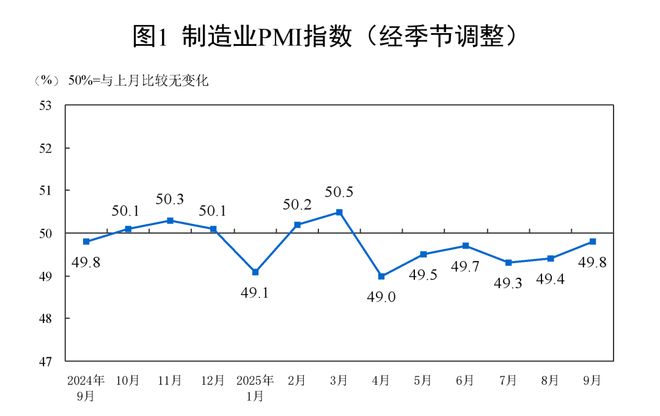
Core Viewpoints - The traditional sectors are experiencing weakened growth, while new momentum shows a significant recovery, necessitating attention to the effects of stable growth policies in key industries [1][7][73]. Manufacturing Sector - In September, the manufacturing PMI improved, with a rise of 0.4 percentage points to 49.8%, aligning with seasonal expectations. The production index reached a six-month high at 51.9%, up 1.1 percentage points from the previous month [1][7][73]. - The new orders index increased by only 0.2 percentage points to 49.7%, indicating a slower recovery compared to previous years. The demand structure continues to show that external demand is outperforming internal demand, with new export orders rising more significantly than domestic orders [1][13][73]. - The purchasing volume index rose by 1.2 percentage points to 51.6%, driven by stronger production, while the price indices for raw materials and factory output remained resilient [1][7][73]. New Momentum Industries - The PMI for new momentum industries, such as equipment manufacturing and high-tech manufacturing, showed significant improvement, with the equipment manufacturing PMI rising 1.1 percentage points to 51.6% and high-tech manufacturing PMI remaining in the expansion zone at 51.9% [2][19][74]. - Conversely, high-energy-consuming industries saw a decline in PMI by 0.7 percentage points to 47.5%, reflecting ongoing weakness in real estate and infrastructure investments [2][19][74]. Non-Manufacturing Sector - The non-manufacturing PMI fell to the critical point of 50%, with the construction PMI slightly recovering by 0.2 percentage points to 49.3%, while the service sector PMI dropped 0.4 percentage points to 50.1% [2][24][74]. - The service sector, particularly industries closely related to consumer travel, such as dining and cultural activities, experienced a significant decline in business activity indices, falling below critical levels [2][24][74]. Future Outlook - Although traditional momentum faces downward pressure on both quantity and price, new momentum is accelerating its support for the economy. Continuous monitoring of the effects of new incremental policies is essential [3][75]. - The upcoming stable growth policies in key industries like construction materials and steel are expected to mitigate the risks associated with the downturn in infrastructure and real estate sectors [3][75].

国家统计局发布9月重要数据
2 1 Shi Ji Jing Ji Bao Dao· 2025-09-30 11:27
Core Insights - The manufacturing Purchasing Managers' Index (PMI) for September is reported at 49.8%, an increase of 0.4 percentage points from the previous month, indicating continued improvement in manufacturing activity [1][6][7] Manufacturing Activity - The production index reached 51.9%, up 1.1 percentage points, marking a six-month high, suggesting active manufacturing production [6][7] - The new orders index is at 49.7%, a slight increase of 0.2 percentage points, indicating a modest improvement in market demand [6][7] - Large enterprises reported a PMI of 51.0%, while medium and small enterprises reported PMIs of 48.8% and 48.2%, respectively, indicating varying levels of activity across different enterprise sizes [6] Sector Performance - Key sectors such as equipment manufacturing, high-tech manufacturing, and consumer goods showed PMIs of 51.9%, 51.6%, and 50.6%, respectively, all above the manufacturing average, indicating robust activity [9] - The consumer goods sector has returned above the threshold line, reaching its highest level this year [2][9] Inventory and Pricing - The raw materials inventory index is at 48.5%, up 0.5 percentage points, indicating a continued reduction in inventory levels, albeit at a slower pace [10] - The purchasing price index for raw materials is at 53.2%, down 0.1 percentage points, while the factory price index is at 48.2%, down 0.9 percentage points, suggesting a narrowing profit margin for manufacturers [9][10] Business Confidence - The production and business activity expectations index has risen for three consecutive months, now at 54.1%, indicating improved confidence among manufacturers regarding market conditions [10]
9月PMI:新动能接力旧动能:中采PMI点评(25.09)
Shenwan Hongyuan Securities· 2025-09-30 10:56
Group 1: PMI Overview - In September, the manufacturing PMI improved to 49.8%, up 0.4 percentage points from 49.4% in August[1][7] - The non-manufacturing PMI decreased to 50.0%, down from 50.3% in the previous month[1][7] Group 2: Manufacturing Sector Insights - The production index rose to 51.9%, marking a 1.1 percentage point increase, the highest in nearly six months[2][8] - The new orders index increased by only 0.2 percentage points to 49.7%, indicating weaker demand recovery compared to production[2][8] - New export orders improved by 0.6 percentage points to 47.8%, outpacing the increase in domestic orders[2][3] Group 3: Industry Performance - The equipment manufacturing PMI rose by 1.1 percentage points to 51.6%, while high-tech manufacturing PMI remained in the expansion zone at 51.9%[3][16] - High-energy consumption industries saw a decline in PMI by 0.7 percentage points to 47.5%, reflecting ongoing weakness in real estate and infrastructure[3][16] Group 4: Non-Manufacturing Sector Trends - The construction PMI slightly improved by 0.2 percentage points to 49.3%, while the service sector PMI fell by 0.4 percentage points to 50.1%[4][20] - The service sector's new orders index dropped significantly by 1.0 percentage point to 46.7%, indicating reduced consumer activity[4][34]
制造业PMI连续两个月回升,后续怎么看?:——2025年9月PMI点评
EBSCN· 2025-09-30 10:42
Manufacturing Sector - The manufacturing PMI for September 2025 is 49.8%, an increase of 0.4 percentage points from the previous month, aligning with seasonal recovery trends[2][5] - The production index rose to 51.9%, up 1.1 percentage points from last month, indicating accelerated production activities as extreme weather impacts dissipate[5][14] - The new orders index increased slightly to 49.7%, suggesting persistent demand insufficiency, with a widening production-demand gap of 2.2 percentage points[5][14] Industry Performance - Equipment manufacturing PMI rose significantly to 51.9%, up 1.4 percentage points, while high-tech manufacturing PMI remains stable at 51.6%[5][15] - Consumer goods manufacturing PMI reached its highest level of the year at 50.6%, driven by seasonal factors like the upcoming holiday[5][15] - Traditional high-energy-consuming industries saw a decline in PMI to 47.5%, influenced by weak demand from real estate and infrastructure investments[5][15] Economic Outlook - The fourth quarter is expected to show a positive trend in manufacturing PMI due to the end of extreme weather and the onset of the traditional production peak season[5] - Recent economic stimulus measures, including policy adjustments and new financial tools, are anticipated to support economic growth in the fourth quarter[5] Service Sector - The service sector business activity index for September is 50.1%, a decrease of 0.4 percentage points from the previous month, reflecting a cooling in service consumption post-summer[31] - Financial services continue to show strength, with the business activity index rising above 60%, indicating robust support for the real economy[31] Construction Sector - The construction sector's business activity index increased slightly to 49.3%, ending a two-month decline but remaining at historically low levels due to reduced demand from real estate and infrastructure[35] - Anticipated government projects and new financial tools are expected to bolster construction activity in the upcoming quarter[35]