军工

Search documents
阶段新高后大幅回调,国防军工ETF(512810)挫逾2%!航天智装、中国卫星等商业航天热门股领跌
Xin Lang Cai Jing· 2025-12-16 01:59
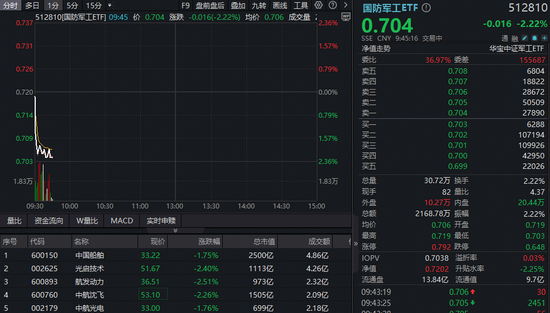
Core Viewpoint - The defense and military sector experienced a significant pullback, with the popular defense military ETF (512810) dropping over 2% after reaching a two-month high the previous day [1][6]. Group 1: Market Performance - On December 16, the defense military ETF (512810) saw a decline of 2.22%, closing at 0.704, with a trading volume of 18,300 [2][5]. - Key stocks within the sector, such as Aerospace Intelligence, Shanghai Hanhua, and China Satellite, showed weak performance with declines of 8.04%, 5.77%, and 5.52% respectively [5][6]. - Major weighted stocks like China Shipbuilding, Guangqi Technology, and Aero Engine Corporation also experienced losses [5][6]. Group 2: Industry Outlook - The long-term investment value of the military sector is highlighted, with the recent pullback potentially opening up new investment opportunities [3][5]. - The Ministry of Finance's budget draft for 2025 indicates a national defense expenditure of 1.78 trillion yuan, with 40% allocated for equipment costs, and over 30% of that focused on aviation equipment [3][5]. - The State Council's recent guidelines emphasize the importance of "military intelligence and unmanned equipment" and "satellite internet" as key development areas, aiming for significant results by year-end [3][5]. - Analysts from Guotai Junan point out that the increasingly complex international environment and rising defense spending in the U.S. underscore the intensifying great power competition, which will drive demand for advanced military equipment [3][5]. - Zhongtai Securities notes that the commercial aerospace sector is seeing increased activity, with new rocket launches accelerating the development of satellite internet, and a robust demand for aerospace equipment expected in the next five years [3][6].


国防军工行业2026年投资策略:“全球化、AI+”,高质量发展兼顾价值与成长
GF SECURITIES· 2025-12-15 14:50
Core Insights - The report emphasizes the importance of "globalization and AI+" in advancing high-quality development in the defense and military industry, highlighting the need for modernization and efficiency improvements in military systems [5][30][34] - The investment strategy focuses on balancing value and growth, with traditional sectors entering an S-curve evolution phase while new demands and replacements coexist [5][30] Section Summaries 1. Current Development Stage from the S-Curve Perspective - The defense and military industry is in a growth phase, with traditional sectors experiencing rapid development during the previous five-year plan, but not yet entering a slowdown [16][26] - The S-curve model indicates that the industry lifecycle includes multiple product lifecycles, with the current focus on extending product lifespans through innovation [23][24] 2. S-Curve Cycle Expansion - Global military trade remains robust, emphasizing the importance of lifecycle management from equipment to services [9][18] - The report anticipates that the demand for large aircraft and low-altitude economic activities will accelerate due to supportive policies [9][28] 3. S-Curve Cycle Evolution - Supply chain reforms are crucial for reducing costs and complexity, enhancing the focus on maintenance and repair services [9][33] - The integration of unmanned systems and intelligent technologies is expected to drive significant advancements in military capabilities [9][51] 4. New Cycle of the S-Curve: Emerging Industries - The report identifies commercial aerospace, AI, controllable nuclear fusion, quantum information, and deep-sea technology as key areas for future growth [9][57][65] - The acceleration of technological advancements and policy support is expected to unlock new market opportunities in these sectors [9][58] 5. Investment Recommendations - The report recommends focusing on companies that align with the evolving S-curve, particularly those involved in supply chain reform, maintenance, and unmanned systems [5][30] - Specific companies highlighted for investment include 航发动力, 中航高科, and 国睿科技, among others, which are positioned to benefit from these trends [6][9]


刚刚,市场传出关键动向!下周操作,紧抓这条“最强主线”
Sou Hu Cai Jing· 2025-12-15 13:45
Market Overview - Global markets experienced a stark contrast this week, with the Dow Jones rising over 1% while the Nasdaq fell by 1.6% due to pressure from technology stocks [1] - Asian markets showed relative stability, with the Nikkei 225 and Korea Composite Index both rising, while the Hong Kong Hang Seng Index saw a slight decline of 0.4% [1] - A key signal indicates a shift in funds globally from overvalued sectors to those combining value and growth [1] Commodity Trends - Commodity prices displayed a divided trend, with international oil prices dropping over 4%, negatively impacting A-shares in coal and oil sectors [1] - Conversely, gold and copper prices rose, reflecting market risk aversion and expectations for economic recovery [1] A-share Market Dynamics - The ChiNext Index surged by 2.74%, leading the market, while the STAR 50 Index followed with a 1.7% increase; however, the Shanghai Composite Index slightly declined by 0.34% [1] - The market's profitability is concentrated in the technology growth sector, with a noticeable shrinkage in overall market turnover as funds opted for small and mid-cap growth stocks [1] Sector Performance - The telecommunications sector outperformed with a significant increase of 6.27%, followed by military and electronics sectors [1] - Traditional sectors such as coal, oil, and real estate lagged significantly, highlighting a "strong technology, weak cycle" market trend that aligns with recent policy directions [1] Policy and Future Outlook - The Central Economic Work Conference emphasized policies for "appropriate total volume and structural optimization," focusing on supporting technological innovation and "new productive forces," effectively granting a "policy license" to the technology growth sector [2] - The Federal Reserve's recent interest rate cut has provided a loose liquidity environment for global markets [2] - The A-share market is likely to continue a "structural market" trend, with a strong focus on technology growth sectors such as telecommunications, electronics, semiconductors, and military [2] Investment Strategy - Investors are advised to focus on the core theme of "new productive forces," with an overweight position in telecommunications, AI computing, and high-end manufacturing [2] - Caution is advised against chasing high prices, with recommendations to wait for quality stocks to pull back for better entry points [2]
流动性&交易拥挤度&投资者温度计周报:自媒体A股搜索热度重回高位-20251215
Huachuang Securities· 2025-12-15 12:14
Liquidity - The supply side of funds is expanding, with net inflows of leveraged funds increasing to 196 billion CNY, placing it in the 75th percentile over the past three years[10] - The demand side is contracting, with equity financing dropping to 72 billion CNY, which is in the 41st percentile over the past three years[10] - Southbound funds experienced a net outflow of 31.1 billion CNY, marking the first net outflow in six months[41] Trading Congestion - The trading heat for the communication sector increased by 24 percentage points to 76%, while the military industry rose by 23 percentage points to 89%[2] - The chemical sector saw a decline of 40 percentage points to 47%, and the photovoltaic sector decreased by 24 percentage points to 56%[2] Investor Sentiment - Retail investors saw a net inflow of 112.4 billion CNY, up by 166.6 billion CNY from the previous value, placing it in the 61.5th percentile over the past five years[2] - The search interest for A-shares on social media has returned to a high level, indicating increased investor engagement[2] Fundraising and Buybacks - The total amount of stock buybacks fell to 9.5 billion CNY, down from 57.7 billion CNY, which is in the 21st percentile over the past three years[25] - The total equity financing amount was 71.7 billion CNY, with IPOs contributing 12.7 billion CNY and refinancing accounting for 59.1 billion CNY[28]
谨慎观望?
第一财经· 2025-12-15 11:57
2025.12. 15 A股三大指数集体收跌,沪指盘中虽一度下探但仍在3850点关键支撑位附近获得承接,日内 最低接近前期震荡平台下沿,三大指数均运行于5日、10日线下方,形成短期空头排列。 2312家上涨 涨跌停比 6:2 个股跌多涨少,局部热点活跃,盘面上,算力硬 件产业链下挫,CPO、存储器方向领跌;摩尔线 程、超硬材料、半导体、AI穿戴、创新药概念股 跌幅居前。大消费走强,零售、食品方向活跃; 保险、军工表现强势。 两市成交额 万亿元 ▼ 15.24% 两市成交额明显缩量,资金观望情绪浓厚,全 天呈现"早盘放量冲高,午后加速缩量"的倒 "V"型走势,防御性板块成交相对活跃,资金 逆势流入,科技成长板块成交菱缩最为明显, 资金大规模撤离,技术面存在回调压力。 资金情绪 主力资金净流出 7 / 1 散户资金净流入 机构呈现防御性收缩,机构加速从高波动科技题材和高位成长板块撤离,转向低估值高股息的银行、保 险、白酒等防御性板块、同时对政策受益的新质生产力领域保持观望; 散户保持谨慎观望, 从前期追涨热 门题材转为逢高减仓,对高估值板块普遍回避,更倾向于跟随机构布局低估值防御板块,多数散户选择轻 仓等待市场方 ...

观典防务实控人全额归还近亿元占款 保壳之战迈出关键一步
Zhong Guo Zheng Quan Bao· 2025-12-15 10:52
Core Viewpoint - The repayment of non-operational fund occupation by the controlling shareholder of Guandian Defense marks a significant step in addressing the company's financial issues, although the risk of delisting remains due to poor performance in 2024 [1][2]. Group 1: Financial Repayment - Guandian Defense announced that it received a total of approximately 99.46 million yuan, which includes the principal of 96.94 million yuan and interest of 2.51 million yuan, fully repaid by the controlling shareholder [1]. - The funds were originally occupied due to factoring matters without commercial substance, and the controlling shareholder confirmed this situation constituted non-operational fund occupation [1]. Group 2: Company Performance and Risks - For the fiscal year 2024, Guandian Defense reported a total profit of -144 million yuan, a net profit attributable to the parent company of -136 million yuan, and a net profit after deducting non-recurring items of -111 million yuan, with operating revenue of 89.98 million yuan [1]. - The company’s stock has been subject to delisting risk warnings since April 30, 2025, due to negative audited profit figures and operating revenue below 100 million yuan after excluding unrelated business and non-commercial income [1]. - The selection of the auditing agency and the performance in the fiscal year 2025 will be critical factors affecting the company's listing status moving forward [2].

巴基斯坦海军试射远程地对空导弹
Yang Shi Xin Wen Ke Hu Duan· 2025-12-15 10:33
Core Viewpoint - The Pakistan Navy successfully conducted a long-range surface-to-air missile test in the northern Arabian Sea, demonstrating its combat capabilities and readiness [1] Group 1 - The Pakistan Navy's statement highlighted the effective engagement of highly mobile aerial targets during the firepower demonstration [1] - The naval fleet commander observed the missile test from a vessel, underscoring the operational readiness of the navy [1]
资金跟踪系列之二十四:两融净买入规模上升,机构ETF被继续净申购
SINOLINK SECURITIES· 2025-12-15 09:29
Macro Liquidity - The US dollar index continued to decline, and the degree of "inversion" in the China-US interest rate spread has deepened. The nominal and real interest rates of 10Y US Treasury bonds have both rebounded, with inflation expectations remaining unchanged [1][14]. - Offshore dollar liquidity has marginally tightened, while the domestic interbank funding environment remains balanced and relatively loose. The yield spread between 10Y and 1Y bonds continues to widen [1][19]. Market Trading Activity - Overall market trading activity has increased, with trading heat in sectors such as light industry, retail, military, textiles, communications, and real estate all above the 80th percentile [2][25]. - The volatility of major indices has generally increased, with the volatility of sectors like communications, electric power, and electronics remaining above the 80th historical percentile [2][31]. Institutional Research - Research activity is concentrated in sectors such as electronics, pharmaceuticals, electric power, machinery, and non-ferrous metals, with an upward trend in research heat for non-ferrous metals, computers, and textiles [3][42]. Analyst Forecasts - Analysts have adjusted the net profit forecasts for the entire A-share market for 2025/2026, with increases in forecasts for sectors including pharmaceuticals, coal, automobiles, food and beverage, and oil and petrochemicals [4][21]. - The proportion of stocks with upward revisions in net profit forecasts for 2025/2026 has increased across the A-share market [4][17]. Northbound Trading Activity - Northbound trading activity has rebounded, continuing to net sell A-shares. The ratio of buy/sell amounts in sectors like communications, electronics, and finance has increased, while it has decreased in electric power, chemicals, and automobiles [5][31]. - Northbound trading primarily net bought sectors such as communications, machinery, and home appliances, while net selling occurred in pharmaceuticals, computers, and electronics [5][33]. Margin Financing Activity - The activity of margin financing has slightly increased but remains at a relatively low level since late July 2025. The main net purchases were in sectors like electronics, communications, and military [6][39]. - The proportion of financing purchases in sectors such as oil and petrochemicals, retail, and electronics has increased [6][38]. Hot Stocks Trading - The trading volume on the "Dragon and Tiger List" has increased, with sectors like retail, light industry, and electric power showing relatively high and rising trading volumes [7][41]. Active Equity Fund Positioning - The positions of actively managed equity funds have continued to decline, with significant increases in positions in sectors like pharmaceuticals, agriculture, and retail [8][45]. - The correlation of actively managed equity funds with mid/small-cap growth and mid-cap value has increased, while the correlation with large-cap growth and large/small-cap value has decreased [8][48]. - The scale of newly established equity funds has continued to decline, with both active and passive fund sizes decreasing [8][50].
工信部:加快卫星互联网建设发展!国防军工应声上涨,512810创两个月新高!抚顺特钢涨停,航天电子历史新高
Xin Lang Cai Jing· 2025-12-15 03:13
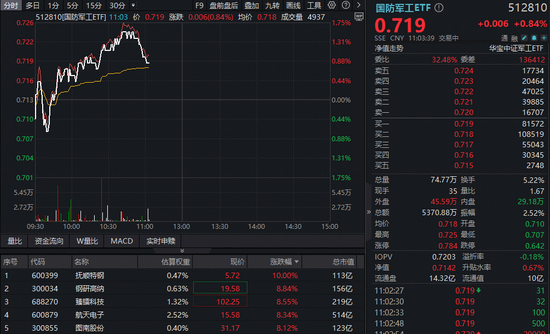
Core Viewpoint - The defense and military industry continues to strengthen, with significant activity in commercial aerospace, satellite internet, and large aircraft sectors, leading to notable stock performance and ETF growth [1][6]. Group 1: Market Performance - On December 15, the defense and military ETF (512810) rose by 1.54%, reaching a two-month high, and significantly outperformed the Shanghai Composite Index and CSI 300 over the past week [1][6]. - Notable stocks such as Aerospace Electronics and Fushun Special Steel hit their daily limit, while Steel Research and Zhenray Technology saw substantial gains [1][6]. Group 2: Government Initiatives - The Minister of Industry and Information Technology emphasized the need to deepen the digital transformation of the manufacturing sector and advance the development of 6G technology and satellite internet [3][8]. - The government is focusing on building information infrastructure and promoting the integration of artificial intelligence with manufacturing [3][8]. Group 3: Industry Analysis - Analysts indicate that advanced military technology is spilling over into civilian sectors, creating new industries worth trillions, such as commercial aerospace, low-altitude economy, future energy, deep-sea technology, and large aircraft [3][8]. - This spillover is expected to drive the development of new processes, materials, and devices, fostering a positive cycle of "military technology benefiting civilian applications and vice versa," which will further elevate the growth ceiling of the defense and military industry [3][8]. Group 4: Investment Opportunities - The defense military ETF (512810) covers various hot themes including commercial aerospace, controllable nuclear fusion, low-altitude economy, large aircraft, deep-sea technology, and military AI, making it an efficient tool for investing in core assets of the defense and military sector [3][8].


早盘直击|今日行情关注
申万宏源证券上海北京西路营业部· 2025-12-15 02:16
Group 1 - The Federal Reserve has lowered interest rates by 25 basis points, adopting a dovish stance, leading the market to shift focus towards domestic policy expectations and economic priorities for the upcoming year [1] - The A-share market experienced fluctuations, with the Shanghai Composite Index showing a similar pattern to the previous week, characterized by two upward movements and a mid-week adjustment, closing below the 60-day moving average [1] - The Shenzhen Component Index performed stronger, closing above the 60-day moving average, while the average daily trading volume in both markets increased significantly to approximately 1.9337 trillion yuan, indicating heightened market activity [1] Group 2 - Market hotspots last week were primarily concentrated in the military and telecommunications sectors, with small and mid-cap stocks, as well as technology stocks, leading the gains, while large-cap blue-chip stocks experienced slight adjustments [1] - The Shanghai Composite Index is in a recovery phase after a rapid adjustment in mid-November, finding support above the low point from early October, although it faced another downward adjustment after filling a gap [1]