纯碱
Search documents
地缘冲突缓和,??偏弱震荡
Zhong Xin Qi Huo· 2025-06-25 06:50
投资咨询业务资格:证监许可【2012】669号 中信期货研究|⿊⾊建材策略⽇报 2025-06-25 地缘冲突缓和,⿊⾊偏弱震荡 伊以局势缓和,受此影响双焦再度转弱。除此之外⿊⾊板块处于真空 期,能交易的其他驱动⾮常有限。产业⽅⾯热卷需求回暖,螺纹季节 性下⾏。供应端铁⽔⾼位回升,整体供需均环⽐⾛强,库存暂⽆压 ⼒。不过市场对后市需求预期依然偏悲观,整体⽽⾔,盘⾯仍处于震 荡盘整阶段。 1、铁元素方面,海外矿山开始财年末和季末冲量,发运量有季节性 增加预期,7月上旬之前发运或将维持高位,但同比增量有限;需求 端钢企盈利率和铁水回升,预计短期可以维持高位。本周到港季节性 回升,港口小幅累库。短期海外矿山季末冲发运,矿石库存有阶段性 小幅累库预期,但预计幅度有限,整体供需矛盾不突出。近期重点关 注需求端钢企盈利状况和检修计划。 2、碳元素方面,近期主产区环保及安全检查趋严,煤矿间歇式停产 现象较多,焦煤产量持续下滑,但整体供应的收缩幅度相对有限; 进口方面,贸易商拉运积极性偏弱,口岸通关延续低位。需求端, 焦炭产量高位回落,焦企在去库及亏损压力下、开工存在进一步下降 预期。库存端,焦煤刚需有所下滑、下游原料补库需 ...
《特殊商品》日报-20250625
Guang Fa Qi Huo· 2025-06-25 02:59
Report on Natural Rubber 1. Investment Rating Not provided. 2. Core View In the expectation of increasing supply and weak demand, the rubber price is expected to remain weak. Hold short positions above 14,000 and pay attention to the raw material supply in each production area and macro - event disturbances [1]. 3. Summary by Directory - **Spot Price and Basis**: On June 24, the price of Yunnan state - owned full - latex increased by 50 yuan/ton to 13,850 yuan/ton, with a 0.36% increase. The full - latex basis (switched to the 2509 contract) increased by 335 yuan/ton to 185 yuan/ton, with a 223.33% increase. The price of Thai standard mixed rubber decreased by 200 yuan/ton to 13,600 yuan/ton, with a 1.45% decrease [1]. - **Inter - month Spread**: The 9 - 1 spread decreased by 30 yuan/ton to - 870 yuan/ton, with a 3.57% decrease; the 1 - 5 spread increased by 10 yuan/ton to - 20 yuan/ton, with a 33.33% increase; the 5 - 9 spread increased by 20 yuan/ton to 890 yuan/ton, with a 2.30% increase [1]. - **Fundamental Data**: In April, Thailand's production decreased by 43,500 tons to 105,700 tons, with a 29.16% decrease; Indonesia's production decreased by 15,200 tons to 194,100 tons, with a 7.26% decrease; India's production decreased by 7,600 tons to 45,400 tons, with a 14.34% decrease; China's production increased by 42,300 tons to 58,100 tons. The weekly operating rate of semi - steel tires for automobiles increased by 0.31 percentage points to 78.29%, and that of full - steel tires increased by 4.24 percentage points to 65.48% [1]. - **Inventory Change**: The bonded area inventory increased by 1,410 tons to 606,975 tons, with a 0.23% increase. The factory - warehouse futures inventory of natural rubber on the Shanghai Futures Exchange decreased by 2,620 tons to 32,256 tons, with a 7.51% decrease [1]. Report on Glass and Soda Ash 1. Investment Rating Not provided. 2. Core View For soda ash, the current oversupply situation is obvious, and there will be a further profit - reduction process. The previous photovoltaic resumption brought some demand, but the growth of photovoltaic capacity has slowed down. After the maintenance, inventory accumulation may accelerate. Hold short positions. For glass, the spot market is improving, but the demand will slow down in the off - season, and the industry needs capacity clearance to solve the oversupply problem. The 09 contract is expected to fluctuate between 950 - 1050, and there is still pressure in the medium - to - long term [4]. 3. Summary by Directory - **Glass - related Price and Spread**: The prices of glass in North China, East China, Central China, and South China remained unchanged on June 25. The glass 2505 contract increased by 4 yuan/ton to 1,106 yuan/ton, with a 0.36% increase; the glass 2509 contract increased by 8 yuan/ton to 1,015 yuan/ton, with a 0.79% increase [4]. - **Soda Ash - related Price and Spread**: The prices of soda ash in North China, East China, Central China, and Northwest China remained unchanged. The soda ash 2505 contract decreased by 7 yuan/ton to 1,199 yuan/ton, with a 0.58% decrease; the soda ash 2509 contract decreased by 12 yuan/ton to 1,161 yuan/ton, with a 1.00% decrease [4]. - **Supply Volume**: As of June 20, the soda ash operating rate increased by 6.33 percentage points to 84.90%, and the weekly production increased by 55,000 tons to 740,100 tons, with an 8.04% increase. The float glass daily melting volume decreased by 1,000 tons to 155,700 tons, with a 0.70% decrease; the photovoltaic daily melting volume decreased by 1,000 tons to 98,990 tons, with a 1.00% decrease [4]. - **Inventory**: As of June 20, the glass factory warehouse increased by 1,923,000 weight - boxes to 69,685,000 weight - boxes, with a 2.84% increase. The soda ash factory warehouse increased by 62,000 tons to 1,686,300 tons, with a 3.82% increase; the soda ash delivery warehouse decreased by 20,000 tons to 327,100 tons, with a 5.87% decrease [4]. - **Real Estate Data**: The year - on - year growth rate of new construction area increased by 2.99 percentage points to - 18.73%; the construction area decreased by 7.56 percentage points to - 33.33%; the completion area increased by 15.67 percentage points to - 11.68%; the sales area increased by 12.13 percentage points to - 1.55% [4]. Report on Log Futures 1. Investment Rating Not provided. 2. Core View The log futures were weak. The market is in a situation of weakening supply and demand during the high - temperature and rainy season from June to August. The 07 contract has intense long - short competition around the delivery cost. It is recommended to wait and see [5]. 3. Summary by Directory - **Futures and Spot Price**: On June 24, the log 2507 contract decreased by 12.5 yuan/cubic meter to 806.5 yuan/cubic meter, with a 1.53% decrease; the log 2509 contract decreased by 5.5 yuan/cubic meter to 794.5 yuan/cubic meter, with a 0.69% decrease; the log 2511 contract decreased by 1 yuan/cubic meter to 794 yuan/cubic meter, with a 0.13% decrease [5]. - **Supply**: In May, the port shipping volume increased by 228,000 cubic meters to 1,955,000 cubic meters, with a 13.20% increase. The number of ships from New Zealand to China, Japan, and South Korea decreased by 5 to 58, with a 7.94% decrease [5]. - **Inventory**: As of June 20, the national log inventory decreased by 100,000 cubic meters to 3,350,000 cubic meters, with a 2.90% decrease. The inventory in Shandong decreased by 20,000 cubic meters to 1,990,000 cubic meters, with a 1.00% decrease; the inventory in Jiangsu decreased by 23,000 cubic meters to 1,109,900 cubic meters, with a 2.05% decrease [5]. - **Demand**: As of June 20, the daily average warehouse - out volume increased by 38,000 cubic meters to 636,000 cubic meters, with a 6.35% increase. The daily average warehouse - out volume in Shandong increased by 10,000 cubic meters to 340,000 cubic meters, with a 3% increase; the daily average warehouse - out volume in Jiangsu increased by 36,000 cubic meters to 226,000 cubic meters, with a 19% increase [5]. Report on Industrial Silicon 1. Investment Rating Not provided. 2. Core View The industrial silicon futures fluctuated strongly. Although the demand is increasing, the supply is increasing even more. Pay attention to the change of the spot - futures arbitrage window. The increase in the production of polysilicon and silicone is beneficial to the demand for industrial silicon and inventory digestion, as well as the arbitrage of buying industrial silicon and shorting polysilicon. But if the demand weakens again, the inventory pressure will suppress the price of industrial silicon [6]. 3. Summary by Directory - **Spot Price and Main Contract Basis**: On June 24, the price of East China oxygen - passing S15530 industrial silicon remained unchanged at 8,150 yuan/ton. The price of East China SI4210 industrial silicon remained unchanged at 8,700 yuan/ton; the price of Xinjiang 99 silicon remained unchanged at 7,600 yuan/ton [6]. - **Inter - month Spread**: The 2507 - 2508 spread increased by 5 yuan/ton to 10 yuan/ton, with a 50.00% increase; the 2509 - 2510 spread increased by 5 yuan/ton to 30 yuan/ton, with a 16.67% increase [6]. - **Fundamental Data**: In May, the national industrial silicon production increased by 0.69 million tons to 30.77 million tons, with a 2.29% increase. The production in Xinjiang decreased by 0.44 million tons to 16.31 million tons, with a 2.60% decrease; the production in Yunnan decreased by 0.34 million tons to 1 million tons, with a 25.43% decrease; the production in Sichuan increased by 1.24 million tons to 2.37 million tons, with a 109.47% increase [6]. - **Inventory Change**: As of June 24, the Xinjiang inventory decreased by 1.09 million tons to 17.58 million tons, with a 5.81% decrease; the Yunnan inventory increased by 0.04 million tons to 2.62 million tons, with a 1.55% increase. The social inventory decreased by 1.3 million tons to 55.9 million tons, with a 2.27% decrease [6]. Report on Polysilicon 1. Investment Rating Not provided. 2. Core View The polysilicon futures price fluctuated greatly. The current fundamental contradiction is the mismatch between weak demand and high supply, which leads to a strong expectation of price decline. Pay attention to the production release of polysilicon. If there is continuous resumption of production, the price will be under pressure. Hold short positions cautiously [7]. 3. Summary by Directory - **Spot Price and Basis**: On June 24, the average prices of N - type re -投料, P - type cauliflower - like material, and N - type granular silicon remained unchanged. The N - type material basis (average price) decreased by 470 yuan/ton to 3,415 yuan/ton, with a 12.10% decrease; the cauliflower - like material basis (average price) decreased by 470 yuan/ton to 9,415 yuan/ton, with a 4.75% decrease [7]. - **Futures Price and Inter - month Spread**: The PS2506 contract increased by 470 yuan/ton to 31,085 yuan/ton, with a 1.54% increase. The PS2506 - PS2507 spread increased by 50 yuan/ton to 845 yuan/ton, with a 6.29% increase; the PS2507 - PS2508 spread increased by 125 yuan/ton to 485 yuan/ton, with a 34.72% increase [7]. - **Fundamental Data**: In May, the polysilicon production increased by 0.07 million tons to 9.61 million tons, with a 0.73% increase. The polysilicon import volume decreased by 0.21 million tons to 0.08 million tons, with a 72.71% decrease; the polysilicon export volume increased by 0.08 million tons to 0.21 million tons, with a 66.17% increase [7].
鲍威尔称不排除提前降息可能,沪指首收复3400点
Dong Zheng Qi Huo· 2025-06-25 01:29
1. Report Industry Investment Ratings Not provided in the given content. 2. Core Views of the Report - The Fed's July rate - cut possibility is low, and the US dollar will fluctuate in the short term. Gold is expected to be weak in the short term due to the easing of the Iran - Israel conflict. The stock market's high - risk preference may continue, and the high - level oscillation pattern will persist. The bond market's long - term trend is bullish, but it is currently hesitant to break through. Most commodities face supply - side pressures, and their prices are expected to be under pressure, while some may have short - term trading opportunities [12][16][18][24]. 3. Summary by Relevant Catalogs 3.1 Financial News and Comments 3.1.1 Macro Strategy (Foreign Exchange Futures - US Dollar Index) - International Atomic Energy Agency plans to return to Iranian nuclear facilities. Powell's congressional stance is hawkish, negating short - term rate - cut expectations, so the Fed's July rate - cut possibility is low, and the US dollar will fluctuate in the short term [10][12]. - Investment advice: The US dollar will fluctuate in the short term [13]. 3.1.2 Macro Strategy (Gold) - Powell said the US is not in a recession. If inflation or the labor market is weak, the Fed may cut rates early. Bostic believes there is no need to cut rates currently but expects a 25 - basis - point cut later this year. Gold prices have fallen by more than 1% due to the decline in market risk - aversion sentiment after the Iran - Israel cease - fire [14][15][16]. - Investment advice: Gold is expected to be weak in the short term, and attention should be paid to the risk of decline [16]. 3.1.3 Macro Strategy (Stock Index Futures) - The Shanghai Composite Index has regained 3400 points. Six departments have issued a document to promote consumer finance support. The stock market's risk preference has recovered due to the easing of the Iran - Israel conflict, and the high - risk preference may continue, with the high - level oscillation pattern persisting [17][18]. - Investment advice: Suggest balanced allocation [19]. 3.1.4 Macro Strategy (US Stock Index Futures) - The US consumer confidence index in June was lower than expected. Powell reiterated the Fed's wait - and - see attitude and did not rule out the possibility of an early rate cut. After the Iran - Israel cease - fire, the market risk preference has improved significantly, and the technology sector has led the index [20][21][22]. - Investment advice: US stocks are expected to oscillate weakly at the current level [22]. 3.1.5 Macro Strategy (Treasury Bond Futures) - The central bank will conduct 300 billion yuan of MLF operations and 406.5 billion yuan of 7 - day reverse repurchase operations. The central bank's over - renewal of MLF shows its intention to protect liquidity. The bond market's long - term trend is bullish, but it is currently hesitant to break through [23][24]. - Investment advice: Long positions can be held, and attention should be paid to the strategy of buying on dips [25]. 3.2 Commodity News and Comments 3.2.1 Agricultural Products (Soybean Oil/Rapeseed Oil/Palm Oil) - Indonesia's palm oil inventory in April increased to 3.04 million tons. The palm oil market is affected by the easing of geopolitical conflicts and the decline in crude oil prices. The market is in a game between production increases in the origin and inventory accumulation in the sales area [26]. - Investment advice: Wait for the market sentiment to stabilize and then gradually arrange long positions in the far - month contracts [26]. 3.2.2 Agricultural Products (Sugar) - It is predicted that Brazil's sugar production will increase by 2.7% in the 2025/26 season, and the global market may have a supply surplus of 2.6 million tons. The Brazilian sugar production still has uncertainties, and the international sugar price is under pressure from the supply side [29][30]. - Investment advice: The rebound space and sustainability of Zhengzhou sugar are limited [30]. 3.2.3 Agricultural Products (Corn Starch) - China's corn - starch exports in May continued to rise. The export policy has been relaxed, but the export proportion is still relatively small. The core factor of the starch supply - demand situation may be the cassava substitution [31][32]. - Investment advice: It is recommended to wait and see mainly [32]. 3.2.4 Agricultural Products (Corn) - The spot price of Northeast corn is running strongly, but the futures price has started to fall. The warehouse receipt pressure may appear, and the old - crop contracts are expected to oscillate narrowly [33]. - Investment advice: It is recommended to wait and see for old - crop contracts, and pay attention to short - selling opportunities for new - crop contracts 11 and 01 when the production situation is clearer [33]. 3.2.5 Black Metals (Steam Coal) - The price difference of imported steam coal exists. The coal price has eased in June, and the demand has a seasonal recovery. The short - term price is expected to be stable [33][34]. - Investment advice: The short - term price is expected to be stable [34]. 3.2.6 Black Metals (Iron Ore) - Malaysia has imposed anti - dumping duties on Chinese and Japanese cold - rolled steel coils. The iron ore price is in an oscillating market, with seasonal pressure on the fundamentals, and the overall trend is expected to be weak [36]. - Investment advice: The price will oscillate weakly, with the spot weaker than the futures [37]. 3.2.7 Non - ferrous Metals (Industrial Silicon) - The price of organic silicon DMC has been slightly adjusted upwards. The resumption of production of industrial silicon is greater than the reduction, and the demand is not improving significantly. The price is expected to oscillate at a low level [38]. - Investment advice: Consider short - selling on rebounds and pay attention to supply - side changes and the cash - flow risks of large enterprises [38]. 3.2.8 Non - ferrous Metals (Copper) - Peru has extended the informal mining temporary license to the end of the year. The macro - level factors for copper are mixed in the short term. The LME inventory is decreasing, and the domestic inventory is at a low level. The copper price is expected to oscillate strongly in the short term [43]. - Investment advice: Adopt a bullish strategy for single - side trading and wait patiently for cross - period layout opportunities [43]. 3.2.9 Non - ferrous Metals (Nickel) - In May, the import and export volume of Philippine nickel ore increased. The nickel market has a tight supply of high - grade nickel ore, and the nickel - iron supply is expected to be in surplus in June. The pure - nickel price is oscillating weakly [44][45]. - Investment advice: Wait and see in the short term, and pay attention to short - selling opportunities on rebounds in the medium term [45]. 3.2.10 Non - ferrous Metals (Lead) - The LME lead has a discount. The market is trading the expectation of improved demand. The supply of primary lead is stable, and the supply of recycled lead has decreased. The demand is in the off - season and is expected to be weak until July [46]. - Investment advice: Pay attention to buying opportunities on dips in the short term, and wait and see for cross - period and cross - market arbitrage [46]. 3.2.11 Non - ferrous Metals (Zinc) - The LME zinc has a discount. Some zinc smelters are resuming production. The supply of zinc is increasing, and the inventory accumulation expectation is strengthening, but the inventory accumulation height is limited. The zinc price decline may be a tug - of - war process [49]. - Investment advice: Adopt a short - selling strategy on rallies, pay attention to the 21500 - 21600 yuan support level, and consider positive - spread arbitrage strategies [49]. 3.2.12 Non - ferrous Metals (Lithium Carbonate) - Some lithium projects have obtained approvals or financing. The LC2507 contract has a high position, and attention should be paid to the position - reduction rhythm before entering the delivery month [51]. - Investment advice: Do not chase short positions at the current level, consider partial profit - taking for previous short positions, and pay attention to the 9 - 11 positive - spread arbitrage opportunities [52]. 3.2.13 Energy Chemicals (Crude Oil) - The API crude - oil inventory has decreased. Oil prices have continued to fall, and the risk premium has been significantly reversed. The supply of the crude - oil market has high potential for increase in the medium - to - long term [53][54]. - Investment advice: The short - term risk premium will be reversed [55]. 3.2.14 Energy Chemicals (Urea) - Some urea plants have had failures and stopped production. The urea price is falling, and the supply - demand expectation is weak. The key variable lies in the export [57]. - Investment advice: Pay attention to changes in export quotas and overall, the supply - demand situation is weak [57]. 3.2.15 Energy Chemicals (Bottle Chips) - The export price of bottle - chip factories has been partially reduced. The polyester raw material price has fallen significantly, and the bottle - chip industry plans to reduce production in July, which will relieve the supply pressure [61]. - Investment advice: Pay attention to opportunities to expand the processing margin of bottle chips on dips and beware of the impact of raw - material price fluctuations [61]. 3.2.16 Energy Chemicals (Soda Ash) - The soda - ash market is oscillating at a low level. The fundamentals are under pressure, with supply stable and demand weak [62]. - Investment advice: Adopt a short - selling strategy on rallies in the medium term [62]. 3.2.17 Energy Chemicals (Float Glass) - The float - glass price in the Shahe market is stable. The glass demand will decline seasonally, and the supply will be relatively stable. The price has downward adjustment space [64]. - Investment advice: The short - term rebound may be difficult to sustain, and the price has downward adjustment space [64]. 3.2.18 Energy Chemicals (Styrene) - The price of pure benzene has been reduced. The supply of styrene is gradually recovering, and the demand is relatively stable. The pure - benzene price may have some repair space [67]. - Investment advice: The styrene price depends on the oil price and supply disturbances, and pay attention to the impact of the home - appliance subsidy policy [67]. 3.2.19 Energy Chemicals (Carbon Emissions) - The CEA price has risen. The carbon - market trading has increased slightly, but the supply - demand structure is expected to be loose this year, and the price is under pressure [68]. - Investment advice: It is recommended to wait and see [69].
瑞达期货纯碱玻璃产业日报-20250624
Rui Da Qi Huo· 2025-06-24 10:16
形势不容乐观,5月房地产数据显示下滑明显,需求预计进一步走弱。下游深加工订单下滑,采购以刚需为 免责声明 | 项目类别 | 数据指标 | 最新 | 环比 数据指标 | 最新 | 环比 | | --- | --- | --- | --- | --- | --- | | | 纯碱主力合约收盘价(日,元/吨) 纯碱与玻璃价差(日,元/吨) | 1161 146 | -12 玻璃主力合约收盘价(日,元/吨) -20 纯碱主力合约持仓量(日,手) | 1015 1569278 | 8 84429 | | | 玻璃主力合约持仓量(日,手) | | | | | | | | 1472003 | 30129 纯碱前20名净持仓 | -307826 | -34580 | | 期货市场 | 玻璃前20名净持仓 | -245913 | 29274 纯碱交易所仓单(日,吨) | 3863 | -150 | | | 玻璃交易所仓单(日,吨) | 877 | 0 纯碱9月-1月合约价差 | 7 | -5 | | | 玻璃合约9月-1月价差 | -51 | 4 纯碱基差(日,元/吨) | 46 | 9 | | | 玻璃基差(日,元/吨) | ...
银河期货原油期货早报-20250624
Yin He Qi Huo· 2025-06-24 04:23
Report Industry Investment Ratings No specific industry investment ratings are provided in the given reports. Core Views - The market is significantly affected by the Israel - Iran cease - fire news. Crude oil prices have dropped sharply as the geopolitical risk premium fades. Different energy and chemical products will gradually return to fundamental - driven pricing, with varying trends based on their supply - demand fundamentals [1][2]. - For most products, short - term market trends are influenced by geopolitical factors, and mid - to long - term trends are determined by supply - demand relationships, production capacity changes, and cost factors. Summary by Commodity Crude Oil - **Market Review**: WTI2508 closed at $68.51, down $5.33 (-7.22%); Brent2508 closed at $71.48, down $5.53 (-7.18%); SC2508 closed at 537.7 yuan/barrel after night trading [1]. - **Logic Analysis**: Market prices in response to the cooling of geopolitical conflicts. If geopolitical conflicts ease, crude oil will return to fundamental pricing, with short - term trading on third - quarter peak - season expectations and long - term trading on the contradiction of increased supply - demand surplus under OPEC+ continuous production increases. The expected trading range for Brent in the third quarter is $60 - 72 per barrel [2]. - **Trading Strategy**: Short - term volatility, with Brent trading in the range of $66 - 72 per barrel. Pay attention to the certainty of the Middle - East cease - fire [2]. Asphalt - **Market Review**: BU2509 closed at 3737 points (-1.16%) at night; BU2512 closed at 3574 points (-1.27%) at night. Spot prices in different regions showed an upward trend [3]. - **Logic Analysis**: After the sharp drop in oil prices, the upward cost - driven factor for asphalt disappeared. The short - term supply - demand situation is weak, and inventory is lower than the same period. The price of the BU main contract is expected to range from 3600 to 3750 [5]. - **Trading Strategy**: Weak and volatile. The spread between asphalt and crude oil will rebound [5]. Liquefied Petroleum Gas (LPG) - **Market Review**: PG2507 closed at 4538 (-0.42%) at night; PG2508 closed at 4522 (-0.18%) at night. Spot prices in different regions showed different trends [5]. - **Logic Analysis**: With the decline in oil prices, the supply of LPG decreased slightly last week, and the international shipping volume decreased. The combustion - end demand is expected to be weak, while the chemical - sector demand is expected to increase. Overall, the fundamentals are relatively loose, and the price is expected to decline [8]. - **Trading Strategy**: The price of LPG is expected to be weak [8]. Fuel Oil - **Market Review**: FU09 closed at 3341 (-0.83%) at night; LU08 closed at 3988 (-0.05%) at night. Singapore paper - cargo spreads changed [8]. - **Logic Analysis**: High - sulfur fuel oil trading remains active, with high - sulfur cracking supported by geopolitical factors and peak - season power - generation demand. Low - sulfur fuel oil supply is increasing, but downstream demand is weak. The price of high - sulfur fuel oil is expected to be supported, while low - sulfur fuel oil needs to be observed for further trends [10][11]. - **Trading Strategy**: Wait - and - see for single - side trading. Consider taking profit on the positive spread of FU9 - 1 [11]. Natural Gas - **Logic Analysis**: US natural gas inventory accumulation was lower than expected. Production increased slightly, demand was at a historical high, and LNG export volume was 14.2 bcf/d. European natural gas prices decreased due to the cease - fire news. The price of natural gas is expected to rise [11][13]. - **Trading Strategy**: Go long on HH at dips and be bullish on TTF [13]. PX - **Market Review**: PX2509 closed at 7076 (-0.70%) at night. Spot prices increased, and PXN was $264/ton, up $8/ton [13][14]. - **Logic Analysis**: Many PX plants have maintenance plans or production cuts, and the Asian PX operating rate has declined recently, resulting in tight supply. The price is expected to fluctuate widely in the short term [14]. - **Trading Strategy**: Wide - range fluctuations. Long PX and short PTA for spreads [14][15]. PTA - **Market Review**: TA509 closed at 4986 (-0.52%) at night. Spot prices and basis changed [15]. - **Logic Analysis**: Some PTA plants have reduced production or shut down, and the operating rate has decreased. Downstream polyester operating rate has increased, but profits have been compressed. The price is expected to fluctuate widely in the short term [15]. - **Trading Strategy**: Wide - range fluctuations. Long PX and short PTA for spreads [15][16]. Ethylene Glycol - **Market Review**: EG2509 closed at 4454 (-1.04%) at night. Spot basis and prices changed [16][17]. - **Logic Analysis**: Domestic and foreign plants have restarted or increased production, and the operating rate has increased significantly. Downstream polyester operating rate has increased, but terminal demand has weakened. The supply - demand pattern in June and July is still tight, and the price is expected to fluctuate widely [17]. - **Trading Strategy**: Wide - range fluctuations [17][18]. Short - Fiber - **Market Review**: PF2508 closed at 6796 (-0.44%) at night. Spot prices increased, but downstream was mostly waiting and watching [18]. - **Logic Analysis**: Supply has increased and demand has decreased recently, but production and sales are stable, and processing fees have increased. Some large factories have tight supply, and processing fees are expected to be strongly supported. The price is expected to fluctuate widely following raw materials [19]. - **Trading Strategy**: Wide - range fluctuations. Short PTA and long PF for spreads [19][20]. PR (Bottle Chips) - **Market Review**: PR2509 closed at 6172 (-0.58%) at night. Spot market trading was okay [19][20]. - **Logic Analysis**: Some bottle - chip plants have increased production, and inventory has risen. Some plants have plans to reduce production or shut down. The price is expected to fluctuate widely following raw materials [20][21]. - **Trading Strategy**: Wide - range fluctuations [20][21]. Styrene - **Market Review**: EB2508 closed at 7486 (-1.28%) at night. Spot prices and basis changed [21]. - **Logic Analysis**: Pure - benzene prices are expected to be stable and slightly strong. Styrene supply has increased, and downstream operating rate is at a seasonal low. The price is mainly guided by cost factors and is expected to fluctuate widely [22]. - **Trading Strategy**: Wide - range fluctuations [22]. Plastic PP - **Market Review**: LLDPE prices fluctuated, and PP prices were relatively stable [23]. - **Logic Analysis**: Previous price increases were affected by Middle - East geopolitics. After the cease - fire news, oil prices dropped, and plastic PP is expected to open lower. In the medium term, supply - demand is expected to be weak, and a short - selling strategy on rallies is recommended [24][25]. - **Trading Strategy**: Open lower. Short - sell on rallies, paying attention to the certainty of the cease - fire and oil prices [25]. PVC and Caustic Soda - **PVC Market Review**: PVC prices were slightly adjusted, and trading was light [27]. - **PVC Logic Analysis**: Supply is expected to increase, and demand is still dragged down by the real - estate market. The medium - to long - term supply - demand is in surplus, and a short - selling strategy on rebounds is recommended [29]. - **Caustic Soda Logic Analysis**: The 09 contract of caustic soda is expected to be weak. Demand is expected to have no significant increase in the medium term, and new production capacity is expected to be put into operation. A short - selling strategy is recommended [30]. - **Trading Strategy**: Short - sell caustic soda and PVC. Hold the 8 - 10 reverse spread for caustic soda [31][32]. Glass - **Market Review**: The glass 09 contract closed at 1009 yuan/ton (+0.20%) at night. Spot prices changed slightly [32]. - **Logic Analysis**: Supply is increasing, and demand is affected by the real - estate market. The price is expected to be weak in the short term. Pay attention to cost reduction and plant cold - repair [33]. - **Trading Strategy**: Look for short - selling opportunities on rebounds. Sell out - of - the - money call options [34]. Soda Ash - **Market Review**: The soda - ash 09 contract closed at 1170 yuan/ton (-0.3%) at night. Spot prices fluctuated slightly [34]. - **Logic Analysis**: Supply is at a high level, and demand from downstream photovoltaic glass is expected to decline. Inventory has increased, and costs have decreased. A short - selling strategy is recommended [35]. - **Trading Strategy**: Short - sell soda ash. Sell out - of - the - money call options [36]. Urea - **Market Review**: Urea futures closed at 1711 (-2%). Spot prices declined, and trading was weak [36]. - **Logic Analysis**: Supply is at a high level, and domestic demand is declining. International prices are strong, and export orders have increased, but the market is still expected to be weak in the short term [37]. - **Trading Strategy**: Weak trend. Sell call options on rebounds [38]. Methanol - **Market Review**: Methanol futures closed at 2469 (-1.71%). Spot prices in different regions varied [38]. - **Logic Analysis**: International supply has tightened, but domestic supply is loose. Downstream demand is stable, and port inventory is increasing. The price is expected to decline in the short term [39]. - **Trading Strategy**: Weak trend. Sell call options [39]. Logs - **Market Review**: Log prices in some regions increased slightly, and the main contract price rose [39][40]. - **Logic Analysis**: Downstream demand is still weak, and the market faces challenges in the medium - to long - term. The futures market is supported by delivery rules. [42]. - **Trading Strategy**: Wait - and - see for single - side trading. Pay attention to the 9 - 11 reverse spread [42]. Double - Coated Paper - **Market Review**: The double - coated paper market was stable with some declines. Trading was general [42]. - **Logic Analysis**: Industry profitability is low, production has decreased, but inventory pressure is still high. Demand is weak, and pulp prices provide limited support [43]. Corrugated Paper - **Market Review**: Corrugated and box - board paper prices declined slightly, and trading was weak [44]. - **Logic Analysis**: Supply may be reduced, demand is in the off - season, and prices are expected to decline slightly in the next period [45]. Pulp - **Market Review**: Pulp futures declined. Spot prices of different types of pulp changed [45]. - **Logic Analysis**: Domestic paper production has increased, and Taiwan's paper production has declined. The price of the SP main contract is expected to be affected negatively [47]. - **Trading Strategy**: Wait - and - see for the SP 09 contract. Hold the 5*SP2509 - 2*NR2509 spread [47]. Natural Rubber and 20 - Number Rubber - **Market Review**: RU09 closed at 13835 (-0.82%); NR08 closed at 12020 (+0.08%). Spot prices of different types of rubber changed [47][48]. - **Logic Analysis**: Vietnam's rubber industry faces challenges from EU regulations. Domestic inventory shows different trends. [49]. - **Trading Strategy**: Wait - and - see for the RU09 contract. Hold short positions on the NR08 contract. Adjust stop - loss levels [50]. Butadiene Rubber - **Market Review**: BR08 closed at 11440 (-0.13%). Spot prices of butadiene rubber and related products changed [51]. - **Logic Analysis**: Domestic butadiene rubber inventory is increasing. Some tire projects are being invested [52]. - **Trading Strategy**: Short - sell a small amount of the BR08 contract. Hold the BR2508 - NR2508 spread. Sell the BR2508 call 12200 contract [52][53].
美企一年后逆袭?中国收到“战书”之际,在中亚拿下关键订单
Sou Hu Cai Jing· 2025-06-24 03:48
核电站(资料图) 可事实上,中国在全球稀土产业中的地位难以撼动。数据显示,中国控制着全球约70%的稀土矿开采 量,85%的精炼产能,以及超90%的稀土金属合金和磁铁产量 。美国虽拥有一定稀土储量,却在关键的 分离提纯技术上,与中国存在着巨大差距。美国能源部此前资助的15个本土稀土项目,至今无一个实现 商业化量产 。而且,部分美国企业在重建本土稀土产业链时,连关键生产设备都依赖从中国进口 。如 此一来,美企所谓"一年逆袭",更像是不切实际的口号,要想在稀土领域挑战中国,他们面临着技术、 产能、供应链等多方面短期内难以逾越的障碍。 在美企对中国稀土"宣战"之时,中国在中亚的合作取得了重大进展。6月17日,第二届中国—中亚峰会 在哈萨克斯坦举行 。峰会期间成果丰硕,中国与中亚国家签署了一系列合作文件。比如中工国际与哈 萨克斯坦苏打有限责任公司签署了江布尔州年产50万吨纯碱厂项目二期商务合同,合同金额达3.37亿美 元 。 据报道,近日有美企放话,要在一年后逆袭,打破中国在稀土领域的主导地位。与此同时,在第二届中 国—中亚峰会上,中国与中亚国家合作成果丰硕,拿下关键订单。这两件事看似孤立,实则反映了当下 复杂的国际经 ...
黑色建材日报:环保检查影响供给,产区煤价稳中有涨-20250624
Hua Tai Qi Huo· 2025-06-24 03:43
Report Industry Investment Ratings - No specific industry investment ratings are provided in the content. Core Views - The glass and soda ash markets are experiencing a weak demand in the off - season, with both showing a trend of narrow - range fluctuations and a general outlook of weakening oscillations [1][2]. - The ferrosilicon and silicomanganese markets have obvious off - season characteristics, with both showing a continuous oscillating trend [3][4]. Summary by Related Catalogs Glass and Soda Ash Market Analysis - Glass: The glass futures rebounded slightly yesterday. In the spot market, the morning buying sentiment was good, but the overall purchase volume was average. Except for a price increase of a small - board safety glass brand, other brands' quotes were stable [1]. - Soda Ash: The soda ash futures oscillated downward yesterday. In the spot market, the overall downstream procurement was average, mainly for rigid - demand restocking, and the speculative sentiment was weak [1]. Supply - Demand and Logic - Glass: With some production lines in the red, the glass supply decreased month - on - month. The downstream rigid demand remained weak, and real - estate data was still at a low level. During the traditional consumption off - season, the high inventory of glass strongly suppressed prices. Attention should be paid to glass factories' cold - repair plans and profit situations [1]. - Soda Ash: As previously - overhauled alkali plants resumed production and new projects were launched, the soda ash output increased month - on - month, resulting in a relatively loose supply. The demand from the float and photovoltaic sectors weakened, and the real - estate sector continued to drag down consumption. With the expected contraction of float - glass supply in the future and the approaching of the short - term consumption off - season, the demand for heavy soda ash was expected to weaken further. In the long run, oversupply would continue to push down prices [1]. Strategy - Glass: Oscillating weakly [2]. - Soda Ash: Oscillating weakly [2]. Double Silicon (Silicomanganese and Ferrosilicon) Market Analysis - Silicomanganese: Yesterday, the main contract of silicomanganese futures fell by 6 yuan/ton to 5610 yuan/ton. In the spot market, the silicomanganese market oscillated. At the beginning of the week, the market was full of wait - and - see sentiment, and there were few spot quotes. The price of 6517 silicomanganese in the northern market was 5480 - 5530 yuan/ton, and in the southern market, it was 5500 - 5550 yuan/ton. The silicomanganese output rebounded from a low level, the molten - iron output increased slightly, and the demand for silicomanganese increased slightly. The inventories of silicomanganese manufacturers and registered warrants were at medium - to - high levels, suppressing the price of silicomanganese. The port inventory of manganese ore decreased slightly. Attention should be paid to silicomanganese inventories and manganese - ore shipments [3]. - Ferrosilicon: Yesterday, the main contract of ferrosilicon futures closed at 5316 yuan/ton, up 16 yuan/ton from the previous day. In the spot market, the ferrosilicon market rose slightly. The ex - factory price of 72 - grade ferrosilicon natural lumps in the main production areas was 5050 - 5150 yuan/ton (cash and tax included), and the price of 75 - grade ferrosilicon was 5600 - 5750 yuan/ton. Currently, the ferrosilicon output increased month - on - month, the demand increased slightly, and the factory inventory was at a high level. As the consumption off - season approached, the consumption intensity of ferrosilicon would be tested. The ferrosilicon production capacity was relatively loose, and the short - term price was dragged down by costs. However, the overall restocking of ferrosilicon was in a healthy state. Attention should be paid to the impact of electricity - price changes and industrial policies on the black - metal sector [3]. Strategy - Silicomanganese: Oscillating [4]. - Ferrosilicon: Oscillating [4].
商品期货早班车-20250624
Zhao Shang Qi Huo· 2025-06-24 03:33
1. Report Industry Investment Ratings No relevant content provided. 2. Core Views of the Report The report provides market analysis and trading strategies for various commodities including basic metals, agricultural products, and energy chemicals. It evaluates the market performance, fundamentals, and offers corresponding trading suggestions for each commodity based on supply - demand dynamics, macro - economic factors, and industry - specific events. 3. Summary by Commodity Category Basic Metals Copper - Market performance: Copper prices oscillated strongly yesterday [1]. - Fundamentals: Trump announced a cease - fire between Israel and Iran, causing a sharp drop in crude oil prices. US PMI data exceeded expectations while European PMI data was weak. The supply of copper ore remained tight, and Glencore stated that the mountain ISA smelter was difficult to continue operating. Demand showed some resilience, with premiums for flat - water copper in East and South China at 70 yuan and 20 yuan respectively, and the London structure at a 392 - dollar back [1]. - Trading strategy: Maintain the idea of buying on dips [1]. Aluminum - Market performance: The closing price of the electrolytic aluminum 2508 contract showed no significant change from the previous trading day, closing at 20,365 yuan/ton. The domestic 0 - 3 month spread was 435 yuan/ton, and the LME price was 2,559 dollars/ton [1]. - Fundamentals: On the supply side, electrolytic aluminum plants maintained high - load production, and the operating capacity increased slightly. On the demand side, the operating rate of aluminum products decreased slightly [1]. - Trading strategy: LME has forced traders holding near - month contract positions exceeding available inventory to reduce their positions to limit spot liquidity risk. Aluminum ingots have seen inventory accumulation (15,000 tons) for the first time since June. It is necessary to observe whether the inventory accumulation is continuous, and aluminum prices may come under pressure to decline. It is recommended to wait and see [1]. Alumina - Market performance: The closing price of the alumina 2509 contract showed no significant change from the previous trading day, closing at 2,906 yuan/ton. The domestic 0 - 3 month spread was 288 yuan/ton. On June 20, India had a transaction of 30,000 tons at a price of 366 dollars/ton (the previous transaction was also at 366 dollars/ton) [1]. - Fundamentals: On the supply side, new production capacity continued to be released, and the operating capacity increased. On the demand side, electrolytic aluminum plants maintained high - load production, and the operating capacity was stable [1]. - Trading strategy: The alumina futures price encountered resistance when rising. In the medium term, the pressure of production capacity release and inventory accumulation persists, and the price may continue to operate at a low level [1]. Industrial Silicon - Market performance: On Monday, the market opened low and then oscillated. The main 09 contract closed at 7,420 yuan/ton, up 30 yuan/ton from the previous trading day. The position decreased by 2,437 lots to 303,119 lots. Today, the warehouse receipt volume decreased by 439 lots to 54,184 lots [1]. - Fundamentals: Last week, spot prices stopped falling. On the supply side, there was no significant contraction, and the number of open furnaces increased by 5. Weekly inventory decreased slightly for two consecutive weeks, and after the market decline, the visible inventory of warehouse receipts turned into invisible inventory. On the demand side, the production of polysilicon in June may increase slightly compared to May, and there are plans for复产 this week. The production of organic silicon was relatively stable, and the decline in industrial chain prices widened. The downstream demand for aluminum alloys entered the off - season, and the operating rate was relatively stable [1]. - Trading strategy: If the futures price continues to rise, it may face hedging pressure, and the rebound of the market may be limited. Before there is an effective reduction in actual supply during the flood season, maintain a bearish view. It is expected that the market will oscillate at a low level. Consider shorting lightly after a rebound. Pay attention to the on - site sentiment at the Leshan industry conference [1]. Polysilicon - Market performance: On Monday, the market opened low and then oscillated. The main 08 contract closed at 30,615 yuan/ton, down 605 yuan/ton from the previous trading day. The position increased by 10,054 lots to 78,183 lots. The 11 contract closed at 30,030 yuan/ton. Today, the warehouse receipt volume remained unchanged at 2,600 lots (7,800 tons) [1]. - Fundamentals: On the supply side, the weekly production changed little, and the industry inventory decreased slightly. There are still expectations of复产 in the future, and the market is pessimistic about the joint production cuts by leading enterprises. On the demand side, the silicon wafer production schedule data has recovered, which is related to the production scheduling of some enterprises' previous orders in the third quarter due to limited quotas. The expected production schedule for the third quarter is still declining quarter - on - quarter. According to the balance sheet, inventory will start to accumulate in July [1]. - Trading strategy: The industry's复产 plan exceeded expectations. In the short term, it is recommended to go short on the 07 contract on rallies. Pay attention to the industry's production cut plan [2]. Agricultural Products Soybean Meal - Market performance: Overnight, CBOT soybeans declined, affected by favorable weather in the production area and the sharp drop in crude oil prices [2]. - Fundamentals: On the supply side, the supply from South America was abundant in the near term, and the growth of US soybeans was normal in the long term. On the demand side, South America was the main influence in the short term, US soybean exports were seasonally weak, but the US biodiesel policy was beneficial to the demand for soybean crushing [2]. - Trading strategy: In the short term, US soybeans will oscillate strongly; in China, although there will be a large arrival of soybeans later, demand will also remain high. The domestic market will follow the international cost side [2]. Corn - Market performance: The corn 2509 contract corrected, and the spot price of corn declined slightly [2]. - Fundamentals: This year, the supply - demand situation has tightened marginally, and the grain rights have shifted to channels, increasing the bargaining power of channels. The expected import volume of substitutes will decrease significantly, which is beneficial to the demand for domestic corn. The wheat support - price purchase has boosted the wheat price, which will also drive up the corn price. The spot price is expected to oscillate strongly [2]. - Trading strategy: With the reduction of remaining grain and the wheat support - price purchase, the futures price is expected to oscillate strongly [2]. Palm Oil - Market performance: Malaysian palm oil rose yesterday [2]. - Fundamentals: On the supply side, the production area is in the seasonal production - increasing period, and Malaysia's production in May increased by 5% month - on - month. On the demand side, the exports from the production area improved month - on - month. ITS showed that exports,from June 1 - 20 increased by 14% month - on - month [2]. - Trading strategy: In the short term, the volatility of palm oil will increase, affected by the large fluctuations in crude oil and other factors. The trading difficulty has increased. Pay attention to crude oil and biodiesel policies [2]. Eggs - Market performance: The egg 2508 contract performed strongly, and the spot price was stable [2]. - Fundamentals: Due to breeding losses, the culling of old hens is expected to decrease temporarily. Supply remains high, and the hot and humid weather is not conducive to egg storage, but low prices stimulate demand. With strong supply and weak demand and cost support, the futures and spot prices are expected to oscillate [2]. - Trading strategy: With sufficient supply and cost support, the futures price is expected to oscillate [2]. Pigs - Market performance: The pig 2509 contract performed strongly, and the spot price of pigs rose [2]. - Fundamentals: Large - scale farms have been continuously reducing the weight of pigs recently, and the pressure to sell at the end of the month has decreased. Small - scale farmers, on the contrary, continue to hold back pigs to gain weight. At the end of the month, the supply from the breeding side will decrease, and the entry of second - fattening will support the price. The pig price is expected to be strong in the short term. In the medium term, the supply will continue to increase, and the center of the pig price will gradually decline. Pay attention to the slaughter rhythm of enterprises and the trend of second - fattening [2]. - Trading strategy: With reduced supply at the end of the month, the futures price is expected to oscillate strongly [2]. Energy Chemicals PVC - Market performance: The V09 contract closed at 4,897, down 0.3% [3]. - Fundamentals: PVC was driven up by the rise in crude oil prices and then retreated. On the supply side, the plants of Wanhua, Bohua, etc. are gradually being put into production, and the supply growth rate is expected to reach about 5%. The upstream operating rate is 80%, and maintenance has gradually ended. Social inventory has been continuously decreasing. On June 19, the new sample of PVC social inventory was 569,300 tons, a decrease of 0.74% month - on - month and 37.97% year - on - year. India has postponed the BIS anti - dumping investigation until December, which is beneficial to exports. The carbide price is 2,400 yuan, and it is expected to decline in the future. The spot price has stopped rising, with 4,800 yuan in East China and 4,870 yuan in Inner Mongolia [4]. - Trading strategy: It is recommended to gradually close short positions and wait and see. Since there is no driving force for a rebound, consider selling call options above 4,950 [4]. PTA - Market performance: The CFR China price of PX is 899 dollars/ton, equivalent to 7,430 yuan/ton in RMB at the current exchange rate. The spot price of PTA in East China is 5,260 yuan/ton, and the spot basis is 264 yuan/ton [4]. - Fundamentals: On the cost side of PX, domestic production still has maintenance plans for plants such as Zhejiang Petrochemical and Shandong Weilian, and the load increase is limited. Overseas, a 400,000 - ton plant of South Korea's GS has restarted, a 500,000 - ton plant of Japan's Eneos has unexpectedly shut down, plants in Iran and Israel have shut down, the restart of a Saudi plant has been postponed, and Vietnam's NSRP has reduced production. It is expected that imports will remain at a low level. For PTA, Hengli Dalian and Fuhai Chuang are implementing maintenance plans, Yisheng New Materials has briefly reduced production, and Jiaxing Petrochemical's 1.5 - million - ton plant has restarted. Overall, the supply has decreased, but the medium - and long - term supply pressure remains large. The polyester load remains around 92%, the comprehensive inventory is at a medium - level in history, and the profit of polyester products has been greatly compressed. Continuously pay attention to the implementation of production cuts. The load of downstream texturing and weaving machines has decreased overall and is at a medium - level in history. After the peripheral factors drove the market last Friday, there was concentrated replenishment at the terminal; since the weekend, downstream enterprises have mainly been digesting their stocks, with only rigid demand following up. As of now, the downstream raw material inventory is mainly 10 - 15 days, with sporadic high - inventory reaching about 1 month. Overall, both PX and PTA are in a de - stocking pattern [4]. - Trading strategy: Continue to hold long positions in PX. PTA has tight short - term liquidity but large medium - and long - term surplus pressure. Maintain the view of shorting the processing margin on rallies [4]. Glass - Market performance: The FG09 contract closed at 1,007, up 0.1% [4]. - Fundamentals: The glass trading volume has been mixed, and the average price has been stable. Downstream demand is gradually improving. On the supply side, 4 production lines will resume production in July, and the supply growth rate is expected to increase by 1.2% month - on - month. The daily melting volume of glass is 156,000 tons, a decrease of 8.8% year - on - year. Inventory has unexpectedly accumulated. On June 19, the upstream inventory was 69,887,000 heavy boxes, an increase of 0.29% month - on - month and 16.82% year - on - year. The order days of downstream deep - processing enterprises are 9.8 days, the operating rate is about 48%, which is lower than in previous years. In terms of valuation, losses have increased, with a large loss of 195 yuan for the natural - gas route, a profit of about 85 yuan for the coal - gas route, and a loss of 105 yuan for the petroleum - coke route. The spot prices are 1,120 yuan in North China, 1,020 yuan in Central China, 1,230 yuan in East China, and 1,280 yuan in South China [4]. - Trading strategy: The downward trend of glass prices is hard to reverse. It is recommended to sell call options above 1,250 [4]. MEG - Market performance: The spot price of MEG in East China is 4,597 yuan/ton, and the spot basis is 78 yuan/ton [4]. - Fundamentals: Plants are restarting in a concentrated manner, increasing the supply. Pay attention to the implementation of Zhejiang Petrochemical's maintenance plan at the end of the month. Overseas, plants in Canada, Saudi Arabia, and Malaysia have restarted, increasing the import supply. The inventory at East China ports is around 620,000 tons, at a historically low level. The polyester load remains around 92%, the comprehensive inventory is at a medium - level in history, and the profit of polyester products has been greatly compressed. Continuously pay attention to the implementation of production cuts. The load of downstream texturing and weaving machines has decreased overall and is at a medium - level in history. As of now, the downstream raw material inventory is mainly 10 - 15 days, with sporadic high - inventory reaching about 1 month. Overall, the supply - demand situation of MEG has weakened [4]. - Trading strategy: With the easing of the geopolitical situation, it is recommended to take short positions [4]. Soda Ash - Market performance: The SA09 contract closed at 1,173, down 0.3% [4]. - Fundamentals: The supply - demand of soda ash is in a weak balance, and the supply is gradually recovering. On the supply side, the Lianyungang Soda plant has reached full production, and the upstream operating rate of soda ash is 86%. Summer maintenance has gradually ended, and Qinghai Fatou Soda and Xuzhou Fengcheng Soda have maintenance plans this month. Inventory has accumulated at a high level. On June 23, the upstream inventory was 1.7559 million tons, an increase of 29,200 tons from last Thursday, a rise of 1.69%. The number of days of pending orders for upstream manufacturers is 11 days. The inventory at delivery warehouses is 311,000 tons, a decrease of 20,000 tons month - on - month. On the downstream demand side, the daily melting volume of photovoltaic glass is 98,000 tons, the inventory days are 30.5 days, and the photovoltaic glass production line of China National Building Materials Yixing has blocked the kiln mouth. The soda ash price has changed little, with the delivered price around 1,250 yuan, the futures - spot quotation in Shahe at 09 contract + 20, and the factory - pickup price in Inner Mongolia at 09 contract - 160 [4][5]. - Trading strategy: The supply - demand of soda ash is weak on both sides, and it will oscillate at the bottom. Consider selling out - of - the - money call options above 1,400 for soda ash options [5].
研究所晨会观点精萃-20250624
Dong Hai Qi Huo· 2025-06-24 01:04
Group 1: Overall Market Sentiment - The geopolitical risk in the Middle East has declined, leading to an overall increase in global risk appetite. In China, economic growth is generally stable, with strong consumption growth in May but a slowdown in investment and industrial production, which also boosts domestic risk appetite [2]. Group 2: Asset Recommendations - Stock indices are expected to oscillate and rebound in the short - term, with a recommendation of cautious short - term long positions. Treasury bonds are expected to remain at a high level and oscillate, with a suggestion of cautious observation. For commodities, black metals are in short - term low - level oscillation (cautious observation), non - ferrous metals are oscillating strongly (cautious short - term long positions), energy and chemicals are experiencing increased volatility (cautious observation), and precious metals are at a high - level oscillation (cautious observation) [2]. Group 3: Stock Indices - Driven by sectors such as digital currency, energy metals, and port shipping, the domestic stock market has risen. The short - term market trading logic focuses on Middle East geopolitical risks, changes in US trade policies, and trade negotiation progress. With the decline in short - term Middle East geopolitical risks, the impact on the market has weakened. It is recommended to be cautiously long in the short - term [3]. Group 4: Precious Metals - On Monday, the precious metals market oscillated upward. Geopolitical conflicts and the Fed's hawkish stance have an impact on precious metals. The market is currently focused on the Middle East situation, and the attitude of Iran should be closely monitored [3]. Group 5: Black Metals Steel - With demand at a low level, the spot and futures prices of steel continue to oscillate. The real - world demand for steel still has resilience, but the market's outlook is pessimistic. Supply is expected to remain high in the short - term, and the market is expected to oscillate at the bottom [4][5]. Iron Ore - On Monday, the spot and futures prices of iron ore slightly declined, while the futures price rebounded. Short - term demand is okay, but the supply is expected to remain high in the second quarter. The price is expected to oscillate within a range [5]. Silicon Manganese/Silicon Iron - The spot prices of silicon manganese and silicon iron remained flat on Monday. Short - term demand is okay, but downstream procurement is weak. The market is expected to oscillate within a range, and short - term rebound opportunities can be considered if energy prices continue to strengthen [6]. Group 6: Chemicals Soda Ash - On Monday, soda ash oscillated. Supply remains abundant, demand has contracted, and inventory has increased. The price is expected to be under pressure and oscillate within a range [7]. Glass - On Monday, glass was weakly oscillating. Supply is mainly for rigid demand, and demand is weak due to the poor real - estate market. The price is expected to oscillate within a range [7]. Group 7: Non - Ferrous Metals Copper - The US Federal Reserve's June interest - rate meeting was more hawkish. The production of copper is at a high level, and demand may decline marginally. The price is expected to oscillate, and the negotiation results between the US and other countries and the US's copper tariff policy should be monitored [8]. Aluminum - Central funds of 138 billion yuan will be gradually released in the third and fourth quarters. Aluminum prices are rising, mainly driven by the external market. Downstream demand may weaken, and the inventory situation should be monitored [9]. Aluminum Alloy - It has entered the off - season for demand, but the tight supply of scrap aluminum provides some support for the price. The price is expected to oscillate strongly in the short - term, but the upside is limited [9]. Tin - The supply of tin ore is tight, and the demand is in the off - season. The price is expected to oscillate strongly in the short - term, but the upside is restricted by high tariffs,复产 expectations, and weakening demand [10]. Group 8: Energy and Chemicals Crude Oil - Iran's attack on a US airbase did not target energy infrastructure, and the probability of Iran blocking the Strait of Hormuz has decreased significantly, leading to a sharp decline in oil prices [11]. Asphalt - Asphalt prices will follow the decline in oil prices. The shipment volume has improved slightly, and the inventory is being depleted. It will continue to fluctuate at a high level following crude oil [11]. PX - The cost support for PX is strong in the short - term, but the decline in oil prices brings uncertainties. PX prices may face a callback risk and will continue to oscillate strongly following crude oil [11]. PTA - The basis of PTA remains at a high level. The upstream - downstream contradiction is significant, and the inventory is accumulating. The decline in oil prices will severely impact the futures price [12][13]. Ethylene Glycol - The probability of Iran blocking the Strait of Hormuz has decreased, and the impact on device shutdowns has weakened. The inventory depletion has slowed down, and the price may experience a larger callback following the decline in oil prices [13]. Short - Fiber - The decline in crude oil prices will drive down short - fiber prices. It will continue to oscillate strongly following the polyester sector, but the terminal orders are average [13]. Methanol - Methanol prices have squeezed downstream profits, and the price is expected to decline in the short - term due to the possible end of geopolitical conflicts [13]. PP - The production of PP is increasing, and downstream开工 has slightly declined. The price is expected to fall with the decline in oil prices [13]. LLDPE - The device production has not increased significantly, and downstream demand has not changed much. The futures price is expected to continue to weaken, with increased short - term volatility [13]. Group 9: Agricultural Products US Soybeans - Overnight, CBOT soybeans declined. Favorable weather in the US Midwest is expected to benefit crop growth [14]. Soybean and Rapeseed Meal - The inventory of soybeans and soybean meal in Chinese oil mills has increased. The supply - demand of soybean meal is gradually becoming more balanced, and the rapeseed meal market is dominated by the soybean meal market [15]. Oils and Fats - The decline in geopolitical risks in the Middle East has led to a decline in the premium of international oils and fats. The inventory of palm oil and soybean oil in China has increased [15][16]. Corn - The price of corn in the Northeast has risen, but the supply from the Northeast to North China has increased, and the price in North China has decreased. The start of wheat procurement and the possible increase in old - corn sales may lead to a high - level consolidation of corn prices [16]. Hogs - The weight - reduction efforts of pig - raising groups are limited. The spot price in the benchmark area is stable, and the futures price is expected to be repaired. The price is expected to fluctuate within a range, with possible stronger fluctuations [17].
下游消费疲软 纯碱反弹空间受限
Qi Huo Ri Bao· 2025-06-24 00:53
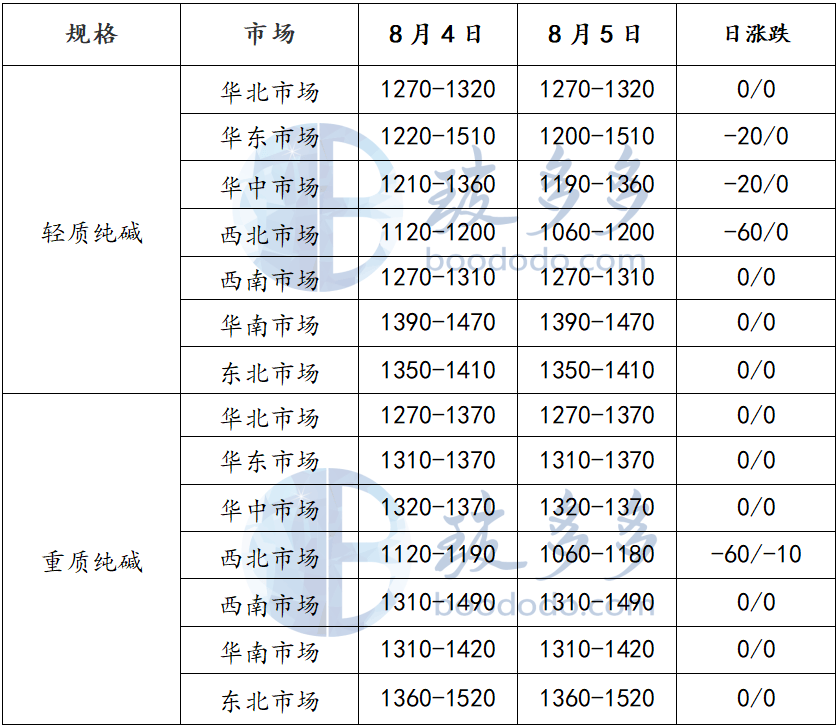
Core Viewpoint - The soda ash industry is experiencing a downward trend in prices due to oversupply and weak demand, with the main contract dropping to around 1150 RMB/ton without signs of stabilization [1] Supply and Production - Major soda ash producers, including Biyuan Yingen, Henan Jingshan, and Shandong Haohua, have initiated maintenance in May and June, but supply pressure remains high [1][2] - The industry is facing record-high inventory levels exceeding 2 million tons, prompting companies to reduce supply through early maintenance [1][2] - In May, the operating rate of soda ash manufacturers was 84%, with a production of approximately 3.14 million tons, a month-on-month decrease of 2.2% [2] Demand Dynamics - Demand for soda ash has significantly contracted, with daily melting volumes for float glass decreasing by nearly 20,000 tons compared to last year's peak, and a 13% year-on-year reduction in daily melting volume for photovoltaic glass [1][4][5] - The real estate sector is in a bottoming cycle, with various investment and construction metrics showing declines, which negatively impacts the demand for float glass [4] - The photovoltaic sector is also underperforming, with a significant drop in installed projects and increasing inventory levels for photovoltaic glass, leading to a reduction in production capacity [5] Cost and Profitability - Despite the decline in soda ash prices, the costs of key raw materials like coal and salt are also decreasing, providing some profit margins for producers [3] - The cost support for ammonia-soda process has shifted from 1300-1400 RMB/ton at the beginning of the year to 1100-1150 RMB/ton currently [3] - The profitability of the soda ash industry may face further compression due to the ongoing oversupply situation, despite some producers still maintaining profits [5]