零售业

Search documents
【固收】固定资产投资累计同比增速延续回落态势——2025年8月经济数据点评兼债市观点(张旭/李枢川)
光大证券研究· 2025-09-16 23:07
Core Viewpoint - The economic data for August 2025 indicates a slowdown in industrial production, a decline in fixed asset investment, and weaker-than-expected retail sales growth, reflecting the impact of "anti-involution" policies on the actual economy [4][5][6][7]. Industrial Production - The industrial added value for large-scale enterprises grew by 5.2% year-on-year in August, a decrease of 0.5 percentage points from July, marking two consecutive months of declining growth [4][5]. - Month-on-month, the industrial added value increased by 0.37% in August, lower than the growth rates in the same months of 2023 and 2024 [5]. Fixed Asset Investment - The cumulative year-on-year growth rate of fixed asset investment continued to decline, with August showing a significant drop in infrastructure investment [6]. - Real estate investment remains weak, while manufacturing and infrastructure investments have also retreated from their high levels earlier in the year, with negative year-on-year growth for two consecutive months [6]. Retail Sales - The total retail sales of consumer goods increased by 3.4% year-on-year in August, with a month-on-month growth rate of 0.17%, indicating a slight recovery but still below seasonal expectations [7]. - The month-on-month growth rate in August was lower than the corresponding rates in 2023 and 2024, suggesting a weaker consumer spending environment [7]. Bond Market Outlook - In the bond market, there has been a noticeable divergence in government bond yields since August, with short-term yields remaining stable while long-term yields have increased significantly [8]. - The current liquidity is relatively ample, and the bond market is expected to perform well, with the 10-year government bond yield estimated to stabilize around 1.7% [8][9]. - Convertible bonds have not outperformed their underlying stocks since August 25, and while they remain a relatively high-quality asset, their current valuation levels are elevated, necessitating a more strategic approach [9].


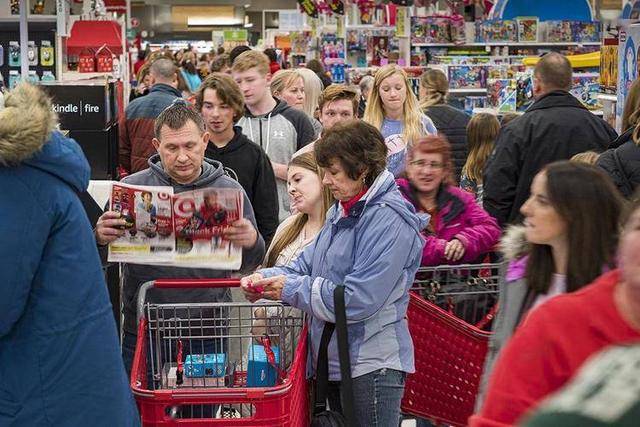
US retail sales surge 0.6% in August, beating forecasts
Invezz· 2025-09-16 13:14
Core Insights - US retail sales increased by 0.6% in August, surpassing economists' expectations of a 0.2% rise, indicating strong consumer spending despite broader economic weaknesses [1] Retail Sales Performance - The Census Bureau's report highlights a significant growth in retail sales, reflecting consumer resilience [1]
美国经济有多糟糕:失业率竟直线上升,美国民众勒紧裤腰带过日子
Sou Hu Cai Jing· 2025-09-16 06:22
Group 1: Economic Overview - The current U.S. economy is heavily supported by consumer spending, with many individuals still employed and able to spend [1] - However, the foundation of this "prosperity" appears unstable, as total debt has reached a historical high and serious delinquencies have also surged to a decade-high [1] - A recent PwC survey indicates that inflation and future uncertainties are prompting households to plan for reduced holiday spending by approximately 5.3% [1] Group 2: Employment Data - The unemployment rate stands at 4.3%, the highest since 2021, yet still below the long-term average of 5.7% since 1948 [3] - A significant downward revision of 911,000 non-farm jobs over the past year marks the largest adjustment since 2000, suggesting that real economic growth is weaker than previously reported [3] - In August, only 22,000 jobs were added, and for the first time since 2020, layoffs exceeded new hires, resulting in a net job loss of 13,000 [5] Group 3: Labor Market Dynamics - The balance of supply and demand in the labor market is shifting, with the number of job seekers surpassing available job openings for the first time in four years [5] - The employment index in manufacturing has dropped to a five-year low, indicating a cooling demand across various sectors, particularly in leisure, professional services, retail, and manufacturing [5] - Confidence among unemployed individuals in finding new jobs has plummeted to 44.9%, the lowest since this survey began in 2013 [5] Group 4: Financial Market Response - Despite a struggling real economy, the financial markets are thriving, with the S&P 500 index rising over 10% this year and reaching new historical highs [7] - Poor economic data is fueling expectations that the Federal Reserve will soon implement interest rate cuts, with traders predicting a 90% chance of a cumulative 75 basis points cut by year-end [7] - Major institutions, including Fitch and Bank of America, forecast at least two rate cuts by the Fed this year, with further cuts anticipated next year [7] Group 5: Economic Contradictions - The U.S. economy is characterized by conflicting perspectives, with some believing the worst is over due to improving corporate profits and confidence indicators, while others see a fragile consumer market underpinned by high debt levels [9] - The labor market shows low unemployment rates, yet internal conditions are deteriorating, creating a disconnect between the financial markets and the real economy [9] - This complex situation places the U.S. economy at a critical juncture, described as a bent steel bar that is "bending but not yet broken" [9] Group 6: Policy Challenges - Policymakers face the challenge of balancing inflation control, job stability, and market reassurance, where any action could exacerbate existing tensions [11] - Public sentiment reflects growing dissatisfaction with economic performance, indicating that economic issues have become a significant political pressure point [11]
中国2025年8月经济数据图景:8月生产改善,投资放缓
Hua Tai Qi Huo· 2025-09-16 02:40
Report Industry Investment Rating No relevant content provided. Core Viewpoints - In August, industrial production improved with the national above - scale industrial added value growing 5.2% year - on - year and 0.37% month - on - month, and 6.2% year - on - year from January to August. The decline of PPI narrowed, and CPI decreased year - on - year but was flat month - on - month. Core CPI increased for four consecutive months. Domestic consumption is expected to continue to recover in Q3 [3]. - From January to August, national fixed - asset investment (excluding rural households) was 326111 billion yuan, with a year - on - year growth of 0.5%, and a month - on - month decline of 0.20% in August. The third - industry investment was dragged down by real estate, but the investment structure continued to optimize [4]. - From January to August, the total retail sales of consumer goods was 323906 billion yuan, with a year - on - year growth of 4.6%, and 39668 billion yuan in August, with a year - on - year growth of 3.4%. The consumer market is recovering, but the demand foundation needs to be consolidated. In the real estate market, both investment and sales were under pressure from January to August [5]. Summary by Directory Growth: Steady Uptick - In August, the national above - scale industrial added value grew 5.2% year - on - year and 0.37% month - on - month, and 6.2% year - on - year from January to August. The equipment and high - tech manufacturing industries outperformed the overall level. Some product outputs increased significantly. However, external uncertainties remain [11]. Inflation: Month - on - Month Recovery - In August 2025, the national PPI decreased 2.9% year - on - year, with the decline narrowing. The pressure on energy and raw material supply and demand eased marginally, some external - demand industries improved, and new - quality productivity industries and consumption - upgrade demand supported price increases. However, factors such as weak downstream demand and international input still restrict the full recovery of PPI, which is expected to continue a mild recovery [21]. - In August, CPI decreased 0.4% year - on - year and was flat month - on - month. Core CPI increased 0.9% year - on - year, with the increase expanding for four consecutive months. Food prices were the main drag, while non - food prices and service consumption showed positive trends. Domestic consumption is expected to continue to recover in Q3 [45]. Investment: Marginal Slowdown - From January to August 2025, national fixed - asset investment (excluding rural households) was 326111 billion yuan, with a year - on - year growth of 0.5%, and a month - on - month decline of 0.20% in August. The second - industry investment grew rapidly, while the third - industry investment was dragged down by real estate. Investment growth varied by region. Overall, the investment structure is optimizing, but the real estate market still drags down the overall investment [59]. Production: Continued Growth - From January to August 2025, the national above - scale industrial added value grew 6.2% year - on - year, with a 5.2% year - on - year and 0.37% month - on - month growth in August. The manufacturing industry maintained growth, and high - tech manufacturing outperformed. New kinetic energy products grew rapidly, and foreign trade also increased. However, the foundation for the continuous recovery of the industrial economy needs to be consolidated [63]. Consumption: Slowing Growth - From January to August 2025, the total retail sales of consumer goods was 323906 billion yuan, with a year - on - year growth of 4.6%, and 39668 billion yuan in August, with a year - on - year growth of 3.4%. The consumer market showed the characteristics of stable growth in commodity consumption and resilience in service consumption. Online consumption grew rapidly. Overall, the consumer market is recovering, but the demand foundation needs to be consolidated [74]. Real Estate: Both Investment and Demand Under Pressure - From January to August, national real estate development investment was 60309 billion yuan, with a year - on - year decline of 12.9%. The funds in place for real estate development enterprises decreased, and sales were weak. The real estate market still faced downward pressure, but inventory reduction policies had some effects. The demand - side confidence needs to be restored [86]. Appendix - In August, the national economy maintained a stable and progressive development trend. Industrial production, services, market sales, fixed - asset investment, foreign trade, etc. all showed certain growth, and employment and prices were generally stable. However, there were still many external uncertainties, and the economy faced challenges [103].
数据点评 | 8月经济:“反内卷”影响开始显现(申万宏观·赵伟团队)
赵伟宏观探索· 2025-09-15 16:03
Core Viewpoint - The impact of "anti-involution" on mid- and downstream production and investment is beginning to show [2][71] Production - Upstream production remains strong, but "anti-involution" is affecting mid- and downstream production, with industrial added value in August decreasing by 0.5 percentage points to 5.2% [2][71] - Specific sectors such as coal mining are performing well, while transportation equipment, metal products, and downstream sectors like beverages and food are experiencing declines [2][71] Investment - Fixed asset investment continues to decline, primarily due to the impact of "anti-involution" on mid- and downstream investment, compounded by a reduction in new construction projects affecting current real estate investment [2][71] - In August, fixed asset investment fell by 1.0 percentage points to -6.3%, with construction and installation investment dropping significantly by 5 percentage points to -11.1% [2][71] - Real estate investment saw the largest decline, down 2.4 percentage points to -19.4%, while manufacturing investment also decreased by 0.9 percentage points to -1.2% [2][71] Real Estate - Demand-side sales and housing prices continue to decline, with the supply chain of "new construction-rework-investment-completion" also weakening [3][72] - In August, the sales area of commercial housing fell by 2.7% year-on-year, while the sales amount decreased by 14.0% [3][72] - The credit financing growth rate for real estate companies remains negative at -8.1%, with new construction down 4.8 percentage points to -20.3% [3][72] Consumption - Some "trade-in" products are showing signs of decline, while service consumption remains relatively stable [3][72] - In August, the total retail sales of consumer goods grew by 3.4%, down 0.3 percentage points from the previous month, with significant declines in home appliances and communication equipment [3][72] Summary - The effects of "anti-involution" on domestic supply and demand are becoming evident, but external demand is expected to continue contributing to economic resilience, with manageable downward pressure anticipated in the second half of the year [4][73] - The economic landscape in September shows weak domestic demand and strong external demand, with a focus on monitoring the impacts of "anti-involution" and the lagging effects of reduced new construction projects in real estate [4][73]
中国经济观测点丨8月新注册经营主体数量下降 资本市场融资减少
Xin Hua Cai Jing· 2025-09-15 15:26
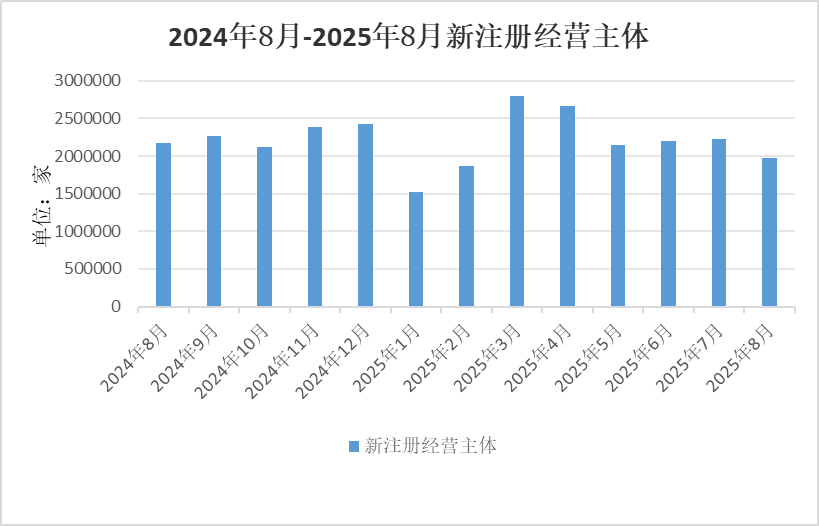
Group 1 - The core viewpoint of the article highlights a decline in new business registrations across China in August 2025, with a total of 1.9698 million new entities registered, marking a year-on-year decrease of 9.36% and a month-on-month decrease of 11.7% [2][11]. - Guangdong province leads in new business registrations, with 281,125 new entities, significantly outpacing the second-ranked Henan province, which registered 138,363 new entities [4][5]. - The top ten provinces for new business registrations account for over 60% of the total registrations, indicating a concentration of entrepreneurial activity in these regions [5]. Group 2 - Liaoning province shows the highest year-on-year growth rate in new business registrations at 69.3%, followed by Beijing at 21.84% [7]. - The retail sector continues to dominate new business registrations, with 197,000 new entities, far exceeding the wholesale sector, which registered 113,400 [9]. - The capital market experienced a significant reduction in financing activities, with only 313 investment events recorded in August, down from 631 in July, and a total financing scale of 57.543 billion yuan, a decrease of 52.41% [11].
摩根大通策略师:美联储降息不太可能扭转经济放缓局面
Sou Hu Cai Jing· 2025-09-15 09:01
Core Viewpoint - Morgan Stanley's Chief Market Strategist David Kelly observes signs of a gradual slowdown in the US economy, which is expected to put pressure on cyclical sectors such as manufacturing and retail [1] Economic Impact - A reduction in the benchmark interest rate is unlikely to reverse the current economic situation [1] - Kelly suggests that if stock market investors believe that rate cuts will benefit the overall direction and profitability of the economy, they are misunderstanding the situation [1] Market Sentiment - When the Federal Reserve lowers interest rates, it reduces interest income and leads to a belief that further rate cuts are forthcoming, causing individuals to delay borrowing [1] - This situation fosters a perception that the Federal Reserve is fearful of an economic recession, which in turn instills fear of recession among the public [1]

高盛:市场内幕为联储降息做准备
Goldman Sachs· 2025-09-15 01:49
Investment Rating - The report indicates a cautious outlook on the market, with a focus on potential interest rate cuts by the Federal Reserve, which may influence stock trading strategies [1][2]. Core Insights - The Federal Reserve's cautious stance is influenced by high inflation and mixed employment data, leading to uncertainty about future interest rate cuts [1][2]. - There is a notable volatility in artificial intelligence stocks, with concerns about the sustainability of growth in language model adoption [1][4]. - Economic data shows a bifurcated landscape, with a slow recovery in the labor market but optimistic projections for early 2026 due to fiscal expansion and potential interest rate cuts [1][5]. - Retail and consumer stocks have performed better than last year, with positive indicators from companies like Walmart, although negative changes in non-farm employment data could lead to market turbulence [1][6]. - Investors are advised to adjust their portfolios towards early-cycle and more cyclical stocks rather than being overly concentrated in artificial intelligence-related stocks [1][7]. Economic Data and Labor Market - Current economic data is polarized, with some indicators suggesting a potential recession while others indicate a possible acceleration in recovery by early 2026 [5]. - The labor market is recovering slowly, with employment growth not returning to previous levels, and factors like immigration and AI potentially impacting job growth [5]. Retail and Consumer Sector - Retail and consumer stocks have shown significant improvement compared to last summer, with Walmart's strong back-to-school performance signaling a positive holiday sales season [6]. - However, there is a risk of market volatility if non-farm employment data shows negative trends [6]. Investment Strategy Recommendations - Investors should focus on a non-recessionary rate-cutting cycle and the anticipated strong recovery in 2026, adjusting portfolios to favor early-cycle and cyclical stocks [7]. - Maintaining flexibility and closely monitoring economic data changes is crucial for investment strategy formulation [7]. Market Volatility and Opportunities - The report highlights that the current financial environment is very loose, with potential market volatility even from small interest rate cuts [13]. - There are significant investment opportunities in the U.S. front-end supply volatility, with events like Oracle's earnings showing substantial price movements [15]. - Emerging markets, particularly in Asia, are showing improved trading performance, driven by AI themes and favorable conditions for non-dollar denominated assets [16][19].
下周(9月15日-21日)市场大事预告:
Sou Hu Cai Jing· 2025-09-14 11:12
Market Events Overview - The People's Bank of China will have a total of 12,645 billion yuan in reverse repos maturing next week, with specific maturities throughout the week [1] - A total of 47 companies will have lock-up shares released next week, amounting to 3.073 billion shares with a total market value of 79.75 billion yuan based on the closing price on September 12 [2] - Four new stocks are set to be issued next week, with a total of approximately 413 million shares expected to raise 7.645 billion yuan [2] Economic Data Releases - Key economic indicators to be released include China's August retail sales, industrial output, and fixed asset investment data on September 15 [1] - The global payment share of the Chinese yuan in August will be announced on September 18 [2] - Various international economic data will be released throughout the week, including the U.S. retail sales and unemployment rate, as well as the Eurozone inflation data [3][4] Central Bank Decisions - The Federal Reserve is expected to announce a 25 basis point rate cut next week, with market focus shifting to future rate paths and economic forecasts [3][4] - Other central banks, including those of Indonesia, Canada, Brazil, and the UK, will also announce their rate decisions, with varying expectations based on recent inflation data [4] Legislative and Regulatory Developments - New housing rental regulations in China will take effect on September 15, aimed at improving contract management and clarifying responsibilities [5] - The "Rural Road Regulations" will also come into effect on September 15, establishing a comprehensive system for rural road management [5] - The Hong Kong Legislative Council has passed a bill allowing electronic display of driver's licenses, effective September 15 [6]
走访上市公司 推动上市公司高质量发展系列(二十四)
证监会发布· 2025-09-12 11:07
Group 1 - Fujian Securities Regulatory Bureau has deepened regular visits to listed companies, achieving a coverage rate of 70.75% by visiting 75 companies and addressing 60 issues related to financing, cross-border trade, compliance governance, and investment approval [3] - The bureau has implemented targeted assistance for companies, providing tailored solutions for issues such as policy understanding and risk response, resulting in successful financing support for a software and information technology service company [3][4] - Since the beginning of 2025, 15 listed companies in Fujian have announced mergers and acquisitions totaling over 17 billion, with significant financing activities including 36 companies raising over 160 billion through various means [5] Group 2 - Anhui Securities Regulatory Bureau has conducted visits to 133 listed companies, achieving a coverage rate of 78.29% and addressing 63 issues to enhance company quality [6][7] - The bureau focuses on technology-driven companies, organizing events to facilitate communication between scientists, entrepreneurs, and investors, aiming to accelerate the transformation of scientific achievements [7][8] - Since 2024, 328 companies in Anhui have implemented cash dividends totaling approximately 70 billion, with 11 companies engaging in mergers and acquisitions amounting to about 33 billion [10] Group 3 - Jiangxi Securities Regulatory Bureau has visited 71 listed companies, covering nearly 80% and resolving 65 issues related to financing, production operations, and project approvals [11][13] - The bureau emphasizes the importance of corporate governance and innovation, encouraging companies to leverage capital market tools for transformation and upgrading [12][14] - In the first half of 2025, 57 listed companies in Jiangxi distributed cash dividends totaling approximately 8.78 billion, while 30 companies engaged in mergers and acquisitions worth around 6.71 billion [13]