电动汽车

Search documents
摩根士丹利宏观策略谈-年终收官时刻以全局视角眺望全球
摩根· 2025-12-17 15:50
Investment Rating - The report maintains a cautious optimism regarding the Chinese stock market, expecting a high single-digit growth in the index for the year 2026 [3][12]. Core Insights - The nominal GDP growth expectation for China is around 4%, slightly below market consensus, with a focus on moderate fiscal policies emphasizing infrastructure investment [1][2]. - The report highlights China's first-mover advantage in emerging industries such as technology, batteries, electric vehicles, robotics, and photovoltaics, projecting an increase in global export market share from 15% to 16%-17% [1][5]. - The U.S. Federal Reserve is expected to implement two additional rate cuts in early 2026, contributing to a relatively loose liquidity environment that favors risk assets [1][9]. Summary by Sections Macroeconomic Policy - The overall macroeconomic policy for China in 2026 is characterized as moderately supportive rather than aggressively stimulative, aiming to stabilize current growth levels and alleviate deflationary pressures [2][3]. Fiscal and Monetary Policy - Fiscal policy is expected to be moderate but may be front-loaded in the first half of the year, focusing on infrastructure investments such as urban renewal and AI computing centers [3][15]. - Monetary policy will emphasize structural tools with limited room for interest rate cuts, projected to be between 10-20 basis points for the year [3][15]. Real Estate and Consumption Policies - Specific measures in the real estate sector include potential mortgage rate subsidies expected to be detailed after the 2025 Two Sessions, aimed at stabilizing market expectations [4][17]. - Consumption policies will continue to support trade-in programs and explore service sector consumption subsidies, with implementation anticipated in the second half of 2026 [4][17]. Industry Competition and Export Outlook - The competitive landscape for China's industries remains strong, particularly in high-growth sectors like electric vehicles and robotics, with an expected increase in export market share [5][20]. - Despite global trade protectionism, China's export market share is projected to rise, supported by a large pool of engineering graduates and a strong manufacturing base [5][20]. Economic Challenges and Future Vision - Current economic conditions show a slight recovery in market confidence, but challenges remain in addressing consumer spending and social welfare issues [6][7]. - The report emphasizes the need for gradual policy adjustments and feedback collection from market participants to ensure effective implementation of proposed economic measures [7][25].
特斯拉自动驾驶出租车项目取得进展,为投资者兑现人工智能梦想提供实证
Xin Lang Cai Jing· 2025-12-17 15:43
Core Insights - Tesla's investors are increasing their positions as the dream of becoming shareholders in an autonomous driving fleet is becoming a reality [1] - CEO Elon Musk confirmed that testing for autonomous taxis without a safety driver has begun, leading to a surge in Tesla's stock price to its highest point of the year [1][4] - The stock rose by 4% on Monday and an additional 3% on Tuesday, surpassing the historical high set nearly a year ago [1][4] Group 1 - Tesla's revenue primarily comes from car sales, but the company aims to create an on-demand autonomous driving fleet and introduce humanoid robots into households [4] - The progress in autonomous taxi testing signals to investors that Tesla's ambitious plans are steadily advancing [4] - Analyst Dan Ives estimates that Tesla's AI and autonomous driving business could generate at least $1 trillion in value [5] Group 2 - The easing of federal regulations under the Trump administration is expected to accelerate the rollout of Tesla's core projects in the next 3 to 6 months [5] - Musk plans to double the size of the autonomous taxi testing fleet and expand testing to Phoenix and Nevada [5] - Ives predicts that Tesla will capture 70% of the global autonomous driving market over the next decade due to its unmatched scale and breadth of operations [6]

击穿行业天花板:马斯克的万亿商业局
Tai Mei Ti A P P· 2025-12-17 12:13
Core Insights - Elon Musk's net worth surged to $491.9 billion, with a $150 billion increase in just nine months, solidifying his position as the world's richest person [1] - SpaceX announced plans for a historic IPO with a target valuation of $1.5 trillion and a fundraising goal of $30 billion, which would set a record for the largest IPO in history [2][3] - Musk's nine companies span across space, energy, AI, and life sciences, fundamentally reshaping industry norms and pushing the boundaries of traditional business [1][11] Space Infrastructure: $1.5 Trillion IPO and Cash Flow Engine - SpaceX's IPO is expected to launch in mid-2026, with a fundraising target exceeding $30 billion, surpassing the previous record held by Saudi Aramco [2] - Starlink, SpaceX's cash flow pillar, has 7.65 million active subscribers globally, contributing 43% of subscriptions from North America and 40% from emerging markets [2] - SpaceX's projected revenue for 2025 is $15 billion, increasing to $22-24 billion in 2026, with over 80% of revenue coming from Starlink [2] Ground Ecosystem: Tesla + Robots Reshaping Manufacturing and Energy - Tesla's stock price increased by 70.1% from March to December 2025, significantly contributing to Musk's wealth increase [5] - Tesla's market valuation of $1.5 trillion is equivalent to the combined market caps of Toyota, Volkswagen, and Ford, with a focus on electric vehicles and energy solutions [6] - Tesla has delivered over 6 million vehicles by 2024, capturing 22% of the global electric vehicle market [6] Future Layout: AI + Brain-Computer Interfaces - xAI, established in 2023, aims to create a top-tier AI system and has raised over $30 billion for its development [8] - Neuralink, founded in 2016, focuses on high-precision brain-computer interface technology and plans to start human clinical trials in 2025 [9] - The Boring Company and Hyperloop are also part of Musk's future vision, aiming to enhance human efficiency and expand living boundaries [10] Conclusion - Musk's wealth and IPO ambitions represent a gamble on technology reshaping commercial boundaries, with each of his companies challenging industry ceilings [11] - The potential for Musk's wealth to reach unprecedented levels hinges on the successful execution of SpaceX's IPO, Tesla's production goals, and breakthroughs in AI and brain-computer interfaces [12]
业内人士热议中国企业出海:出海方式更多元 增长结构更均衡
Zhong Zheng Wang· 2025-12-17 08:44
Core Insights - Chinese enterprises have achieved significant success in international markets but face challenges such as insufficient brand recognition and the need for improved localization [1][2] - China's merchandise trade export value exceeded that of the same period in 2024, contributing positively to economic growth [1] - China is positioned as a key player in global green transformation, leading in sectors like photovoltaics, wind energy, electric vehicles, and energy storage [1] Industry Trends - The "2025 China Brand Going Global Top Ten Industry Research Report" indicates a steady growth trend for Chinese brands abroad, with manufacturing, technology, and consumer sectors collaborating effectively [1] - New generation brands are enhancing their product capabilities, technological levels, and global operational experience, leading to more diversified and balanced growth structures [1] - The shift in export strategies is moving from merely selling products to building systems and creating brands [1] Challenges and Recommendations - Companies face challenges related to regional and cultural differences, as well as policy variations when expanding internationally [2] - It is recommended that enterprises deepen their understanding of local cultures and customs to advance localization strategies [2] - Establishing infrastructure such as logistics and warehousing is essential for successful international operations [2] - A dual focus on technology and compliance is crucial for long-term stability, necessitating the development of a trustworthy and secure global service network [2]
全球锂供应难以满足电动汽车需求缺口
Wen Hua Cai Jing· 2025-12-17 07:05
Group 1 - The report by Kearney and the World Economic Forum indicates that global lithium supply can only meet one-third (35%) of the projected demand by 2035 [1][2] - It warns that the pace of electrification, digitalization, and emission reduction is outstripping the supply of necessary mineral resources [2] - Lithium supply needs to more than double by 2035, with demand for rare earth elements and copper needing to increase by over 50% to meet expected needs [2][3] Group 2 - Even if all announced projects are implemented, existing mines and smelters can only meet 35-45% of the projected lithium and graphite demand [3] - Global electric vehicle demand is expected to exceed 20 million units by 2025, with electric vehicles accounting for over 40% of new car sales by 2030 [3] - The report highlights a significant time mismatch in the value chain, as battery and motor factories can scale production in 1-3 years, while new mining projects typically require 10-20 years for development [3][4] Group 3 - Delays in grid construction will have a cascading effect, slowing down the deployment of electric vehicle charging networks, renewable energy projects, and new digital facilities [4] - The report emphasizes the urgent need for bold supply-side investments and smarter demand-side actions to ensure the resilience of critical mineral supply chains [4] Group 4 - Global data center capacity is projected to triple by 2035, supported by investments ranging from $3 trillion to $7 trillion before 2030 [4] - Data centers will consume 6% of global gallium resources and 2.4% of germanium resources by 2035, which are essential for semiconductors and sensors [4] Group 5 - The supply risks for gallium, germanium, and rare earth elements are exacerbated by geopolitical tensions, market financing uncertainties, and infrastructure bottlenecks [5][6] - The current challenge is not the availability of materials but the actual access to these materials, as global demand for data centers and semiconductor capacity expands [6] Group 6 - The European battery industry is rapidly expanding, with over €82 billion committed to building gigafactories, primarily from EU member states [6][7] - By 2030, these projects are expected to achieve an annual production capacity exceeding 1.2 terawatt-hours, enabling Europe to meet its own demand and become a global exporter [7] Group 7 - Any weakening of EU automotive emission standards could undermine investment confidence in the battery industry, jeopardizing the foundational agreements that ensure long-term demand [7] - The report warns that without stable demand policies, Europe risks becoming dependent on imported battery materials, losing the opportunity to establish a competitive and autonomous industrial base [7]
EV晨报 | 马斯克个人财富超6000亿美元;小鹏、理想获L3牌照开启常态化测试;英伟达计划增产H200芯片满足中国企业需求
Sou Hu Cai Jing· 2025-12-17 02:56
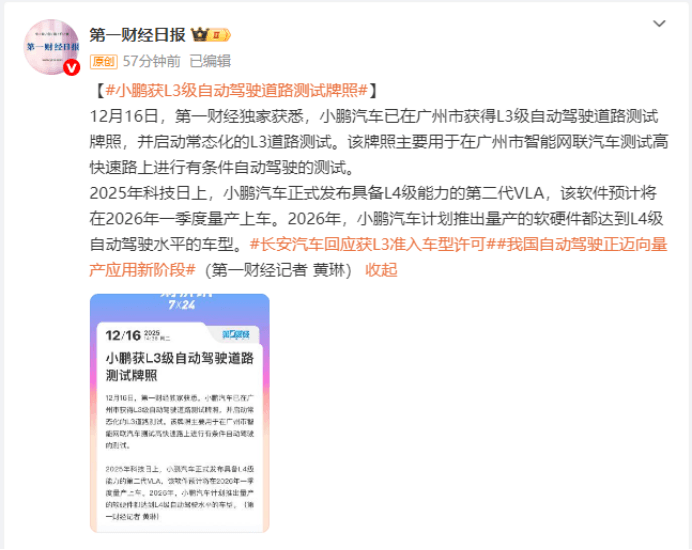
Group 1: Elon Musk's Wealth Surge - Elon Musk's net worth has surged to approximately $677 billion, an increase of $168 billion, primarily due to SpaceX's latest valuation of $800 billion, which doubled from $400 billion in August [1] - Musk holds about 42% of SpaceX, contributing significantly to his wealth increase [1] - In addition to SpaceX, Musk owns 12% of Tesla, valued at $197 billion, and has a 53% stake in xAI Holdings, estimated at $60 billion [1] - If SpaceX goes public in 2026 with a valuation of around $1.5 trillion, Musk could become the world's first trillionaire [1] Group 2: Autonomous Driving Developments - XPeng Motors has received an L3 autonomous driving license in Guangzhou, allowing for regular testing on designated high-speed roads [2][5] - Li Auto has also obtained an L3 license in Beijing and has begun regular testing [5] - Huawei's Hongmeng Zhixing has initiated L3 autonomous driving testing in Shenzhen, covering 1,000 kilometers of high-speed roads [5][8] - The first batch of L3 autonomous vehicle licenses in China has been issued, with models from Changan and Huawei being tested under specific conditions [8] Group 3: NVIDIA's H200 Chip Production Increase - NVIDIA is considering increasing the production of its H200 chips to meet the strong demand from Chinese companies, including Alibaba and ByteDance [9] - The U.S. government recently approved NVIDIA to sell H200 GPUs to China, with a condition to allocate 25% of sales to the U.S. [9] - NVIDIA is managing its supply chain to ensure that sales to China do not affect its ability to supply U.S. customers [9] Group 4: Ford's Shift in Electric Vehicle Strategy - Ford has announced the discontinuation of its F-150 Lightning electric pickup truck, shifting focus to more profitable hybrid and gasoline models [18] - This decision is expected to result in a loss of approximately $19.5 billion, marking one of the largest asset impairment cases in the company's history [18] - The company has faced challenges such as lower-than-expected demand and high costs in its electric vehicle segment, leading to a cumulative loss of $13 billion since 2023 [19] Group 5: AI Developments by Xiaomi and Alibaba - Xiaomi has released and open-sourced its MiMo-V2-Flash model, which has 309 billion parameters and performs comparably to DeepSeek-V3.2 [13][15] - Alibaba has launched the Wanxiang 2.6 series model, the first video model supporting role-playing features, enhancing capabilities for professional video production [16][17]


申万宏源:维持小米集团-W“买入”评级 高端化战略与人车家全生态赋予更强韧题
Zhi Tong Cai Jing· 2025-12-17 02:46
申万宏源发布研报称,维持小米集团-W(01810)"买入"评级,25Q3业绩略超预期,和以前的存储周期相 比,具备比竞争对手更强的韧性,主因高端化战略初见成效,人车家全生态形成的业务结构更为均衡, 产品结构高端化潜力尚未充分释放,后续催化上行因素带来叙事反转。 IoT方面 端侧AI落地,推进家电加速出海。25Q3收入276亿元,毛利率23.9%,YoY+3.2pct/QoQ+1.4pct,主因产 品结构优化。此外国补退坡属于阶段性影响,已在公司的预判范围内,不会影响长期的高端化和出海方 向。9月发布Xiaomi-MiMoAudio语音开源大模型;11月发布智能家居未来探索方案Xiaomi Miloco,使用 MiMo+VLMiloco端侧视觉大模型,赋能全屋智能的"感知+理解+执行"能力。看好后续出海动能,维持 26-27年收入增速预测14%/9%。 互联网服务与EV 小米集团25Q3业绩略超预期。营业收入1131亿元(预期1125亿),YoY+22%/QoQ2%,主因互联网服务和 电动汽车业务收入超预期。经调整净利润113亿(预期100亿),YoY+81%/QoQ+4%。公司已连续三季站稳 千亿营收、22% ...


申万宏源:维持小米集团-W(01810)“买入”评级 高端化战略与人车家全生态赋予更强韧题
智通财经网· 2025-12-17 02:44
Core Viewpoint - Xiaomi Group-W (01810) maintains a "buy" rating with Q3 2025 performance slightly exceeding expectations, driven by a successful high-end strategy and a balanced business structure across its ecosystem [1] Financial Performance - Q3 2025 revenue reached 113.1 billion yuan, slightly above the expected 112.5 billion yuan, with a year-over-year increase of 22% and a quarter-over-quarter increase of 2%, primarily due to better-than-expected internet services and electric vehicle (EV) business revenue [1] - Adjusted net profit for Q3 2025 was 11.3 billion yuan, exceeding the expected 10 billion yuan, with a year-over-year increase of 81% and a quarter-over-quarter increase of 4% [1] - The company has maintained over 100 billion yuan in revenue, 22% gross margin, and 10 billion yuan profit for three consecutive quarters [1] Mobile Segment - In Q3 2025, Xiaomi shipped 43.3 million mobile units with an average selling price (ASP) of 1,063 yuan and a gross margin of 11.1%, meeting expectations [2] - The management has set a shipment target of 170 million units for 2025 [2] IoT Segment - Q3 2025 IoT revenue was 27.6 billion yuan with a gross margin of 23.9%, showing a year-over-year increase of 3.2 percentage points and a quarter-over-quarter increase of 1.4 percentage points, driven by product structure optimization [3] - The company anticipates that the reduction in national subsidies will have a limited impact on its long-term high-end strategy and international expansion [3] - New AI initiatives and smart home solutions are expected to enhance the company's capabilities in the IoT space, with revenue growth forecasts of 14% and 9% for 2026 and 2027, respectively [3] Internet Services and EV - Q3 2025 internet services revenue was 9.4 billion yuan, with a year-over-year increase of 11% and a gross margin of 76.9% [4] - Advertising revenue reached 7.2 billion yuan, up 17% year-over-year, with overseas revenue of 3.3 billion yuan, up 19% year-over-year, both achieving record highs [4] - The EV segment reported a revenue of 29 billion yuan in Q3 2025, with 109,000 units delivered and an ASP of 260,000 yuan, achieving a gross margin of 25.5% and an operating profit of 700 million yuan for the quarter [4] - The delivery target for 2025 has been raised to 400,000 units from the previous target of 350,000 units [4]
11月新增非农谈不上强劲:环球市场动态2025年12月17日
citic securities· 2025-12-17 02:37
Economic Indicators - In November 2025, the U.S. added 64,000 non-farm jobs, exceeding the expected 50,000, while the unemployment rate rose to 4.6%, higher than the anticipated 4.5%[5] - October's non-farm employment saw the largest decline in five years, with a drop of 105,000 jobs, primarily due to federal employees opting for "delayed resignation" programs[5] Stock Market Performance - U.S. stock indices showed mixed results, with the Dow Jones falling 302 points (0.62%) to 48,114, while the Nasdaq rose 0.23% to 23,111[8] - European markets declined, with the UK FTSE 100 down 0.68% to 9,684 and the German DAX down 0.63% to 24,076[8] Commodity and Currency Trends - WTI crude oil prices fell below $55 per barrel for the first time since 2021, influenced by oversupply and geopolitical tensions[27] - The U.S. dollar index decreased by 0.2%, reflecting a year-to-date decline of 9.5%[26] Bond Market Insights - U.S. Treasury yields fell by 1-3 basis points, with the 10-year yield at 4.15% and the 30-year yield at 4.81%[30] - The bond market showed mixed signals, with the 2-year Treasury yield at 3.49%, down 1.5 basis points[30] Asian Market Dynamics - The Asia-Pacific stock markets mostly declined, with South Korea's KOSPI dropping 2.2% to 3,999 points, while Vietnam's index rose 2.0% to 1,679 points[21] - Hong Kong's Hang Seng Index fell 1.54% to 25,235 points, with significant declines in technology and financial sectors[10]



马斯克身家跃升至6770亿美元,SpaceX上市在即或将造就首位“万亿富翁”
Sou Hu Cai Jing· 2025-12-17 01:50
Group 1 - Tesla's stock surged by 3.56%, increasing its market value by $53.7 billion (approximately 378.6 billion RMB), making it a standout performer amid a declining market [1] - Elon Musk's net worth reached $677 billion, making him the first individual in history to surpass a net worth of $600 billion, marking a significant milestone in modern business history [1] - Analysts attribute Tesla's strong performance to advancements in artificial intelligence, autonomous driving, and energy sectors, as well as rising expectations for the upcoming Robotaxi and Optimus robot commercialization [2] Group 2 - SpaceX is preparing for an IPO in mid-2026, with a target valuation of $1.5 trillion, potentially making it the highest-valued public company in the tech and aerospace sectors [4] - Musk holds approximately 42% of SpaceX, which could contribute over $630 billion to his wealth if the company achieves its projected valuation [4] - The combination of Musk's holdings in Tesla, xAI, Neuralink, and SpaceX positions him to potentially become the first individual with a net worth exceeding $1 trillion [4] Group 3 - Musk's wealth is rooted in innovative ventures across various high-tech fields, including electric vehicles, reusable rockets, and brain-machine interfaces, transforming ambitious visions into impactful business entities [5] - SpaceX's Starlink project has provided high-speed internet to over 4 million users globally and secured key contracts in military and aviation sectors, showcasing its multifaceted value [5] - The anticipated valuation of SpaceX reflects a new economic paradigm where private companies can rival the market capitalizations of major oil giants, indicating a shift in wealth accumulation driven by technological innovation [6]