水泥

Search documents
港股异动 | 水泥股涨幅居前 前三季行业收入下滑但利润改善 水泥去产能进程有望加速
智通财经网· 2025-11-20 05:59
Group 1 - The cement sector has seen significant stock price increases, with companies like Shanshui Cement rising by 4.23%, China National Building Material by 3.55%, and Anhui Conch Cement by 2.9% [1] - According to Zhongtai Securities, the cement sector achieved a total revenue of 181.1 billion yuan in the first three quarters, a year-on-year decline of 8.5%, while net profit attributable to shareholders reached 9.5 billion yuan, a year-on-year increase of 159.1% [1] - The increase in net profit is attributed to a low base from the previous year and relatively strong industry prices alongside lower coal prices [1] Group 2 - Huatai Securities emphasizes that effective control of clinker production line capacity and output is crucial for achieving cement capacity reduction [1] - Looking ahead to 2026, policy constraints are expected to accelerate the rectification of excess clinker production capacity, facilitating the practical implementation of cement capacity reduction [1] - The anticipated decline in industry profitability in Q3 2025 may accelerate the consolidation of cement capacity in certain regions, particularly in South China [1]
瑞银展望2026:卷还是不卷?洞察中国大宗周期
瑞银· 2025-11-20 02:16
Investment Rating - The report upgrades the rating for lithium carbonate due to unexpected demand from energy storage orders [5] Core Insights - The aluminum and copper sectors are fundamentally solid, driven by demand growth from the energy transition, with global copper demand expected to grow by 3% and prices potentially reaching $11,000 [4][5] - The photovoltaic (PV) industry faces severe overcapacity, with supply far exceeding demand, leading to widespread losses among companies [8][9] - The steel industry shows strong demand resilience, with no significant need for production cuts, while the cement industry struggles with low capacity utilization and regional management challenges [6][7] Summary by Sections Aluminum and Copper - The copper market is tightening, with global mine supply expected to increase by only 1% in 2026, while demand is projected to grow by 3% [4] - The aluminum sector mirrors copper's demand dynamics, with limited new capacity from Indonesia and Mozambique [4] Lithium and Energy Storage - Lithium carbonate's rating has been upgraded due to a surge in energy storage orders, with significant increases in production utilization rates for upstream materials [5][14] - The lithium battery market's demand has exceeded expectations, with total demand rising to 2,000-2,270 GWh [14] Steel and Cement - The steel industry maintains strong demand, with no immediate need for production cuts, while the cement sector faces challenges due to low utilization rates and regional management difficulties [6][7] Photovoltaic Industry - The PV industry is experiencing a critical turning point, with overcapacity issues leading to significant losses, despite expectations for gradual improvement in profitability starting in 2025 [8][13] - Government intervention is necessary to address overcapacity, as market-driven measures have proven insufficient [9][11] Future Outlook - The report anticipates that global PV demand growth may slow, with China's installation expected to stabilize between 200-250 GW in the coming years [12] - The lithium battery supply chain is expected to see a 25% increase in global production by 2026, with a corresponding rise in prices for certain materials [20]
三大行业将完成首次碳排放配额清缴
Ke Ji Ri Bao· 2025-11-19 23:26
Core Points - The Ministry of Ecology and Environment has released the "Quota Allocation Plan for National Carbon Emission Trading Market for Steel, Cement, and Aluminum Smelting Industries for 2024 and 2025," which outlines the allocation, clearing, and transfer of carbon emission quotas for these industries [1] - The plan continues the framework of free quota allocation based on carbon emission intensity control, linking the quota amount to actual carbon output, without setting an absolute cap on total emissions, thus ensuring necessary space for industry development [1] - The plan aims to incentivize carbon reduction by allowing companies with lower carbon emissions per unit product to have higher quota surplus rates [1] Industry Expansion - The Ministry has initiated preparatory work for expanding the carbon trading market to include industries such as chemicals, petrochemicals, civil aviation, and papermaking, with technical documents being drafted for quota allocation and reporting guidelines [2] - The expansion will follow the principle of "mature one, include one," based on industry development status, pollution reduction contributions, data quality, and carbon emission characteristics [2] - By 2027, the carbon trading market is expected to cover major emission industries in the industrial sector, with a gradual shift from intensity control to total control for industries with stable total emissions [2]
三大行业基础结转量增加碳价大幅上涨
Zhong Xin Qi Huo· 2025-11-19 13:44
Group 1: Report Industry Investment Rating - The report does not explicitly mention an industry investment rating. Group 2: Core Viewpoints of the Report - The adjustment of the "Scheme" provides effective support for carbon prices, and it is recommended to pay attention to opportunities for buying on dips [3]. - In the short - term, the increase in the basic carry - over volume of the three major industries leads to an increase in potential purchase demand, but it is necessary to note that it may not all be converted into market buying demand [3]. - In the long - term, the total quota gap of quota - deficient enterprises in the three major industries increases, and the supply - demand may be tight, which will drive up carbon prices [4]. Group 3: Summary by Related Content Policy Adjustment - On November 17, 2025, the Ministry of Ecology and Environment issued the "Scheme", which has two adjustments compared with the previous draft: the coefficient of carbon emission intensity and carbon emission intensity deviation is adjusted from 0.1 to 0.15, and the upper and lower limits of carbon emission intensity deviation are adjusted from ±30% to ±20%; the basic carry - over volume of key emission units in the steel, cement, and aluminum smelting industries is adjusted from 10,000 tons to 100,000 tons. For key emission units included in two or more industries, the basic carry - over volume is adjusted to the sum of the basic carry - over volumes of key emission units in each industry (≥110,000 tons) [1]. Market Performance - On November 19, 2025, the carbon emission quota rose sharply in the early trading and hit the daily limit, with a slight pull - back at the close. The closing price was 66.86 yuan/ton, with a gain of over 8%. The trading volume for the whole day was 1.1464 million tons, a 17.6% increase from the previous day's trading volume [2]. Short - term Impact - The adjustment of the "Scheme" allows enterprises in the three major industries to buy more quotas before the end of the year to carry over to next year, increasing short - term potential purchase demand. After the adjustment, the potential purchase demand of newly added enterprises increased from 1.334 million tons to 13.34 million tons [3]. Long - term Impact - The increase in the coefficient of carbon emission intensity and carbon emission intensity deviation makes the quota surplus or deficit of enterprises larger. Considering that the quota carry - over policy only lasts until the end of 2025, in 2026, quota - surplus enterprises may be more inclined to "hoard" quotas, while quota - deficient enterprises will convert all quota gaps into market demand due to compliance requirements, so the supply - demand may be tight and drive up carbon prices [4]. Operation Suggestions - Quota - surplus enterprises should confirm whether the remaining quotas meet the maximum carry - over volume requirements, and sell the excess part on rallies; key emission units in the three newly included major industries in the national carbon market can pay attention to opportunities for buying on dips in the carbon market [4]. Noun Explanation - Carbon emission intensity coefficient: An indicator characterizing the advanced level of an enterprise's carbon emission intensity control; when an enterprise is better than the industry benchmark level, the value is >0; otherwise, the value is <0 [5]. - Carbon emission intensity deviation: In 2025, the carbon emission intensity coefficients of steel enterprises, cement clinker production lines, and aluminum electrolysis processes are based on the gap between the carbon emissions per ton of products in their main processes and the industry balance value [5].
碳市场配额方案落地,钢铁等三大行业低碳转型将迎哪些机遇与挑战
Di Yi Cai Jing· 2025-11-19 13:08
Core Viewpoint - The Chinese carbon market is maturing through policy improvements and corporate exploration, with a focus on controlling greenhouse gas emissions and reducing overall emission reduction costs [1][2]. Group 1: Policy Framework and Market Mechanism - The Ministry of Ecology and Environment has issued a plan for the allocation of carbon emission quotas for the steel, cement, and aluminum industries for 2024 and 2025, emphasizing a stable policy framework and free quota allocation based on carbon intensity [1]. - The total carbon quota in the market has exceeded 8 billion tons per year, representing a more than tenfold increase compared to the cumulative transaction volume of 696 million tons in 2024, indicating a surge in emission reduction demand in the industrial sector [1]. Group 2: Industry Challenges and Opportunities - High-energy-consuming industries are facing a "de-involution" demand, where the expansion of the carbon market can encourage companies to reduce emissions and promote industrial upgrades, moving away from low-level homogeneous competition [2]. - The complexity of the industrial sector poses challenges for emission reduction, as seen in the aluminum industry, where production costs are significantly impacted by electricity and carbon costs [4]. Group 3: Data Quality and Regulatory Measures - The quality of carbon emission data is crucial for the healthy operation of the carbon market, with the Ministry of Ecology and Environment emphasizing the need for rigorous monitoring and verification of emission data [5]. - Measures to ensure data quality include improving the monitoring, reporting, and verification (MRV) system, enhancing daily regulatory oversight, and encouraging companies to strengthen their internal data management [5].


非金属建材行业25年前三季度总结:玻纤价格继续修复,水泥行业同比改善明显
ZHONGTAI SECURITIES· 2025-11-19 12:51
Investment Rating - The report provides a positive outlook for the fiberglass industry, indicating a recovery in prices and an upward trend in industry prosperity [4]. Core Insights - The fiberglass industry has seen a price recovery, driven by demand from emerging sectors such as wind power, thermoplastics, and electronics. The overall supply-demand balance remains stable, with major companies maintaining strong pricing strategies [4]. - The brand building materials sector is facing challenges in growth and profitability, with a notable decline in revenue and profits among sample companies. However, operational quality is improving as companies focus on cost control and brand management [5]. - The cement sector has shown significant profit improvement, with a notable increase in net profits compared to the previous year, despite a decline in revenue. This is attributed to a low base from the previous year and stable pricing in the industry [6]. - The glass industry, particularly float and photovoltaic glass, is still under pressure, with revenues and profits declining. However, there are signs of improvement in the third quarter due to price increases [8]. Summary by Sections Fiberglass - The fiberglass industry reported a total revenue of 42.798 billion, a year-on-year increase of 24.25%, and a net profit of 4.601 billion, up 95.04% [4][15]. - Major companies like China Jushi and Zhongcai Technology are highlighted as leaders in the market, with strong profit margins and operational efficiency [20][26]. - The price trend for fiberglass is on an upward trajectory, supported by stable demand from new applications [29]. Brand Building Materials - The brand building materials sector experienced a revenue decline of 6.14% year-on-year, with total revenue of 110.539 billion, marking the lowest level in five years [37]. - Net profit for the sector fell by 25% to 5.775 billion, also the lowest in five years, indicating significant pressure on profitability [37]. - The industry is undergoing a phase of capacity clearing, with expectations of market share redistribution and potential stabilization of profit margins in the future [5]. Cement - The cement sector achieved a total revenue of 181.1 billion, a decline of 8.5% year-on-year, while net profit surged by 159.1% to 9.5 billion, benefiting from a low base and stable pricing [6][55]. - Key players such as Huaxin Cement and Conch Cement are recommended for investment due to their strong performance [6]. - The outlook for the cement industry remains positive, with expectations of continued profit improvement in the coming years [6]. Glass - The float glass sector reported a revenue of 29.39 billion, down 8.99% year-on-year, with a net profit of 0.92 billion, down 51.04% [84]. - The photovoltaic glass sector faced significant challenges, with a revenue decline of 19.43% to 16.706 billion and a net loss of 0.018 billion [104]. - Despite the challenges, there are signs of recovery in the third quarter, with revenue growth driven by price increases [104].
梅雁吉祥(600868.SH):梅雁旋窑将其日产2000吨新型干法熟料水泥生产线的60万吨/年水泥熟料产能指标转让
Ge Long Hui A P P· 2025-11-19 12:27
Core Viewpoint - Meiyan Jixiang (600868.SH) announced the transfer of 600,000 tons/year cement clinker production capacity from its subsidiary Meizhou Meiyan Rotary Kiln Cement Co., Ltd. This transfer requires the shutdown and dismantling of the main equipment, including the kiln [1] Group 1 - The company plans to dispose of certain assets from Meiyan Rotary Kiln through public bidding, which includes specified buildings and machinery that are to be scrapped [1] - The current trading counterpart for the asset disposal has not yet been determined [1]

三大行业基础结转量增加,碳价大幅上涨
Zhong Xin Qi Huo· 2025-11-19 09:54
伊 张默涵 从业资格号:F03097187 投资咨询号: Z0020317 投资咨询业务资格: 证监许可【2012】669号 三大行业基础结转量增加,碳价大幅上涨! 2025年11月17日,生态环境部发布《2024、2025年度全国碳排放权交易市场钢铁、水泥、铝冶炼行业配额总量和 分配方案》(下称《方案》):对比生态环境部之前发布的征求意见稿,《方案》有两处调整:(1)碳排放强度与碳 排放强度偏离度的系数由0.1调整为0.15,碳排放强度偏离度上下限由±30%调整为±20%; (2)钢铁、水泥、铝冶炼行 业重点排放单位基础结转量由1万吨调整为10万吨;对于纳入两个及两个以上行业的重点排放单位,其基础结转量由1万 吨调整为各行业重点排放单位基础结转量的总和(≥11万吨)。 2025/11/19 2025年11月19日,碳排放配额早盘直线拉升涨停,收盘略有回调,收盘价66.86元/吨,涨幅超8%。 能源转型与碳中和组 受《方案》的影响,碳价早盘直线拉升,并于10:53涨停,收盘时价格略有回调;全天成交量为114.64万吨,较昨日成交 量上涨17.6%。短期需关注基础结转量的增加带来的潜在需求是否能转化为有效的市场 ...
水泥板块11月19日跌1.48%,福建水泥领跌,主力资金净流出3.19亿元
Zheng Xing Xing Ye Ri Bao· 2025-11-19 08:52
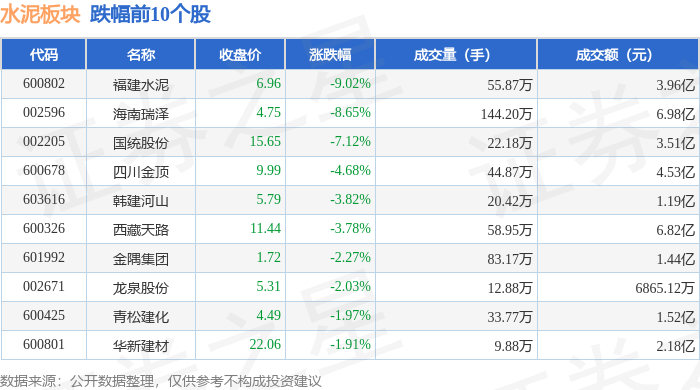
Market Overview - The cement sector experienced a decline of 1.48% on November 19, with Fujian Cement leading the drop [1] - The Shanghai Composite Index closed at 3946.74, up 0.18%, while the Shenzhen Component Index closed at 13080.09, unchanged [1] Individual Stock Performance - Fujian Cement (600802) saw a significant drop of 9.02%, closing at 6.96, with a trading volume of 558,700 shares and a turnover of 396 million yuan [1] - Other notable declines included Baking House (002596) down 8.65%, Guotong Co. (002205) down 7.12%, and Sichuan Jinding (600678) down 4.68% [1] Capital Flow Analysis - The cement sector experienced a net outflow of 319 million yuan from institutional investors, while retail investors saw a net inflow of 307 million yuan [1] - The table of capital flow indicates that major stocks like Conch Cement (600585) had a net inflow of 17.47 million yuan from institutional investors, while it faced a net outflow from retail investors [2] Detailed Capital Flow for Selected Stocks - Qing Song Jianhua (600425) had a net inflow of 2.49 million yuan from institutional investors and a significant net inflow of 16.80 million yuan from retail investors [2] - Other stocks like Xibu Construction (002302) and Jinyu Modong (000401) also showed varied capital flows, with institutional inflows and retail outflows [2]


生态环境部:已启动化工石化民航造纸等行业碳交易扩围准备工作
Di Yi Cai Jing· 2025-11-19 07:55
Core Viewpoint - The carbon emissions trading market in China is set to expand significantly by 2027, covering major high-emission industries such as chemicals, petrochemicals, civil aviation, and paper manufacturing, with a focus on improving data quality and regulatory capacity [1][2][4]. Group 1: Carbon Emissions Trading Market Expansion - By 2027, the carbon emissions trading market will primarily cover major industrial sectors [2]. - The Ministry of Ecology and Environment has initiated preparations to expand coverage to industries like chemicals, petrochemicals, civil aviation, and paper manufacturing [1][2]. - The carbon emissions reports from relevant industries since 2013 have been collected and verified to address data quality issues [1]. Group 2: Allocation and Management of Emission Quotas - The allocation plan for the steel, cement, and aluminum industries has been published, with a focus on free allocation based on carbon intensity control [4][5]. - The quota distribution will target the highest carbon-emitting enterprises, which account for over 98% of emissions in their respective sectors [5]. - The Ministry will issue pre-allocated quotas for 2025 to the steel, cement, and aluminum industries in the first half of next year [8]. Group 3: Data Quality and Regulatory Measures - The Ministry emphasizes the importance of carbon emissions data quality as foundational for the carbon market, with plans to enhance the monitoring, reporting, and verification (MRV) system [6][9]. - Advanced technologies such as blockchain, big data, and artificial intelligence will be utilized for comprehensive regulatory oversight [9]. - Companies are required to establish robust internal management systems for carbon emissions data to ensure compliance and accuracy [9].