
铝行业

Search documents
涨逾4%!政策利好刺激沪铝节后首日刷逾3年新高 但基本面不容忽视
Sou Hu Cai Jing· 2026-01-05 08:50
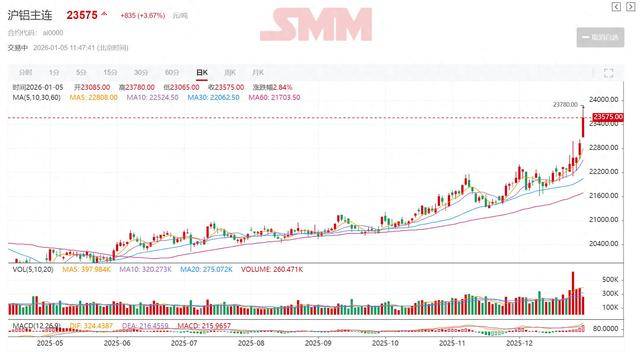
来源:上海有色网 元旦假期归来首个交易日,沪铝主连在经历前6个交易日的接连上涨之后继续跳空高开,盘中一度涨逾 4%,最高上探至23780元/吨,刷新2022年3月以来的新高。截至午间收盘,沪铝主连以3.67%的涨幅报 23575元/吨。 消息面上,委内瑞拉方面的政治冲突也一度引发市场热议,公开资料显示,委内瑞拉铝土矿资源量约 34.8亿吨,已探明储量13.3亿吨,占全球第三。但需要注意的是,委内瑞拉铝土矿资源开发勘探程度较 低,且其并不是主要的铝市场产出国和消费地,因此,该地的相关冲突并不会对整体产业链产生直接影 响。整体而言,该事件虽然会对市场产生一定程度上的情绪面影响,但对实际的铝市场供需影响较小。 至于当前实际的铝市场,据SMM了解,近期铝价维持高位,下游需求端受铝价高位抑制以及环保限产 的共同制约,铝水比例显著下滑,下游型材等多个板块开工率延续弱势,现货消费表现疲软。 伦铝方面也在元旦假期期间继续上扬并成功突破3000美元/吨的整数关口,今日开盘之后也继续上涨, 盘中最高一度上探至3069美元/吨,刷新2022年5月以来的新高。 且库存近期也呈现累库态势,据SMM数据显示,2025年年底,随着前期沸沸 ...

今日长江现货铅价上涨 后市行情能否延续涨势?
Xin Lang Cai Jing· 2026-01-05 04:15
Group 1 - The core viewpoint of the article highlights a significant divergence within the non-ferrous metals sector, driven by geopolitical risks and supply constraints, leading to a strong performance in copper, aluminum, and precious metals, while lead prices show a weak rebound lacking fundamental support [1][2] - The surge in copper and aluminum prices is attributed to heightened geopolitical tensions and supply disruptions from key production areas, which have created a narrative of scarcity in industrial metals, further fueled by positive market sentiment and capital inflows [1][3] - Lead prices experienced a daily increase of 125 yuan/ton to 17,425 yuan/ton; however, this rebound is characterized as "virtual fire," primarily driven by market sentiment rather than improvements in the underlying fundamentals, as evidenced by weak demand and increasing inventory pressures [1][2] Group 2 - Leading companies in the sector are adopting different strategies in response to market conditions, with copper, aluminum, and precious metals firms focusing on capacity expansion and resource allocation, while lead industry players are concentrating on cost control and cash flow management to navigate the current phase of industry pressure [2][3] - The short-term outlook suggests that copper and aluminum prices are likely to remain strong due to supportive supply narratives and macroeconomic expectations, while lead prices are expected to face downward pressure from rising inventories and weak demand, with a projected trading range of 17,100 to 17,500 yuan/ton [3][4] - The overall market for non-ferrous metals is characterized by a mix of strong and weak performances, necessitating a careful approach to investment opportunities, particularly in distinguishing between strong commodities like copper and aluminum and weaker ones like lead [4]

需求预期或上调,铝价强势突破创新高
Zhong Guo Neng Yuan Wang· 2026-01-05 01:24
Group 1: Aluminum - The price of alumina remains stable at 2685 yuan/ton, with metallurgical-grade alumina production capacity reaching 88.689 million tons/year and a weekly operating rate increase of 0.55 percentage points to 80.39% [1][3] - The short-term supply-demand fundamentals for alumina continue to show an oversupply, with inventories accumulating and spot prices remaining weak [1][3] - Domestic electrolytic aluminum prices increased by 1.59% to 22,700 yuan/ton, while London aluminum prices rose by 1.79% to 3,010 USD/ton, with electrolytic aluminum margins increasing by 7.18% to 6,862 yuan/ton [3] Group 2: Copper - Copper prices experienced fluctuations after reaching historical highs, with weekly changes in London copper, Shanghai copper, and US copper prices being +2.39%, -0.49%, and -2.62% respectively [2] - Domestic copper inventories saw a significant accumulation, with social inventories of electrolytic copper at 238,900 tons, a 23.40% increase [2] - The supply-demand balance for copper may shift from tight equilibrium to shortage due to insufficient capital expenditure in copper mines and frequent supply disruptions [2] Group 3: Lithium - Lithium carbonate prices increased by 5.90% to 118,500 yuan/ton, while lithium spodumene prices rose by 3.89% to 1,548 USD/ton, indicating a positive trend in lithium prices [4] - The supply of lithium carbonate increased by 1.2% to 22,400 tons, with SMM weekly inventory decreasing by 0.2% to 109,600 tons, marking 20 consecutive weeks of inventory reduction [4] - The demand for lithium batteries remains strong, with expectations for continued growth in lithium demand despite seasonal trends [4] Group 4: Cobalt - Cobalt prices are expected to continue rising, with MB cobalt increasing by 1.53% to 24.88 USD/pound and domestic cobalt prices rising by 10.11% to 490,000 yuan/ton [5] - The Democratic Republic of Congo has lifted its cobalt export ban, implementing a quota system instead, which may affect the supply chain in the near future [5] - The structural tightness in cobalt raw materials remains unchanged, supporting the outlook for rising cobalt prices [5]
有色金属:聚焦:铝:价格后发者的追赶
2025-12-31 16:02
Summary of the Conference Call on Nonferrous Metals Industry Focus - The report focuses on the nonferrous metals industry, specifically aluminum and copper markets. Key Points and Arguments Aluminum Price Performance - Since the beginning of the year, LME copper 3-month contracts have increased by 27.2%, while LME aluminum 3-month contracts have only risen by 11.2%, leading to a copper-aluminum price ratio of 4.4 [3][4] - The disparity in price performance is attributed to two main factors: copper's stronger financial attributes under macroeconomic conditions and global inventory imbalances caused by U.S. demand [3] - It is anticipated that aluminum may perform tighter than copper in 2026, with liquidity benefits potentially already priced in [3] Supply and Demand Dynamics - Global electrolytic aluminum supply is expected to remain low in 2026, with the pace of new projects in Indonesia likely to be slower than market expectations [4][5] - The supply constraint reflects the scarcity of an efficient industrial system rather than just insufficient capital expenditure at the mining level [6] - Demand for aluminum is expected to be more resilient due to its cost-effectiveness compared to copper, with a notable shift in the air conditioning industry towards aluminum usage [4][8] Trade and Regulatory Impacts - The EU's Carbon Border Adjustment Mechanism (CBAM) will come into effect on January 1, 2026, impacting the cost structure for aluminum production in Europe [9][10] - The CBAM tax will apply to direct carbon emissions from aluminum production, which could increase costs for new smelting plants and affect overall demand [11] Future Outlook - The supply constraints in aluminum are expected to persist, while demand is likely to benefit from its cost advantages, leading to potential price increases [12] - The ongoing transition from copper to aluminum in various applications, particularly in the air conditioning sector, is expected to further support aluminum consumption [8][12] Statistical Insights - As of December 22, aluminum ingot inventory decreased to 578,000 tons, and aluminum rod inventory fell to 120,000 tons, indicating a trend of inventory depletion [8] - The average direct emissions for global aluminum production are approximately 1.57 tons CO2e per ton of aluminum, with the EU's baseline emissions for 2026 set at 1.55 tons CO2e per ton [10] Additional Important Information - The report highlights the historical correlation between copper and aluminum prices, suggesting that price movements in one metal can significantly influence the other [3][18] - The anticipated increase in aluminum prices is expected to help restore the copper-aluminum price ratio to its historical average [12]
铝价存趋势格局,氧化铝寻底路漫漫
Yin He Qi Huo· 2025-12-31 08:17
Report Industry Investment Rating No relevant content provided. Core Viewpoints of the Report - The aluminum price is expected to show a trending pattern, while alumina is on a long - term downward path. The financial attribute of aluminum will continue to strongly drive the price in 2026, and the global supply - demand shortage of aluminum will support the price. Alumina will maintain a cost - based pricing logic due to an oversupply situation [6][86]. - The consumption of aluminum will grow at a low rate but still have bright spots, such as in energy transformation, lightweight applications, and the export of aluminum - processed products. However, traditional industries like real estate and home appliances may still perform weakly [34][54]. - The supply of recycled cast aluminum alloy will be affected by raw material shortages and policy uncertainties, and its price will generally follow the trend of the aluminum price [89]. Summary by Directory Part One: Preface Summary 1. Market Review - **Electrolytic Aluminum**: Overseas tariffs, monetary policies, and the "de - dollarization" trend have affected the aluminum price. The supply - demand contradiction and low inventory have supported the price, and the cost has decreased while the profit has increased [5]. - **Aluminum Alloy**: The casting aluminum alloy futures were successfully launched this year. The price of aluminum alloy is highly correlated with the aluminum price, but the spot price of casting aluminum alloy has difficulty following the increase in the aluminum price [5]. - **Alumina**: The supply - demand situation at home and abroad has turned to oversupply, and the price has declined. The industry is shifting profits to the ore end, and there are basis trading opportunities [5]. 2. Market Outlook - **Electrolytic Aluminum**: The financial attribute will continue to strongly drive the aluminum price. The supply - demand shortage and low inventory will give the price greater elasticity [6]. - **Aluminum Alloy**: The supply - demand pattern will remain slightly oversupplied, and the price will generally follow the metal sector and the aluminum price. There are risks in basis and cross - variety spreads [6]. - **Alumina**: The oversupply situation will continue, and the price will maintain a downward - selling strategy. There are policy risks, and basis trading opportunities still exist [6]. 3. Strategy Recommendation - **Unilateral**: Be bullish on the aluminum price on dips; the absolute price of casting aluminum alloy will follow the aluminum price, and pay attention to basis and variety spread opportunities before the expiration of warehouse receipts; maintain a downward - selling strategy for alumina, and pay attention to price elasticity risks driven by policy expectations [7]. - **Arbitrage**: Pay attention to the expansion of the monthly spread of aluminum at low inventory levels, the convergence of the basis at the end of the off - season, and the repeated arbitrage opportunities in the internal - external price difference; for aluminum alloy, pay attention to the arbitrage opportunities in the range of a discount of 100 - 1400 yuan to the aluminum price and the spot - futures arbitrage opportunities; there are basis trading opportunities for alumina when the warehouse receipts are low and before expiration [7]. Part Two: Supply Rigidity and Global Shortage, Aluminum Price in a Trending Pattern 1. 2025 Aluminum Market Review - The aluminum price showed a volatile upward pattern in 2025, with the Shanghai Aluminum main contract price ranging from a minimum of 19,000 yuan to a maximum of 22,980 yuan, an annual increase of 13.8% [11]. - The price increase in the first and fourth quarters was mainly driven by LME aluminum, while in the second and third quarters, the price rebounded steadily after a decline [12][13]. 2. 2026 - 2030 Global Electrolytic Aluminum Supply Outlook - **Domestic**: The supply - side constraints on domestic electrolytic aluminum capacity still exist. The capacity will reach the theoretical ceiling in 2026, and the supply elasticity will decrease significantly. The production in 2026 and 2027 will have limited growth [20][21][22]. - **Overseas**: The overseas electrolytic aluminum capacity is expected to increase by 820,000 tons in 2026 and 1.65 million tons in 2027. The new - investment capacity is mainly concentrated in Indonesia [24][25]. - **Imports**: China will still rely on imported aluminum ingots in 2026, and the net import volume is expected to increase to 2.5 million tons [33]. 3. Aluminum Consumption with Low Growth but Bright Spots - **Export of Aluminum - processed Products**: The export volume of aluminum - processed products in 2025 is expected to be about 10.2 million tons, a year - on - year decrease of 2.55%. It is expected to turn positive in 2026, with an increase of about 400,000 tons [34]. - **Domestic Aluminum Demand**: The proportion of domestic aluminum demand in the total apparent demand increased in 2025. The growth of domestic demand was mainly in the first half of the year, and the demand in the energy transformation and lightweight application fields will be a stable growth source [41][54]. - **Difference between Apparent Demand and Actual Output**: The apparent demand of aluminum is significantly higher than the actual output of aluminum - processed materials, mainly due to the inventory in the intermediate links of the industry [45]. - **Traditional Industries**: The demand for aluminum in the real estate industry will still be weak, and the home appliance industry is expected to have a mild growth in air - conditioner production. The "aluminum - for - copper" substitution is ongoing [59][65]. 4. Certainties and Uncertainties of Aluminum - The global aluminum supply - demand gap may continue in the next five years, which will increase the price elasticity of aluminum. Tariffs and trade barriers mainly affect the price difference between regions, and the EU's CBAM policy may increase the trading cost [69][70]. - The aluminum market has a weak tolerance for supply - side uncertainties. Overseas electrolytic aluminum plants face risks such as accidents, carbon tariffs, and energy supply, and the climate phenomenon may also affect production and demand [71]. 5. Supply - Demand Balance and Inventory Expectations - **Balance Sheet**: The global economic growth is expected to be slow from 2025 to 2030. The domestic aluminum demand in 2026 is expected to increase by 2.54%. The global aluminum supply - demand gap is expected to be 570,000 tons in 2026 and 330,000 tons in 2027 [72]. - **Inventory**: Overseas, the LME aluminum spot basis has been in a premium state, and the new regulatory rules may make the price increase more stable. Domestically, the overall inventory is expected to remain stable, but attention should be paid to the changes in the monthly spread and basis during peak seasons [79][84]. 6. Macroeconomic and Fundamental Factors Affecting Aluminum Price The price of aluminum is affected by both financial and commodity attributes. In 2026, the resonance of these two attributes may push the aluminum price to break through previous highs, and the smelting profit is expected to be considerable [86]. Part Three: Recycled Cast Aluminum Alloy Expected to Follow the Aluminum Price 1. Supply - Demand of Recycled Aluminum Alloy - **Supply**: In 2025, the total built - in capacity of recycled aluminum alloy reached 18.67 million tons, with a low production rate due to raw material shortages, price inversion, and policy disturbances. In 2026, about 1 million tons of new capacity are expected to be put into operation, but the supply growth is still restricted [89]. - **Demand**: The demand for recycled aluminum alloy is mainly from the transportation industry, especially in the automotive sector. The demand growth rate is expected to slow down in 2026 [94][95]. - **Supply - Demand Balance**: The industry is expected to face a shortage in 2025 and 2026. The futures market may drive demand, but the expiration of warehouse receipts may widen the basis [102]. 2. Scrap Aluminum Raw Materials - The global scrap aluminum trade has been growing steadily. China's scrap aluminum is in short supply and relies on imports. The application of scrap aluminum in non - alloy products is increasing, which will keep the scrap aluminum in short supply and narrow the refined - scrap price difference [105][108]. 3. Price and Spread of Recycled Aluminum Alloy The price of recycled aluminum alloy is highly correlated with the aluminum price. In 2026, it is expected to follow the aluminum price, but the seasonal performance of the spread may be weaker than in previous years [113][114]. Part Four: Alumina in an Oversupply Situation with a Long - term Downward Path 1. 2025 Alumina Market Review The alumina price showed a downward trend in 2025, mainly due to the improvement of the supply - demand situation. The price rebounded in May and July but then continued to decline. The domestic production capacity and output increased significantly [120][121][124]. 2. Alumina Supply Outlook - **Domestic**: The domestic alumina production capacity is expected to increase in 2026, with a theoretical maximum output of 103.68 - 104.68 million tons. After considering dynamic balance, the output is expected to be about 99.45 million tons, a year - on - year increase of 4.8% [127][128]. - **Overseas**: The overseas alumina production is expected to increase by about 7% to 61.73 million tons in 2026 [133]. 3. Alumina Supply - Demand Balance Expectation The growth rate of electrolytic aluminum production is not significant, and there will be an oversupply of about 4 million tons at home and abroad in 2026. The alumina price will mainly follow the cost - based pricing logic, but the price may rebound if the supply - demand surplus narrows [141]. 4. Bauxite with Significant Increment and Expected Price Decline In 2025, the domestic bauxite production increased slightly, and the import volume increased significantly. The supply of bauxite is expected to be in surplus in 2026, and the price is expected to continue to decline, which will drive the alumina price down [145][153][154].
有色金属周度观点-20251230
Guo Tou Qi Huo· 2025-12-30 11:13
Group 1: Report Industry Investment Rating - There is no information about the report industry investment rating in the provided content. Group 2: Report's Core View - The report provides weekly views on various non - ferrous metals, including copper, aluminum, zinc, lead, nickel, tin, lithium carbonate, industrial silicon, and polysilicon, analyzing their market conditions, supply - demand situations, and suggesting corresponding investment strategies [1]. Group 3: Summary According to Related Catalogs Copper - Market: LME was absent during Christmas, while domestic Shanghai copper increased positions to a record level, with the price reaching a maximum of 102,000 yuan, and LME copper jumped to a maximum of 12,900 dollars after opening. The high price may face adjustment pressure but could also benefit from raw material shortages and other factors. The target price is adjusted upwards, with LME copper at about 13,100 dollars and Shanghai copper at about 104,000 yuan [1]. - Domestic Supply - Demand: The SMM spot discount in Shanghai and Guangdong widened, and the social inventory increased. High copper prices affected the pre - Spring Festival start - up of copper - related intermediate products, but overseas price differences mitigated the impact of the domestic off - season [1]. - Overseas: Congo (Kinshasa) suspended the processing of artisanal copper and cobalt mines, and waiting for overseas investment banks to update the 2026 copper target price [1]. - Strategy: Observe or try an option combination of selling call options at an exercise price of 104,000 yuan and buying put options at 98,000 yuan [1]. Aluminum and Alumina - Industry: Policy guidance on alumina and copper smelting industries was issued, but it will take time to implement. The supply of electrolytic aluminum is slowly increasing, while the supply of alumina is in surplus and needs large - scale production cuts to stabilize [1]. - Demand: The weekly start - up rate of domestic aluminum downstream processing leading enterprises decreased by 0.6% to 60.8%, and the apparent consumption was basically flat year - on - year [1]. - Inventory and Spot: Aluminum ingot and aluminum rod social inventories increased, and spot discounts widened. The processing fee of South China aluminum rods remained stable [1]. - Trend: Shanghai aluminum follows the sector's fluctuations, with limited fundamental drivers, and the medium - term upward trend remains unchanged. Bulls can participate based on the MA40 daily line [1]. Zinc - Market: The external market was in high - level shock last week, and Shanghai zinc repeatedly tested 23,000 yuan. The supply is tight, but the end - of - year consumption is weak [1]. - Spot and Supply: LME inventory increased, and the squeeze - out atmosphere declined. Domestic and imported ore TC decreased, and the zinc concentrate import window opened. The supply - side pressure decreased, and there is strong support at around 22,800 yuan/ton for Shanghai zinc [1]. - Consumption: After the zinc price fell slightly last week, downstream restocking increased, and the start - up rate rebounded. The market is not pessimistic about January's zinc consumption [1]. - Trend: With strong cost support, reduced supply - side pressure, and resilient consumption expectations, Shanghai zinc is expected to fluctuate in the range of 22,800 - 23,800 yuan/ton [1]. Lead - Market: The main contract of Shanghai lead rose 4% last week but encountered resistance at around 17,500 yuan/ton [1]. - Spot and Supply: LME lead inventory is at a high level, and the spot import window opened. The supply of primary and secondary lead has different situations, and the overall supply tension has not been alleviated [1]. - Consumption: Most battery enterprises stopped purchasing raw lead ingots at the end of the year, and the spot trading was light [1]. - Trend: Shanghai lead will fluctuate in the range of 16,800 - 17,500 yuan/ton [1]. Nickel and Stainless Steel - Futures: Shanghai nickel and stainless steel futures had active trading after rising [1]. - Macro and Demand: The 2026 nickel ore quota in Indonesia decreased significantly, and the downstream purchasing willingness weakened at the end of the year. The profit of stainless steel was repaired, and the social inventory decreased [1]. - Spot and Supply: The premiums of different nickel products varied, and the upstream prices began to rebound. The inventories of pure nickel, nickel iron, and stainless steel all decreased [1]. - Strategy: Wait for the end of market disturbances and mainly observe in the short term [1]. Tin - Market: The tin market fluctuated at a high level last week, and the market sentiment followed silver and copper prices [1]. - Supply: There is a lack of new information on the situation in eastern Congo (Kinshasa), and attention should be paid to the mining conference in Wa State around the New Year [1]. - Consumption: High tin prices suppressed consumption, and the domestic social inventory increased [1]. - Trend: High - level risks are emphasized. It is recommended to participate in selling out - of - the - money call options with an exercise price of 350,000 yuan and pay attention to the callback range [1]. Lithium Carbonate - Futures: The lithium carbonate futures rose sharply last week and then tumbled on Monday [1]. - Spot: The spot price of Shanghai electric carbon strengthened, but the market trading was light. The downstream's acceptance of high prices was limited [1]. - Macro and Demand: The demand maintained strong resilience, but the downstream demand decreased slightly this month [1]. - Supply: The total market inventory decreased, and the ore price was strong [1]. - Trend: The lithium carbonate futures price limit - down on Monday, entering the trend - stopping stage, and risk prevention should be noted [1]. Industrial Silicon - Price: The industrial silicon futures fluctuated upward, driven by the expected end - of - month production cuts and the demand for price support at low prices [1]. - Cost: The price of silicon coal, the core raw material, remained stable [1]. - Supply - Demand: The weekly supply decreased slightly, and the start - up rates in major production areas declined. The production of polysilicon and the start - up rate of organic silicon DMC have different situations [1]. - Inventory: The social inventory in major areas increased slightly [1]. - Trend: The demand still has pressure, but the decline has narrowed. The futures price may remain firm, but the upward space is limited [1]. Polysilicon - Price: The futures price rose and then fell last week, with policy support but also affected by regulatory strengthening and the approaching holiday. The spot price increased slightly [1]. - Supply - Demand: The supply increased slightly, and the demand was affected by rising auxiliary material costs. The price increase has not led to actual transactions [1]. - Inventory: The manufacturer's inventory increased [1]. - Trend: The market is in a "strong expectation, weak reality" game, and the futures price will probably fluctuate at a high level. Risk control should be noted [1].
伦铝价格继续上涨 12月29日LME铝库存减少1800吨
Jin Tou Wang· 2025-12-30 03:05
Group 1 - LME aluminum futures prices continued to rise, opening at $2952 per ton and currently at $2959 per ton, with an increase of 0.24% [1] - The highest price during the day reached $2965 per ton, while the lowest dipped to $2948 per ton [1] Group 2 - On December 29, LME aluminum futures had an opening price of $2966.0, a highest price of $2997.5, a lowest price of $2939.0, and a closing price of $2949.0, reflecting a decrease of 0.25% [2] - As of December 29, the Shanghai Futures Exchange reported aluminum warehouse receipts of 78,455 tons, an increase of 1,697 tons compared to the previous trading day [2] - LME registered aluminum warehouse receipts totaled 447,825 tons, with canceled receipts at 71,425 tons, a decrease of 1,800 tons [2] - LME aluminum inventory stood at 519,250 tons, also down by 1,800 tons [2] - The electrolytic aluminum spot price ratio between Shanghai and London was 7.51, with an import loss of 2,221.25 yuan per ton, compared to a loss of 2,502.53 yuan per ton on the previous trading day [2]
长江有色:29日铝价大涨 现货成交氛围尚可
Xin Lang Cai Jing· 2025-12-29 08:54
Group 1 - The core viewpoint of the articles indicates that aluminum prices are experiencing fluctuations due to various macroeconomic factors, including expectations of interest rate cuts by the Federal Reserve and rising oil prices, which have positively influenced the non-ferrous metals sector [1][2]. Group 2 - As of December 29, China's major regions saw an increase in electrolytic aluminum social inventory by 26,000 tons to 638,000 tons, driven by seasonal demand weakness and rising in-transit inventory [2]. - The production capacity of electrolytic aluminum in Indonesia is increasing, while domestic projects in Xinjiang and Inner Mongolia are gradually coming online, contributing to a high daily output of aluminum [2]. - Despite the increase in supply, long-term constraints on electricity are expected to limit production capacity growth, while the demand for aluminum remains strong due to its cost advantages over copper, particularly in the air conditioning sector [2]. - The market sentiment remains optimistic, with expectations that aluminum prices will continue to rise, suggesting a bullish trading strategy while advising caution in position management [2].
有色“集体狂欢”掀看涨热潮,铸造铝强势上行
Xin Lang Cai Jing· 2025-12-29 08:54
Core Viewpoint - The aluminum alloy market is experiencing price increases driven by macroeconomic factors and strong demand, although future demand uncertainties and high inventory levels may limit further price gains [1][2]. Group 1: Market Performance - The main contract for casting aluminum alloy (2602) opened with a brief drop but rebounded, closing at 21,590 yuan, an increase of 195 yuan or 0.91% [1]. - The trading volume for the day was 9,139 lots, a decrease of 3,705 lots, while open interest fell by 1,147 lots to 6,056 [1]. Group 2: Price Movements - On December 29, the average price for casting aluminum alloy ingots (A356.2) was reported at 23,900 yuan/ton, up by 300 yuan; A380 ingots averaged 23,500 yuan/ton, also up by 300 yuan; ADC12 averaged 22,100 yuan/ton, increasing by 200 yuan; ZL102 averaged 23,300 yuan/ton, up by 300 yuan; and ZLD104 averaged 23,200 yuan/ton, rising by 300 yuan [1]. Group 3: Fundamental Analysis - The current price surge for ADC12 provides strong support for futures prices, while high scrap aluminum prices and tight supply continue to exert cost support [2]. - As of December 26, aluminum alloy weekly inventory stood at 52,300 tons, slightly down from the previous week but still at historically high levels [2]. - The market is experiencing a positive trading atmosphere, with increased buying activity driven by bullish expectations and pre-holiday stocking needs [2]. Group 4: Future Outlook - Despite strong support for aluminum alloy prices, expectations of weakening demand and high inventory levels in the recycled aluminum sector may limit upward price momentum [2].
中金:料明年铝供应前低后高 整体增量仍有限
智通财经网· 2025-12-29 07:33
Core Viewpoint - The report from CICC indicates that aluminum prices have significantly underperformed copper prices during the current wave of rising non-ferrous metals, with LME copper rising by 27.2% and LME aluminum by only 11.2% since the beginning of the year, leading to a copper-aluminum ratio increase to 4.4 [1] Group 1: Market Dynamics - CICC attributes the disparity in performance to two main factors: copper's stronger financial attributes under favorable macro conditions and the global inventory imbalance caused by the U.S. siphoning effect [1] - From a balance sheet perspective, CICC anticipates that aluminum may perform tighter than copper by 2026, with liquidity benefits potentially already priced in [1] Group 2: Supply Forecast - CICC forecasts that aluminum supply will initially be low and then increase, but the overall increment will remain limited, with a projected net increase of approximately 1.1 million tons of electrolytic aluminum in 2026, representing a year-on-year growth of 1.5% [1] - The report highlights that the pace of future electrolytic aluminum projects in Indonesia may be slower than expected due to power supply constraints, despite the apparent sufficiency of planned capacity [2] Group 3: Long-term Constraints - CICC emphasizes that the supply constraints in electrolytic aluminum reflect the scarcity of an efficient industrial system, which is an external factor to the industry [2] - The report suggests that while short-term capital expenditure issues in mining may be resolved through price incentives, the construction pace of the industrial system is not influenced by electrolytic aluminum prices, indicating a more rigid long-term supply constraint [2] Group 4: Demand and Cost Factors - On the demand side, aluminum benefits from its cost-effectiveness, facing weaker negative feedback from downstream sectors, with scenarios of substituting aluminum for copper expanding into air conditioning applications [2] - The report notes that concerns about demand overextension in the first half of the year have not materialized, driven by export demand for end products, and that the Carbon Border Adjustment Mechanism (CBAM) will slightly increase the overall cost curve for the industry [2]