
机械

Search documents
A股“924”行情一周年:总市值增长36万亿元 逾1400只个股涨超100% 你翻倍了吗?
Hua Xia Shi Bao· 2025-09-22 01:17
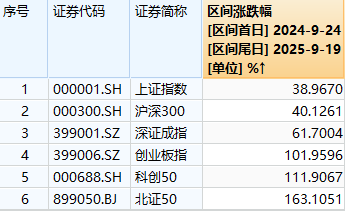
Market Performance - The A-share market has experienced a significant bull market since September 24, 2024, with major indices showing substantial increases, including a 39% rise in the Shanghai Composite Index and a 102% increase in the ChiNext Index as of September 19, 2025 [1][2] - The total market capitalization of A-shares reached approximately 104 trillion yuan, reflecting a growth of about 36 trillion yuan over the past year [4] Policy Impact - The bull market is characterized as a "policy bull" and a "confidence bull," driven by a series of financial policies announced by regulatory bodies aimed at promoting economic growth [1][2] - The Central Political Bureau meeting emphasized the need to boost the capital market and facilitate long-term capital inflows, supporting mergers and acquisitions of listed companies [2] Sector Performance - All 30 sectors in the CITIC classification have seen increases, with the top five sectors being Communication, Electronics, Computer, Media, and Machinery, which rose approximately 120%, 108%, 99%, 88%, and 76% respectively [6] - Conversely, the bottom five sectors, including Coal, Oil and Petrochemicals, and Utilities, showed modest gains ranging from 6% to 24% [6] Stock Performance - Over 3,000 stocks have risen by more than 50%, with 1,400 stocks increasing by over 100% since the bull market began [1][6] - Notably, over 400 stocks have surged by more than 200%, with the top three stocks experiencing increases exceeding 1000% [8] Future Outlook - Analysts suggest that the current bull market has further potential, despite recent adjustments due to external factors such as the Federal Reserve's interest rate changes [9][10] - The market is expected to undergo structural shifts in the fourth quarter, with potential opportunities in cyclical sectors and low-position technology branches [10]


A股“924”行情一周年:总市值增长36万亿元,逾1400只个股涨超100%,你翻倍了吗?
Hua Xia Shi Bao· 2025-09-22 00:16
Core Viewpoint - The A-share market has experienced a significant bull market since September 24, 2024, with major indices showing substantial increases, driven by policy support and improved investor confidence [2][3][8]. Market Performance - As of September 19, 2025, the Shanghai Composite Index has risen approximately 39%, the Shenzhen Component Index has increased by 61.7%, and the ChiNext Index has surged by about 102% since the "924" market [2][3][4]. - The total market capitalization of A-shares reached approximately 104 trillion yuan, an increase of about 36 trillion yuan over the past year [4][5]. Policy Impact - A series of financial policies announced by the central government aimed at supporting economic growth have been pivotal in boosting market confidence [2][3]. - The Central Political Bureau's meeting emphasized the need to enhance capital market support and facilitate the entry of long-term funds [3][8]. Sector Performance - All 30 sectors tracked by Citic have seen gains, with the top five sectors being Communication, Electronics, Computer, Media, and Machinery, which have risen approximately 120%, 108%, 99%, 88%, and 76% respectively [5][6]. - Conversely, sectors such as Coal, Oil & Gas, and Utilities have shown minimal growth, with increases ranging from 6% to 24% [5]. Individual Stock Performance - Over 5200 stocks have risen since the "924" market, with 3089 stocks increasing by more than 50% and 424 stocks rising over 200% [5][6]. - The top three performing stocks have seen increases exceeding 1000%, with the highest being 1710% [7]. Future Outlook - Analysts suggest that the current bull market has further potential, despite recent adjustments due to external factors like the Federal Reserve's interest rate changes [8][9]. - The market is expected to undergo structural shifts, with a potential focus on cyclical sectors and technology branches in the upcoming quarters [9].

国庆前后市场怎么走?十大券商最新研判
Ge Long Hui A P P· 2025-09-21 23:58
Market Overview - The market experienced fluctuations last week, with the Shanghai Composite Index falling by 1.30%, while sectors like power equipment, electronics, and communications continued to lead in gains, contrasting with the underperforming banking, non-banking, and food and beverage sectors [1] Broker Strategies - Guotai Junan Securities believes that the recent market adjustment presents an opportunity, asserting that the Chinese stock market will not stop here. They highlight the positive implications of the recent US-China talks and the potential for capital market reforms to accelerate, suggesting that the A/H share indices may reach new highs [2] - Guojin Securities indicates that a bull market is in the making, with a focus on cyclical opportunities in manufacturing and a shift from technology-driven growth to export-oriented growth as liquidity constraints ease [2] - Zheshang Securities anticipates continued consolidation in the Shanghai Composite Index, recommending a cautious approach and suggesting adjustments in sector allocations, particularly reducing exposure to technology and media while increasing positions in real estate and infrastructure [3] - Everbright Securities expects the A-share market to maintain a volatile pattern leading up to the National Day holiday, with a focus on structural balance amid potential profit-taking [4] - China Merchants Securities notes a historical pattern of financing trends around the National Day holiday, suggesting a potential rebound in market sentiment post-holiday, with a focus on sectors like solid-state batteries and AI [5] - Industrial Securities emphasizes a rotational investment strategy to navigate market volatility, advocating for a diversified approach across multiple sectors [6][7] - CITIC Securities highlights the clarity in market trading themes following the Fed's interest rate cut, with a focus on AI and domestic demand recovery as key drivers [8] - Huaxia Securities maintains a positive long-term outlook despite short-term fluctuations, emphasizing the importance of structural support from policies aimed at stabilizing the stock market [9] - Galaxy Securities recommends four main investment themes in the construction sector during the 14th Five-Year Plan period, focusing on urban renewal and digital transformation in construction [11]
国庆前后市场怎么走?日历效应如何?十大券商最新研判
Ge Long Hui· 2025-09-21 23:32
Market Overview - The market experienced fluctuations last week, with the Shanghai Composite Index falling by 1.30%, while sectors like power equipment, electronics, and communications continued to lead in gains, contrasting with stagnant performance in banking, non-banking, and food and beverage sectors [1] Broker Insights - Guotai Junan Securities believes that the recent market adjustment presents an opportunity, asserting that the Chinese stock market will not stagnate and is expected to reach new highs, driven by favorable conditions such as a stable short-term risk outlook and potential capital market reforms [1] - Guojin Securities indicates that a bull market may be in the making, with opportunities arising from the easing of liquidity constraints and a shift towards cyclical manufacturing sectors like non-ferrous metals, machinery, and chemicals [2] - Zheshang Securities suggests a period of consolidation for the Shanghai Composite Index, recommending a cautious approach to investment and a focus on sectors like hard technology and infrastructure [3] - Everbright Securities anticipates continued market fluctuations leading up to the National Day holiday, with a tendency for funds to secure profits amid uncertainties [4] - According to China Merchants Securities, historical patterns suggest that financing activities typically contract before the holiday and surge afterward, with a focus on sectors like solid-state batteries and AI [5] - Industrial rotation is emphasized by Industrial Securities, advocating for a diversified approach to investment to navigate market volatility [6][7] - CITIC Construction Investment highlights the clarity in future market trends following the Federal Reserve's interest rate cuts, with a focus on AI and domestic demand recovery [8] - Huaxia Securities maintains a positive long-term outlook despite short-term fluctuations, emphasizing the importance of sectors like AI and essential materials [9] - Galaxy Securities recommends four investment themes in the construction sector, focusing on urban renewal and digital transformation in construction [10]
美联储降息25个基点内外资机构看好中国资产前景
Shang Hai Zheng Quan Bao· 2025-09-21 15:28
Group 1 - The Federal Reserve has lowered the federal funds rate target range by 25 basis points to between 4.00% and 4.25%, which is expected to create a more favorable external environment for Chinese assets, enhancing their attractiveness [2] - Multiple institutions, including Invesco and Fidelity International, express optimism about investment opportunities in non-US markets, particularly in China, Japan, and Europe, following the Fed's rate cut [2] - Emerging market equities are viewed as having good investment value, with current valuations being only one-third of developed markets, supported by a weaker dollar and easing monetary policies in the Asia-Pacific region [2] Group 2 - The easing of external constraints is expected to enhance the People's Bank of China's operational flexibility in monetary policy tools, such as MLF/LPR and structural instruments [3] - As the US economy shows signs of weakening and the Fed's independence comes under scrutiny, a gradual shift to a rate-cutting cycle is anticipated, which may lead to a significant increase in foreign capital inflow into A-shares and Hong Kong stocks [4] - Key investment themes identified by Manulife include high-growth sectors like AI and robotics, sectors benefiting directly from liquidity easing, and industries with improving fundamentals due to policy changes, such as power equipment and chemicals [4]

最高100%!美国刚施压盟友对华加税,特朗普就收到2个坏消息,注定只能跟中国单挑?
Sou Hu Cai Jing· 2025-09-21 12:43
Group 1 - The core argument of the articles revolves around President Trump's proposal to impose a 100% tariff on China and India due to their continued oil purchases from Russia, which the U.S. views as support for Russia's war efforts, particularly against Ukraine [1][3][5] - The proposal has faced significant opposition from key allies, including Japan and the European Union, who prioritize their economic relationships with China and India over U.S. demands [3][5][7] - Japan's Finance Minister expressed that imposing tariffs solely based on oil purchases from Russia is unacceptable, highlighting Japan's economic dependence on trade with China and the potential negative impact on its own economy [3][5] Group 2 - The European Union has shown reluctance to support the U.S. tariff proposal, citing the importance of maintaining economic ties with China and India, particularly in sectors like automotive and electronics [5][7] - The unilateral pressure from the U.S. is seen as ineffective, as countries like Japan, the EU, and India are making decisions based on their own economic interests rather than following U.S. directives [7] - Future U.S.-China relations may hinge on the ability of both parties to engage in equal dialogue, with potential for cooperation in areas such as technology, agriculture, and energy, rather than escalating tensions through unilateral actions [8]

【太平洋研究院】9月第四周线上会议
远峰电子· 2025-09-21 11:47
Group 1 - The article discusses various upcoming webinars focusing on different sectors, including pharmaceuticals, home appliances, machinery, media, agriculture, and finance [31][33]. - Key topics include updates on raw material pharmaceuticals, in-depth reports on Green Source Group, recommendations for Ningbo Jingda, investment perspectives in the media industry, and analysis of pig production capacity regulation policies [31][32]. Group 2 - The webinars are scheduled for September 22 to September 25, with specific times and passwords provided for each session [31][33]. - Each session features industry analysts who will present insights and analyses relevant to their respective sectors [31][32].

A股热浪催生“股神”公司:主业边缘化 炒股成新赛道
Xi Niu Cai Jing· 2025-09-20 01:20
Group 1: Market Trends and Company Investments - The A-share market has attracted significant investment from listed companies, with at least 8 companies utilizing over 1 billion yuan for securities investments or fund purchases this year [2] - Notable investments include Liou Co. with a maximum investment of 3 billion yuan, Fangda Carbon and Seven Wolves with maximum investments of 2.4 billion yuan and 2 billion yuan respectively [2] - As of September 10, the Shanghai Composite Index, Shenzhen Component Index, and ChiNext Index have increased by 11.33%, 21.00%, and 36.71% respectively, prompting companies to invest idle funds into the securities market [2] Group 2: Company Performance Driven by Investments - Seven Wolves reported a net profit of 160 million yuan in the first half of 2025, with 130 million yuan derived from stock investments, despite only 30 million yuan from its main clothing business [3] - In 2024, Seven Wolves achieved revenue of 3.14 billion yuan, a decline of 8.84%, but reported a net profit of 285 million yuan, a year-on-year increase of 5.35%, largely due to 236 million yuan in securities investment income [3] - Liou Co. achieved a net profit of 478 million yuan in the first half of 2025, a year-on-year increase of 164.28%, primarily due to gains from investments in Li Auto [5] Group 3: Notable Investment Strategies - Jin Feng Investment Holdings, a subsidiary of Jin Feng Technology, has been actively reducing its holdings in the rapidly rising stock of Shangwei New Materials, having sold 1.6328 million shares in the past two months [6] - Jin Feng Investment reported an investment income of 1.962 billion yuan for the entire year, surpassing Jin Feng Technology's net profit of 1.86 billion yuan [7] - Jilin Aodong's net profit for the first half of 2025 reached 1.282 billion yuan, exceeding its revenue of 1.126 billion yuan, indicating a strong reliance on financial asset investments [9][11] Group 4: Investment Motivations and Strategies - Companies often emphasize that the funds used for securities investments are "idle funds," reflecting a strategic choice during periods of business stagnation [24] - Investment motivations can be categorized into cash management and industrial synergy, with companies like Jiangsu Guotai reallocating funds initially intended for overseas expansion to financial products [24][25] - Ningde Times exemplifies an industrial synergy approach, holding 39.4 billion yuan in lithium battery companies to strengthen supply chain control and enhance competitive power [25]

热点追踪周报:由创新高个股看市场投资热点(第 212 期)-20250919
Guoxin Securities· 2025-09-19 12:47
Quantitative Models and Construction Methods 1. Model Name: 250-Day New High Distance - **Model Construction Idea**: This model tracks the distance of a stock's closing price from its 250-day high to identify momentum and trend-following opportunities in the market. It is inspired by studies showing that stocks near their 52-week highs tend to outperform[11][18]. - **Model Construction Process**: The formula for the 250-day new high distance is: $ 250\ Day\ New\ High\ Distance = 1 - \frac{Close_t}{ts\_max(Close, 250)} $ Where: - $Close_t$ represents the latest closing price - $ts\_max(Close, 250)$ represents the maximum closing price over the past 250 trading days If the latest closing price reaches a new high, the distance is 0. If the price has fallen from the high, the distance is a positive value indicating the percentage drop[11]. - **Model Evaluation**: This model effectively captures market momentum and highlights stocks or indices that are leading the market trends[11][18]. 2. Model Name: Stable New High Stock Screening - **Model Construction Idea**: This model identifies stocks with stable price paths and consistent momentum, as smoother price trajectories are associated with stronger momentum effects[27]. - **Model Construction Process**: The screening process involves the following steps: - **Analyst Attention**: Stocks must have at least 5 "Buy" or "Overweight" ratings in the past 3 months - **Relative Strength**: Stocks must rank in the top 20% of the market based on 250-day price performance - **Price Stability**: Stocks are scored based on two metrics: - **Price Path Smoothness**: Measured by the ratio of price displacement to the total price path length - **Momentum Consistency**: Calculated as the time-series average of the 250-day new high distance over the past 120 days - **Trend Continuation**: Stocks are ranked based on the 5-day average of the 250-day new high distance, and the top 50 stocks are selected[27][29]. - **Model Evaluation**: This model emphasizes the importance of smooth and consistent price movements, which are less likely to attract excessive attention and thus generate stronger momentum effects[27][29]. --- Model Backtesting Results 1. 250-Day New High Distance - **Indices' 250-Day New High Distance**: - Shanghai Composite: 1.63% - Shenzhen Component: 1.09% - CSI 300: 1.08% - CSI 500: 1.24% - CSI 1000: 1.54% - CSI 2000: 1.91% - ChiNext Index: 1.79% - STAR 50 Index: 1.28%[2][12][34] 2. Stable New High Stock Screening - **Selected Stocks**: 50 stocks were identified, including Industrial Fulian, Giant Network, and Shengyi Electronics. - **Sector Distribution**: - Technology: 18 stocks (e.g., Electronics) - Manufacturing: 15 stocks (e.g., Machinery)[3][30][35] --- Quantitative Factors and Construction Methods 1. Factor Name: 250-Day New High Distance - **Factor Construction Idea**: Measures the relative position of a stock's closing price to its 250-day high, capturing momentum and trend-following signals[11]. - **Factor Construction Process**: $ 250\ Day\ New\ High\ Distance = 1 - \frac{Close_t}{ts\_max(Close, 250)} $ - $Close_t$: Latest closing price - $ts\_max(Close, 250)$: Maximum closing price over the past 250 trading days[11]. 2. Factor Name: Price Path Smoothness - **Factor Construction Idea**: Quantifies the smoothness of a stock's price trajectory, as smoother paths are associated with stronger momentum effects[27]. - **Factor Construction Process**: - **Price Path Smoothness**: Ratio of price displacement to total price path length over a given period[27]. 3. Factor Name: Momentum Consistency - **Factor Construction Idea**: Measures the stability of a stock's momentum over time, emphasizing consistent performance[27]. - **Factor Construction Process**: - **Momentum Consistency**: Time-series average of the 250-day new high distance over the past 120 days[27]. 4. Factor Name: Trend Continuation - **Factor Construction Idea**: Captures short-term momentum by analyzing recent price movements[27]. - **Factor Construction Process**: - **Trend Continuation**: 5-day average of the 250-day new high distance, with stocks ranked based on this metric[27]. --- Factor Backtesting Results 1. 250-Day New High Distance - **Indices' 250-Day New High Distance**: - Shanghai Composite: 1.63% - Shenzhen Component: 1.09% - CSI 300: 1.08% - CSI 500: 1.24% - CSI 1000: 1.54% - CSI 2000: 1.91% - ChiNext Index: 1.79% - STAR 50 Index: 1.28%[2][12][34] 2. Stable New High Stock Screening Factors - **Selected Stocks**: 50 stocks were identified, including Industrial Fulian, Giant Network, and Shengyi Electronics. - **Sector Distribution**: - Technology: 18 stocks (e.g., Electronics) - Manufacturing: 15 stocks (e.g., Machinery)[3][30][35]



热点追踪周报:由创新高个股看市场投资热点(第212期)-20250919
Guoxin Securities· 2025-09-19 11:24
Quantitative Models and Construction Methods 1. Model Name: 250-Day New High Distance Model - **Model Construction Idea**: This model tracks the distance of the latest closing price from the highest closing price over the past 250 trading days. It is used to identify stocks or indices that are approaching or have surpassed their historical highs, which can serve as indicators of market trends and hotspots[11][18]. - **Model Construction Process**: The formula for the 250-day new high distance is: $ 250\ Day\ New\ High\ Distance = 1 - \frac{Close_t}{ts\_max(Close, 250)} $ Where: - $ Close_t $ represents the latest closing price - $ ts\_max(Close, 250) $ represents the maximum closing price over the past 250 trading days If the latest closing price reaches a new high, the distance is 0. If the price has fallen from the high, the distance is a positive value indicating the percentage drop[11]. - **Model Evaluation**: The model is effective in identifying stocks or indices with strong momentum and can be used to monitor market trends and leading sectors[11][18]. 2. Model Name: Stable New High Stock Screening Model - **Model Construction Idea**: This model focuses on identifying stocks that not only achieve new highs but also exhibit stable price paths and consistent momentum. It incorporates factors such as analyst attention, relative strength, and price stability to refine the selection of high-momentum stocks[27][29]. - **Model Construction Process**: The screening criteria include: - **Analyst Attention**: At least 5 buy or overweight ratings in the past 3 months - **Relative Strength**: 250-day price change in the top 20% of the market - **Price Stability**: Stocks are ranked based on the following metrics: - **Price Path Smoothness**: Ratio of price displacement to the total price path - **New High Continuity**: Average 250-day new high distance over the past 120 days - **Trend Continuity**: Average 250-day new high distance over the past 5 days The top 50 stocks based on these criteria are selected as stable new high stocks[27][29]. - **Model Evaluation**: The model emphasizes the temporal characteristics of momentum and identifies stocks with smoother price paths, which are less likely to experience extreme volatility[27][29]. --- Model Backtesting Results 1. 250-Day New High Distance Model - **Indices' 250-Day New High Distance**: - Shanghai Composite: 1.63% - Shenzhen Component: 1.09% - CSI 300: 1.08% - CSI 500: 1.24% - CSI 1000: 1.54% - CSI 2000: 1.91% - ChiNext Index: 1.79% - STAR 50 Index: 1.28%[12][13][34] 2. Stable New High Stock Screening Model - **Selected Stocks**: 50 stocks were identified, including Industrial Fulian, Giant Network, and Shengyi Electronics. - **Sector Distribution**: - Technology: 18 stocks (e.g., Electronics) - Manufacturing: 15 stocks (e.g., Machinery)[30][35] --- Quantitative Factors and Construction Methods 1. Factor Name: 250-Day New High Distance - **Factor Construction Idea**: Measures the relative position of the latest closing price to the highest price in the past 250 trading days, indicating momentum strength[11]. - **Factor Construction Process**: The formula is: $ 250\ Day\ New\ High\ Distance = 1 - \frac{Close_t}{ts\_max(Close, 250)} $ Where: - $ Close_t $ is the latest closing price - $ ts\_max(Close, 250) $ is the maximum closing price over the past 250 trading days[11]. - **Factor Evaluation**: This factor effectively captures momentum and is widely used in trend-following strategies[11][18]. 2. Factor Name: Price Path Smoothness - **Factor Construction Idea**: Evaluates the stability of a stock's price movement by comparing the displacement of the price path to its total length[27]. - **Factor Construction Process**: $ Price\ Path\ Smoothness = \frac{Price\ Displacement}{Total\ Price\ Path} $ Where: - Price Displacement is the straight-line distance between the starting and ending prices - Total Price Path is the cumulative sum of absolute daily price changes over a given period[27]. - **Factor Evaluation**: Stocks with smoother price paths tend to exhibit stronger and more sustainable momentum[27]. 3. Factor Name: New High Continuity - **Factor Construction Idea**: Measures the consistency of a stock's ability to maintain new highs over time[29]. - **Factor Construction Process**: $ New\ High\ Continuity = Average\ (250\ Day\ New\ High\ Distance\ Over\ Past\ 120\ Days) $ This factor calculates the mean of the 250-day new high distance over a rolling 120-day window[29]. - **Factor Evaluation**: This factor highlights stocks with persistent upward trends, making them attractive for momentum-based strategies[29]. --- Factor Backtesting Results 1. 250-Day New High Distance - **Indices' 250-Day New High Distance**: - Shanghai Composite: 1.63% - Shenzhen Component: 1.09% - CSI 300: 1.08% - CSI 500: 1.24% - CSI 1000: 1.54% - CSI 2000: 1.91% - ChiNext Index: 1.79% - STAR 50 Index: 1.28%[12][13][34] 2. Price Path Smoothness and New High Continuity - **Selected Stocks**: 50 stocks were identified, including Industrial Fulian, Giant Network, and Shengyi Electronics. - **Sector Distribution**: - Technology: 18 stocks (e.g., Electronics) - Manufacturing: 15 stocks (e.g., Machinery)[30][35]
