
电子

Search documents
资金跟踪系列之三十:机构ETF继续明显净赎回,两融转向净流出
SINOLINK SECURITIES· 2026-01-26 15:04
Macro Liquidity - The US dollar index has declined, and the degree of the China-US interest rate "inversion" has deepened. The nominal and real yields of 10Y US Treasuries remained unchanged and rebounded, respectively, with inflation expectations slightly decreasing [1][15] - Offshore US dollar liquidity is generally loose, while the domestic interbank funding situation is balanced but tight. The term spread (10Y-1Y) has narrowed [1][15] Market Trading Activity - Market trading activity has significantly decreased, with the volatility of the Shanghai Composite 50 and CSI 500 indices rising. Sectors such as military, electric new energy, consumer services, chemicals, and home appliances have trading heat levels above the 90th percentile [2][25] - The volatility of the Shanghai Composite 50 and CSI 500 indices has increased, while the volatility of various sectors remains below the 80th historical percentile [2][31] - Market liquidity indicators have declined, with liquidity metrics for various sectors remaining below the 60th historical percentile [2][35] Institutional Research - The research heat for sectors such as electronics, electric new energy, automotive, computers, and machinery is high, while only the banking sector has seen a sequential increase in research heat [3][42] Analyst Forecasts - Analysts have raised net profit forecasts for the entire A-share market for 2026/2027. The proportion of stocks with upward revisions in net profit forecasts has continued to rise [4][50] - Specific sectors such as agriculture, non-ferrous metals, consumer services, computers, and electronics have seen upward adjustments in their 2026/2027 net profit forecasts [4][50] - The net profit forecasts for the ChiNext Index, CSI 500, and Shanghai Composite 50 for 2026/2027 have been increased, while the forecasts for the CSI 300 have been adjusted downwards/upwards [4][51] Northbound Trading Activity - Northbound trading activity has decreased, but there continues to be a net purchase of A-shares. The ratio of total buying and selling in sectors like electronics, automotive, and home appliances has increased [5][31] - For stocks with northbound holdings of less than 30 million shares, the main net purchases have been in electronics, electric new energy, and chemicals, while net sales have occurred in computers, media, and military sectors [5][33] Margin Financing Activity - The activity of margin financing has continued to decline, reaching its lowest level since late July 2025. The net selling last week was 8.265 billion yuan, with significant net purchases in non-ferrous metals, finance, and food and beverage sectors [6][35] - The proportion of financing purchases across various sectors has decreased [6][38] - Margin financing continues to net buy large-cap growth/value sectors [6][39] Dragon and Tiger List Trading Activity - The trading activity on the Dragon and Tiger list has continued to rise, although the total trading amount on the list as a percentage of total A-share trading has decreased [7][41] Active Equity Fund Positions - The positions of actively managed equity funds have continued to decline, while ETFs have seen significant net redemptions. Active equity funds have mainly increased positions in light industry, banking, and pharmaceuticals, while reducing positions in electric new energy, communications, and chemicals [8][45] - The correlation of active equity funds with large/mid-cap growth/value has increased, while the correlation with small-cap growth/value has decreased [8][48] - The scale of newly established equity funds has continued to rise, with active and passive funds seeing respective increases and slight decreases [8][50]
数说公募纯债与混合资产策略基金2025年四季报:固收+规模再创新高,含权敞口小幅下降
SINOLINK SECURITIES· 2026-01-26 15:04
Report Title - "Counting the Public Offering Pure Bond and Hybrid Asset Strategy Funds' 2025 Q4 Reports - The Scale of 'Fixed Income +' Reaches a New High, and the Exposure to Equity Slightly Declines" [1] Report Date - January 26, 2026 [2] Market Overview General Fixed - Income Fund Scale in 2025 Q4 - Among the top 20 fund companies in terms of general fixed - income fund scale, the scale of some companies increased while others decreased. For example, the scale of China Merchants Fund increased by 9.88% to 3512.27 billion yuan, while the scale of E Fund decreased by 4.71% to 3627.05 billion yuan [8]. Hybrid Asset Strategy Fund Scale in 2025 Q4 - In the hybrid asset strategy fund scale ranking, the scale changes also varied. For instance, the scale of Invesco Great Wall Fund increased by 32.11% to 2263.68 billion yuan, while the scale of Fullgoal Fund decreased by 5.85% to 1281.73 billion yuan [8]. Performance Return - Different types of funds had different average returns in 2025 Q4, year - to - date, and in the past 1 - year, 3 - year, and 5 - year annualized periods. For example, the average return of convertible bond funds in 2025 Q4 was 0.84%, and the year - to - date return was 23.10% [15]. Maximum Drawdown - The average maximum drawdowns of various fund types also differed. For example, the average maximum drawdown of convertible bond funds in 2025 Q4 was - 5.26%, and the year - to - date maximum drawdown was - 8.90% [15]. Annualized Sharpe Ratio - The annualized Sharpe ratios of different fund types were distinct. For example, the annualized Sharpe ratio of short - term pure bond funds in 2025 Q4 was 4.28 [15]. Asset Allocation Leverage Ratio - In 2025 Q4, different types of funds had different leverage ratios and their changes compared to Q3. For example, the leverage ratio of short - term pure bond funds was 111.89% in Q4, an increase of 0.40% compared to Q3 [40]. Holding Characteristics Stock Holdings - From 2025 Q1 to Q4, the industry and stock holding ratios of funds changed. For example, the proportion of non - ferrous metals in the stock market value increased from 11.27% in Q1 to 14.65% in Q4 [54][57]. Bond Holdings - The industry and bond holding ratios of funds also changed over the four quarters of 2025. For example, the proportion of bank bonds in the bond market value decreased from 20.75% in Q1 to 14.45% in Q4 [67][68]. Fund Managers' Views Pure Bond Market Views - Different fund managers had different views on the pure bond market in 2026 Q1. For example, Huang Yingjie of Bank of Communications Yulong Pure Bond A believed that the bond market might be in a range - bound market with a steeper curve [74]. Bond and Stock Market Views - Some fund managers had comprehensive views on the bond and stock markets. For example, Deng Xinyu and Zhao Yucheng of China Europe Dingli A were optimistic about the stock market's structural opportunities and adjusted their convertible bond positions [75]. Convertible Bond and Stock Market Views - Fund managers also had different views on the convertible bond and stock markets. For example, Huang Bo of Everbright Tianyi A planned to select high - cost - effective convertible bonds for the fund's fixed - income part [79].
A股晚间热点 | 上期所连续出手降温 涉及白银、锡、铜等期货
智通财经网· 2026-01-26 14:17
Group 1 - The Ministry of Commerce will optimize the implementation of the old-for-new consumption policy to promote the consumption of durable goods such as automobiles and home appliances in 2026 [1] - The Ministry will focus on expanding market access in the service sector and will promote pilot projects in telecommunications, healthcare, and education [1] Group 2 - The Shanghai Futures Exchange has implemented measures to cool down the market by adjusting trading limits and margin requirements for silver, tin, and copper futures [2] - The exchange aims to maintain trading order and combat violations in response to strong market sentiment in precious and non-ferrous metals [2] Group 3 - In January 2026, a total of 177 domestic online games were approved, including titles from Beiwai Technology and Sanqi Interactive Entertainment [3] Group 4 - The People's Bank of China emphasized the need to innovate and enrich policy tools to maintain the stability of financial markets and the overall financial system [4] - The central bank will enhance policies for cross-border use of the RMB and promote trade facilitation [4] Group 5 - Guoxing Aerospace revealed its "Star Computing" plan, which includes a network of 2,400 inference satellites and 400 training satellites aimed at achieving significant computational power [5] - The plan targets a total of 100,000 P-level inference computing power and 1,000,000 P-level training computing power [5] Group 6 - A mysterious fund has placed significant sell orders on multiple stocks, including Zijin Mining and China Ping An, indicating ongoing market pressure [6][7] - The sell orders have been noted as the third instance of such activity within 20 days, suggesting a trend of market manipulation [7] Group 7 - Major ETFs in the A-share market have seen a significant reduction in shares, with the average decrease for large-scale ETFs reaching 27.24% over seven trading days [8] - The CSI 1000 ETFs have experienced even more drastic declines, with some funds losing over 50% of their shares [8] Group 8 - The Hong Kong Monetary Authority announced an increase in the total quota for RMB business funding arrangements from 100 billion to 200 billion RMB, effective February 2 [10] Group 9 - The C919 aircraft production is accelerating, with a target of delivering at least 28 aircraft in 2026, potentially achieving a production rate of one aircraft every 10 to 15 days [12] - The domestic commercial aircraft production and the self-sufficiency of aviation engines are expected to drive growth in the aerospace sector [12] Group 10 - Longyuan Donggu has received a notification for a project with a total sales amount expected to be between 2.2 billion and 3 billion RMB [18] - Several companies, including Jinfei Kaida and Shankai Intelligent, have secured significant project notifications, indicating positive business developments [18]


2025年外贸增速前十省份:中西部占9席
第一财经· 2026-01-26 14:14
Core Viewpoint - In 2025, the central and western provinces of China experienced significant growth in foreign trade, driven by products such as "new three samples" (electric vehicles, lithium batteries, and photovoltaic products), with nine out of the top ten provinces in export growth being from these regions [3][4]. Group 1: Trade Growth Data - Chongqing's foreign trade reached 800.68 billion yuan in 2025, a year-on-year increase of 12%, ranking 8th nationally, exceeding the national average by 8.2 percentage points [3][5]. - The top ten provinces in foreign trade growth in 2025 were Xinjiang (19.9%), Shaanxi (18.5%), Hubei (18.2%), Qinghai (17.6%), Anhui (17.3%), Gansu (16.2%), Henan (14.1%), Chongqing (12%), Hebei (11%), and Yunnan (10.2%) [3][4]. - Hubei's foreign trade exceeded 800 billion yuan, reaching 834.01 billion yuan, with an 18.2% growth rate, ranking 12th nationally [8]. Group 2: Factors Driving Growth - The growth in Chongqing's foreign trade was attributed to a 11.6% increase in high-tech product exports, contributing 7.4 percentage points to overall trade growth [10]. - The "new three samples" saw an export growth rate of 73.5%, with integrated circuits, computer accessories, and auto parts also showing significant increases [10][11]. - In Anhui, the export of automobiles reached 1.228 million units, a 28.7% increase, making it the first province to export over one million vehicles in a year [11]. Group 3: Regional Economic Dynamics - The central and western regions are enhancing their economic openness, with the rapid growth of "new three samples" products contributing to this trend [12]. - The export of lithium-ion batteries from Qinghai surged by 3.8 times, becoming the province's top export product [12]. - The eastern coastal provinces, while still dominant in foreign trade, are seeing increased competition from the central and western regions, which are improving their positions in the national trade landscape [12].
科技主题观点综述:全球算力多点突破,AI驱动端侧应用渗透(更正)-20260126
Shanghai Securities· 2026-01-26 13:03
Investment Rating - The report maintains an "Overweight" rating for the electronics industry [1] Core Insights - The "hard technology" sector is expected to perform well under the influence of AI, with domestic computing chips, AI-PCB, AIDC supporting facilities, and AI edge SoC chip design/testing showing rapid growth in 2024 and maintaining high growth in Q1-Q3 of 2025. This sector is projected to benefit from continued growth in domestic computing capital investment and increasing penetration of edge applications, becoming one of the fastest-growing areas in the electronics and technology industries [4] - The valuation system of the technology industry is likely to be restructured due to the ongoing competition between major powers, particularly in the semiconductor manufacturing and equipment sectors, where the domestic production ratio is currently low. Companies such as Cambricon, SMIC, North Huachuang, Haiguang Information, and Zhongwei Company are recommended for attention [4] - Computing power remains the most important theme for the year, with a focus on AI-PCB (semiconductors) and AI optical modules. Companies like Shenghong Technology, Huitian Technology, and others are highlighted for their potential [4] - Some consumer electronics stocks, particularly those in the "Apple supply chain," have become more cost-effective due to macroeconomic impacts on stock prices. Leading companies in the fruit chain and ODM sectors are expected to leverage demand in AIoT, humanoid robots, and automotive electronics to achieve performance and valuation improvements in the second half of the year [4] Summary by Sections AI and Computing Power - The demand for AI computing technology is increasing, leading to significant breakthroughs for PCB manufacturers in the AI server field. The overall market for AI chips is expected to grow, with China being a major consumer market [18][22] - The AI-driven demand for computing power is pushing the development of various applications, including automotive electronics and IoT, which are expected to drive growth in the chip industry [18] Semiconductor and Equipment - The semiconductor manufacturing sector is projected to see substantial growth, with companies like SMIC and North Huachuang showing promising revenue and profit growth rates [17] - The PCB equipment market is expected to grow significantly, with a projected market size of 290.25 billion yuan in 2024, increasing to 347.09 billion yuan by 2026 [27] Consumer Electronics - The CIS market is experiencing a recovery, driven by demand from smartphones, security, and automotive applications. Domestic manufacturers are increasing their market presence with high-end products [46] - The SoC market is expected to grow, with AI technology becoming a crucial component for various applications, including smart home devices and automotive electronics [44]





科技板块震荡盘整,持续关注科创50ETF易方达(588080)、科创200ETF易方达(588270)等产品布局机会
Mei Ri Jing Ji Xin Wen· 2026-01-26 13:01
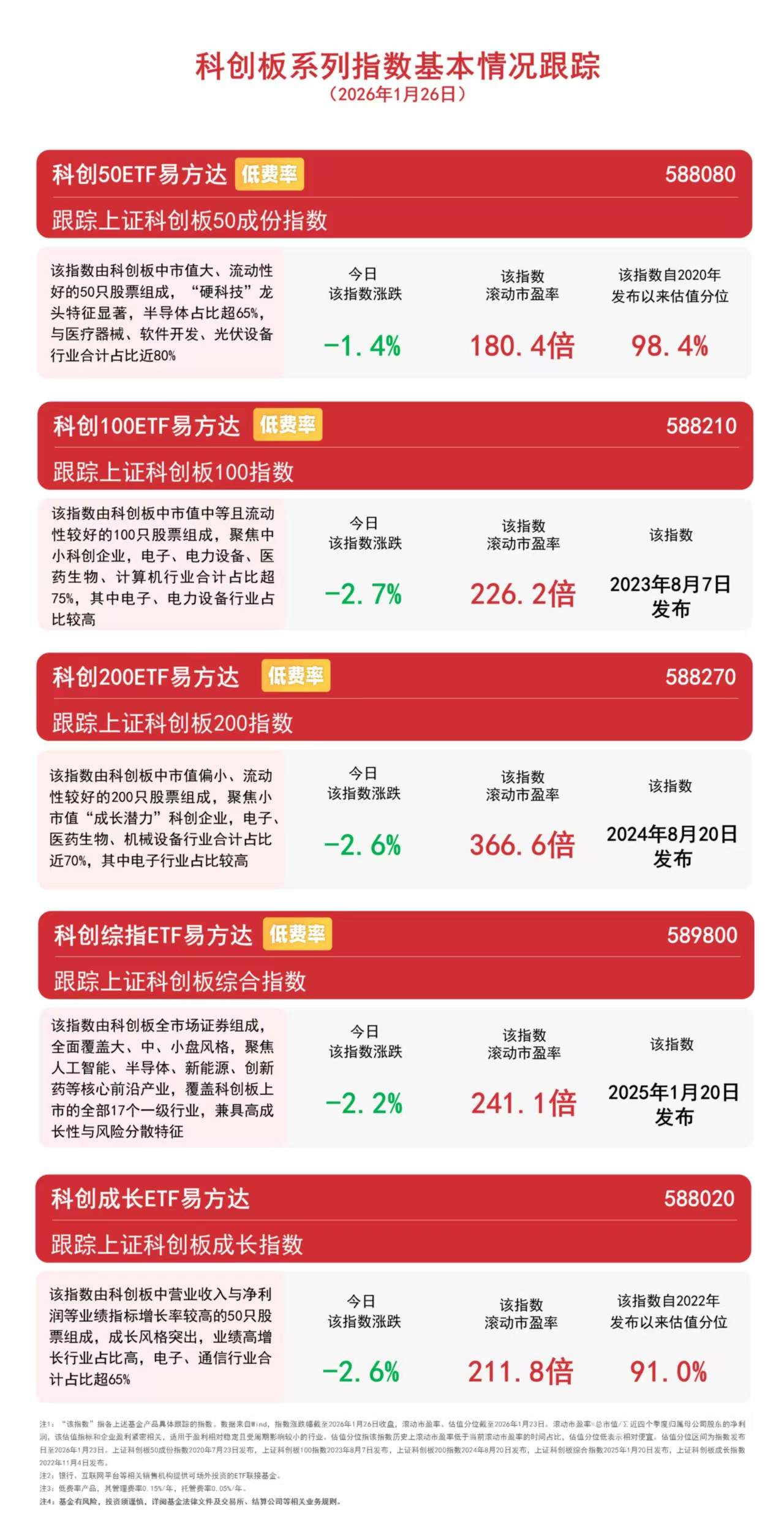
截至收盘,科创50指数下跌1.4%,科创综指下跌2.2%,科创200指数、科创成长指数均下跌2.6%,科创100指数下跌2.7%。 资金近日回流相关产品, Wind数据显示,科创50ETF易方达(588080)连续两个交易日"吸金",合计约3亿元。 科创板系列指数基本情况跟踪 (2026年1月26日) 科创50ETF易方达 低费率 科创100ETF易方达 作要主要 跟踪上证科创板100指数 该指数由科创板中市值中等且流动 性较好的100只股票组成,聚焦中 小科创企业,电子、电力设备、医 药生物、计算机行业合计占比超 75%,其中电子、电力设备行业占 比较高 令日 该指数涨跌 226. 2倍 -2. 7% 该指数 滚动市盈率 跟踪上证科创板50成份指数 | 该指数由科创板中市值大、流动性 | 令日 | 该指数 | 该指数自 | | --- | --- | --- | --- | | 好的50只股票组成, "硬科技"龙 | 该指数涨跌 | 滚动市盈率 | 发布以来 | | 头特征显著,半导体占比超65%, | | | | | 与医疗器械、软件开发、光伏设备 | -1.4% | 180. 4倍 | 98. | | ...
公募基金2025四季报调仓图谱:科技制造主线强化 传统蓝筹获回流布局 新能源内部分化(附加减仓TOP50榜单)
Xin Lang Cai Jing· 2026-01-26 12:17
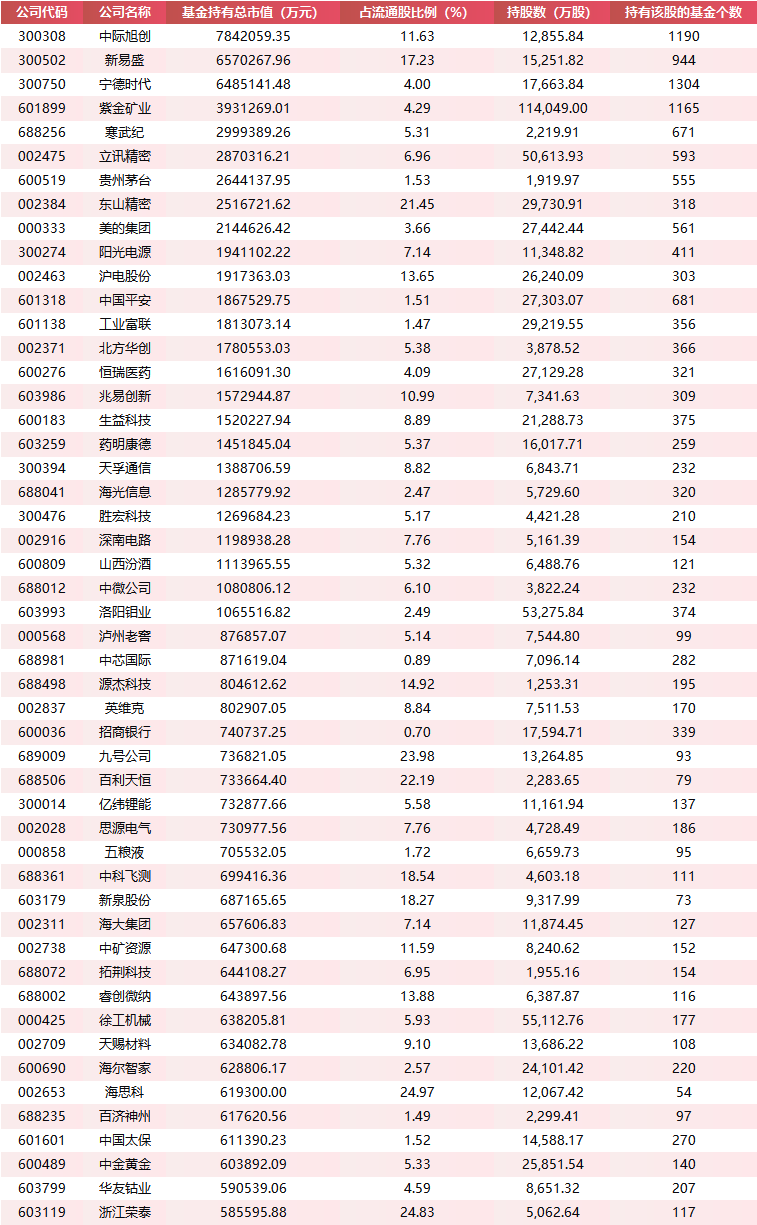
Core Insights - Public funds continue to focus on technology growth and high-end manufacturing, while also reallocating to consumer and financial leaders with returning valuations [1][14] - The structure of holdings indicates a significant increase in positions in AI computing, semiconductor equipment, and resource sectors, while reducing exposure to batteries, consumer electronics, and pharmaceuticals [14] Group 1: Fund Holdings Overview - As of Q4 2025, public fund holdings data shows that technology growth and high-end manufacturing remain core investment directions, with traditional industry leaders and some cyclical stocks also maintaining high allocation levels [1] - The top 50 heavy stocks include major players in technology sectors such as communication, AI, and electronics, reflecting institutional confidence in technological innovation and industrial upgrades [2][3] - Notable stocks like Ningde Times, Zhongji Xuchuang, and Zijin Mining are held by over a thousand funds, indicating strong consensus among institutions on these targets [4] Group 2: Increases in Holdings - The increase in holdings is prominently seen in technology stocks, with Zhongji Xuchuang receiving over 22.6 billion yuan in fund increases, ranking first, followed by Xinyi Sheng with approximately 9.6 billion yuan [5][6] - Traditional sectors also saw significant increases, with China Ping An gaining over 10.5 billion yuan, and other blue-chip stocks like Midea Group and Haier Smart Home returning to substantial increase lists [5] - Resource stocks such as Zijin Mining and Luoyang Molybdenum also experienced collective increases, reflecting high enthusiasm for non-ferrous and energy metal sectors amid global manufacturing recovery expectations [5] Group 3: Decreases in Holdings - Certain stocks in the consumer electronics and OEM sectors, including Industrial Fulian and Lixun Precision, faced collective reductions, indicating a cautious stance on their growth prospects [8] - The internal structure of the new energy vehicle supply chain showed differentiation, with battery leaders like Ningde Times and Yiwei Lithium Energy being reduced [8] - Pharmaceutical stocks like Heng Rui Medicine and WuXi AppTec also saw significant reductions due to industry policy uncertainties and valuation pressures [8] Group 4: New Entrants in Holdings - A number of new stocks have entered the fund's heavy holdings, characterized by small to mid-cap sizes and high growth expectations, covering advanced manufacturing and industrial upgrade sectors [11][12] - Notable new entrants include Chaojie Co. and Guocheng Mining, which have garnered attention from multiple funds, indicating potential focus areas for institutional investment [11][12]





【26日资金路线图】两市主力资金净流出超750亿元 石油石化等行业实现净流入
证券时报· 2026-01-26 11:36
截至收盘,上证指数收报4132.61点,下跌0.09%;深证成指收报14316.64点,下跌0.85%;创业板指收报3319.15点,下跌0.91%。两 市合计成交32482.03亿元,较上一交易日增加1629.79亿元。 沪深300今日主力资金净流出95.23亿元,创业板净流出281.49亿元。 | | | 各板块最近五个交易日主力资金净流入数据(亿元) | | | --- | --- | --- | --- | | 日期 | 沪深300 | 创业板 | 科创板 | | 2026-1-26 | -95. 23 | -281. 49 | 14. 49 | | 2026-1-23 | -10. 05 | 15. 15 | -31.71 | | 2026-1-22 | 17.99 | -4. 70 | -3. 20 | | 2026-1-21 | 154. 35 | -61. 61 | -17.06 | | 2026-1-20 | -199.71 | -388. 98 | 1.17 | | | | 尾盘资金净流入数据(亿元) | | | 2026-1-26 | 15. 52 | -6. 76 | 4. 12 | ...

主力资金 | 10股尾盘遭资金大幅出逃!
Zheng Quan Shi Bao Wang· 2026-01-26 11:24
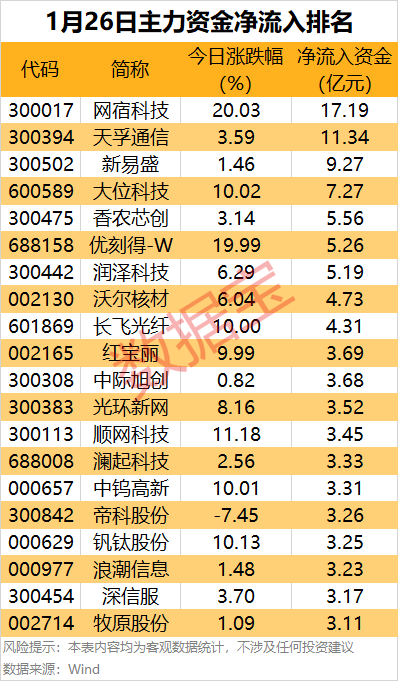
Group 1: Market Overview - On January 26, the main funds in the Shanghai and Shenzhen markets experienced a net outflow of 757.1 billion yuan, with the ChiNext index seeing a net outflow of 281.49 billion yuan and the CSI 300 index a net outflow of 95.23 billion yuan [1] - Among the 10 primary industry sectors, the non-ferrous metals sector had the highest increase at 4.57%, followed by the petroleum and petrochemical sector at 3.18% and the coal sector at 2.07% [1] - In contrast, the defense and military industry saw the largest decline at 4.47%, with the automotive, social services, electronics, real estate, and computer sectors also experiencing declines exceeding 2% [1] Group 2: Fund Inflows and Outflows by Industry - Six industries saw net inflows of main funds, with the pharmaceutical and biotechnology sector leading at 3.29 billion yuan, followed by the communication sector at 2.519 billion yuan, and both the non-bank financial and banking sectors exceeding 1.4 billion yuan [1] - Conversely, 25 industries experienced net outflows, with the electronics, power equipment, and defense industries each seeing outflows exceeding 11 billion yuan [1] Group 3: Individual Stock Performance - Two stocks, Wangsu Science & Technology and Tianfu Communication, had significant net inflows exceeding 1.1 billion yuan, with Wangsu Science & Technology seeing a net inflow of 1.719 billion yuan and a price increase of 20.03% [2][3] - A total of 120 stocks had net inflows exceeding 100 million yuan, with 23 stocks exceeding 300 million yuan [2] - On the other hand, over 270 stocks had net outflows exceeding 1 billion yuan, with the leading outflow from Xunwei Communication at 1.946 billion yuan, followed by Goldwind Technology at 1.864 billion yuan [4][5] Group 4: End-of-Day Fund Flows - At the end of the trading day, the main funds saw a net outflow of 15.61 billion yuan, with the ChiNext index experiencing a net outflow of 6.76 billion yuan [6] - Four stocks had net inflows exceeding 1 billion yuan at the end of the day, with Hikvision leading at 1.471 billion yuan and a price increase of 1.13% [6][7] - Conversely, 25 stocks had net outflows exceeding 700 million yuan, with CATL, Weichai Power, and Tongfu Microelectronics each seeing outflows exceeding 2 billion yuan [8][9]




【26日资金路线图】两市主力资金净流出超750亿元 石油石化等行业实现净流入
Zheng Quan Shi Bao· 2026-01-26 11:08
1月26日,A股市场整体下跌。 2.创业板主力资金净流出超280亿元 沪深300今日主力资金净流出95.23亿元,创业板净流出281.49亿元。 | | | 各板块最近五个交易目主力资金净流入数据(亿元) | | | --- | --- | --- | --- | | 日期 | 沪深300 | 创业板 | 科创板 | | 2026-1-26 | -95. 23 | -281. 49 | 14. 49 | | 2026-1-23 | -10. 05 | 15. 15 | -31. 71 | | 2026-1-22 | 17.99 | -4. 70 | -3. 20 | | 2026-1-21 | 154. 35 | -61. 61 | -17.06 | | 2026-1-20 | -199.71 | -388. 98 | 1.17 | | | | 尾盘资金净流入数据(亿元) | | | 2026-1-26 | 15. 52 | -6. 76 | 4. 12 | | 2026-1-23 | 30. 66 | 12. 61 | 1.87 | | 2026-1-22 | 27. 26 | 3. 30 | 0. 84 ...
