
证券业

Search documents
逼近业内预测年内高值,宽幅震荡下,9月债市现券收益率创今年次高
Zheng Quan Shi Bao· 2025-10-14 12:07
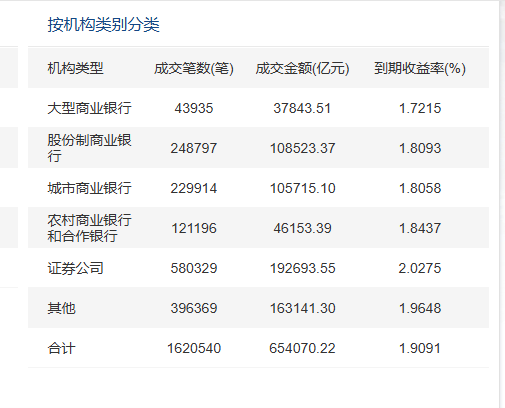
Core Viewpoint - The bond market is experiencing intensified fluctuations in Q4, contrasting with last year's bullish trend, leading to challenges in trading strategies [1][4]. Market Performance - As of September, the yield on bonds from various banks has risen above 1.8%, with specific yields recorded at 1.8093% for joint-stock banks, 1.8058% for city commercial banks, and 1.8437% for rural commercial banks, marking a significant increase from the previous month [1][2]. - The trading volume of bonds in September reached 146,366.88 billion yuan, with the overall yield averaging 1.9091% across different bank types [2][3]. Yield Trends - The ten-year government bond yield has been fluctuating, reaching 1.8591% by October 14, with predictions suggesting a range between 1.5% and 1.9% for the remainder of the year [2][4]. - The yields recorded in September are the second highest of the year, following March's figures, indicating a potential peak in bond yields [2][5]. Influencing Factors - Several factors are contributing to the bond market's volatility, including the stock-bond relationship, regulatory attitudes, and adjustments in value-added tax policies [2][4]. - The market sentiment has shifted towards a more balanced trading environment, with increased interest in long-term bonds as yields rise [4][5]. Strategic Adjustments - Banks are advised to enhance their trading capabilities while incorporating derivatives for hedging and adjusting their asset allocations to maintain a reasonable bond investment ratio [6]. - Investment strategies are focusing on identifying market trends and adjusting positions to optimize returns, with an emphasis on flexible trading strategies in a volatile environment [6].

每日投行/机构观点梳理(2025-10-14)
Jin Shi Shu Ju· 2025-10-14 10:36
Group 1: Gold and Silver Price Forecasts - Bank of America raised its gold price forecast for next year to $5,000 per ounce, with an average of $4,400 per ounce, and silver to $65 per ounce, with an average of $56 per ounce [1] - The extreme imbalance in the physical silver market may normalize at some point, potentially increasing volatility [1] Group 2: Currency and Interest Rate Predictions - HSBC believes the US dollar is likely to weaken further and may hit a bottom early next year, especially if the Federal Reserve resumes a loosening cycle while avoiding recession [2] - Standard Chartered analysts suggest that if the US economic momentum remains strong, the likelihood of further rate cuts in 2026 may decrease, which could push up the dollar and US bond yields [3] - Dutch International Group anticipates that the UK government may limit inflationary policies in its November budget, paving the way for further rate cuts by the Bank of England [4] Group 3: UK Economic Outlook - Dutch International Group analysts indicate that the UK economy's actual performance is not as weak as reported, but the combination of tightening fiscal policy and loosening monetary policy may pressure the British pound [5] - The UK Chancellor will need to implement tax increases or spending cuts to reduce the fiscal deficit, which may lead to a higher risk for the pound compared to the euro [5] Group 4: Australian Monetary Policy - Nomura Securities suggests that the Australian currency market has overestimated the likelihood of further rate cuts by the Reserve Bank of Australia, as recent policy meeting minutes indicate a lack of clarity on economic capacity and neutral cash rate levels [6] Group 5: AI Industry Developments - CITIC Securities reports that OpenAI's collaboration model of "procurement contracts + equity" with industry chain companies is beneficial for the entire AI ecosystem, aiding in stable computing resources and model capability [7] - The upcoming release of AI products in late 2025 is expected to accelerate commercialization, with significant events including OpenAI's Sora 2 launch and Meta's AI glasses [8] Group 6: Shipping and Trade Dynamics - Huatai Securities analyzes the impact of mutual port fees between China and the US on shipping, suggesting that it may lead to a reallocation of global shipping resources and increase freight rates [9] - The report indicates that if port fees continue, it will systematically raise global oil and bulk shipping rates, benefiting Chinese shipping companies while negatively impacting container shipping [9] Group 7: Export Growth and Economic Indicators - Huatai Securities notes that China's export growth remains strong, with a year-on-year increase of 8.3% in September, driven by AI industry demand and the Belt and Road Initiative [10] - Despite a potential slight decline in export growth rates in Q4 due to high base effects, the overall economic outlook remains positive [10] Group 8: Market Trends and Investment Focus - Huatai Securities highlights that post-holiday market trends are volatile, with a focus on cyclical sectors and defensive stocks as investors shift their attention [11] - The report emphasizes the importance of monitoring third-quarter earnings reports in the food and beverage sector, with a focus on companies with stable demand and improved competitive dynamics [12]
6000亿元,央行最新公告
Mei Ri Jing Ji Xin Wen· 2025-10-14 09:45
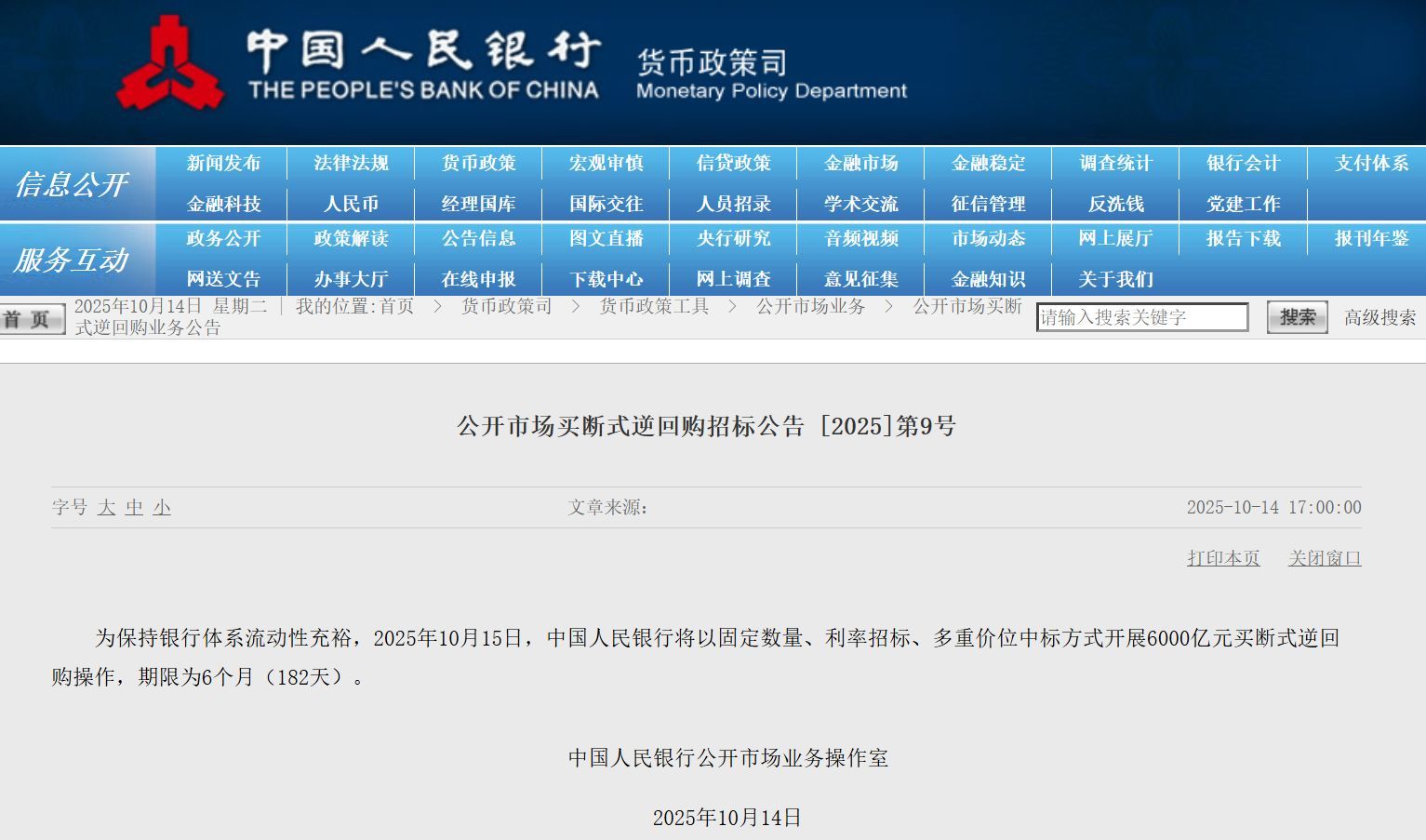
Core Points - The People's Bank of China (PBOC) announced a 600 billion yuan six-month reverse repurchase operation scheduled for October 15, 2025, using a fixed quantity and interest rate bidding method [1] - On the same day, the PBOC conducted a 910 billion yuan seven-day reverse repurchase operation at an interest rate of 1.40% [4] - The liquidity in the financial market showed mixed trends, with the Shanghai Interbank Offered Rate (Shibor) for overnight remaining stable at 1.314% and the seven-day Shibor rising by 4.4 basis points to 1.447% [4] - A report from Huaxi Securities indicated that liquidity is expected to remain stable before the tax period, but the end of October may see increased liquidity pressure due to the overlap of the tax period and month-end [1][4] Summary by Category Monetary Policy - The PBOC will conduct a 600 billion yuan reverse repurchase operation with a six-month term on October 15, 2025, using a fixed quantity and interest rate bidding method [1] - A 910 billion yuan seven-day reverse repurchase operation was conducted on October 14, 2025, at an interest rate of 1.40% [4] Financial Market Trends - The financial market experienced mixed trends, with the overnight Shibor stable at 1.314% and the seven-day Shibor increasing to 1.447% [4] - The weighted average rate of DR007 rose to 1.4495% by the end of trading, while the one-day treasury reverse repurchase rate decreased to 1.416% [4] Liquidity Outlook - Huaxi Securities reported that liquidity is expected to remain stable before the tax period, but the end of October may present challenges due to the overlap of the tax period and month-end [1][4]
税收数据显示中国经济向好态势不断稳固
Zhong Guo Xin Wen Wang· 2025-10-14 08:15
Group 1 - The core viewpoint of the articles indicates that China's tax revenue and invoice sales are showing steady recovery, reflecting a positive economic trend driven by various policies and improved market confidence [1][2][3] Group 2 - Tax revenue from the manufacturing sector increased by 5.4%, accounting for 31% of total tax revenue, with high-end manufacturing showing rapid growth [2] - Domestic value-added tax (VAT) rose by 3.2%, while corporate income tax grew by 4.1%, indicating improved profitability in certain industries [2] - Capital market-related tax revenue surged by 56.8%, with securities transaction stamp duty increasing by 110.5%, highlighting active stock market trading [3] - Real estate-related tax revenue decline has narrowed, reflecting the effectiveness of policies aimed at stabilizing the real estate market, with nearly 800 billion RMB in new tax reductions implemented this year [3] - The overall tax data illustrates the effectiveness of incremental policies aimed at boosting consumption, stabilizing the real estate market, and activating the capital market [3]
瞭望 | 美元信用加速透支
Sou Hu Cai Jing· 2025-10-14 02:55
Core Viewpoint - The decline of the dollar's dominance is attributed to structural issues within the U.S. economy, including the erosion of industrial foundations, increasing debt, political polarization, and governance failures, rather than isolated events or policy mistakes [23]. Group 1: Dollar Asset Safety - The traditional perception of U.S. Treasury bonds as "safe assets" has weakened significantly, as evidenced by simultaneous declines in the stock, bond, and currency markets, indicating a shift in investor risk perception [4][5]. - Following the implementation of the "reciprocal tariff" policy, U.S. stock indices experienced their largest single-day drop in five years, while the yield on 10-year Treasury bonds surged by 48.5 basis points, marking the largest weekly increase since November 2001 [4]. - The dollar index fell nearly 10% from 109 to approximately 98 since the beginning of 2025, with a notable single-day drop of 2% on April 10, 2025, the largest since 2022 [4]. Group 2: Structural Issues in the Dollar System - The U.S. dollar system has inherent structural contradictions, such as the "Triffin Dilemma," which highlights the inability of a single sovereign currency to meet global liquidity needs while maintaining stable value [9]. - The U.S. has increasingly relied on unconventional methods to address capital cycle disruptions, leading to repeated erosion of dollar credit and accelerating the process of "de-dollarization" globally [9][10]. - The dollar's role as a global reserve currency has created significant asymmetrical dependencies, allowing the U.S. to externalize its balance of payments adjustments and exploit global wealth [8]. Group 3: Economic Foundations - The share of U.S. manufacturing output in the global market has declined from 25% in 2000 to 15.9% in 2024, with manufacturing's contribution to U.S. GDP dropping below 10% [11]. - The U.S. has seen a fundamental shift towards a "virtual economy," with 34% of GDP derived from financial services, indicating a move away from traditional manufacturing [11]. - The U.S. faces a diminishing comparative advantage in technological innovation, exacerbated by reduced federal investment in research and education, which has reached its lowest level since 1955 [12]. Group 4: Policy Implications - The "America First 2.0" policy under the Trump administration, characterized by high tariffs and fiscal tightening, has led to increased fiscal burdens and a growing national debt, undermining confidence in U.S. Treasury bonds [19]. - The introduction of stablecoins, which are backed by U.S. Treasury bonds, has created a risky leverage cycle that could threaten the stability of the bond market and the dollar's credibility [20][21]. - Inflationary pressures resulting from high tariffs and fiscal stimulus have forced the Federal Reserve to maintain high interest rates, which could further strain the economy and diminish the dollar's competitive edge [22].
格林大华期货早盘提示-20251014
Ge Lin Qi Huo· 2025-10-13 23:31
Report Industry Investment Rating - The investment rating for the global economy in the macro and financial sector is "flat" [1] Core Viewpoints - The report presents a complex global economic and financial situation, with various factors influencing different markets. The U.S. economic data shows a "schizophrenic" state, and the global economic order is facing challenges. Meanwhile, China's economic indicators are positive, and the AI competition between China and the U.S. has changed the situation [1][2] Summaries by Related Catalogs Important Information - After U.S. President Trump hinted at canceling new tariffs on China on the 12th, U.S. stock index futures rose [1] - The spread between the near - month New York silver futures contract and the London silver spot reached $2.73 per ounce, a multi - year high. The one - month implied lease rate of London silver spot has risen to 40.3%, and the free - floating volume in the London silver market has dropped by 75% compared to the 2019 high [1] - The core driving force of the gold price is the market's expectation of the "order reconstruction" of the global political and economic situation, and its upward trend may not end [1] - Bridgewater Associates founder Ray Dalio warned that the rapid growth of U.S. government debt and intensifying internal and external conflicts are creating a situation "very similar" to that before World War II [1] - U.S. consumer spending and AI capital expenditure are strong, with third - quarter consumer spending growing nearly 3%, but the employment market has slowed down and the unemployment rate has risen, which poses challenges to asset pricing [1] - The era when the 10 - year U.S. Treasury yield is above 4% is coming to an end [1] - The U.S. stock bull market that started in October 2022 has reached its third anniversary, with the S&P 500 index rising 83% and its market value increasing by $28 trillion. The current valuation is at a record - high price - to - earnings ratio of 25 times [1] - The Houthi rebels said they would stop attacking Israeli and Israel - related ships in the Red Sea if Israel complies with the cease - fire agreement in the Gaza Strip [1] - Goldman Sachs has significantly raised its forecast for Alibaba's capital expenditure in the next three years to 460 billion yuan, believing that AI capital expenditure transformation is reshaping Alibaba's growth expectations [1][2] Global Economic Logic - China's September exports were $328.5 billion, with an 8.3% year - on - year increase, and imports had a 7.4% year - on - year increase, reaching a six - month high for exports and a 17 - month high for imports [2] - China's control of rare earths is a firm response to the U.S. restrictions on mature - process semiconductor equipment and materials. Interrupting the U.S. AI chip production may lead to a catastrophic decline in U.S. stocks [2] - According to the HSBC emerging markets survey, China is the preferred stock investment market. International capital is actively increasing its positions in China's technology sector [2] - Huawei's Ascend chips are leading NVIDIA in computing power. Alibaba is actively promoting 380 billion yuan of AI infrastructure construction and plans to increase investment [2] - Due to the U.S.'s continuous wrong policies, the global economy is entering the top - region [2]
每日机构分析:10月13日
Xin Hua Cai Jing· 2025-10-13 14:31
Group 1 - The European Central Bank (ECB) is unlikely to initiate interest rate cuts in the coming months despite weak economic growth in the Eurozone, with a projected GDP growth of approximately 0.1% in Q3, slightly better than the ECB's expectation of "zero growth" [1] - The outcome of the Japanese House of Representatives election will be a key driver of yen volatility, with potential implications for the stock market and long-term government bonds if the ruling Liberal Democratic Party governs alone [2] - The diversification of trade partners is weakening the demand for the US dollar, with "de-dollarization" potentially undermining its status as the world's primary reserve currency [1] Group 2 - Political instability in Japan is dampening safe-haven demand for the yen, as the coalition partner, Komeito, has withdrawn support for the ruling Liberal Democratic Party, creating uncertainty around Prime Minister Kishi's future [2] - US households are expected to become the largest source of demand for US stocks by 2026, with net purchases projected to reach $520 billion, supported by accelerating economic growth and declining unemployment [2] - France is facing significant fiscal pressure, with political divisions hindering necessary fiscal reforms, and the fiscal deficit is expected to narrow to 5.4% of GDP by 2025, although future risks of expansion remain [3]
商务部:中方坚决采取必要措施维护自身权益;央行连续第11个月增持黄金|每周金融评论(2025.10.06-2025.10.12)
清华金融评论· 2025-10-13 11:34
Group 1: Trade Relations and Economic Policies - The Ministry of Commerce of China announced that it will take necessary measures to safeguard its rights in response to the U.S. unilateralism, including imposing special port fees on U.S. vessels [5][6] - Following the U.S. announcement of a 100% tariff on China, global financial markets experienced significant turmoil, with the Dow Jones dropping 878 points (1.90% decline) and the Nasdaq falling 3.56%, resulting in a loss of approximately $700 billion in market value within three minutes of the announcement [6][8] - China's central bank has increased its gold reserves for the 11th consecutive month, with the gold reserves reaching 7.406 million ounces by the end of September, reflecting a month-on-month increase of 4,000 ounces [6][7] Group 2: Housing and Urban Development - The Minister of Housing and Urban-Rural Development, Ni Hong, stated that efforts are underway to transform old houses into "good houses" through renovation, focusing on five key aspects: good standards, good design, good materials, good construction, and good maintenance [7][8] - The shift in housing policy indicates a strategic transition towards improving existing urban infrastructure rather than merely expanding new developments, emphasizing quality of living over quantity [8] Group 3: Manufacturing and Economic Development - A joint implementation plan for promoting service-oriented manufacturing innovation from 2025 to 2028 has been released by seven government departments, aiming to enhance the integration of advanced manufacturing and modern services [9][10] - The plan outlines a roadmap for the next four years, with goals to strengthen the role of service-oriented manufacturing in high-quality development, including the establishment of 20 standards, 50 leading brands, and 100 innovation hubs by 2028 [10] Group 4: Tax Policies and Corporate Restructuring - The Ministry of Finance and the State Taxation Administration released guidelines on tax incentives for corporate mergers and acquisitions, aimed at reducing compliance costs and clarifying applicable policies for various types of restructuring [11] - The guidelines expand the scope of applicable entities to include "public institutions" and introduce clearer execution timelines, enhancing the accessibility of tax policies for businesses undergoing restructuring [11] Group 5: Foreign Exchange Reserves - China's foreign exchange reserves reached $33,387 billion by the end of September, marking an increase of $16.5 billion (0.5%) from the end of August, the highest level since December 2015 [12]

2025 年理财真别想着赌一把!稳稳的才好,一家人的好日子得靠它守着
Sou Hu Cai Jing· 2025-10-13 09:34
Core Insights - The narrative illustrates the financial struggles of an individual facing mounting expenses for education and healthcare, leading to risky investment decisions in the stock market [2][3] - The story highlights the transition from high-risk stock trading to more stable and reliable investment strategies, emphasizing the importance of financial security over speculative gains [4][6] Investment Behavior - Initially, the individual was drawn to stock trading after hearing about significant returns from a colleague, leading to a substantial investment of 320,000 yuan [2] - The initial success in stock trading resulted in a profit of 27,000 yuan in the first month, which created a false sense of security [3] - A sudden market downturn caused by the Federal Reserve's interest rate cut led to significant losses, prompting a family crisis over the mismanagement of funds [3][4] Financial Strategy Shift - Following advice from a neighbor, the individual shifted to a more conservative investment approach, focusing on diversified and low-risk financial products [4][5] - The new strategy included splitting remaining funds into different categories: 30,000 yuan for daily expenses in a high-yield savings account, 100,000 yuan in government bonds for education expenses, and 50,000 yuan in short-term bond funds [4] - The individual also discovered a short-term investment opportunity with a brokerage offering a 4.5% annualized return, which was seen as a favorable option [5] Market Trends - The narrative reflects a broader trend in the financial market where individuals are moving away from high-risk investments towards safer, more stable options, as evidenced by the growth of bank wealth management products and public funds [4][6] - The emphasis on financial prudence and the avoidance of high-risk products is underscored by the character's realization that financial security is paramount for managing family expenses [6] Conclusion - The story concludes with a sense of stability and peace of mind achieved through careful financial planning and investment, contrasting the earlier thrill of speculative trading [6]

资讯早班车-2025-10-13-20251013
Bao Cheng Qi Huo· 2025-10-13 02:25
1. Report Industry Investment Rating No information provided in the content. 2. Core Views of the Report - The recovery of China's logistics industry signals the continuous enhancement of the country's economic endogenous power. The dual - wheel drive of consumer and industrial logistics injects vitality into the economy [4][5]. - The A - share market has adjusted after reaching a new high. Although short - term external uncertainties suppress risk appetite, the core factors driving the market remain unchanged, and the market may continue to fluctuate. Attention should be paid to policy - focused areas, sectors with strong third - quarter report performance, and the technology industry in the medium term [26]. - The convertible bond market has recently recovered, but the market is still over - valued. There may be short - term callback pressure, and investors can buy undervalued equity - biased convertible bonds [23]. 3. Summary by Directory 3.1 Macro Data - GDP in Q2 2025 increased by 5.2% year - on - year, slightly lower than the previous quarter but higher than the same period last year [1]. - In September 2025, the manufacturing PMI was 49.8%, up from the previous month, and the non - manufacturing PMI for business activities was 50.0%, down from the previous month [1]. - In August 2025, social financing scale increment was 25668 billion yuan, M0, M1, and M2 had different year - on - year growth rates, and financial institution RMB loans increased by 5900 billion yuan [1]. - In August 2025, CPI decreased by 0.4% year - on - year, PPI decreased by 2.9% year - on - year, fixed - asset investment (excluding rural households) increased by 0.5% year - on - year, and social consumer goods retail sales increased by 4.6% year - on - year [1]. - In August 2025, export value increased by 4.4% year - on - year, and import value increased by 1.3% year - on - year [1]. 3.2 Commodity Investment 3.2.1 Comprehensive - From the close of trading on October 14, the trading rules of multiple futures contracts on the Shanghai Futures Exchange and Shanghai International Energy Exchange will be adjusted, including changes in the daily price limit and margin ratio [2]. - China has implemented export controls on rare earth items and counter - measures against the US 301 investigation on the shipbuilding industry [3]. - In September 2025, China's logistics industry prosperity index reached a six - month high, indicating strong economic endogenous power [4]. - US Vice - President Vance signaled a willingness to negotiate with China, and some Fed officials hinted at possible interest rate cuts [5]. 3.2.2 Metals - On October 13, spot gold reached a new high of $4060 per ounce and then fell back to $4043 per ounce. Silver prices exceeded $50 per ounce. Some banks issued risk warnings for precious metal investments [6][7]. - According to LME data, on October 9, the inventories of cobalt, zinc, lead, copper decreased, while the inventories of tin, nickel, and aluminum increased [6]. - An American bank strategist predicted that the gold price will reach $6000 by next spring, and Goldman Sachs believes that silver may face greater short - term price fluctuations and downward risks but is likely to rise in the medium term [7]. 3.2.3 Coal, Coke, Steel, and Minerals - Australia plans to reach a mineral resources agreement with the US, considering setting a minimum price for key minerals and providing funds for new rare earth projects [8]. - The China Coking Industry Association released a group standard for coking enterprise energy - efficiency benchmarking [8]. 3.2.4 Energy and Chemicals - International oil prices fell due to factors such as the cease - fire in Gaza, the US government shutdown, and high crude oil inventories [9]. - On October 13, the domestic refined oil price may be lowered for the eighth time this year, reducing residents' travel costs [10]. - China National Petroleum Corporation and Turkmenistan's natural gas company discussed cooperation in the natural gas field [10]. - Iraq set the official selling price of Basra Medium crude oil for Asia in November [10]. - The US government cancelled a large - scale solar project and terminated 223 energy projects [11]. 3.2.5 Agricultural Products - During the National Day and Mid - Autumn Festival holiday, the domestic hog market price continued to decline, with the futures price of the main hog contract down more than 40% from the high in August last year, and the spot price hitting a multi - year low [12]. - APK - Consulting adjusted its forecasts for Ukraine's grain exports and harvests in the 2025/2026 season [12]. 3.3 Financial News 3.3.1 Open Market - On October 11, the central bank conducted 1160 billion yuan of 7 - day reverse repurchase operations, with a net investment of 1160 billion yuan. This week, there will be 10210 billion yuan of reverse repurchase, 1500 billion yuan of treasury cash fixed - deposit, and 8000 billion yuan of 91 - day repurchase expiring [14]. 3.3.2 Key News - China's rare earth export controls are not a ban on exports. China opposes the US tariff threat and will take counter - measures if necessary [15]. - The approval amount of real estate white - list project loans has exceeded 7 trillion yuan, and the second - hand housing market is expanding. The government is studying relevant policies [15][16]. - China has supported overseas institutional investors in conducting bond repurchase business, and some institutions have carried out related transactions [16]. - Some trust companies are required to conduct a review of their bond trading business [16]. - China advocates supporting the multilateral trading system and free trade at the G20 meeting [17]. - The central bank is soliciting opinions on the management method for identifying the beneficial owners of financial institution customers [17]. - China emphasizes the construction of an industrial science and technology innovation system [17]. - Hainan is accelerating the construction of a free trade port and plans to start the full - island customs closure operation on December 18 [18]. - Zhejiang Province plans to build a modern people - centered city by 2030 and fully complete it by 2035 [18]. - Country Garden is restructuring 9 domestic bonds, and 8 of them have passed the restructuring plan [18]. 3.3.3 Bond Market - On the weekend make - up trading day, the domestic bond market strengthened, with bond yields falling, and the central bank's reverse repurchase operations kept the inter - bank funds stable [19]. - On October 11, most money market interest rates declined, and inter - bank repurchase fixed - term rates and silver - silver inter - bank repurchase fixed - term rates also showed different trends [19][20][21]. - On Friday, European and US bond yields generally fell [21]. 3.3.4 Foreign Exchange Market - On Friday, the on - shore RMB against the US dollar rose 14 points, and the RMB central parity rate against the US dollar was raised 54 points. The US dollar index fell, and most non - US currencies rose [22]. 3.3.5 Research Report Highlights - Shenwan Hongyuan believes that the convertible bond market has recovered, but it is still over - valued. There may be short - term callback pressure, and investors can buy undervalued equity - biased convertible bonds [23]. 3.4 Stock Market - A - share indexes adjusted after reaching a new high. The market may continue to fluctuate, and investors should focus on policy - focused and high - performance sectors [26]. - Brokerage firms are optimistic about the fourth - quarter and cross - year market, with a focus on technology and cyclical sectors [26]. - Fund companies are actively deploying for the fourth - quarter market, with a significant increase in the number of newly issued funds, especially equity - based products [26]. 3.5 Today's Reminder - On October 13, 150 bonds will be listed, 154 bonds will be issued, 37 bonds will be paid, and 232 bonds will pay principal and interest [25].