
通信

Search documents
发售电量大幅增长,央企重组持续推进,点名表扬国网、南网,国新办这场发布会能源含量很高!
Zhong Guo Dian Li Bao· 2026-01-28 04:53
Core Insights - The State-owned Assets Supervision and Administration Commission (SASAC) reported on the high-quality development of state-owned enterprises (SOEs) by 2025, highlighting significant growth in assets, productivity, and contributions to national strategies [3][4][6]. Group 1: Financial Performance - Central enterprises' total assets reached 95 trillion yuan, with an average annual growth rate of 6.9% [3] - The added value of central enterprises was 51.3 trillion yuan, a 44.6% increase compared to the previous five-year plan [3] - Total profits amounted to 12.7 trillion yuan, reflecting a 56.2% increase from the previous five-year period [3] Group 2: Productivity and Efficiency - Labor productivity increased from 594,000 yuan to 836,000 yuan per employee, with an annual growth rate of 7.1% [4] - Operating income profit margin improved from 6.2% to 6.7%, indicating enhanced efficiency and competitiveness [4] - R&D investment exceeded 5 trillion yuan over five years, with a 0.27 percentage point increase in R&D intensity [4] Group 3: Strategic Contributions - Central enterprises contributed 12.9 trillion yuan in taxes, a 22.7% increase from the previous five-year period [4] - They transferred 1.2 trillion yuan of state-owned equity to social security funds and supported rural revitalization through targeted assistance [4] - Central enterprises played a crucial role in national energy security and emergency response efforts [4] Group 4: Restructuring and Integration - The SASAC is focusing on the establishment of new central enterprises and strategic restructuring to enhance efficiency in key sectors [5][6] - Professional integration is being promoted, including the consolidation of resources in the cruise and electric vehicle sectors [5] - The aim is to support high-quality mergers and acquisitions to strengthen core capabilities and foster emerging industries [6] Group 5: Innovation and Technology - Central enterprises are actively participating in artificial intelligence (AI) development, with over 1,000 application scenarios created in key industries [7] - Significant investments in computing power and AI infrastructure are being made to support national strategies [7] - Collaborative initiatives are being launched to enhance AI technology accessibility and application across various sectors [8] Group 6: Emerging Industries - Revenue from strategic emerging industries is projected to exceed 12 trillion yuan by 2025, with a significant increase in investment share [9] - Central enterprises are focusing on sectors like integrated circuits, biotechnology, and new energy vehicles, with substantial investments in innovation [9] - The establishment of a collaborative ecosystem is being pursued to enhance supply chain integration and innovation [9][10] Group 7: Future Directions - The SASAC plans to guide central enterprises towards intelligent, green, and integrated development, focusing on enhancing competitiveness and safety [11] - Key areas of focus include new energy, aerospace, and quantum technology, with an emphasis on building globally competitive industrial clusters [11]


2025年央企战略性新兴产业营收规模超12万亿元 连续三年年增1万亿
智通财经网· 2026-01-28 03:39
Core Viewpoint The State-owned Assets Supervision and Administration Commission (SASAC) of the State Council presented the high-quality development goals for state-owned enterprises (SOEs) by 2025, highlighting significant growth in strategic emerging industries and the overall economic contributions of central enterprises. Group 1: Economic Performance - By the end of 2025, the total assets of central enterprises are expected to exceed 95 trillion yuan, with an average annual growth rate of 6.9% [4] - The total profit is projected to reach 2.5 trillion yuan in 2025, with fixed asset investments of 5.1 trillion yuan and tax contributions of 2.5 trillion yuan [4] - The added value of central enterprises is anticipated to be 51.3 trillion yuan, marking a 44.6% increase compared to the previous five-year plan [15] Group 2: Strategic Emerging Industries - Revenue from strategic emerging industries is expected to surpass 12 trillion yuan by 2025, achieving a consistent annual growth of 1 trillion yuan over three years [1][42] - Cumulative investments in strategic emerging industries have exceeded 10 trillion yuan, increasing their share of total investments from 22% to over 40% [1][42] - Key sectors such as integrated circuits, biotechnology, and new energy vehicles are experiencing accelerated development, while artificial intelligence and quantum technology are emerging as competitive fields [1][42] Group 3: Technological Innovation - Central enterprises are projected to invest 1.1 trillion yuan in R&D by 2025, maintaining an annual investment above 1 trillion yuan for four consecutive years [5] - The number of academicians in central enterprises has increased, with significant breakthroughs in various frontier fields [5] - Collaborative innovation efforts have expanded, with over 100 innovation entities participating in joint research initiatives [5] Group 4: Corporate Reform and Governance - The reform actions for state-owned enterprises have shown positive results, enhancing their strategic functions and core competitiveness [10][11] - The revenue from sectors critical to national security and the economy accounts for over 70% of central enterprises' total revenue [10] - Governance improvements include the establishment of a modern enterprise system and enhanced regulatory effectiveness [11] Group 5: Social Responsibility and Community Engagement - Central enterprises have actively participated in rural revitalization efforts, with significant investments and support for local communities [57] - Emergency response capabilities have been strengthened, with substantial resources allocated for disaster relief and public safety [57] - Environmental sustainability initiatives have led to reductions in energy consumption and carbon emissions, contributing to national goals [57]
央企“AI+”专项行动成果显著 超千个应用场景落地
Yang Shi Xin Wen· 2026-01-28 03:11
Core Insights - The State-owned Assets Supervision and Administration Commission (SASAC) emphasizes the importance of artificial intelligence (AI) as a driving force for technological revolution and industrial transformation, launching the "AI+" initiative to enhance the capabilities of central enterprises [1][2] Group 1: High-Value Application Scenarios - Central enterprises are focusing on key industries such as energy, manufacturing, and telecommunications, creating over a thousand application scenarios, with notable implementations in smart management and fault prediction by State Grid and Southern Power Grid [1] - The initiative includes the use of intelligent robots in manufacturing and the development of advanced models for rail transit equipment by China CRRC Group, highlighting AI's role in upgrading traditional industries [1] Group 2: Quality Computing Power Supply - Central enterprises are actively participating in the national computing power layout, increasing investment in computing resources, with major telecom operators establishing four "ten-thousand card clusters" to support large model training [1] - Platforms like "Xirang" and "Computing Network Brain" are being developed to provide standardized computing power services, emphasizing low-cost and high-intelligence advantages while adapting to domestic chip technologies [1] Group 3: Accelerating Large Model Adaptation - Companies are enhancing their full-stack capabilities for large models, with China Mobile's "Jiutian" and China Telecom's "Xingchen" empowering over 200 external units in sectors like energy and manufacturing [2] Group 4: High-Level Open Cooperation - The "Renewal Community" initiative offers over 2,000 domestic intelligent computing chips for free to young entrepreneurs and tech enthusiasts, gathering over 4,000 models and 800 datasets to promote the widespread application of AI technology [2] Group 5: Future Directions of the "AI+" Initiative - The SASAC plans to strengthen investment in AI, focusing on the "14th Five-Year Plan" for AI development, enhancing infrastructure for information communication networks and computing power [2] - There will be an emphasis on cultivating application scenarios in key areas like embodied intelligence and energy, aiming to create an "AI+" industry community and increase the openness of scenarios [2] - The optimization of data supply will be prioritized, particularly in sectors like transportation, smart energy, and financial services, to support model optimization and large-scale application [2]


主力资金监控:电新行业净流出超103亿
Xin Lang Cai Jing· 2026-01-28 03:09
Group 1 - The core point of the article highlights a significant net outflow of over 10.3 billion in the electric new energy sector, indicating a shift in investor sentiment away from this industry [1] - Major sectors experiencing net inflows include industrial metals, non-ferrous metals, and telecommunications, contrasting with the outflows in the electric new energy, power equipment, and machinery sectors [1] - Among individual stocks, Wangsu Science & Technology saw a notable net inflow of over 1.685 billion, leading the gains, while Yangguang Electric Power faced a substantial net sell-off exceeding 1.4 billion [1]
通信2026年度投资策略-聚焦AI-算力降本向光而行-应用落地网络先行
2026-01-28 03:01
Summary of Key Points from Conference Call Records Industry Overview - The focus is on the AI and cloud services industry, particularly the transition to cloud-based computing and cost reduction strategies in 2026 [1][3][4]. Core Insights and Arguments - AI cloud services are expected to enter a growth phase in 2025, with model vendors converting capital expenditures into Kubernetes (K8S) to achieve cloud computing and cost reduction, similar to the mobile internet era [1][3]. - Data center computing power is projected to see significant growth with the large-scale adoption of 1.6T and 224G single-channel technologies, which will profoundly impact China's optical communication industry [1][4]. - LightCounting forecasts that by 2030, the shipment of 1.6T will accelerate, surpassing 800G and 400G around 2028, with Chinese upstream optical chip companies likely achieving global replacement [1][5]. - The transition from copper connections to performance realization narratives is highlighted, with expectations that copper connections will remain dominant for the next two years [1][6]. - The commercial space sector is anticipated to have significant developments in 2026, including reusable liquid rockets and the gradual implementation of commercial satellite constellations [1][12]. Additional Important Insights - The infrastructure for computing power is experiencing price increases, with cloud computing seeing its first price hike in over 20 years, expected to continue until 2026 [2][22][23]. - The CDN market may follow suit with price increases, potentially impacting smaller clients who may seek cheaper alternatives [24][25]. - AI inference in edge computing is projected to have vast applications, with edge nodes becoming ideal for reducing latency and improving cost-effectiveness [26]. - Liquid cooling systems are becoming crucial in data center construction due to increased power demands from GPUs, with significant market opportunities arising from this trend [27]. - Power technology is also evolving, with new market spaces emerging from innovations in power supply systems within data centers [28]. Investment Opportunities - Key investment opportunities in the communication industry include companies like Xuzhuang and Yizhongtian, which are gaining market share in the optical module sector [5][6]. - The potential for growth in AI modules from IoT modules is emphasized, with companies that can provide integrated intelligent solutions expected to see rapid growth [13]. - The commercial rocket sector is highlighted as a critical area for investment, with expectations of successful validation of new reusable rocket models in 2026 [18][19]. - Investors are advised to focus on companies with strong backing and significant satellite planning capabilities in the space computing sector [19][21].
国新证券每日晨报-20260128
Guoxin Securities Co., Ltd· 2026-01-28 02:57
国内市场综述 缩量震荡 小幅收涨 周二(1 月 27 日)大盘缩量震荡,小幅收涨。截至收 盘,上证综指收于 4139.9 点,上涨 0.18%;深成指收 于 14329.91 点,上涨 0.09%;科创 50 上涨 1.51%;创 业板指上涨 0.71%,万得全 A 成交额共 29215 亿元, 较前一日略有上升。 行业方面,30 个中信一级行业有 7 个上涨,其中国防 军工、电子及通信涨幅居前,而煤炭、农林牧渔及综 合金融则跌幅较大。概念方面,培育钻石、超硬材料 及先进封装等指数表现活跃。 海外市场综述 美国三大股指收盘涨跌不一,道指跌 0.83% 周二(1 月 27 日),美国三大股指收盘涨跌不一,道 指跌 0.83%,标普 500 指数涨 0.41%,纳指涨 0.91%。 万得美国科技七巨头指数涨 1.11%,亚马逊、微软涨 超 2%,苹果、英伟达涨超 1%。纳斯达克中国金龙指数 收涨 0.48%,虎牙涨超 19%,金山云涨超 8%。 新闻精要 1. 英国首相斯塔默将访华 中方介绍有关安排及期待 2. 我国将制定《新就业形态劳动者基本权益保障办法》 3. 中国科学院大学星际航行学院成立 4. 中国首个万 ...
未知机构:每日复盘128标普五连阳美元创四年新低黄金新高原油拉升A股震荡上-20260128
未知机构· 2026-01-28 02:45
Summary of Key Points from Conference Call Records Industry Overview - **Market Performance**: The S&P 500 experienced a five-day winning streak, reaching record highs before major tech earnings reports. The dollar hit a four-year low, while gold prices surged. A-shares showed a volatile upward trend, with significant gains in precious metals and the computing hardware supply chain [1][2]. Core Insights and Arguments - **Tech Sector Earnings**: Major tech companies are influencing market trends, with Meta's $60 billion order for fiber optics leading to a 15% surge in Corning's stock. Micron and Microsoft also saw stock increases of over 5% and 2%, respectively, while Tesla's stock fell by 1% [1]. - **Economic Indicators**: In December, profits for large-scale industrial enterprises in China shifted from a 13.1% decline in November to a 5.3% increase, indicating improved profitability and growth in the upper and middle reaches of the industrial sector [1]. - **Commodity Prices**: Gold prices rose over 3%, while silver experienced significant volatility, with a drop of over 10% and a subsequent rise of nearly 9% [1]. Important but Overlooked Content - **Sector-Specific Developments**: - **AI Applications**: The AI sector is seeing significant advancements, with new models expected to launch during the Spring Festival. Companies like Deepseek and Kimi are releasing new products, indicating a robust growth trajectory in AI applications [5][6]. - **Fiber Optics**: Meta's substantial investment in fiber optics is a key development, with potential implications for related companies such as Yangtze Optical Fibre and Hengtong Optic-Electric [6]. - **Aviation Industry**: China’s COMAC plans to increase production and delivery of the C919 narrow-body aircraft, suggesting a potential growth area in the domestic aviation market [6]. - **Semiconductors**: Price adjustments by Zhongwei Semiconductor for MCU and Norflash products, with increases ranging from 15% to 50%, highlight the ongoing demand and pricing power in the semiconductor sector [6]. - **Cloud Computing**: Google announced a price adjustment for data transmission methods in North America, which could significantly impact cloud service providers and related companies [6].




最高法:切实加大知产保护力度 58案适用惩罚性赔偿 合计赔偿20.5亿元
Jing Ji Guan Cha Wang· 2026-01-28 02:40
Group 1 - The Supreme People's Court has established a specialized Intellectual Property Court since January 1, 2019, which has significantly improved the handling of intellectual property cases, with a total of 24,602 cases accepted and 23,069 cases concluded over the past seven years [1] - The court has adopted a principle of "reform over litigation," achieving a 20.9% retrial rate and a 37.7% withdrawal rate for civil cases related to infringement and ownership, both of which are notably higher than pre-reform levels [1] - Cases related to strategic emerging industries have increased from 17.6% in 2019 to 32.4% in 2025, with 6,745 cases accepted in total [1] Group 2 - The court has effectively increased the protection of intellectual property rights, with 58 cases applying punitive damages totaling 2.05 billion yuan, averaging over 35 million yuan per case [2] - A total of 203 antitrust cases have been concluded, with 66 cases recognized as constituting monopolies, impacting various sectors including pharmaceuticals, telecommunications, e-commerce, education, construction, and funeral services [2]
融资资金布局,成本管控是核心
Sou Hu Cai Jing· 2026-01-28 02:37
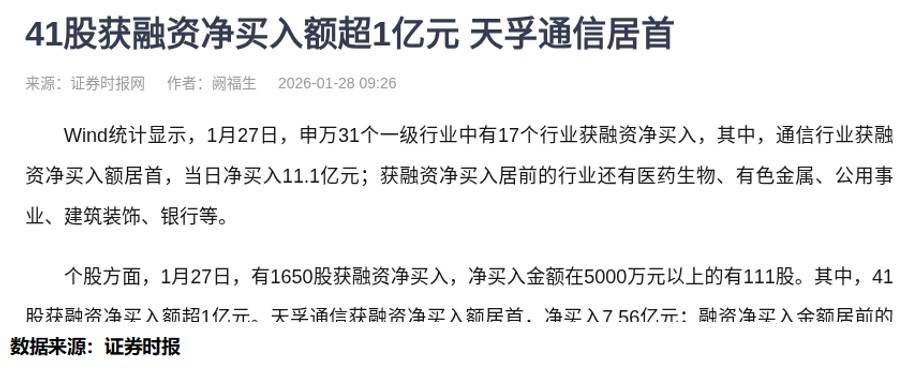
Group 1 - The core viewpoint of the article emphasizes that while short-term capital inflows can indicate market trends, the long-term performance of stocks is primarily determined by institutional investors' cost control strategies [1][3]. - In the recent analysis, 17 out of 31 primary industries received net capital inflows, with the communication sector leading, followed by pharmaceuticals, non-ferrous metals, and public utilities [1]. - Over 1,600 stocks experienced net capital inflows, with 111 exceeding 50 million yuan and 41 surpassing 100 million yuan, indicating significant investor interest [1]. Group 2 - Cost control is a fundamental aspect of value investing, as demonstrated by Warren Buffett's long-term investment in Coca-Cola, where he maintained a low average cost per share [3]. - Institutional trading logic focuses on the safety of holding costs, contrasting with retail investors who often prioritize expected returns [3]. - Quantitative data can reveal institutional trading behaviors, such as increased activity in "institutional inventory" before significant price movements, indicating proactive cost management [3][5]. Group 3 - The behavior of institutional cost management is applicable to both large and small-cap stocks, with early signs of institutional interest often preceding price increases [5]. - Not all small-cap stocks attract institutional interest; for instance, a small-cap stock with low trading volume showed no active institutional inventory, leading to a brief price increase followed by a decline [7]. - The size of a stock's float is not the sole determinant of its performance; rather, the depth of institutional cost management is crucial [9]. Group 4 - Long-term trading behaviors of institutions, such as maintaining active "institutional inventory" for extended periods, can lead to superior stock performance [9]. - Quantitative data can help investors move beyond superficial market sentiments and understand the underlying trading logic of institutional investors [11]. - By focusing on objective trading characteristics, investors can develop a more sustainable and disciplined investment approach, leveraging quantitative data to replace subjective speculation [11].
1月27日机械设备、汽车、国防军工等行业融资净卖出额居前
Sou Hu Cai Jing· 2026-01-28 02:05
Summary of Key Points Core Viewpoint - As of January 27, the latest market financing balance is 27,059.04 billion yuan, showing a decrease of 2.12 billion yuan compared to the previous trading day, with 17 industries experiencing an increase in financing balance, while 14 industries saw a decrease [1]. Industry Financing Balance Changes - The communication industry had the highest increase in financing balance, rising by 1.11 billion yuan to a total of 1,339.67 billion yuan [1]. - Other industries with notable increases include: - Pharmaceutical and biological: increased by 0.44 billion yuan to 1,696.03 billion yuan - Non-ferrous metals: increased by 0.41 billion yuan to 1,494.54 billion yuan - Public utilities: increased by 0.29 billion yuan to 569.69 billion yuan [1]. - Conversely, the following industries experienced significant decreases in financing balance: - Machinery and equipment: decreased by 1.70 billion yuan to 1,418.93 billion yuan - Automotive: decreased by 0.96 billion yuan to 1,242.31 billion yuan - National defense and military: decreased by 0.68 billion yuan to 1,040.47 billion yuan [2]. Percentage Changes in Financing Balance - The coal industry recorded the highest percentage increase in financing balance at 1.09%, totaling 149.82 billion yuan [1]. - Other industries with notable percentage increases include: - Communication: 0.84% - Steel: 0.79% - Agriculture, forestry, animal husbandry, and fishery: 0.59% [1]. - Industries with the largest percentage decreases include: - Machinery and equipment: decreased by 1.19% - Comprehensive: decreased by 1.10% - Oil and petrochemicals: decreased by 0.89% [1].