
新能源车

Search documents
投资前瞻:重视高低切
Wind万得· 2025-08-31 22:50
Market News - The personal consumption loan interest subsidy policy will officially start on September 1, marking the first time the central government has implemented such a policy in this area. This policy aims to provide precise support for the portion of consumption loans actually used for consumption, which is expected to significantly impact the consumption finance industry by accelerating the expansion of institutions into various consumption scenarios through direct cooperation with merchants [3]. - The Ministry of Commerce announced that in September, several policies will be introduced to expand service consumption, utilizing fiscal and financial measures to optimize and enhance service supply capacity [4]. - The Ministry of Housing and Urban-Rural Development and the People's Bank of China issued the "Anti-Money Laundering Work Management Measures for Real Estate Practitioners," effective from September 1, requiring real estate practitioners to fulfill anti-money laundering obligations [3]. Sector Matters - SAIC and Huawei's HarmonyOS have launched their first model, the Shangjie H5, with a pre-sale price starting at 169,800 yuan, set to officially launch on September 23. This model is currently the cheapest equipped with Huawei's ADS 4 intelligent driving assistance system [6]. - The Guangzhou Municipal Bureau of Commerce announced adjustments to the city's automobile "replacement and upgrade" policy, suspending the subsidy policy from August 30, 2025 [6]. Individual Company Events - Hesai Technology, the world's largest manufacturer of automotive lidar sensors, is preparing for an IPO in Hong Kong as early as September, aiming to raise approximately $300 million [10]. - NIO's founder and CEO Li Bin has set a goal to achieve quarterly profitability in Q4 of this year [11]. - SANY Heavy Industry plans to issue shares in Hong Kong in September or October, raising between $1 billion to $1.5 billion [12]. Restricted Stock Unlocking - A total of 28 companies will have restricted shares unlocked during the week of September 1-5, amounting to 2.013 billion shares with a total market value of 18.866 billion yuan based on the closing price on August 29 [14]. - The peak unlocking day is September 3, with six companies unlocking shares worth a total of 7.634 billion yuan, accounting for 40.46% of the week's total unlocking scale [14]. New Stock Calendar - One new stock is scheduled for issuance during the week of September 1-5, with a total issuance of approximately 21.67 million shares, expected to raise 719 million yuan [18]. Institutional Outlook - Guojin Securities suggests that the next investment focus should be on sectors with the greatest marginal improvement in fundamentals, particularly in manufacturing, as the market reaches a 10-year high [21]. - Dongwu Securities emphasizes the importance of liquidity-driven market movements, predicting a potential slowdown in market upward momentum due to diminishing marginal effects of new capital inflows [22]. - Xinda Securities highlights the historical correlation between capacity surplus resolution and market bull runs, recommending attention to sectors like non-ferrous metals and photovoltaics [23].



渗透率持续提升 新能源车成产业链企业“核心引擎”
Shang Hai Zheng Quan Bao· 2025-08-29 19:52
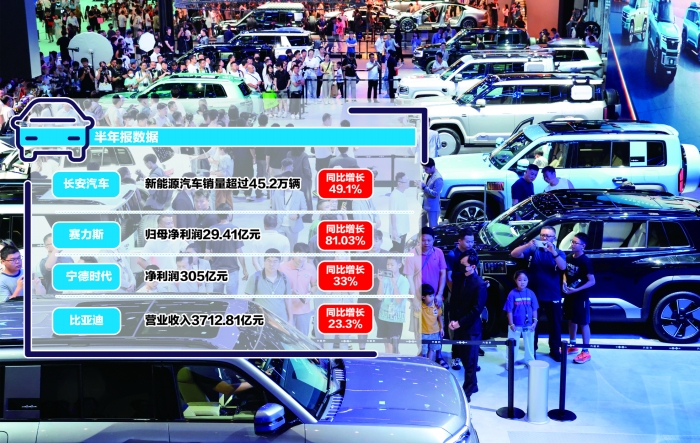
Industry Overview - The Chinese automotive industry is experiencing significant growth in the new energy vehicle (NEV) sector, with NEV sales accounting for over 44% of total vehicle sales in the first half of 2025, marking a new phase in the industry's electrification transformation [6] - The export of Chinese NEVs also saw impressive growth, with a 75.2% year-on-year increase, reaching 1.06 million units, highlighting the global competitiveness of Chinese manufacturing [6] Company Performance - Changan Automobile reported a revenue of 72.69 billion yuan in the first half of 2025, a decline of 5.25% year-on-year, with a net profit of 2.29 billion yuan, down 19.09% [3] - Despite the overall decline in revenue and profit, Changan's NEV sales exceeded 452,000 units, showing a remarkable growth of 49.1% year-on-year, significantly outperforming the industry average [3] - Changan's NEV penetration rate increased to 33%, reaching 50% in the second quarter, indicating a successful transition towards electrification [3] Strategic Collaborations - Seres reported a revenue of 62.40 billion yuan in the first half of 2025, with a net profit of 2.94 billion yuan, reflecting an 81.03% increase year-on-year, largely attributed to its partnership with Huawei for the AITO brand [4] - The AITO series, including models M5, M7, M8, and M9, has gained significant market traction, with over 700,000 users and M9 leading the sales in the 500,000 yuan market segment [4] - BAIC Blue Valley also benefited from its collaboration with Huawei, achieving a revenue of 9.52 billion yuan, a 154.38% increase year-on-year, despite a net loss of 2.31 billion yuan, which was a 10.23% improvement [4] Battery Industry Impact - CATL reported a revenue of 178.9 billion yuan in the first half of 2025, a year-on-year increase of over 7.2%, with a net profit of 30.5 billion yuan, up over 33% [5] - CATL's battery installation volume reached 128.6 GWh, with a market share of 86.3% in the domestic electric bus sector, indicating strong demand for its products [5] - The anticipated net profit for China Innovation Aviation is projected to be between 709 million and 793 million yuan, representing a 70% to 90% increase year-on-year, driven by the scaling of its advanced battery technologies [5]




8/29财经夜宵:得知基金净值排名及选基策略,赶紧告知大家
Sou Hu Cai Jing· 2025-08-29 16:13
Group 1 - The article provides a ranking of mutual funds based on their net asset value updates, highlighting the top and bottom performers in the market [3][4] - The top 10 funds with the highest net value growth include Taiping MSCI Hong Kong Value Enhanced A, and several clean energy and mixed allocation funds [3][4] - The bottom 10 funds are primarily semiconductor industry ETFs, indicating a decline in this sector [4][6] Group 2 - The article notes that the Taiping MSCI Hong Kong Value Enhanced A experienced a net value increase due to a dividend distribution rather than market fluctuations [4] - The overall market performance shows a mixed trend, with the Shanghai Composite Index opening high and the ChiNext Index showing upward movement [6] - Key sectors leading the market include comprehensive and electrical equipment industries, while the semiconductor sector faced declines [6][7] Group 3 - The article discusses the concentration of holdings in the top-performing clean energy fund, with a significant portion of its assets in companies like CATL and others in the new energy sector [7] - Conversely, the semiconductor fund shows a high concentration in underperforming stocks, indicating challenges in this industry [7] - The clean energy fund's net value has outperformed the market, while the semiconductor fund has lagged behind [7]

港股科技ETF(513020)午后翻红,资金抢筹,连续10日净流入超6.8亿元!
Mei Ri Jing Ji Xin Wen· 2025-08-29 09:40
Group 1 - The core viewpoint is that Hong Kong stocks, particularly in the technology sector, are expected to rise again in the second half of the year due to three positive catalytic factors [2] - The first factor is that leading technology companies in Hong Kong are likely to benefit from new technological breakthroughs, especially in the AI sector, where they have a competitive edge and are increasing capital expenditure [2] - The second factor is the potential for foreign capital to exceed expectations as the Federal Reserve may restart interest rate cuts, improving liquidity and stabilizing Sino-US trade relations [2] - The third factor is that there is still room for increased southbound capital inflows, with an expected net inflow of over 1.2 trillion yuan for the year [2] Group 2 - The Hong Kong Technology ETF (513020) tracks the Hong Kong Stock Connect Technology Index (931573), which selects up to 50 quality companies from the technology sector listed under the Stock Connect program [3] - The index covers multiple sub-sectors including internet, biomedicine, new energy vehicles, and chips, aiming to reflect the overall performance of core technology enterprises in the Hong Kong market [3] - Investors without stock accounts can consider the linked funds, such as the Guotai Zhongzheng Hong Kong Stock Connect Technology ETF Initiating Linkage C (015740) and A (015739) [3]
ETF市场日报 | 电池、新能源汽车相关ETF反弹!基金公司开启科技赛道ETF“军备竞赛”
Sou Hu Cai Jing· 2025-08-29 09:24
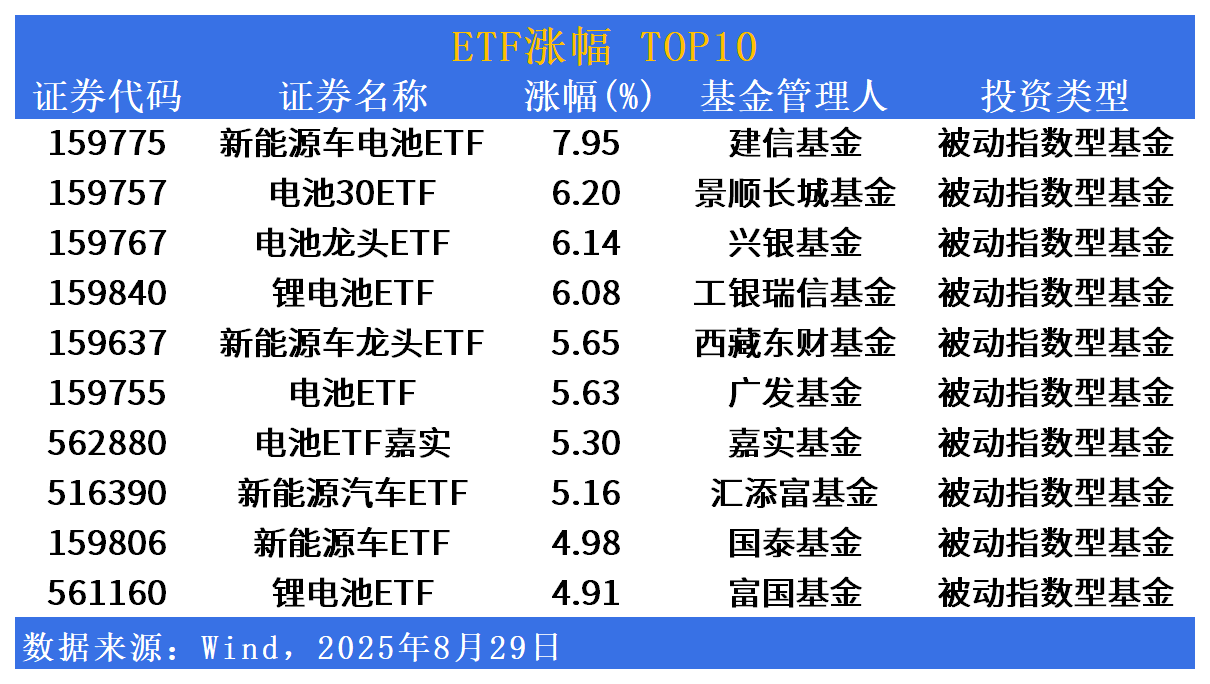
Group 1: ETF Performance - The Sci-Tech Chip ETF (博时, 588990) increased by over 15% [1] - The New Energy Vehicle Battery ETF (159755) led the gains with a rise of 7.95%, followed by the Battery 30 ETF (159757) and Battery Leader ETF (159767) with increases of 6.20% and 6.14% respectively [2][3] - Other ETFs such as the Lithium Battery ETF (159840) and New Energy Vehicle Leader ETF (159637) also showed significant gains, contributing to a positive trend in the sector [2] Group 2: Industry Data - By July 2025, China's power battery installation volume is projected to reach 55.9 GWh, marking a year-on-year growth of 34.3% [2] - Among this, ternary battery installations accounted for 10.9 GWh (19.6% of total), with a month-on-month increase of 1.9%, while lithium iron phosphate battery installations reached 44.9 GWh (80.4% of total), showing a year-on-year growth of 49.0% [2] Group 3: Market Dynamics - The China Passenger Car Association estimates that retail sales of narrow passenger vehicles in August reached approximately 1.94 million units, reflecting a month-on-month increase of 6.2% and a year-on-year increase of 2.0% [2] - The penetration rate of new energy vehicles is expected to reach 56.7%, indicating a deeper level of electrification in the market [2] - Tesla's launch of the six-seat SUV Model Y at a starting price of 339,000 yuan further enhances its product lineup [2] Group 4: Battery Technology Trends - The upgrade and iteration of battery technology are seen as core drivers of expanding terminal demand, with solid-state batteries emerging as a promising next-generation technology due to their high energy density and safety [3] - As battery technology matures and the supply chain improves, new solid-state products are expected to be released, accelerating the industrialization process [3] Group 5: Semiconductor Sector Insights - The semiconductor sector is experiencing a pullback, with global capacity expansion and market share concentrating among leading firms [4] - The demand for wafer foundry services is expected to rise due to the growth of AI and automotive electronics, with advanced processes and specialty technologies anticipated to maintain growth in the coming years [4][5] Group 6: ETF Issuance and Market Sentiment - A new wave of ETF fundraising is set to begin, focusing on sectors such as biotechnology, software, and robotics, indicating a competitive landscape in the tech sector [8][12] - Multiple brokerages express optimism about the tech sector's future, highlighting AI trends and domestic substitution as key drivers [13]
那些买爆雷车的年轻人
投资界· 2025-08-29 07:37
Core Viewpoint - The article discusses the phenomenon of young consumers purchasing "exploded" electric vehicles at significantly discounted prices, highlighting a shift in consumer perception and behavior towards car ownership and brand loyalty in the electric vehicle market [4][22]. Group 1: Market Dynamics - The electric vehicle market is experiencing a price war, with companies like BYD offering substantial discounts on popular models, prompting competitors like Geely and Xpeng to follow suit [6][8]. - Several electric vehicle manufacturers, including HiPhi, Jidu, and Neta, have faced operational crises, leading to a surge in discounted inventory vehicles that attract price-sensitive consumers [5][6][25]. Group 2: Consumer Behavior - Young consumers are increasingly willing to purchase vehicles from brands that have faced financial difficulties, viewing the risk as manageable and the potential savings as worthwhile [22][24]. - The perception of cars has shifted from being long-term investments to more disposable items, with consumers now considering a 3-5 year usage period acceptable [21][22]. Group 3: Vehicle Features and Pricing - The article emphasizes that the "exploded" vehicles often come with high-end features at significantly lower prices, making them attractive options for consumers looking for value [12][26]. - For instance, the Geely Extreme 07 offers features comparable to higher-priced models, such as a large battery and advanced technology, at a fraction of the original price [12][13]. Group 4: Purchasing Process - The process of buying "exploded" vehicles is more complex, often requiring consumers to navigate unofficial channels and verify vehicle conditions themselves [6][19]. - Many consumers report using social media and online platforms to find and purchase these vehicles, indicating a shift in how car sales are conducted in the wake of brand crises [18][19]. Group 5: Brand Loyalty and Trust - Despite the risks associated with purchasing from brands that have "exploded," many consumers maintain a level of trust in the product quality, believing that operational issues do not necessarily reflect the vehicle's performance [22][23]. - The article notes that younger consumers are less brand-loyal and more focused on the vehicle's specifications and price, leading to a reevaluation of traditional brand perceptions in the automotive market [25][26].

固态电池研发催化,新能源车行情狂飙!新能源车ETF(159806)涨超5%,创业板新能源ETF(159387)涨超4%
Mei Ri Jing Ji Xin Wen· 2025-08-29 06:23
每日经济新闻 (责任编辑:董萍萍 ) 在成本端,经过前期价格调整,锂、镍、钴等关键原材料价格趋于稳定,降低了电池制造环节的成本压力。整车企业方面,多款智能化与电动化新车型 集中发布,搭载域控制器、高阶辅助驾驶系统和车载AI芯片的产品逐步成为市场标配,单车价值量提升明显。海外订单的增加与国内消费市场的复苏形成 合力,推动整个产业链的盈利能力进入修复通道。 新能源车产业正从以政策驱动为主,逐渐过渡到以市场驱动为核心的阶段,全球渗透率持续提升,行业规模化效应凸显。在这一过程中,具备规模、技 术、渠道与品牌优势的龙头企业更容易在行业集中度提升的趋势下脱颖而出,分享更大市场蛋糕。中长期来看,新能源车与储能、可再生能源的融合趋势将 带动更多技术迭代和商业模式创新,形成新的增长曲线。 新能源车ETF(159806)紧密跟踪中证新能源汽车指数,成分股分布覆盖动力电池、锂资源、整车制造等多个环节,为投资者提供一键配置全产业链的 高效工具。此外,投资者还可以关注20cm标的创业板新能源ETF(159387),跟踪指数网罗清洁能源生产、存储、传输及应用等环节的上市公司证券,聚焦 于新能源及相关技术领域,强调技术创新与可持续发展特性 ...

涨超6%!固态电池量产,渗透率提升,新能源车的时代来了?
Xin Lang Cai Jing· 2025-08-29 06:03
Core Viewpoint - The new energy vehicle sector is experiencing a strong surge, with significant increases in stock prices and a positive outlook driven by demand, technology advancements, and favorable policies [1][2][3]. Group 1: Market Performance - The China Securities New Energy Vehicle Index (399976) saw an increase of over 6.17%, with a current rise of 5.17% as of 11:20 AM on August 29, 2025 [1]. - Notable individual stocks such as XianDao Intelligent and HangKe Technology surged over 20%, while others like BETTERI, ZhongKe Electric, and Ningde Times saw increases exceeding 10% [1]. Group 2: Demand Factors - New energy vehicles are becoming the mainstay of the automotive market, with a domestic penetration rate consistently above 50% [2]. - Policy subsidies and the upcoming "Golden September and Silver October" sales peak are providing additional support [2]. - The global market is recovering, with projected growth in energy storage battery demand of 9% in a pessimistic scenario and 21.6% in a normal scenario by 2026 [2]. Group 3: Technological Advancements - Solid-state batteries are entering the mass production phase, with plans for small-scale trial production in 2026 and full-scale production in 2027 [2]. - Eight battery companies, including leading firms like Ningde Times and BYD, have established pilot lines for solid-state batteries, typically around 0.3 GWh in scale [2]. Group 4: Supply Chain Dynamics - The rebound in lithium carbonate prices is driving an increase in lithium ore procurement demand, with tight overseas supply and strong price support from traders [2]. - The prices of lithium carbonate and lithium hydroxide have significantly rebounded due to expectations of anti-involution policies and market sentiment in the futures market [2][3]. Group 5: Policy Impact - Anti-involution policies are positively influencing the lithium resource sector by curbing disorderly expansion and unhealthy competition, promoting a rational market [3]. - The battery materials and manufacturing sectors are encouraged to shift from price competition to technological innovation and performance enhancement [3]. Group 6: Investment Outlook - The valuation of the new energy vehicle sector has returned to historically low levels, revealing medium to long-term investment value [3]. - Investors are encouraged to consider participating in the Tianhong China Securities New Energy Vehicle Index Fund to capitalize on long-term industry growth opportunities [3].
创业板新能源ETF(159261)强势上扬,车展与电池峰会催化板块热度
Xin Lang Cai Jing· 2025-08-29 02:53
Group 1 - The 28th Chengdu International Auto Show will be held from August 29 to September 7, increasing attention on the new energy vehicle industry chain [1] - The 2025 Global Power Battery Recycling Industry Summit and the 13th Retired Power Battery Recycling Utilization Forum will take place from August 29 to 31 in Shenzhen, focusing on power battery and recycling technology topics which may catalyze the sector [1] - The National Development and Reform Commission will hold a press conference on August 29, with market attention on new energy industry policy trends [1] Group 2 - As of August 29, the ChiNext New Energy ETF (159261.SZ) rose by 3.44%, and its related index, the New Energy Index (399266.SZ), increased by 3.32% [1] - Major constituent stocks saw significant gains, with CATL up 9.03%, Lead Intelligent up 20.01%, EVE Energy up 5.49%, Zhongke Electric up 15.30%, and Xinwanda up 4.91% [1] Group 3 - According to research from Aijian Securities, high growth in AI demand is driving the expansion of the AI Computing Center (AIDC) market, with the global AI server market expected to reach $125.1 billion in 2024 and grow to $222.7 billion by 2028, significantly boosting supporting energy storage demand [1] - The electrochemical energy storage industry chain is primarily driven by lithium iron phosphate batteries upstream, with integration involving companies like CATL and BYD in the midstream, and downstream applications concentrated in new energy generation, entering a rapid development phase supported by policy and cost reductions [1]



