石油

Search documents
热点思考 | 中东变局下,美国“再通胀”压力几何?(申万宏观·赵伟团队)
赵伟宏观探索· 2026-03-08 23:45
Group 1 - The article discusses the significant impact of the recent Middle East conflict on global oil prices and the potential inflationary pressures on the U.S. economy, particularly focusing on the implications for monetary policy and inflation expectations [2][3][4] - The conflict has led to a spike in Brent crude oil prices, exceeding $90 per barrel, and a shift in market sentiment from risk aversion to inflation trading, resulting in a notable decline in risk asset prices [2][4][19] - The closure of the Strait of Hormuz has severely disrupted oil and gas supplies, affecting not only energy exports but also food imports for Gulf countries, with 26% of global shipping volume and 20% of global trade volume for liquefied natural gas passing through this route [2][19][36] Group 2 - The article highlights that the U.S. inflation is sensitive to oil price fluctuations, estimating that a 10% increase in oil prices could raise the overall Consumer Price Index (CPI) by approximately 24-28 basis points, while core CPI may increase by 4-7 basis points [3][75][113] - Historical data indicates that oil supply shocks can lead to significant price increases, with potential spikes in oil prices reaching up to $140 per barrel under extreme conditions, depending on the duration of supply disruptions [4][87][113] - The Federal Reserve's monetary policy may face limited short-term impacts from rising oil prices, but uncertainty regarding interest rate cuts has increased, especially if high oil prices persist [6][108][113]


中金 | 石油:美伊冲击扩散,上调油价预测
中金点睛· 2026-03-08 23:36
Core Viewpoint - The ongoing geopolitical conflict between the US and Iran has significantly impacted oil and gas facilities in Iran and surrounding Middle Eastern oil-producing countries, leading to a potential reversal of the previously expected oil surplus and an increase in oil prices [2][4]. Group 1: Supply Disruption - The conflict has resulted in damage to multiple oil and gas facilities, with Saudi Arabia's Ras Tanura refinery losing approximately 550,000 barrels per day and Bahrain's Sitrah refinery losing about 448,000 barrels per day [4][5]. - The IEA estimates that the total refining capacity in the Middle East will be around 12 million barrels per day by 2025, accounting for about 11% of global capacity, with current refinery capacity losses reaching approximately 20% [4][5]. - Qatar's Ras Laffan energy facility has also been attacked, leading to a suspension of LNG production, which is critical as Qatar is expected to account for nearly 20% of global LNG exports by 2025 [4][5]. Group 2: Oil Price Forecast - The report suggests that the short-term oil price increase could be in the range of $10-15 per barrel, with Brent crude oil prices expected to trade between $80-85 per barrel [5][22]. - If the disruption in the Strait of Hormuz continues, Brent crude oil prices could rise to over $120 per barrel in the second quarter of 2026, leading to significant consumption of commercial oil inventories [22][30]. - The baseline scenario assumes that the disruption will not last long, with Brent crude oil price forecasts adjusted to $75, $80, $75, and $72.5 per barrel for the first to fourth quarters of the year [22][30]. Group 3: Impact on Global Supply - The reliance of Middle Eastern oil-producing countries on the Strait of Hormuz is significant, with Iran being 100% dependent, and Saudi Arabia and Iraq around 90% dependent [12][21]. - Countries like Iraq, Kuwait, and the UAE have already announced production cuts due to storage capacity constraints and export disruptions, indicating a rising risk of global oil supply shortages [12][21]. - The OECD commercial oil inventories are at historically low levels and may face unexpected consumption risks, potentially mirroring the inventory accumulation seen during the early pandemic [12][22].

见证历史!刚刚开盘,暴涨超22%!哈梅内伊之子,当选伊朗最高领袖
券商中国· 2026-03-08 23:27
原油市场全线暴涨。 受紧张局势持续升级的影响,中东地区石油运输持续受阻,伊拉克、阿联酋、科威特等主要产油国已宣布减产,国际油价涨幅持续扩大。北京时间今日早间,WTI 原油期货开盘一度暴涨超22%,最高触及111.24美元/桶;布伦特原油期货一度暴涨超19%,最高报110.7美元/桶。 摩根大通表示,中东产油国"停产潮"正迅速蔓延,停产规模最高或逼近600万桶/日。一旦全面停产,油价或暴涨30美元/桶。高盛警告称,霍尔木兹海峡石油流量已 暴跌90%,若危机持续,油价甚至超越2008年历史峰值。 如果按波斯湾整体出口能力计算,这一变化意味着潜在供应冲击规模达到1710万桶/日——相当于2022年4月俄罗斯减产峰值的17倍。 伊朗局势方面,据央视新闻最新报道,伊朗专家会议确定新任伊朗最高领袖人选为穆杰塔巴·哈梅内伊。公开资料显示,穆杰塔巴·哈梅内伊出生于1969年,是已故 伊朗最高领袖阿里·哈梅内伊的次子。 开盘暴涨超2 2% 北京时间3月9日早间,国际两大基准原油期货开盘后, 大幅飙涨, 截至06:30,WTI原油期货暴涨超18%,报107.89美元/桶,开盘后 一度暴涨超22%;布伦特原油 期货暴涨超16%,报 ...

伊朗、美国、以色列公布最新战况
21世纪经济报道· 2026-03-08 23:21
美国和以色列对伊朗发动的军事打击8日进入第九天。以下是当天战事速览: ——伊朗 他表示,当前伊朗导弹储备充足且随时可投入作战,美国和以色列持续遭受的导弹袭击恰恰证 明了这一点。 据伊朗媒体报道,伊朗专家会议已就新的最高领袖人选作出最终决定。报道没有透露新的最高 领袖的姓名。 伊朗总统佩泽希齐扬说,伊朗过去没有、将来也不会屈服于"欺凌、压迫和侵略","绝不允许 敌人侵占哪怕一寸土地"。他表示,伊朗武装部队和民兵已在全国部署,如果任何国家企图攻 击和入侵伊朗,伊朗将被迫作出回应,但这并不代表伊朗与邻国存在纠纷。 伊朗最高国家安全委员会秘书拉里贾尼在接受采访时驳斥有关"伊朗导弹能力被摧毁"的说法。 伊朗伊斯兰革命卫队说,当天用无人机与弹道导弹打击了美军位于科威特的直升机基地,对基 地部分设施造成"严重破坏"。伊斯兰革命卫队还说,伊朗武装力量有能力以当前节奏持续高强 度战争至少6个月。 伊斯兰革命卫队发布第25号公告,宣布发起"真实承诺-4"第28波攻势,使用导弹袭击以色列 城市贝尔谢巴、特拉维夫以及美军位于约旦的穆沃费格萨勒提空军基地。贝尔谢巴和特拉维夫 遭到携带超重型弹头的导弹袭击。 ——美国 美国总统特朗普说, ...

陆家嘴财经早餐2026年3月9日星期一
Wind万得· 2026-03-08 22:50
Group 1 - The Chinese Foreign Minister Wang Yi emphasized that this year is a "big year" for China-US relations, calling for a suitable environment for high-level exchanges and risk management [3] - The Iranian situation remains a focal point for the market, with significant developments expected from the upcoming meetings of the National People's Congress and the Chinese People's Political Consultative Conference [5] - The recent surge in oil prices, with US crude oil reaching $111 per barrel, is attributed to the near halt of shipping in the Strait of Hormuz, prompting production cuts from Middle Eastern oil-producing countries [4][21] Group 2 - The Chinese National Bureau of Statistics is set to release February CPI and PPI data, with expectations of a significant year-on-year increase in CPI due to the Spring Festival effect [7] - The Shenzhen Stock Exchange is actively preparing for reforms in the ChiNext board to enhance IPO and refinancing inclusivity while improving the quality of listed companies [8] - The recent popularity of multi-asset FOF products has led to a significant increase in public fund issuance, exceeding 220 billion yuan this year, marking a nearly 30% year-on-year growth [9] Group 3 - OpenClaw, an open-source AI intelligent agent, has gained significant attention in the A-share market, with several listed companies responding to its technological adaptations [9][15] - The recent price fluctuations in the oil market are expected to have a substantial impact on various sectors, with analysts predicting a potential rise in oil prices to historical highs if the geopolitical situation does not stabilize [21][22] - The South Korean government is considering implementing a price control system for oil, marking a significant policy shift in response to rising energy prices due to the Middle Eastern conflict [21]

‘Nightmare scenario’ looms as global markets head for the biggest oil output disruption in history, top energy guru warns
Yahoo Finance· 2026-03-08 17:05
The U.S.-Israeli war on Iran is quickly spiraling into a worldwide energy crisis as the de facto closure of the Strait of Hormuz forces top oil producers to start slashing output. The seeds of the crisis go back to the late 1970s when Iranian oil workers went on strike and the revolution ushered in the Islamic Republic, Daniel Yergin, vice chair of S&P Global and the author of The Prize: The Epic Quest for Oil, Money & Power, wrote in a Financial Times op-ed this weekend. “One legacy of all this has be ...
Oil Market Chaos to Deepen as More Gulf Giants Cut Output
Yahoo Finance· 2026-03-08 16:37
Oil markets are set for yet more chaos on Monday as the war in Iran unleashes unprecedented disruption: major producers are curbing output as storage fills up and the most important waterway for global energy markets remains all but closed. Most Read from Bloomberg The United Arab Emirates and Kuwait have already started reducing oil production as storage runs out, joining Iraq, whose output is now down about 60%. Others may be forced to follow as oil tankers continue avoiding the narrow Strait of Hormu ...
石油战争对资产价格的影响
泽平宏观· 2026-03-08 16:05
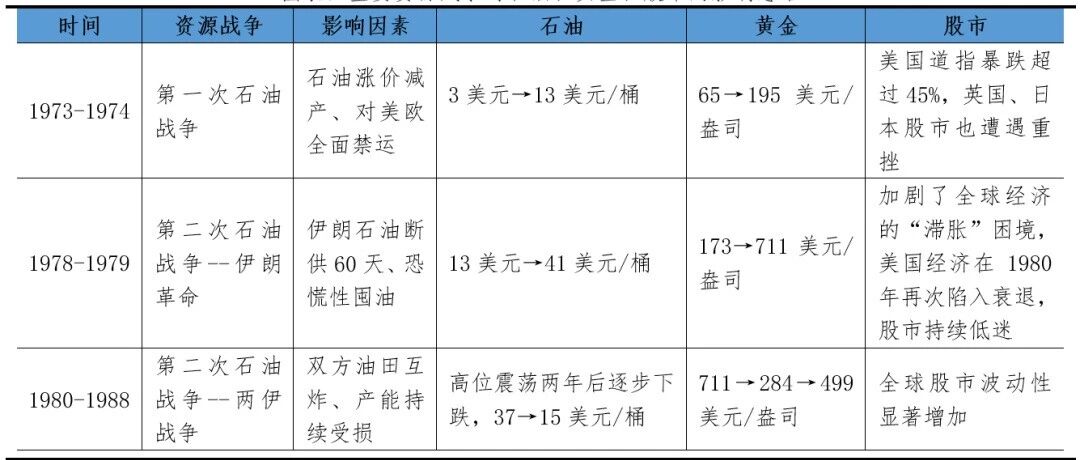
Core Viewpoint - The article discusses the impact and lessons from three oil wars, emphasizing that in times of great conflict, resources are paramount. The first two oil wars in the 1970s and the ongoing conflict between the US and Iran highlight the volatility of oil prices and the broader implications for global markets and economies [2][10]. Summary by Sections First Oil War (1973-1974) - The first oil war was triggered by the Fourth Middle East War, where Arab oil-producing countries used oil as a weapon, leading to a price surge from $3 to $13 per barrel within three months, a 400% increase [10][11]. - This war resulted in severe stagflation in the US, with the stock market experiencing a drop of over 45% [5][11]. - The crisis marked the end of the "cheap oil era" and initiated a decade-long bull market for gold, which increased by 950% from 1973 to 1980 [11]. Second Oil War (1978-1980) - The Iranian Revolution led to a 60-day halt in oil exports, causing prices to rise from $13 to $34 per barrel, followed by a peak of $41 during the Iran-Iraq War [13][15]. - The global economy faced intensified stagflation, with US inflation peaking at 15% and the Federal Reserve raising interest rates dramatically, which further pressured the stock market [19][21]. - The war did not create a long-term bull market for industrial metals, as demand was overshadowed by economic recession [21][22]. Third Oil War: US-Iran Conflict - The potential for a third oil war is indicated by the US's shift in energy strategy, focusing on traditional energy and key minerals, with military and economic means to secure resources [6][24]. - The US aims to control critical resources, including oil and minerals, to maintain its financial hegemony and support domestic manufacturing [25][26]. - The ongoing conflict's duration will significantly influence global asset pricing, inflation expectations, and monetary policy responses [30][31]. Market Implications - Oil prices are expected to rise depending on the conflict's duration, with Brent crude increasing by approximately 28% since the onset of hostilities [30]. - The stock market is likely to face pressure, particularly in sectors sensitive to oil prices, while resource and defense sectors may benefit from rising prices [31]. - The US dollar and treasury bonds are expected to strengthen as investors seek safe-haven assets amid geopolitical tensions [31].
伊朗油库成美以打击目标,机构预测冲突约4周结束,油价或剑指150美元
21世纪经济报道· 2026-03-08 14:06
Core Viewpoint - The article discusses the escalating tensions in the Middle East, particularly the military actions between Israel and Iran, which have led to significant disruptions in oil supply and a sharp increase in global oil prices. Group 1: Military Actions and Their Impact - On March 7, the Israeli military attacked multiple fuel storage facilities in Tehran, marking the first targeting of Iran's civilian energy infrastructure since the military strikes began on February 28 [1] - In retaliation, Iran launched missiles at oil facilities in Haifa, Israel [1] - The ongoing conflict has caused shipping disruptions in the Strait of Hormuz, a critical global oil transport route, leading to a historic surge in oil prices [1] Group 2: Oil Price Predictions - As of March 6, Brent crude oil prices surged to $93 per barrel, while WTI crude oil surpassed $91 [4] - Various institutions have provided forecasts for oil prices, with Barclays predicting $120 per barrel if the Middle East conflict continues for several weeks, and Macquarie suggesting prices could exceed $150 if the Strait of Hormuz is closed for weeks [2][7][10] - Goldman Sachs has indicated that oil prices could breach $100 if no resolution is found within the week [8] Group 3: Supply Chain Disruptions - The conflict has led to production cuts by oil-producing countries, with Kuwait implementing "preventive reductions" in oil production due to regional tensions [5] - Iraq's oil exports have slowed significantly, with a reported reduction of nearly 1.5 million barrels per day due to the situation in the Strait of Hormuz [5] - If the conflict persists, Asian oil-importing countries may need to increase imports from Russia and West Africa to compensate for potential supply shortages from the Middle East [6] Group 4: Market Reactions and Sentiment - The article notes that the escalation of tensions has heightened short-term panic in the oil market, with VLCC freight rates expected to remain high until a clearer resolution emerges [5] - Analysts warn that the current geopolitical landscape presents stronger risks compared to previous conflicts, such as the Russia-Ukraine situation, which could lead to significant price spikes [8][10]


机构预警:若中东冲突持续,这类“坚挺”资产的价格面临高估
第一财经· 2026-03-08 13:59
Core Viewpoint - The article discusses the impact of escalating geopolitical tensions, particularly between Israel and Iran, on global commodity markets, highlighting the potential overvaluation of certain assets and the risks associated with prolonged conflicts [3][4]. Group 1: Commodity Market Insights - The recent surge in WTI crude oil prices, which rose by 12.67% to $91.27 per barrel, reflects concerns over supply disruptions due to geopolitical conflicts [3]. - Copper prices, despite their recent strength driven by speculative demand and expectations of becoming a "new gold," are viewed as vulnerable to downward corrections if global economic growth falters [5]. - In contrast, major commodities like oil, natural gas, and aluminum may have upward potential in a slowing growth environment, with the Strait of Hormuz being critical for global LNG trade and contributing significantly to aluminum and urea production [5]. Group 2: Gold and Silver Market Analysis - Gold prices have shown volatility rather than a consistent upward trend, primarily due to high bond yields and a strong dollar, indicating a potential short-term risk for gold [6]. - The article suggests that if supply disruptions threaten global economic growth, gold may eventually benefit from increased safe-haven demand, while silver's industrial nature makes it more susceptible to economic slowdowns [6]. Group 3: Stock Market Dynamics - Japan's stock market faces significant risks due to its reliance on external energy, with potential negative impacts on corporate profitability from rising import costs amid geopolitical tensions [6]. - The S&P 500 index is showing signs of peaking, with market sentiment becoming increasingly uneasy, although energy stocks continue to rise due to the potential for further increases in energy prices [6][7]. Group 4: Future Market Outlook - The article warns of a significant oil supply shock due to the closure of the Strait of Hormuz, with ongoing attacks on oil tankers potentially leading to further price increases [9]. - Investors are advised to maintain cautious positions until there is clear confirmation of negotiations resuming between the U.S. and Iran, as the current geopolitical situation may lead to heightened market volatility [9].