
公用事业

Search documents
今日45只个股涨停 主要集中在机械设备、公用事业等行业
Zheng Quan Shi Bao Wang· 2025-10-14 07:32
Core Viewpoint - On October 14, the A-share market showed a significant disparity in stock performance, with a total of 1,613 stocks rising and 3,406 stocks falling, indicating a bearish trend in the market overall [1] Industry Summary - The stocks that hit the upper limit (涨停) were primarily concentrated in the following sectors: machinery and equipment, public utilities, electronics, light industry manufacturing, and non-ferrous metals [1] - A total of 45 stocks reached their upper limit, while 9 stocks hit their lower limit, reflecting a selective performance among different industries [1]
国信证券晨会纪要-20251014
Guoxin Securities· 2025-10-14 01:04
Macro and Strategy - The REITs market experienced a decline, with the China REITs Index down 0.3% for the week, underperforming compared to other indices like the China All Bond Index which increased by 0.1% [8][9] - The average weekly performance for property and concession REITs was -0.3% and -0.1% respectively, indicating a general downturn across most sectors [10] - The first foreign consumer REIT, Huaxia CapitaLand Commercial REIT, was successfully listed, marking a significant step towards the internationalization and diversification of China's public REITs market [11] Industry and Company Electric Power Equipment and New Energy - Prices for lithium hexafluorophosphate and electrolytes have risen by 10%-20% since October, leading to improved profitability for companies in the lithium battery supply chain [13][14] - The green methanol industry is advancing, with Jinfeng Technology's project in Inner Mongolia expected to reach an annual production capacity of 1.45 million tons by the end of 2027 [14] - The demand for energy storage systems has surged, with a cumulative bidding scale of 140 GWh in the first nine months of 2025, reflecting a 21% year-on-year increase [15][16] Retail Industry - The retail sector showed stable growth, with a 3.4% year-on-year increase in total retail sales of consumer goods in August 2025 [17] - The beauty and personal care segment is expected to see some growth despite being in a seasonal downturn, driven by marketing strategies and product launches [18] - The gold and jewelry sector experienced a significant growth of 16.8% in retail sales, supported by low base effects and rising gold prices [18] Automotive Industry - The narrow passenger car market is projected to grow by 2% year-on-year in September, with total retail sales expected to reach approximately 2.15 million units [20][21] - The automotive sector has shown strong performance, with the automotive index rising by 54.34% year-to-date, outperforming major indices [21][22] - The market is witnessing a shift towards electric and intelligent vehicles, with significant investments in autonomous driving technologies [22][23] Public Utilities and Environmental Protection - The public utilities sector has shown resilience, with the public utility index rising by 3.45% while the overall market declined [30] - The green methanol production process is gaining traction, with multiple provinces initiating projects under the "136 Document" framework [30][31] - Investment strategies in the public utility sector focus on stable earnings from traditional energy sources while also promoting renewable energy projects [32] Insurance Sector - Recent policy support for the insurance industry is expected to enhance the stability and growth of leading insurance companies [34] - The insurance sector is seen as having significant allocation value due to improving asset returns and favorable policy conditions [34] Metals Industry - The copper market is experiencing upward price pressure due to production cuts from major mines, with expectations of continued profit growth for listed companies [35]
Black Hills Corporation (BKH): A Reliable Utility Powering Steady Dividend Growth
Insider Monkey· 2025-10-14 00:27
Core Insights - Artificial intelligence (AI) is identified as the greatest investment opportunity of the current era, with a strong emphasis on the urgency to invest now [1][13] - The energy demands of AI technologies are highlighted, with data centers consuming as much energy as small cities, leading to concerns about power grid strain and rising electricity prices [2][3] Investment Opportunity - A specific company is positioned as a critical player in the AI energy sector, owning essential energy infrastructure assets that will benefit from the increasing energy demands of AI [3][7] - This company is not a chipmaker or cloud platform but is described as a "toll booth" operator in the AI energy boom, profiting from the surge in electricity demand [4][5] Market Position - The company is noted for its debt-free status and significant cash reserves, equating to nearly one-third of its market capitalization, which provides a strong financial foundation [8] - It holds a substantial equity stake in another AI-related company, offering investors indirect exposure to multiple growth engines in the AI sector [9] Strategic Advantages - The company is involved in large-scale engineering, procurement, and construction (EPC) projects across various energy sectors, including nuclear energy, which is crucial for America's future power strategy [7][8] - The current political climate, particularly Trump's tariffs, is expected to drive onshoring and increase demand for U.S. LNG exports, positioning the company favorably in the market [5][14] Future Outlook - The influx of talent into the AI sector is expected to lead to rapid advancements and innovative ideas, reinforcing the notion that investing in AI is backing the future [12] - The potential for significant returns is emphasized, with projections of over 100% returns within 12 to 24 months for investors who act now [15]



沪指低开高走 科创50逆势上涨
Shen Zhen Shang Bao· 2025-10-13 23:10
Market Overview - On October 13, A-shares opened significantly lower due to renewed US-China trade tensions but rebounded throughout the day, with the Shanghai Composite Index closing down 0.19% at 3889.5 points and the Shenzhen Component down 0.93% [1] - The total trading volume for A-shares was approximately 2.37 trillion yuan [1] - The Hang Seng Index also opened lower but stabilized, closing down 1.52% [1] Sector Performance - Despite the overall market decline, sectors such as non-ferrous metals, semiconductors, military, and banking saw gains, with the non-ferrous sector rising over 3% [2] - More than 90 stocks experienced a limit-up or increased by over 10%, while six non-ST stocks hit the limit-down [2] - Notable gainers included China Rare Earth and Northern Rare Earth, both hitting the limit-up [2] Trade Tensions and Government Response - On October 10, President Trump announced the re-imposition of tariffs on China, leading to significant sell-offs in US markets, with the Dow down 1.9% and the Nasdaq down 3.56% [2] - The Chinese Ministry of Commerce stated that recent export control measures on rare earths were a normal action to improve its export control system, emphasizing that high tariffs are not a proper way to engage with China [3] Investment Strategy - Analysts suggest that the impact of the current tariff situation will be less severe than in April, with a recommendation to focus on defensive sectors such as utilities and banking in the short term [4] - There is an emphasis on monitoring strategic advancements in frontier technology sectors, including nuclear fusion, artificial intelligence, and semiconductor manufacturing for mid-term investment opportunities [4] - The current market environment is characterized by a "wide monetary + wide fiscal" policy, with a suggestion to focus on technology trends and domestic substitution in sectors like AI computing chips and semiconductor equipment [5]
模型切换提示小盘风格占优,外部冲击下韧劲较强:——量化择时周报20251010-20251013
Shenwan Hongyuan Securities· 2025-10-13 10:46
Group 1 - Market sentiment indicators showed a slight decline, with the sentiment score at 1.75 as of October 10, down from 1.85 on September 26, indicating a bearish outlook [8][11] - The trading volume for the entire A-share market increased slightly compared to the previous week, with a peak trading volume of 26,718.18 billion RMB on October 9, indicating improved market activity [14][16] - The financing balance ratio continued to rise, reflecting an increase in market leverage sentiment and improved trading atmosphere among investors [24][26] Group 2 - The model indicates a preference for small-cap value style, with a weak signal strength due to a slight decline in the 5-day RSI relative to the 20-day RSI, suggesting further observation is needed [30][41] - The short-term trend scores for industries such as banks, steel, public utilities, and construction decoration have shown upward trends, with non-ferrous metals currently having the highest short-term score of 98.31 [30][32] - High trading congestion in sectors like non-ferrous metals and coal, alongside lower price increases in sectors like automobiles and electronics, suggests potential volatility risks and opportunities for gradual allocation in low-congestion sectors like pharmaceuticals and beauty care [37][36]
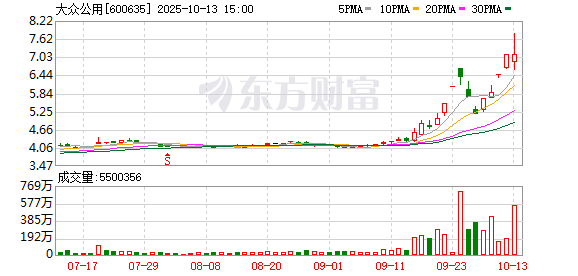
大众公用10月13日龙虎榜数据
Zheng Quan Shi Bao Wang· 2025-10-13 10:03
Core Viewpoint - Dazhong Public (600635) experienced significant trading activity with a turnover rate of 22.74% and a trading volume of 3.963 billion yuan, indicating heightened investor interest and volatility in the stock [2][3]. Trading Activity - The stock closed flat today with a daily amplitude of 18.39% and was listed on the Shanghai Stock Exchange's "Dragon and Tiger List" due to its high volatility and turnover rate [2]. - The net selling by the Shanghai-Hong Kong Stock Connect amounted to 32.528 million yuan, while the total net buying from brokerage seats was 31.262 million yuan [2]. - The top five brokerage seats accounted for a total transaction volume of 795 million yuan, with a net selling of 1.2658 million yuan [2]. Fund Flow - The stock saw a net outflow of 401 million yuan in principal funds today, with large orders contributing to a net outflow of 333.4 million yuan [3]. - Over the past five days, the stock experienced a net inflow of 242 million yuan in principal funds [3]. Margin Trading - As of October 10, the stock's margin trading balance was 759 million yuan, with a financing balance of 754 million yuan and a securities lending balance of 4.7822 million yuan [3]. - The financing balance decreased by 19.2155 million yuan over the past five days, representing a decline of 2.49%, while the securities lending balance increased by 788,500 yuan, reflecting a growth of 19.74% [3]. Financial Performance - According to the semi-annual report released on August 30, the company achieved an operating income of 3.476 billion yuan in the first half of the year, a year-on-year decrease of 5.80%, while net profit reached 333 million yuan, marking a significant year-on-year increase of 172.62% [3].

公用事业行业周报(2025.10.06-2025.10.12):预期触底,风格回暖-20251013
Orient Securities· 2025-10-13 09:47
Investment Rating - The report maintains a "Positive" investment rating for the utility sector in China [5] Core Views - The utility sector is expected to see a recovery in style as it approaches a bottoming out phase [2] - The report highlights that the demand for electricity is likely to remain high due to seasonal inventory replenishment and government policies aimed at stabilizing coal and electricity prices [7] - The report emphasizes the importance of long-term investment in utility assets, particularly in the context of low interest rates and policy encouragement for long-term capital [7] Summary by Sections Investment Recommendations and Targets - The report suggests a focus on utility stocks, particularly in the context of a favorable long-term investment environment for dividend assets [7] - Specific recommendations include: - Thermal Power: Expected profit growth in Q3 2025, with improved commercial models [7] - Hydropower: Suggests investing in high-quality large hydropower projects due to low cost per kilowatt hour [7] - Nuclear Power: Strong long-term growth potential with risks from market pricing already released [7] - Wind and Solar: Anticipated growth in electricity generation under carbon neutrality expectations [7] Industry Dynamics - The report notes a slight increase in coal prices at ports, with inventory levels rising [10][21] - The Three Gorges Reservoir has seen significant increases in both inflow and outflow, indicating improved hydropower generation conditions [29] - The utility sector index outperformed major indices, indicating strong market performance [35][37]
ETF基金周报:战略金属与新兴产业的双重驱动,稀土板块仍具备投资价值-20251013
Dongguan Securities· 2025-10-13 09:21
基 金 ETF 基金周报(20251006-20251010): 战略金属与新兴产业的双重驱动 稀土板块仍具备投资价值 2025 年 10 月 13 日 投资要点 分析师:李荣 SAC 执业证书编号: S0340521010001 基金从业资格证书编号: F4520000001431 电话:0769-26628039 邮箱:lirong@dgzq.com.cn 研 究 本报告的风险等级为中高风险。 本报告的信息均来自已公开信息,关于信息的准确性与完整性,建议投资者谨慎判断,据此入市,风险自担。 请务必阅读末页声明。 证 券 研 究 报 告 资料来源:东莞证券研究所,Wind 资讯 各类ETF基金周度平均收益及资金流动概览:本周全球大类资产显著分 化。日经指数在高市早苗大概率当选女首相等消息影响下跳空涨超5%, 而美国市场受政府停摆影响及贸易摩擦升级的影响,三大指数均跌超2%, 港股市场同步调整,而传统避险资产黄金一度再创出历史新高。国内权 益市场方面,价值风格优于成长风格。在ETF基金方面,商品型ETF和货 币型ETF基金周度平均收益为正,其他类型ETF基金均录得负收益。本周 ETF基金资金流动情况并不显著, ...
量化择时周报:模型切换提示小盘风格占优,外部冲击下韧劲较强-20251013
Shenwan Hongyuan Securities· 2025-10-13 08:12
Group 1: Market Sentiment Indicators - The market sentiment index as of October 10 is 1.75, a slight decrease from 1.85 on September 26, indicating a bearish sentiment [8][11] - The financing balance ratio continues to rise, reflecting an increase in market leverage sentiment and improving trading atmosphere [27][11] - The industry trading volatility continues to decline, suggesting a slowdown in fund switching activity and a decrease in market participants' divergent views on short-term industry value [21][11] Group 2: Timing Model Insights - The model indicates a preference for small-cap value style, with a weak signal strength due to a slight decline in the 5-day RSI relative to the 20-day RSI [45][46] - The short-term trend scores for industries such as non-ferrous metals, power equipment, real estate, machinery, and electronics are notably strong, with non-ferrous metals scoring the highest at 98.31 [34][36] - The model maintains a strong signal for value style, suggesting potential for further strengthening in the future [45][46] Group 3: Industry Crowding and Performance - Recent high returns in non-ferrous metals and coal are accompanied by high fund crowding, indicating potential volatility risks due to valuation and sentiment corrections [42][41] - Industries like automotive and electronics show high crowding but lower returns, while sectors with low crowding such as pharmaceuticals and beauty care may present long-term investment opportunities as risk appetite increases [42][41] - The average crowding levels for industries as of October 10 show automotive, environmental protection, real estate, power equipment, and electronics as the highest, while agriculture, computers, defense, beauty care, and pharmaceuticals are the lowest [40][41]
港股红利资产或具备长期配置价值,关注恒生红利低波ETF(159545)等产品布局机会
Mei Ri Jing Ji Xin Wen· 2025-10-13 07:21
Core Viewpoint - The Hong Kong dividend sector is experiencing a recovery, with the Hang Seng High Dividend Low Volatility Index showing a reduced decline of 0.4% as of 14:50, indicating a potential investment opportunity in stable dividend assets amidst global economic uncertainties [1] Group 1: Market Performance - The Hang Seng High Dividend Low Volatility Index consists of 50 stocks with good liquidity, continuous dividends, moderate payout ratios, and low volatility, with the top three sectors being energy, finance, and utilities, collectively accounting for over 55% of the index [1] - Notable stocks in the index include Luk Fook Holdings, China Gas, China Everbright Environment, and Hengan International, all of which have seen gains of over 1% [1] Group 2: Investment Insights - According to China Merchants Securities, there is a demand for absolute return funds due to global economic uncertainties, making Hong Kong dividend assets attractive for their lower volatility and stronger stability, suggesting long-term allocation value [1] - Analysts suggest that attention should be given to cyclical dividend stocks in the medium term, focusing on the potential recovery of domestic profit cycles, which may favor resource stocks [1] Group 3: Index and ETF Details - The current dividend yield of the Hang Seng High Dividend Low Volatility Index is approximately 6.1% [1] - The Hang Seng Low Dividend ETF (159545) offers a low management fee rate of 0.15% per year, facilitating low-cost investment in the Hong Kong high dividend sector [1]