
多晶硅

Search documents
国家能源局为绿电消费划硬性“KPI”,电解铝首迎强制消费考核
2 1 Shi Ji Jing Ji Bao Dao· 2025-07-25 11:56
Core Viewpoint - The recent notification from the National Development and Reform Commission and the National Energy Administration aims to expand the demand for green certificates, leading to an upward trend in green certificate prices, with expectations for further increases in the future [1][2][3] Group 1: Green Certificate Market Dynamics - The notification sets specific green electricity consumption ratios for key industries, including electrolytic aluminum, steel, cement, polysilicon, and data centers, with the electrolytic aluminum industry being the only one subject to mandatory assessment [1][4] - The green electricity consumption ratio for electrolytic aluminum, steel, cement, and polysilicon is set between 25.2% and 70%, while new data centers are required to achieve 80% [1][5] - The green certificate market has seen significant growth, with a reported 446 million green certificates traded in 2024, marking a 364% year-on-year increase [1] Group 2: Industry-Specific Implications - The electrolytic aluminum industry is highlighted as a major focus due to its high energy consumption and carbon emissions, with a target of 25% renewable energy usage by 2025 [4][6] - Data centers are recognized as rapidly growing energy consumers, with a specific requirement for 80% green electricity consumption, reflecting ongoing efforts to promote low-carbon development [6][7] - The notification allows for a monitoring phase for most industries, providing a buffer period for companies to adapt to the new policies before mandatory assessments begin [2][7] Group 3: Future Outlook and Strategies - The anticipated increase in green certificate prices is driven by factors such as international recognition of Chinese green certificates and adjustments in supply dynamics [2][3] - Companies in energy-intensive sectors are expected to explore various strategies to meet green electricity consumption targets, balancing economic considerations with sustainability goals [7] - The alignment of local renewable energy consumption responsibilities with industry-specific targets indicates a coordinated approach to enhancing green energy adoption across regions [6][7]
短期内市场看多情绪仍然高涨 多晶硅期货易涨难跌
Jin Tou Wang· 2025-07-25 07:17
机构观点 福能期货:反内卷政策预期仍是市场主线,随着"反内卷"预期继续发酵,市场消息传多晶硅收储方案, 叠加焦煤价格大涨,引燃多晶硅市场情绪,目前多晶硅最低交割品交割涨至45000元/吨。根据多晶硅定 调不能低于全成本销售,头部企业报价仍集中在49000-50000元/吨。同时上周硅片价格大幅上调,多晶 硅价格得以传导。短期在政策预期下多晶硅易涨难跌。 兴业期货:多晶硅价格上涨已达成相关政策的短期目标"治理低价无序竞争",后续产能出清难度可能加 大,上涨驱动有所下降。需求端最新数据显示6月光伏新增装机仅14.36GW,同比下降38%,环比下降 85%;由于3-5月抢装导致需求前置,因此三季度需求支撑不足。总体而言,受反内卷影响,短期市场 看多情绪仍然高涨,但也已逐步见顶,结合政策预期及落地情况看,后续市场或进入区间震荡阶段。 多晶硅材料制备技术国家工程实验室主任严大洲:要按中国"双碳"战略目标,设置到2060年中国多晶硅 及光伏产业发展规划,避免"一哄而上,一哄而下"盲目发展,减少国家损失。 24日,多晶硅N型复投硅料价格涨至46000元/吨,最低交割品硅料价格涨至46000元/吨,现货贴水扩至 7740元/ ...
新能源及有色金属日报:政策端扰动持续,多晶硅盘面偏强震荡-20250725
Hua Tai Qi Huo· 2025-07-25 07:11
Group 1: Investment Ratings - No investment ratings for the industry are provided in the report. Group 2: Core Views - The overall sentiment of commodities remains positive. The supply - demand pattern of industrial silicon has improved recently, with reduced inventory. Affected by the anti - involution policy and the rising price of coking coal, the industrial silicon futures market may show a strong performance. For polysilicon, due to the expected impact of the anti - involution policy on capacity and under the influence of capital sentiment, the futures market may also run strongly [3][7]. Group 3: Summary by Industry Industrial Silicon - **Market Analysis**: On July 24, 2025, the main contract 2509 of industrial silicon futures opened at 9560 yuan/ton and closed at 9690 yuan/ton, a change of - 0.21% from the previous day's settlement. The position of the main contract was 336274 lots, and the number of warehouse receipts was 49776 lots, a decrease of 330 lots from the previous day. The spot price of industrial silicon increased. The social inventory in major areas was 53.5 tons, a decrease of 1.2 tons from the previous week [1]. - **Supply - Side**: The spot price of industrial silicon rose. The price of East China oxygen - blown 553 silicon was 10000 - 10200 yuan/ton, and 421 silicon was 10200 - 10500 yuan/ton. The price of Xinjiang oxygen - blown 553 silicon was 9400 - 9600 yuan/ton, and 99 silicon was 9400 - 9500 yuan/ton. Downstream users purchased on demand, and the center of market transactions moved up [1]. - **Consumption - Side**: The quoted price of organic silicon DMC was 12100 - 12800 yuan/ton. The supply was expected to decrease due to an incident at a Shandong organic silicon plant. The decrease in supply and the sharp rise in weekly prices stimulated downstream enterprises' panic - buying sentiment [2]. - **Strategy**: For unilateral trading, it is advisable to be cautiously bullish; there is no strategy for inter - period trading [3]. Polysilicon - **Market Analysis**: On July 24, 2025, the main contract 2509 of polysilicon futures continued to rise, opening at 50025 yuan/ton and closing at 53765 yuan/ton, a 5.15% increase from the previous trading day. The position of the main contract was 172564 lots, and the trading volume was 1123795 lots. The spot price of polysilicon remained stable. The polysilicon manufacturers' inventory decreased, while the silicon wafer inventory increased. The weekly polysilicon output was 25500 tons, a 10.87% increase, and the silicon wafer output was 11.20GW, a 0.90% increase [4]. - **Strategy**: In the short - term, it is recommended to conduct range trading for unilateral trading; there are no strategies for inter - period, cross - variety, spot - futures, and options trading [9]. Silicon Wafers, Battery Cells, and Components - **Silicon Wafers**: The price of domestic N - type 18Xmm silicon wafers was 1.10 yuan/piece, N - type 210mm was 1.45 yuan/piece, and N - type 210R silicon wafers was 1.25 yuan/piece [6]. - **Battery Cells**: The price of high - efficiency PERC182 battery cells was 0.27 yuan/W, PERC210 battery cells was about 0.28 yuan/W, Topcon M10 battery cells was about 0.27 yuan/W, Topcon G12 battery cells was 0.27 yuan/W, Topcon 210RN battery cells was 0.27 yuan/W, and HJT210 half - piece battery was 0.37 yuan/W [6]. - **Components**: The mainstream transaction price of PERC182mm components was 0.67 - 0.74 yuan/W, PERC210mm was 0.69 - 0.73 yuan/W, N - type 182mm was 0.68 - 0.70 yuan/W, and N - type 210mm was 0.68 - 0.70 yuan/W [6].
广发期货日评-20250725
Guang Fa Qi Huo· 2025-07-25 02:49
Report Summary 1. Report Industry Investment Ratings No specific industry investment ratings are provided in the report. 2. Core Viewpoints - In the context of anti - involution narratives and expectations of incremental policies, the overall stock and commodity markets remain strong, while long - term bonds are under pressure. The market is affected by factors such as trade negotiations, central bank policies, and supply - demand relationships in different sectors [2]. 3. Summary by Categories Equity Index - There is an obvious high - low rotation among sectors. It is recommended to gradually take profits on long positions in IM futures and switch to a small amount of short positions in put options on MO with a strike price of 6000 in the 08 contract, and reduce positions, maintaining a moderately bullish stance. On the unilateral strategy, it is advisable to stay on the sidelines in the short term and pay attention to the capital situation and incremental policies [2]. Treasury Bonds - The risk assets suppress long - term bonds. With the tightening of the capital market, the short - selling sentiment in the bond futures market has increased, and the redemption pressure on bond funds may start to rise, which still suppresses the bond market. In terms of the curve strategy, it is possible to continue to bet on the steepening [2]. Precious Metals - Gold is supported by the weakening of the US dollar's credit and its commodity attributes, and it oscillates above the 60 - day moving average. Silver has further upside potential due to the general rise of domestic industrial products and capital inflows, and long positions can be held. Gold continues to correct as the European Central Bank pauses rate cuts for the first time in a year and the risk - aversion sentiment eases [2]. Shipping Index (European Line) - The EC main contract rebounds slightly. With the increasing expectation of anti - involution, the price continues to oscillate strongly. It is recommended to hold short positions in the 08 contract or short the 10 contract at high prices [2]. Steel and Iron Ore - The iron ore has insufficient upward momentum as the molten iron output slightly decreases and the port inventory slightly increases. It is recommended to go long on coking coal and short on iron ore. The steel price continues to oscillate strongly, and long positions can be held [2]. Coking Coal and Coke - The expectation of production - restriction documents is rising, the resumption of coal mines is lagging, the spot market is strong, and the transaction is picking up. The third round of price increases by mainstream coking plants has started, and there is still an expectation of price increases. It is recommended to take profits on long positions step by step at high prices [2]. Non - ferrous Metals - Copper: The short - term sentiment fades, and high copper prices suppress demand. - Aluminum: The market sentiment is bullish, and the aluminum price oscillates at a high level, but the expectation of inventory accumulation in the off - season is still strong. - Other non - ferrous metals also have different market trends and corresponding trading suggestions based on factors such as macro - sentiment, inventory, and supply - demand [2]. Energy and Chemicals - Crude oil: The macro - sentiment eases, and the demand expectation recovers, pushing up the oil price. - Other energy and chemical products such as urea, PX, PTA, etc., have different market trends and trading suggestions according to factors such as supply - demand, macro - environment, and cost [2]. Agricultural Products - Different agricultural products such as soybeans, corn, palm oil, etc., have different market trends and trading suggestions based on factors such as supply - demand, weather, and policy [2]. Special Commodities - Glass: The document on air pollution prevention boosts market sentiment, and the spot transaction is strong. - Rubber: The macro - sentiment is positive, and supply disruptions due to rainy weather in overseas production areas and conflicts between Thailand and Cambodia drive up the rubber price. - Other special commodities also have corresponding market trends and trading suggestions [2]. New Energy - Polysilicon futures oscillate and rise to a new high, but attention should be paid to the risk of a pullback due to the increase in warehouse receipts. - Recycled lithium: The market sentiment is boosted, but the fundamental change is not significant. It is recommended to be cautious and stay on the sidelines [2].
理性参与商品期货交易 勿被短期波动迷惑双眼
Qi Huo Ri Bao Wang· 2025-07-25 02:10
近期,多晶硅、焦煤、玻璃等工业品期货价格大幅上涨,吸引了市场各方高度关注。7月7日至22日,南 华商品指数累计上涨4.9%。 笔者认为,本轮商品期货大涨的主要原因有四点: 二是产业的结构性特点。多晶硅是本轮商品上涨行情中的最强品种,其产业结构特点助推了价格上涨。 多晶硅行业是典型的寡头垄断行业,前五大企业份额占全市场的70%左右,头部企业拥有强大的价格主 导能力。当市场出现利多信号时,头部企业可通过减产、提价等方式影响市场价格,短期内极易引发期 货价格大幅波动。然而,价格持续非理性大涨会严重伤害下游产业链。下游企业无法顺利转嫁成本,利 润空间被大幅挤压甚至亏损,长此以往会打击其生产积极性,可能减少生产规模,反过来影响上游多晶 硅等产品需求。这不仅违背政策初衷,还会破坏产业链生态平衡,可能引发系统性风险。 更重要的是,上一轮商品牛市有地产、投资等领域需求的强劲支持,当时房地产蓬勃发展和大规模基础 设施建设极大地拉动了钢铁、煤炭、水泥等工业品的需求,为价格上涨提供了坚实基础。本轮"反内 卷"政策更多是希望引导供需适配。从政策角度看,只有国内需求合理发展,带动经济稳步增长,才可 能是本轮牛市的根本驱动因素。 另一方 ...
国务院国资委:带头抵制“内卷式”竞争;特朗普再次希望鲍威尔降息|盘前情报
2 1 Shi Ji Jing Ji Bao Dao· 2025-07-25 00:48
Market Performance - On July 24, the A-share market experienced a rise, with all three major indices reaching new highs for the year. The Shanghai Composite Index closed above 3600 points, up 0.65% to 3605.73 points, while the Shenzhen Component Index rose 1.21% to 11193.06 points, and the ChiNext Index increased by 1.5% to 2345.37 points. The total trading volume in the Shanghai and Shenzhen markets was 1.84 trillion yuan, a decrease of 199 billion yuan from the previous trading day [2] - The market showed a mixed performance with over 4300 stocks rising, while sectors such as Hainan Free Trade Zone, rare earth permanent magnets, lithium mining, and super hydropower led the gains. In contrast, sectors like precious metals, banking, and CPO saw declines [2] International Market Overview - In the U.S. stock market on July 24, the Dow Jones Industrial Average fell by 316.38 points, or 0.70%, closing at 44693.91 points. The S&P 500 index rose by 4.44 points, or 0.07%, to 6363.35 points, while the Nasdaq Composite Index increased by 37.94 points, or 0.18%, to 21057.96 points [4] - European markets showed mixed results as well, with the UK FTSE 100 index rising by 76.88 points, or 0.85%, to 9138.37 points, while the French CAC40 index fell by 32.15 points, or 0.41%, to 7818.28 points, and the German DAX index increased by 55.11 points, or 0.23%, to 24295.93 points [3] Commodity Prices - International oil prices rose on July 24, with light crude oil futures for September delivery increasing by $0.78 to $66.03 per barrel, a rise of 1.2%. Brent crude oil futures for September delivery also saw an increase of $0.67, closing at $69.18 per barrel [3] Financial Policies and Regulations - The People's Bank of China and the Ministry of Agriculture and Rural Affairs issued an opinion to enhance financial services for rural reform and promote comprehensive rural revitalization, focusing on increasing financial resources in key areas such as food security and rural industry development [6] - The People's Bank of China announced it will conduct a 400 billion yuan Medium-term Lending Facility (MLF) operation on July 25, with a one-year term [7] - The State-owned Assets Supervision and Administration Commission emphasized optimizing the allocation of state-owned assets and resisting "involution-style" competition, aiming for high-quality state-owned enterprise reforms [9] Industry Insights - The National Medical Insurance Administration announced that the latest round of centralized procurement will not solely rely on the lowest bid as a reference, aiming to promote quality competition and reasonable profit margins in the pharmaceutical sector [11] - In the photovoltaic industry, there are plans to revise the comprehensive energy consumption standards for polysilicon products to eliminate outdated production capacity, with current standards being ≤7.5, 8.5, and 10.5 kgce/kg, and proposed revisions to ≤5, 6, and 7.5 kgce/kg [12]






碳中和50ETF(159861)涨超1.1%,硅产业链调整或迎转机
Mei Ri Jing Ji Xin Wen· 2025-07-24 23:16
Industry Overview - The polysilicon industry is undergoing a significant adjustment phase, with government ministries and associations actively intervening through measures such as "anti-involution" actions and capacity mergers [1] - The price of silicon materials has risen for three consecutive weeks, leading to a collective increase in silicon wafer prices, with the average transaction price of N-type G10L monocrystalline silicon wafers rising by 22.09% month-on-month [1] - Component prices have also seen a slight increase, with the average price of distributed projects rising by 2.92% [1] - The rising prices along the supply chain are expected to transmit downstream [1] Market Forecast - Global photovoltaic installations are expected to reach approximately 580 GW by 2025, with polysilicon demand estimated at around 1.4 million tons and domestic production expected to be about 1.35 million tons, indicating a gradual improvement in supply-demand dynamics [1] Investment Opportunities - The Carbon Neutrality 50 ETF (159861) tracks the Environmental 50 Index (930614), which is compiled by China Securities Index Co., Ltd. This index selects listed companies involved in clean energy, environmental engineering, and resource recycling from the A-share market, reflecting the overall performance of securities related to the environmental industry [1] - The index covers multiple sub-sectors of the environmental industry, providing good industry representation and investment reference value [1] - Investors without stock accounts may consider the Guotai CSI Environmental Industry 50 ETF Connect C (012504) and Guotai CSI Environmental Industry 50 ETF Connect A (012503) [1]
“反内卷行情”升温,中国股、汇齐涨,国际投资者怎么看
Di Yi Cai Jing· 2025-07-24 13:19
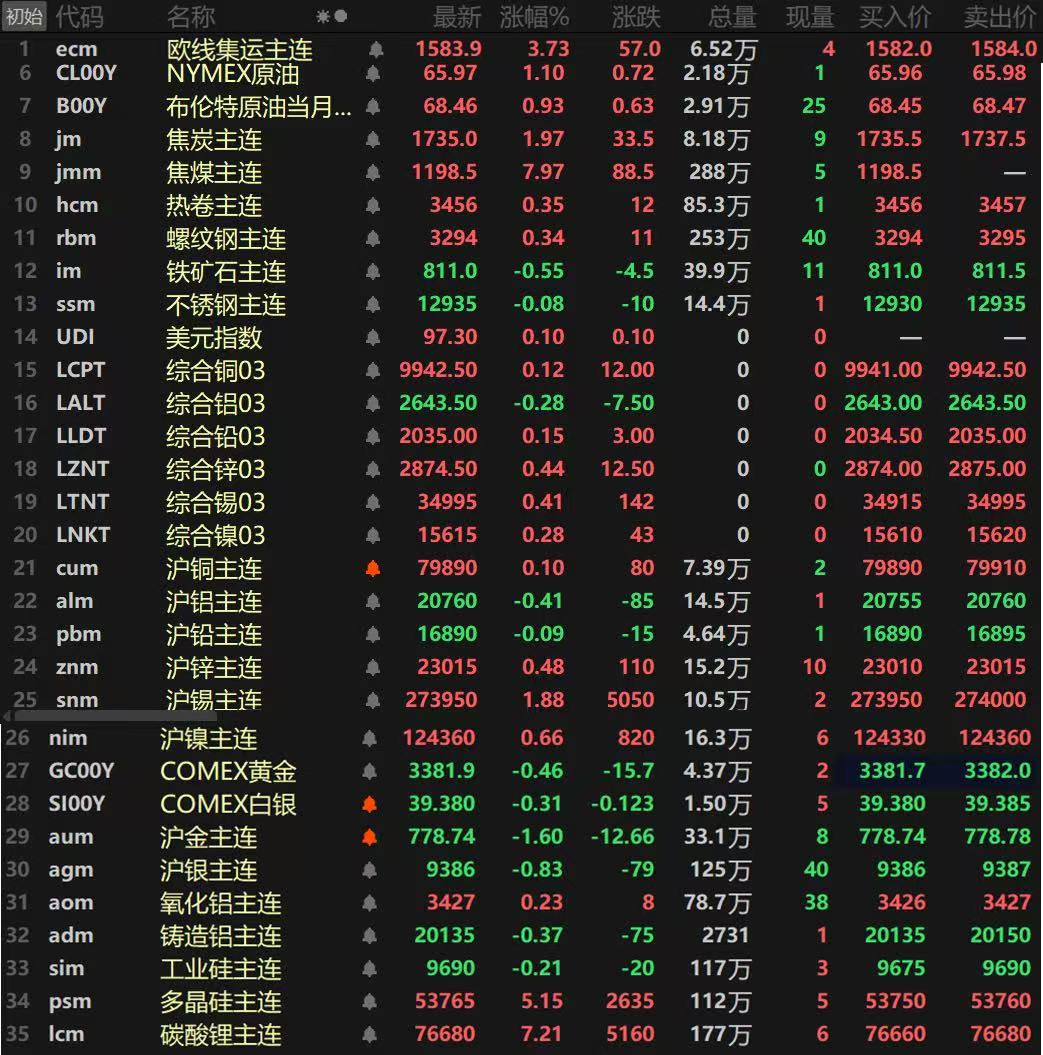
国内外基金普遍出现加仓或"空头回补"迹象。 本周,资本市场情绪明显再度升温,A股突破3600点大关,港股持续创下年内新高,隔夜中概股也纷纷大涨,离岸人民币对美元持续升值并进入7.14区间。 国际投行普遍认为,三大因素主导了近期的乐观情绪——"反内卷"政策深入,西藏水坝工程提振基建投资预期,美国与日本、印尼的贸易协议以及与欧盟协 议的积极预期提振了市场对中美贸易协议的预期。 其中,"反内卷交易"在本周主导市场,接受记者采访的国内外基金普遍出现加仓或"空头回补"迹象。例如,光伏公司股价平均上涨了32%,高盛认为这反映 市场对光伏领域(特别是硅料)通过"反内卷"成为解决产能问题试点行业的预期。同时,多晶硅价格(非成交价格)在两周内上涨40%,各界预计产业内公 司可能讨论收购尾部产能的计划。 | 初始 代码 | | 名称 | * ● | 反新 | 涨幅% | 涨跌 | 总量 | 现宣 | 买入价 | 卖出价 | | --- | --- | --- | --- | --- | --- | --- | --- | --- | --- | --- | | 17 | ecm | 欧线集运主连 | 4 | 1583.9 | 3 ...
有色和贵金属每日早盘观察-20250724
Yin He Qi Huo· 2025-07-24 09:56
Report Industry Investment Rating No relevant content provided. Core Viewpoints of the Report The report analyzes the market conditions, important information, logical analysis, and trading strategies of various metals including precious metals, copper, alumina, electrolytic aluminum, cast aluminum alloy, zinc, lead, nickel, stainless steel, industrial silicon, polysilicon, and lithium carbonate. Overall, the uncertainty of US tariffs and policies will bring inflation rebound and economic slowdown, and the independence of the Federal Reserve is also unknown. Precious metals are expected to remain in a pattern of being easy to rise and difficult to fall. Other metals are affected by factors such as supply and demand, policies, and market sentiment, showing different trends and investment suggestions [4]. Summary by Relevant Catalogs Precious Metals - **Market Review**: London gold fell 1.3% to $3386.7 per ounce after three - day gains, London silver fell 0.12% to $39.216 per ounce. Affected by the external market, Shanghai gold futures fell 0.78% to 785.26 yuan per gram, and Shanghai silver futures fell 0.36% to 9431 yuan per kilogram. The US dollar index fell 0.18% to 97.214, the 10 - year US Treasury yield dropped to 4.39%, and the RMB exchange rate against the US dollar rose 0.21% to 7.1547 [3]. - **Important Information**: There are developments in trade negotiations between the US and other major economies, and the Federal Reserve's situation has eased market risk - aversion. The probability of the Federal Reserve maintaining interest rates unchanged in July is 97.4%, and the probability of a 25 - basis - point cut is 2.6%. In September, the probability of maintaining interest rates unchanged is 37.2%, and the probability of a cumulative 25 - basis - point cut is 61.2% [3]. - **Logical Analysis**: The uncertainty of US tariffs and policies will bring inflation rebound and economic slowdown, and the independence of the Federal Reserve is also unknown. Precious metals are expected to remain in a pattern of being easy to rise and difficult to fall [4]. - **Trading Strategy**: Consider holding long positions based on the 5 - day moving average for unilateral trading; hold a wait - and - see attitude for arbitrage and options [5][6][7]. Copper - **Market Review**: The night - session Shanghai copper 2509 contract closed at 79680 yuan per ton, down 0.16%, and the Shanghai copper index increased its positions by 1404 lots to 513,000 lots. The overnight LME copper closed at $9933.5 per ton, up 0.36%. The LME inventory decreased by 25 tons to 125,000 tons, and the COMEX inventory increased by 418 tons to 244,000 tons [9][10]. - **Important Information**: The output of Vale and MMG's copper mines increased. Kazakhstan plans to double copper production by 2030, and a Canadian mining company hopes its project will be put into production in 2030. The 232 tariff will be implemented on August 1st, with a 50% tariff rate [13][14][15]. - **Logical Analysis**: The short - term market has increased expectations for a new round of supply - side reform and anti - deflation, and copper prices are running strongly. Supply is high, and it is in the consumption off - season, with limited upside potential [15]. - **Trading Strategy**: Copper prices are expected to run strongly in the short - term for unilateral trading; hold a wait - and - see attitude for arbitrage and options [16]. Alumina - **Market Review**: The night - session alumina 2509 contract fell 53 yuan to 3366 yuan per ton. The spot price in the north rose, and the national weighted index also increased [18]. - **Important Information**: Policies to eliminate backward production capacity are about to be released. There were spot transactions in Shandong and Vietnam. The alumina warehouse receipts on July 23 were 6922 tons, unchanged from the previous day. The production of some factories in Shanxi has changed [19][20][21]. - **Logical Analysis**: The market has optimistic expectations for policies, but details are yet to be determined. The current warehouse receipts are at a low level. If the increase in warehouse receipts is limited, the alumina price will still be supported above the full cost of high - cost production capacity [22]. - **Trading Strategy**: Alumina prices will fluctuate widely in the short - term for unilateral trading; hold a wait - and - see attitude for arbitrage and options [23][24]. Electrolytic Aluminum - **Market Review**: The night - session Shanghai aluminum 2508 contract rose 70 yuan per ton to 20960 yuan per ton. The spot price of aluminum ingots in different regions increased. The price of thermal coal also rose [26]. - **Important Information**: The inventory of electrolytic aluminum in major markets increased, and the warehouse receipts of the Shanghai Futures Exchange decreased. The housing completion area decreased, and there were trade negotiations between the US and other countries. The output of some aluminum plants increased, and the export and import volume of aluminum products changed [27][30][31]. - **Logical Analysis**: The negotiation of tariffs has made progress, and the LME aluminum price has rebounded. Domestically, policies to eliminate backward production capacity are expected to boost aluminum prices. The aluminum rod production has decreased, and the inventory of aluminum ingots may increase slightly. The aluminum consumption off - season may not be too serious [31]. - **Trading Strategy**: Aluminum prices will run strongly in the short - term for unilateral trading; hold a wait - and - see attitude for arbitrage and options [32]. Cast Aluminum Alloy - **Market Review**: The night - session cast aluminum alloy 2511 contract fell 70 yuan to 20140 yuan per ton. The spot price in different regions remained unchanged [35]. - **Important Information**: The weighted average full cost of the casting aluminum alloy industry in June increased, and the profit margin narrowed. The weekly production of casting aluminum alloy increased [35]. - **Logical Analysis**: The supply of alloy ingot enterprises is restricted by the shortage of scrap aluminum, and the demand is affected by the off - season. The futures price is mainly affected by the cost and aluminum price. Pay attention to the arbitrage opportunity of buying spot and selling far - month futures [36]. - **Trading Strategy**: Cast aluminum alloy prices will fluctuate at a high level following the aluminum price for unilateral trading; consider arbitrage when the spot - futures price difference is above 300 - 400 yuan; hold a wait - and - see attitude for options [37][38]. Zinc - **Market Review**: The overnight LME zinc rose 0.23% to $2860 per ton, and the Shanghai zinc 2509 rose 0.15% to 22940 yuan per ton. The spot trading in Shanghai was light, and the spot premium and discount were weak [41]. - **Important Information**: The zinc production of some companies changed. From January to May, the global zinc concentrate production increased, while the refined zinc production decreased, and there was a cumulative surplus [42][43]. - **Logical Analysis**: Zinc prices may rebound in the short - term, but in the long - term, the supply of the mine end is sufficient, and the consumption is in the off - season, with the domestic social inventory likely to increase [44][45]. - **Trading Strategy**: Zinc prices are expected to be strong in the short - term, and profitable long positions can consider partial profit - taking; hold a wait - and - see attitude for arbitrage and options [46][47]. Lead - **Market Review**: The overnight LME lead rose 0.69% to $2028.5 per ton, and the Shanghai lead 2509 rose 0.03% to 16910 yuan per ton. The spot price remained unchanged, and the trading was light [49]. - **Important Information**: The supply of waste lead - acid batteries is stable, and the import and export volume of lead - acid batteries changed [49][50]. - **Logical Analysis**: In the short - term, the supply of lead ingots may improve, and the consumption of lead - acid batteries is not good but has peak - season expectations [51][52]. - **Trading Strategy**: Profitable long positions can leave the market temporarily, and try to go long lightly at low prices; hold a wait - and - see attitude for arbitrage and options [53]. Nickel - **Market Review**: The overnight LME nickel rose to $15575 per ton, and the inventory decreased. The Shanghai nickel rose to 123660 yuan per ton. The premium of spot nickel changed [55]. - **Important Information**: There was a project adjustment plan for nickel powder production. The third - round Sino - US trade negotiations will be held, and relevant work has been carried out for the problems of key enterprises in the non - ferrous metal industry [56]. - **Logical Analysis**: The market has optimistic expectations for policies, but nickel supply and demand are in surplus, and it is in the off - season. The short - term price follows the macro - sentiment [57]. - **Trading Strategy**: Follow the macro - atmosphere in the short - term for unilateral trading; hold a wait - and - see attitude for arbitrage; sell deep - out - of - the - money put options for options [58][59][60]. Stainless Steel - **Market Review**: The main stainless - steel SS2509 contract fell to 12900 yuan per ton, and the spot price of cold - rolled and hot - rolled stainless steel was reported [62]. - **Important Information**: The purchase price of high - carbon ferrochrome by Shanxi Taigang decreased, and the high - nickel pig iron in Indonesia was traded [63]. - **Logical Analysis**: The market has optimistic expectations for policies, but the actual demand is not good. The cost has changed, and the market pays attention to the overall atmosphere [64]. - **Trading Strategy**: Stainless - steel prices will be strong in a volatile manner for unilateral trading; hold a wait - and - see attitude for arbitrage [65][66]. Industrial Silicon - **Market Review**: The industrial silicon futures rose 0.58% after a sharp rise and fall, and the spot price rose [68][69]. - **Important Information**: A monomer enterprise in Shandong entered maintenance, and the supply decreased [70]. - **Logical Analysis**: The production of leading enterprises may decline in July, and there is a supply - demand gap before their resumption. The long - term trend depends on the resumption rhythm, and there is upward pressure in the short - term [71]. - **Trading Strategy**: Exit long positions for unilateral trading; hold put options for options; participate in reverse arbitrage for the 11th and 12th contracts and positive arbitrage for the 11th and 10th contracts for arbitrage [72]. Polysilicon - **Market Review**: The polysilicon futures rose 5.5% after a sharp callback, and the spot price increased [74]. - **Important Information**: The solar power generation capacity increased, but the new photovoltaic installation in June decreased [75]. - **Logical Analysis**: The increase in polysilicon prices can be transmitted to the downstream. The market has strong expectations for capacity integration, and the future trend depends on the number of warehouse receipts [76]. - **Trading Strategy**: Gradually exit long positions as the pressure on the market increases; buy protective put options for options; participate in reverse arbitrage for far - month contracts for arbitrage [77]. Lithium Carbonate - **Market Review**: The main lithium carbonate 2509 contract fell to 69380 yuan per ton, and the spot price increased [79]. - **Important Information**: The lithium concentrate export volume of Zimbabwe increased, and the Guangzhou Futures Exchange raised the trading fee [80]. - **Logical Analysis**: Observe whether the trend changes after the increase in fees and warehouse receipts. There are concerns about supply reduction, and pay attention to relevant factors in the future [80]. - **Trading Strategy**: Follow the short - term trend for unilateral trading; hold a wait - and - see attitude for arbitrage; sell deep - out - of - the - money put options for options [80][81][82].
瑞达期货多晶硅产业日报-20250724
Rui Da Qi Huo· 2025-07-24 09:07
1. Report Industry Investment Rating - Not provided in the content 2. Core View of the Report - The overall demand side of polysilicon still faces significant pressure. The polysilicon price increased due to rising coal and energy prices and the influence of the anti - involution conference, but it has deviated far from the fundamentals. If the downstream cannot absorb the high prices, it will form a negative feedback. With the possible addition of delivery brands by the exchange, the price may return to the mean. It is recommended not to chase the upward trend and suggests temporary observation or laying out put options [2] 3. Summary by Relevant Catalogs 3.1 Futures Market - The closing price of the main polysilicon contract is 53,765 yuan/ton, with a month - on - month increase of 3,685 yuan/ton; the position volume of the main contract is 172,564 lots, with a month - on - month increase of 6,923 lots. The price difference between August and September polysilicon is 115 yuan/ton, with a month - on - month decrease of 145 yuan/ton; the price difference between polysilicon and industrial silicon is 44,075 yuan/ton, with a month - on - month increase of 3,520 yuan/ton [2] 3.2 Spot Market - The spot price of polysilicon is 46,000 yuan/ton, with no month - on - month change; the basis of polysilicon is - 4,080 yuan/ton, with a month - on - month decrease of 975 yuan/ton. The weekly average price of photovoltaic - grade polysilicon is 4.94 US dollars/kg, with no month - on - month change. The average prices of cauliflower - type, dense - type, and re - feeding polysilicon are 30 yuan/kg, 36 yuan/kg, and 34.8 yuan/kg respectively, all with no month - on - month change [2] 3.3 Upstream Situation - The closing price of the main industrial silicon contract is 9,690 yuan/ton, with a month - on - month increase of 165 yuan/ton; the spot price of industrial silicon is 10,000 yuan/ton, with a month - on - month increase of 500 yuan/ton. The monthly export volume of industrial silicon is 52,919.65 tons, with a month - on - month decrease of 12,197.89 tons; the monthly import volume is 2,211.36 tons, with a month - on - month increase of 71.51 tons. The monthly output of industrial silicon is 305,200 tons, with a month - on - month increase of 5,500 tons; the total social inventory of industrial silicon is 552,000 tons, with a month - on - month increase of 10,000 tons [2] 3.4 Industry Situation - The monthly output of polysilicon is 95,000 tons, with a month - on - month decrease of 1,000 tons; the monthly import volume of polysilicon is 1,113 tons, with a month - on - month increase of 320 tons. The weekly spot price of imported polysilicon materials in China is 6.01 US dollars/kg, with a month - on - month increase of 0.98 US dollars/kg; the monthly average import price of polysilicon is 2.19 US dollars/ton, with a month - on - month decrease of 0.14 US dollars/ton [2] 3.5 Downstream Situation - The monthly output of solar cells is 6.7386 million kilowatts, with a month - on - month decrease of 318,300 kilowatts; the average price of solar cells is 0.82 RMB/W, with a month - on - month increase of 0.01 RMB/W. The monthly export volume of photovoltaic modules is 88,975,860 units, with a month - on - month decrease of 14,424,120 units; the monthly import volume is 11,095,900 units, with a month - on - month decrease of 1,002,590 units. The monthly average import price of photovoltaic modules is 0.31 US dollars/unit, with a month - on - month decrease of 0.01 US dollars/unit. The weekly comprehensive price index of the photovoltaic industry (SPI) for polysilicon is 26.63, with a month - on - month increase of 4.34 [2] 3.6 Industry News - At the Photovoltaic Industry Supply Chain Development (Datong) Seminar on July 24, Yan Dazhou, the director of the National Engineering Laboratory for Polysilicon Material Preparation Technology, stated that the comprehensive energy consumption of polysilicon has been continuously decreasing, and the revision of the comprehensive energy consumption standard per unit product of polysilicon is being promoted. The current first - level, second - level, and third - level comprehensive energy consumption per unit product of polysilicon are ≤7.5 kgce/kg, 8.5 kgce/kg, and 10.5 kgce/kg respectively, and the revised corresponding standards are expected to be ≤5 kgce/kg, 6 kgce/kg, and 7.5 kgce/kg to eliminate backward production capacity [2] 3.7 Viewpoint Summary - From the supply side, the overall output of polysilicon enterprises increased this week, with some enterprises increasing production and some undergoing shutdown for maintenance, and the self - disciplined production reduction measures did not cause significant fluctuations in production capacity. From the demand side, affected by the anti - involution conference, production capacity declined significantly, but the price gradually recovered. The production schedule of downstream photovoltaic modules has been adjusted down to a certain range, and the marginal demand has weakened. As the profits of silicon wafer enterprises stabilize, the overall decline in production is expected to end, and battery cell enterprises also have production reduction plans [2] 3.8 Key Focus - No news today [2]