潮玩

Search documents
A股免税百货多股涨停,港股“新消费三姐妹”股价大涨
Xin Lang Cai Jing· 2025-12-22 11:02
Group 1: Market Performance - The Hong Kong new consumption sector showed strength on December 22, with notable stock increases: Mixue Group rose nearly 10%, Lao Pu Gold increased over 6%, and Pop Mart gained 3.68% [1] - In the A-share market, duty-free and department store stocks surged, with Haiqi Group, China Duty Free, and Dongbai Group hitting the daily limit; Wangfujing and Baida Group rose over 5% [1] Group 2: Policy and Industry News - The Ministry of Commerce emphasized boosting consumption and expanding the supply of quality goods and services during a meeting on December 20 [1] - Hainan's duty-free consumption was significantly boosted following the full closure of the Hainan Free Trade Port, with Sanya's duty-free sales reaching 118 million yuan on the first day, showing an 85% year-on-year increase [2] Group 3: Company Developments - Mixue Group's stock price surged following the opening of its Hollywood store on December 20, with competitive pricing significantly lower than local brands [2] - Mixue Ice City has expanded internationally, with approximately 4,700 overseas stores across 13 countries, and plans for further expansion in the Americas [3] - Lao Pu Gold experienced increased consumer traffic due to the upcoming holiday season, with reports of long queues at multiple locations [4] - Lao Pu Gold's single-store sales are estimated to be about twice that of Cartier and three times that of Van Cleef & Arpels, indicating strong competition with luxury brands [4] - Pop Mart's stock rose over 5% following a collaboration with Heytea, marking the first global launch of a co-branded product [4]




源飞宠物携手黑玩跨界战略合作 供应链能力拓展至潮玩新赛道
Zheng Quan Shi Bao Wang· 2025-12-22 10:57
Core Viewpoint - The strategic partnership between Yuanfei Pet (001222.SZ) and the潮玩 brand Heyone marks an extension of Yuanfei's business boundaries into the潮玩 sector, leveraging its established manufacturing and supply chain management capabilities rather than pursuing blind cross-industry expansion [1][2]. Group 1: Strategic Cooperation - The collaboration will initially focus on IP product development and production within the supply chain [2]. - Heyone is recognized for its original IPs such as "哦崽," "MIMI," and "R3NA," which have gained significant recognition among young consumers [2]. - The partnership is expected to enhance Yuanfei's exploration of new consumer scenarios while maintaining its core business in pet food and supplies [2]. Group 2: Manufacturing and Supply Chain Capabilities - Yuanfei Pet has developed a comprehensive manufacturing and supply chain management system centered on safety standards, material selection, production processes, and delivery stability [1]. - The company has accumulated mature experience in key product lines such as leashes and plush toys, focusing on environmental safety, complex process control, production consistency, quality stability, and reliable delivery [1]. - The core capabilities of Yuanfei are deemed highly adaptable to the潮玩 sector, which also demands stringent quality, safety, and detail requirements [1]. Group 3: Market Positioning and Future Plans - The partnership is seen as a significant opportunity for Yuanfei to deepen its understanding of潮玩 products and market demands while ensuring steady development in its core pet-related businesses [2]. - Yuanfei plans to continue monitoring structural opportunities in the new consumer market, focusing on product enhancement and industry collaboration for long-term value [2].
《学习时报》:何为“犒赏经济”|宏观经济
清华金融评论· 2025-12-22 09:08
Core Viewpoint - The article discusses the emergence of a new consumption model called "Reward Economy" among the younger demographic in China, which is becoming a significant driver of domestic demand and consumption expansion as the economy transitions from high-speed growth to high-quality development [2][3]. Group 1: Definition and Characteristics of "Reward Economy" - "Reward Economy" refers to consumers purchasing non-essential goods or experiential services within their financial means to gain immediate pleasure, self-affirmation, and psychological healing in response to work and life pressures [3][4]. - This consumption behavior is increasingly popular among young people, serving as an important indicator of the vitality and resilience of the current Chinese consumer market [3][4]. Group 2: Psychological and Social Drivers - The rise of "Reward Economy" is driven by psychological and sociological factors, including the need for self-repair of psychological resilience and the significant elevation of demand levels as per Maslow's hierarchy of needs [6][7]. - Approximately 30% of young consumers engage in spending for emotional healing, indicating a shift from functional consumption to meaningful consumption, where products carry emotional significance beyond their material value [6][7]. Group 3: Impact on Industry and Market Dynamics - The development of "Reward Economy" is reshaping consumer behavior and imposing higher demands on the supply side, promoting industrial structural transformation and market vitality [7]. - Companies are adjusting product strategies to meet diverse, personalized, and quality-oriented consumer preferences, leading to innovation and the creation of new business models that integrate emotional value [7][8]. Group 4: Cultural Consumption and Economic Growth - A significant portion of spending within the "Reward Economy" is concentrated in the cultural and creative sectors, such as domestic cultural products and traditional crafts, which are driving the growth of the cultural industry and promoting the innovative development of traditional Chinese culture [7][8].

源飞宠物与潮玩品牌黑玩达成战略合作
Zheng Quan Shi Bao Wang· 2025-12-22 07:33
人民财讯12月22日电,据源飞宠物消息,近日,源飞宠物与潮玩品牌Heyone黑玩达成战略合作。以此 次战略合作为契机,源飞宠物围绕既有的制造与供应链管理能力,开展在相关消费产品场景中的协同探 索。未来,公司将在保持核心业务稳健发展的同时,依托现有产业能力,持续深化对产品与市场需求的 理解,稳步推进相关协同工作。 转自:证券时报 ...
泡泡玛特尾盘涨近5% 喜茶与公司旗下人气IP星星人联名活动登陆喜茶全球门店
Zhi Tong Cai Jing· 2025-12-22 07:03
Core Viewpoint - Pop Mart (09992) experienced a nearly 5% increase in stock price, closing at 202.6 HKD with a trading volume of 1.752 billion HKD, following the announcement of a collaboration with Heytea featuring the popular IP "Starry People" [1] Group 1: Collaboration and Market Response - The collaboration between Heytea and Pop Mart's IP "Starry People" was officially launched on December 22, featuring a winter-themed concept that includes customized merchandise, drinks, themed stores, and pop-up events [1] - The market reacted positively to the collaboration, as evidenced by the stock price increase of 5.13% [1] Group 2: IP Development and Competitive Advantage - According to a report from Zhongyin International, Pop Mart is exploring a self-sustaining and replicable path in IP creation and operation, exemplified by the "Starry People" IP, which was created by illustrators Da Xin and Ali and has shown promising market response within just one year of signing [1] - The company's core competitive advantage lies in its continuous IP exploration and operational capabilities, which can maintain stable fan bases for existing IPs while also nurturing new IPs with high growth potential [1] - There may be a discrepancy in market expectations regarding Pop Mart's IP ecosystem incubation and operational capabilities, suggesting potential value for investors amid a weak market sentiment and significant prior corrections [1]

港股异动 | 泡泡玛特(09992)尾盘涨近5% 喜茶与公司旗下人气IP星星人联名活动登陆喜茶全球门店
智通财经网· 2025-12-22 07:01
Core Viewpoint - Pop Mart (09992) has seen a nearly 5% increase in stock price, closing at 202.6 HKD with a trading volume of 1.752 billion HKD, indicating positive market sentiment following a collaboration with Heytea [1] Group 1: Collaboration and Market Response - On December 22, Heytea launched a collaboration with Pop Mart's popular IP, the Starry People, featuring a "Winter with Stars" theme across global stores [1] - The collaboration includes customized Starry People imagery, co-branded beverages, merchandise, themed stores, and pop-up events, enhancing brand visibility and consumer engagement [1] Group 2: IP Development and Market Potential - According to a report from CCB International, Pop Mart is exploring a self-sustaining and replicable path in IP creation and operation, exemplified by the Starry People, which was created by illustrators Da Xin and A Li and has received positive market feedback within just one year of signing [1] - The company's core competitive advantage lies in its continuous IP exploration and operational capabilities, maintaining stable fan bases for existing IPs while having high growth potential for new IPs [1] - Despite a weak market sentiment and significant prior corrections, Pop Mart may possess certain allocation value, suggesting potential for future growth [1]
——互联网传媒周报20251215-20251219:字节AI云和入口变现加速,游戏受益春节旺季+应用商店议价力下降-20251222
Shenwan Hongyuan Securities· 2025-12-22 06:38
Investment Rating - The industry investment rating is "Overweight," indicating that the industry is expected to outperform the overall market [8]. Core Insights - The commercialization of AI applications by ByteDance and the acceleration of MaaS (Model as a Service) may compel major internet companies like Alibaba, Tencent, and Baidu to expedite their AI strategies and monetization efforts [1]. - The demand for self-indulgent consumption among the post-90s and post-00s generations is expected to continue growing, with gaming and music sectors showing resilience despite market fluctuations [1]. - The gaming sector is anticipated to rebound quickly, driven by the upcoming Spring Festival and the global expansion of gaming applications [1]. - Companies with high-frequency data demonstrating growth certainty for 2026 are likely to see early rebounds in their stock performance [1]. Summary by Sections AI and Internet Media - ByteDance's AI application commercialization and partnerships are expected to enhance its market position, with the daily token usage surpassing 50 trillion [1]. - The market share of ByteDance's Volcano Engine in the MaaS segment is projected to reach 49% by the first half of 2025 [1]. - Major competitors are urged to accelerate their AI cloud strategies and monetization efforts in response to ByteDance's advancements [1]. Gaming Sector - The gaming industry is poised for growth, particularly with the Spring Festival approaching, which is expected to boost user engagement and revenue [1]. - Key recommended stocks include Giant Network, which is expected to see increased revenue and daily active users, and 37 Interactive Entertainment, noted for its high dividends and low PE ratio [1]. Music and Other Entertainment - The music subscription model shows strong user retention and cash flow potential, with NetEase Cloud Music still in its growth phase [1]. - The collectible toy market, represented by Pop Mart, has shown significant revenue growth, driven by product innovation and market expansion [1]. Advertising and Media - Focus on advertising sustainability remains, with the acquisition of New Wave expected to enhance bargaining power within the industry [1]. - The advertising sector is projected to maintain growth despite competition from e-commerce and local services [1].
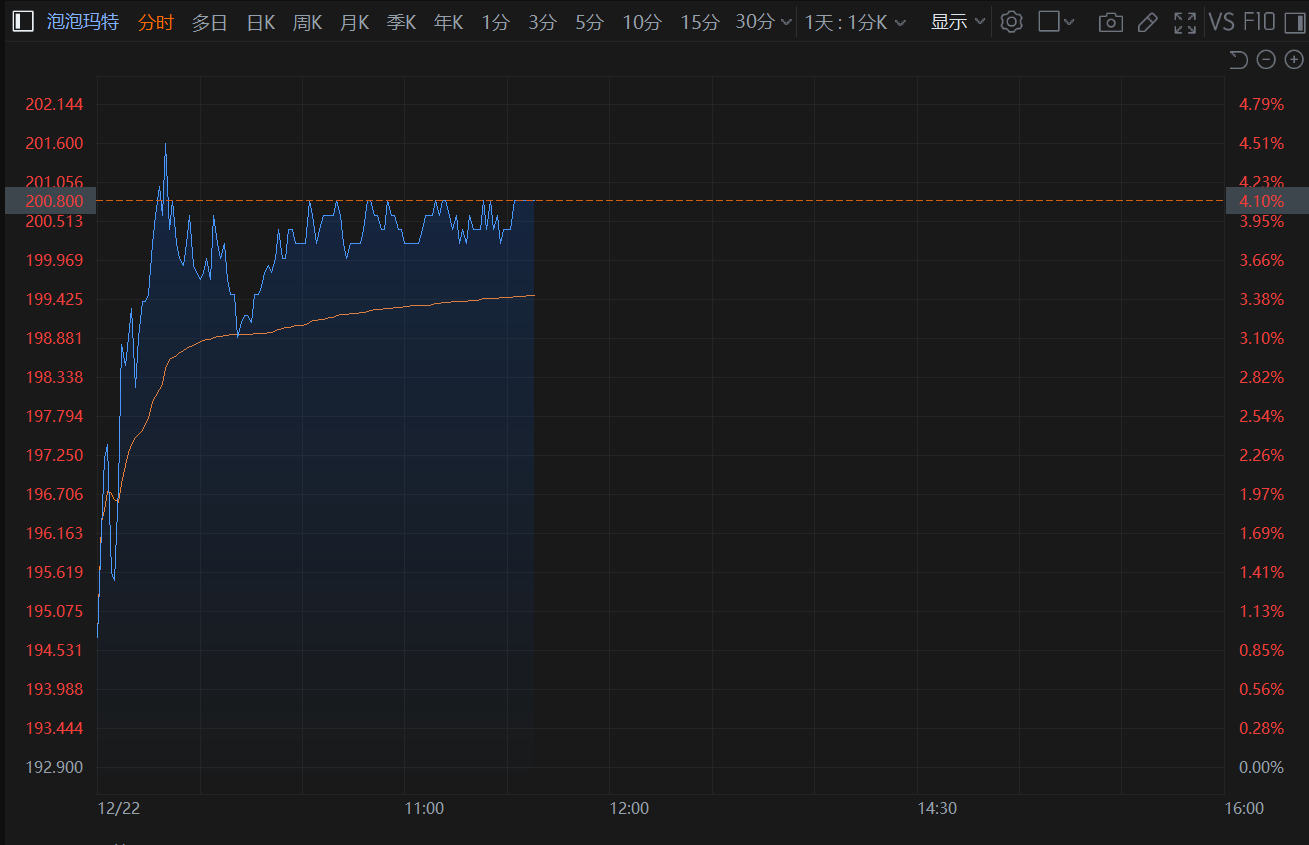
泡泡玛特涨超4%,股价重回200港元,Crybaby特展延长IP生命周期
Ge Long Hui· 2025-12-22 04:09
Group 1 - The core point of the news is that Pop Mart (9992.HK) has seen a significant stock price increase, surpassing 4% to reach 200 HKD, with a total market capitalization of 269.66 billion HKD [1] - The Crybaby exhibition in Shanghai is scheduled from December 20, 2025, to January 25, 2026, at the West Bund Dream Center, which is expected to attract a diverse audience and enhance brand visibility [1] - The exhibition will feature large-scale art installations and limited edition products that require online purchase for in-store pickup, providing new revenue streams beyond product sales [1] Group 2 - Guotai Junan Securities noted that the exhibition could lead to increased social media engagement, enhancing brand presence and extending the IP lifecycle through diverse operational strategies [1] - Morgan Stanley's recent report indicates that the appointment of Wu Yue to Pop Mart's board reflects the company's successful resource acquisition for new business development and recognition of its IP in fashion and entertainment [1] - This recognition boosts confidence in Pop Mart's ability to deploy impactful marketing and product resources [1]
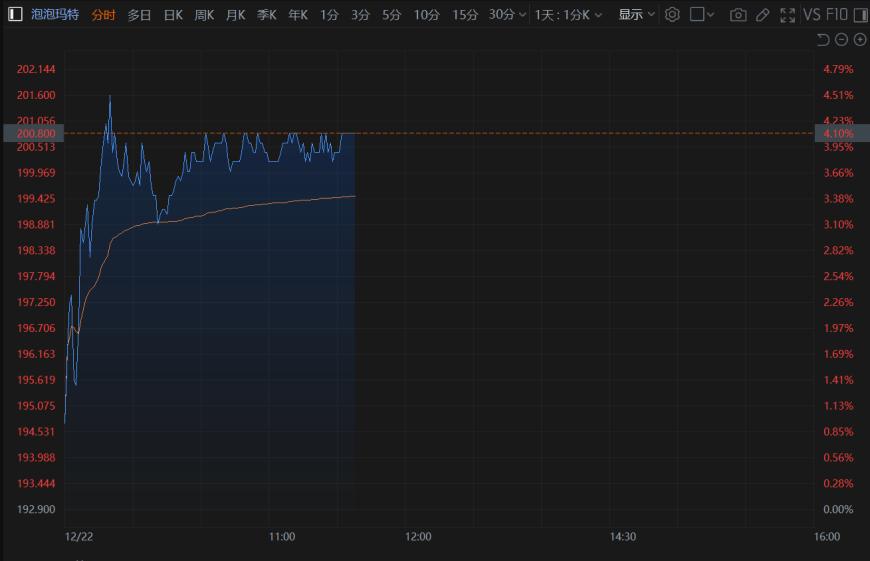
港股泡泡玛特涨超4%,股价重回200港元
Jin Rong Jie· 2025-12-22 03:54
本文源自:金融界AI电报 泡泡玛特(9992.HK)盘初快速拉升,目前涨超4%股价重回200港元,总市值2696.6亿港元。 ...
港股异动丨泡泡玛特涨超4%,股价重回200港元,Crybaby特展延长IP生命周期
Ge Long Hui· 2025-12-22 03:42
摩根士丹利日前发布的研报认为,吴越加入泡泡玛特董事会意味着公司过去两年的成功为发展新业务赢得了更多资源,也意味着公司旗下IP在时尚和娱乐领 域获得了高度认可,这增强了其对于泡泡玛特有能力部署具有影响力的营销和产品资源的信心。 泡泡玛特(9992.HK)盘初快速拉升,目前涨超4%股价重回200港元,总市值2696.6亿港元。消息上,泡泡玛特Crybaby特展上海站将于2025年12月20日至2026 年1月25日在上海西岸梦中心梦工场举行。 国金证券指出,此次特展不仅有适合打卡分享的大型装置艺术,还设有需线上抢购后到店取限量商品和限量周边,有望吸引多样化的人群参展并分享。不仅 拓展了泡泡玛特除商品销售以外的变现手段(展览门票收入),更有望通过参展人员在社交媒体平台的自发打卡分享实现信息传播裂变,保持品牌的"在场 感"的同时增加信息"触点",通过成熟且多样化的运营手段延长IP生命周期、提高IP高度。 ...