快消品

Search documents
经销商账号流量低、转化难怎么破?构建高协同强转化的线上销售网络
Sou Hu Cai Jing· 2025-08-07 12:06
Core Insights - The construction and operation of a new media matrix for distributors is becoming a key engine for brands to penetrate lower-tier markets, activate terminals, and achieve overall growth [1] Group 1: Industry Trends - The trend of empowering distributors to establish and operate localized content on platforms like Douyin, WeChat Video, and Xiaohongshu is no longer optional but essential for channel competitiveness and market share [1] - Industries such as home improvement, automotive aftermarket, home appliances, fast-moving consumer goods, clothing, and hardware are increasingly recognizing the importance of this trend [7] Group 2: Challenges Faced - Many brands face challenges such as content homogenization among distributor accounts, leading to low engagement and ineffective conversion [1] - Distributors often operate independently without coordination, resulting in weak execution and motivation due to insufficient incentives from headquarters [1] - The large number of distributor accounts makes data collection time-consuming and difficult, complicating the monitoring of operational effectiveness [1] Group 3: Operational Objectives - The core operational goal is to create a strong conversion-oriented approach that directly targets traceable actions such as lead generation, store visits, and transactions [8] - Building a private user pool for distributors to achieve long-term operations is essential [8] Group 4: Advantages of Distributor Matrix - The distributor matrix allows for deep penetration into regional markets by leveraging local networks, channels, and storage resources [9] - It enables precise traffic redirection to terminals through location-based services (LBS), converting online traffic into store visitors [9] - The matrix reduces brand communication costs by creating a "dandelion effect" where numerous accounts amplify brand exposure exponentially [9] - It helps build a trust loop with consumers through brand endorsement, local case studies, and real-time interaction, significantly enhancing decision-making efficiency [9] Group 5: Operational Logic - The top-level design involves independent operation by distributors while headquarters provides empowerment and constraints [11] - Headquarters acts as the "brain," formulating strategies, providing standardized content templates, and offering training incentives [13] - Distributors focus on local adaptation of content, enhancing relevance to local users [15][17] Group 6: Flow Operation - The flow operation aims to create a closed loop from visibility to interest, lead generation, store visits, and transactions [18] - Utilizing short video matrices to enhance local traffic and optimize user search pathways is crucial [20] Group 7: Empowerment and Management - Headquarters monitors overall exposure, interaction, and traffic effects, while distributors focus on conversion metrics [22] - Regular training and sharing of successful content examples are part of the empowerment system [24] Group 8: Case Studies - The automotive brand Hongqi integrated resources from 500 distributors on Douyin, creating a powerful communication network [26] - The project resulted in over 7,500 short videos with a total view count of 720 million and a fan increase of over 2 million [32] - The Wuling brand established a unified account system across thousands of distributors, ensuring consistent brand representation [34]


告别同质化“内卷”,以创新品质引领市场新风尚
Sou Hu Cai Jing· 2025-08-06 23:07
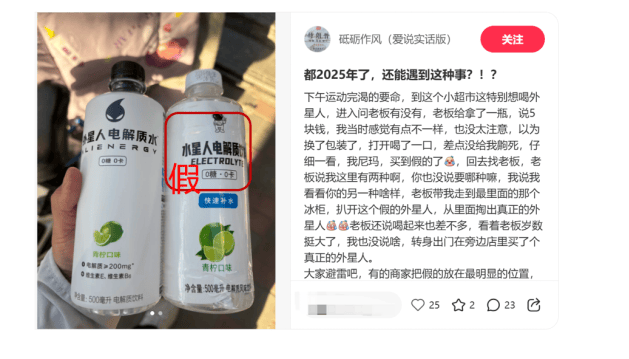
Core Viewpoint - The recent "anti-involution" topic has gained significant attention from regulatory bodies and industry players, emphasizing the need for innovation in emerging fields and transformation in traditional sectors to avoid low-level homogeneous competition [1] Group 1: Market Dynamics - The rise of imitation products, often referred to as "shanzhai," has become a focal point, misleading consumers and disrupting market order [2] - Consumers have shared experiences of mistakenly purchasing imitation products due to similar packaging, highlighting the prevalence of pixel-level imitation in the fast-moving consumer goods (FMCG) sector [1] - Legal actions against imitation products are increasing, with courts imposing significant penalties to protect innovation and deter infringement [2] Group 2: Brand Protection and Legal Actions - The case of Yuanqi Forest's "Alien Electrolyte Water" illustrates the swift legal response to trademark infringement, with the court ruling in favor of Yuanqi Forest and awarding damages of 5 million yuan [2] - The judicial system is sending a clear message about the importance of protecting original brands and punishing counterfeiters [2] Group 3: Innovation and Quality - Original brands that focus on quality and technological innovation are gaining consumer trust, while imitators struggle to replicate the intrinsic value of these products [4][5] - Companies like Yuanqi Forest and Dali Food Group have successfully differentiated themselves through innovation, leading to a positive market reputation [5] - The emphasis on quality control and unique value propositions is essential for companies to thrive in a competitive landscape [5]
五大业务均有增长!联合利华:预计下半年将继续改善
Nan Fang Du Shi Bao· 2025-08-05 06:57
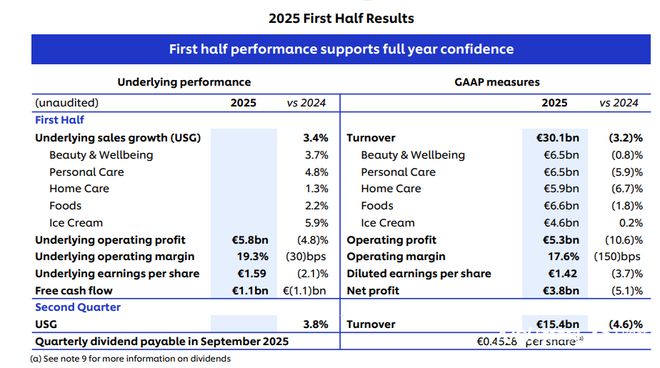
Core Insights - Unilever reported a 3.2% decline in sales to €30.1 billion for the first half of 2025, with a net profit decrease of 5.1% to €3.8 billion, while maintaining a gross margin of 45.7% [1][3] - Underlying sales growth (USG) for the first half was 3.4%, driven by a 1.5% increase in volume and a 1.9% price increase [1][4] Segment Performance - The Foods segment, which includes brands like Knorr, saw a 1.8% decline in sales to €6.6 billion, but an underlying sales growth of 2.2% [2][3] - The Beauty & Wellbeing segment, including brands like Dove and AHC, experienced a 0.8% sales decline to €6.5 billion, with a 3.7% underlying sales growth [2][3] - Personal Care sales also fell by 5.9% to €6.5 billion, but underlying sales grew by 4.8% [2][3] - Home Care sales decreased by 6.7% to €5.9 billion, with a 1.3% underlying sales growth [2][3] - The Ice Cream segment reported a slight sales increase of 0.2% to €4.6 billion, with a notable underlying sales growth of 5.9% [2][3] Regional Performance - Sales in the Asia Pacific region declined by 4.3% to €12.8 billion, while the Americas saw a 4.9% drop to €10.9 billion; Europe, however, experienced a 2.3% increase to €6.4 billion [5][6] - Underlying sales growth in the Asia Pacific region was the highest at 3.5%, with the Americas showing a 3.0% price increase and Europe achieving a 2.8% volume growth [6][4] Strategic Focus - Unilever is focusing on the Indian market as a key growth area, while also planning to divest assets worth €1.5 billion to €2 billion, emphasizing that these are not fire sales [8][10] - The company aims to enhance its portfolio by increasing investments in beauty and personal care, particularly in high-end and e-commerce segments [10][11] - Recent acquisitions include brands like Wild and Dr. Squatch, which complement Unilever's existing product lines [9][10] Future Outlook - Unilever anticipates a full-year underlying sales growth rate of 3% to 5% for 2025, supported by the performance in the first half [4][8] - The company expects continued improvement in the second half of the year, particularly in the Chinese and Indonesian markets [8][9]

摩根士丹利:东盟消费者+医疗保健
摩根· 2025-07-16 00:55
Investment Rating - The report indicates a positive investment outlook for healthcare stocks in Southeast Asia, particularly in countries facing aging populations like Thailand [5][12]. Core Insights - The Asian consumer market is characterized by price sensitivity, with consumers downgrading spending in food but increasing expenditures in travel [1][4]. - The rapid growth of the fast-moving consumer goods (FMCG) market in Southeast Asia, particularly in Indonesia, the Philippines, and Thailand, is noteworthy, with growth rates double that of India [1][7]. - Local brands are gaining market share over global brands due to their ability to offer personalized products at lower prices through e-commerce and social media [6][4]. Summary by Sections Consumer Behavior - Asian consumers prioritize value for money and are highly sensitive to prices, often influenced by macroeconomic cycles [4][1]. - The Z generation plays a significant role in consumer behavior, heavily relying on social media and influencers for purchasing decisions [4][1]. Demographics and Market Impact - Approximately one-third of Asia's population is under 25, but significant demographic differences exist, with countries like Thailand facing rapid aging [5][1]. - The increase in single-person households is driving growth in pet ownership and online entertainment [5][1]. FMCG Market Trends - The combined FMCG market size of Indonesia, the Philippines, and Thailand is comparable to that of India, with a growth rate significantly higher than India's [7][1]. - There is a notable opportunity for growth in the dairy sector, particularly in Indonesia, where per capita spending is significantly lower than in Thailand [7][1]. Grocery Retail Sector - Traditional small stores remain important in Asia, but modern retail channels are growing faster, with convenience stores dominating the market [8][9]. - Thailand's 7-11 is one of the most profitable globally, with substantial room for market share expansion [11][9]. E-commerce Development - The e-commerce market in Southeast Asia is rapidly expanding, with a current market size of $160 billion and a compound annual growth rate exceeding 30% [20][21]. - Despite the growth, e-commerce penetration remains lower than in China and South Korea, indicating further potential for development [21][20]. Healthcare Sector Potential - The healthcare sector in Southeast Asia has significant growth potential, driven by low current spending relative to GDP and an aging population [12][5]. - Thailand's healthcare spending has increased by approximately 7% over the past decade, highlighting a growing demand for healthcare services [12][5]. Key Companies - CPO is a leading grocery retailer in Thailand with a market capitalization of approximately $12 billion, dominating the convenience store segment [24]. - Astro is Indonesia's largest diversified group, holding significant market shares in both the automotive and heavy equipment sectors [24]. - Jollibee, the largest listed fast-food chain in Asia, is expanding internationally while maintaining a strong domestic presence [27]. - BDMS operates the largest private healthcare network in Thailand, catering to both local and international patients [29]. - bh Hospital is a major private hospital in Southeast Asia, known for its high profit margins and focus on international patients [30].
品牌线上控价策略,有哪些办法?
Sou Hu Cai Jing· 2025-07-15 13:14
Group 1 - The article emphasizes the importance of direct communication with low-priced sellers as a flexible preemptive measure to address pricing issues [1][3] - Effective communication can lead to significant results, with one fast-moving consumer goods brand achieving a 30% compliance rate among errant sellers, while communication costs were only 1/5 of other methods [3] - The success of this approach heavily relies on the cooperation of the sellers, suggesting the need for dedicated personnel to follow up and document interactions [3] Group 2 - Utilizing platform complaints for product delisting is highlighted as an efficient constraint within the rules framework, requiring a complete evidence chain for submission [4] - The success rate for properly submitted complaints can reach 80%, as demonstrated by a clothing brand that removed 62 low-priced links within a week, stabilizing price fluctuations from 25% to 8% [4] - The article outlines the potential penalties for offending stores, including point deductions and restrictions on platform activities [4] Group 3 - Legal intervention is presented as a final deterrent for stubborn sellers who ignore previous measures, advocating for a "gradient handling mechanism" [4] - This strategy balances cost efficiency and brand image while maintaining price order, starting with flexible communication, followed by platform rules, and culminating in legal action [4] - Sending warning letters drafted by professional law firms has proven effective, with a 3C brand achieving a 75% compliance rate within a week after sending 20 letters [5] Group 4 - Legal actions can be pursued against sellers who refuse to comply after receiving warning letters, with the possibility of civil lawsuits for damages [5] - The article notes that a beauty brand successfully obtained 500,000 yuan in compensation through litigation, setting a precedent to deter potential violators [5]

宗馥莉的5个挑战:疑似家族继承权危机如何应对?
Hu Xiu· 2025-07-15 13:05
Core Viewpoint - The recent controversy surrounding Wahaha represents a typical "corporate control crisis" that could significantly impact its brand and operational stability [1]. Group 1: Impact on Brand Value - The brand's "emotional account" is severely overdrawn due to the ongoing litigation, which undermines its core narrative of "national craftsmanship" and "the shoe king" with negative labels of "family feud" [6]. - Consumer trust is shaken as doubts arise about the company's product commitments amidst internal discord, which is particularly detrimental for a fast-moving consumer goods company [6]. - The founder's reputation is at risk of being tarnished due to the perceived conflicts among heirs, representing a secondary disaster in crisis management [6]. Group 2: Internal Stakeholder Confidence Crisis - The inheritance lawsuit primarily impacts internal stakeholders, particularly the extensive distributor network that values stability above all [8]. - Uncertainty from the lawsuit may lead distributors to shift allegiance to competitors, jeopardizing Wahaha's channel advantages [9]. - Financial institutions and investors are likely to reassess risks, complicating the company's financing and business collaborations [10]. Group 3: Leadership Challenges for Successor - The crisis serves as a public test of the successor's "crisis leadership," with external scrutiny on her ability to manage the situation effectively [11]. - The successor faces five leadership challenges, including decision-making authority dilution and potential talent attrition due to uncertainty [12]. - The need for legitimacy and authority is critical, as the successor must gain recognition from both family members and external shareholders [14]. Group 4: Trust and Reputation Restoration - The family dispute raises questions about the transparency of the company's governance structure, necessitating timely and sincere communication to rebuild trust [15][16]. - Balancing the diverse interests of stakeholders, including family members and institutional investors, is essential for achieving consensus and stability [18]. - The successor must demonstrate empathy and engage in open dialogue to address the complex demands of various stakeholders [18]. Group 5: Crisis Response Strategy - The crisis response should be swift and decisive, focusing on separating family disputes from company operations in public discourse [36]. - The mid-term strategy involves setting favorable agendas, such as enhancing governance transparency and redirecting public attention towards corporate social responsibility [38]. - Long-term measures should include establishing a family charter or irrevocable trust to solidify succession rules and prevent future disputes [40]. Group 6: Stakeholder Engagement - Formal recognition of the identities of potential family members through legal validation is crucial for family harmony [42]. - Implementing transparent information-sharing mechanisms will ensure all family members have equal access to financial and governance information [44]. - Differentiated economic support plans, such as trust funds and flexible dividend mechanisms, can address the varying needs of family members [46].
英敏特高级副总裁徐如一:年轻人喜欢玩梗,品牌要开得起玩笑
Nan Fang Du Shi Bao· 2025-07-11 09:19
Core Insights - The brand image and narrative favored by Chinese consumers have significantly changed over the past two years, with a preference for mature, reliable, and approachable brands over cold and serious ones [2][5] - In the current competitive environment, brands must innovate by understanding long consumption cycles, exploring differentiated consumer needs, and creating emotional resonance to succeed [2][8] Brand Innovation Trends - Over the past decade, many brands in key global markets have opted for product line extensions, such as new flavors and packaging, rather than breakthrough innovations [4] - The Chinese market has seen a rapid increase in brand collaborations, with the number of brands engaging in IP collaborations reaching levels similar to the more mature Japanese market within five years [4][5] Consumer Engagement Strategies - Brands can maintain longevity by utilizing social marketing to engage consumers emotionally, as seen in the example of Japanese instant noodle brands innovating through marketing strategies that resonate with younger audiences [5][8] - Emotional resonance is becoming a key breakthrough point for brand innovation, transcending age demographics and tapping into broader consumer sentiments [8][9] Emerging Consumer Segments - The Alpha generation, aged 0 to 15, is being studied for their unique consumption habits, showing a preference for emotional and aesthetic values over traditional metrics like academic performance [9] - The concept of "childlike fun" is expanding beyond the younger demographic, appealing to a wider audience, including adults and seniors, as evidenced by the 41% of theme park visitors being non-children [9]

大品牌换经销商很正常,但无人接盘已成为新常态
阿尔法工场研究院· 2025-07-11 03:30
Core Viewpoint - The fast-moving consumer goods (FMCG) industry is facing a significant crisis as distributors are increasingly unwilling to take on major brands, leading to a potential collapse of the distribution channel system [10][11][52]. Group 1: Distributor Dynamics - Historically, when manufacturers wanted to change distributors, there were many willing to take over, but now major brands are struggling to find new distributors as many are voluntarily exiting [3][5]. - Distributors are now actively reducing their operations, cutting ties with brands that do not provide immediate profitability, regardless of whether they are large or small [28][48]. - The shift from distributors merely complaining about profitability to outright refusing to engage in business marks a critical change in the industry [26][27]. Group 2: Channel Environment Stages - The deterioration of the channel environment can be categorized into three stages: 1. Deterioration of manufacturer-distributor relationships due to issues like stock pressure and unprofitability [15]. 2. A worsening channel environment characterized by increased control by manufacturers over distributor sales teams and the rise of direct supply models that limit distributor opportunities [20][22]. 3. Active contraction by distributors, who are now cutting brands that do not yield profits, indicating a severe crisis in the deep distribution model [25][29]. Group 3: Challenges in Brand Management - Major brands are losing their ability to innovate and push new products, which is essential for maintaining market relevance [36][40]. - The traditional dual-driven model of brand and channel distribution is failing, leading to an over-reliance on channel-driven strategies that disrupt the overall distribution system [41][40]. - Frequent changes in distributors are damaging brand reputation and market stability, making it increasingly difficult to find new distributors willing to take on the brands [43][45]. Group 4: Future Directions for Manufacturers and Distributors - Manufacturers need to rethink their channel strategies, focusing on direct supply to large retailers and fostering new types of operators who can drive innovation [58][59]. - Distributors have several options moving forward, including engaging with B2B platforms, transitioning to operational roles, or reducing their market presence [61][62][64]. - The emergence of new operational models that integrate online and offline strategies is crucial for revitalizing the industry and ensuring sustainability [66][70].
报告:上半年金融、科技与高端制造业需求突出 促上海办公室市场小幅回暖
Zhong Guo Xin Wen Wang· 2025-07-09 03:49
Group 1: Market Overview - The Shanghai real estate market showed signs of recovery in the first half of 2025, driven by strong performance in finance, consumer goods manufacturing, and technology sectors [1] - A total of 4 new office projects were launched, with a cumulative supply of 302,000 square meters, reflecting a 3.9% decrease compared to the previous period [1] - The financial sector led the demand for office space, accounting for 22%, followed by consumer goods manufacturing at 17%, and TMT (Technology, Media, and Telecommunications) at 16% [1] Group 2: Rental Trends - Rental prices in Shanghai decreased by 3.0% to 247.2 yuan per square meter, while effective rents fell by 4.3% to 174.4 yuan per square meter [2] - The market is expected to see an additional supply of approximately 770,000 square meters in the next six months, which may increase competition but also enhance market liquidity [2] Group 3: Retail Market Insights - The retail property market is projected to receive about 577,000 square meters of new supply in the coming months, which is expected to improve regional commercial quality [3] - The demand for dining establishments dominated the retail market, accounting for 45%, with a notable presence of Chinese cuisine brands [2][3] - The retail sector's demand share increased to 41%, with apparel demand at 23%, indicating active expansion of fashion and outdoor brands [2][3]
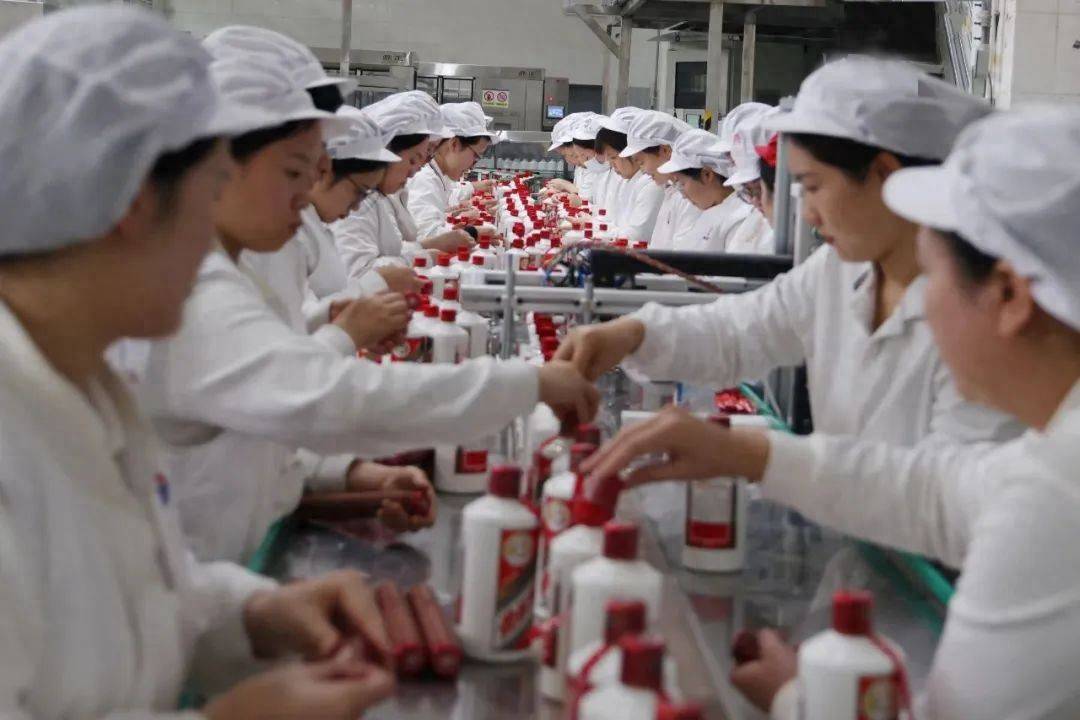
茅台承担不起行业低迷的责任
Sou Hu Cai Jing· 2025-07-07 04:37
Core Viewpoint - The article emphasizes that the challenges faced by the liquor industry, particularly the Moutai brand, cannot be solely attributed to a single company acting as a "savior" but rather require collective efforts from all industry participants to overcome structural issues and innovate for survival [1][2][3][5][6][7]. Group 1: Industry Dynamics - The liquor industry is experiencing a downturn, leading to a tendency to either idolize top brands like Moutai as a "safe haven" or to adopt a passive stance, which is a form of escapism [1]. - Moutai's success is rooted in the high-end market, creating a disconnect with the broader consumer market, similar to how luxury brands cannot resolve issues in fast-moving consumer goods [2]. - The perception of Moutai as a "safe asset" reflects investor panic over economic uncertainty, resulting in Moutai accounting for 56% of the liquor sector's market value in 2023, which exacerbates the disparity between large and small enterprises [3]. Group 2: Social and Economic Factors - The public's excessive focus on Moutai simplifies complex economic issues into a search for a benchmark, obscuring the real structural problems such as overcapacity and changing consumer preferences [5]. - Even if Moutai wanted to take on industry responsibility, its management capabilities are limited to its supply chain and cannot address deeper issues like channel inventory and price discrepancies [6]. - The expectation for a public company to sacrifice shareholder interests to "save the industry" contradicts modern corporate governance principles [7]. Group 3: Responsibility and Innovation - The current challenges in the liquor market stem from multiple factors, and blaming a single entity is unscientific; key stakeholders include government, industry associations, leading enterprises, and small businesses [7][9]. - The slow recovery of consumer confidence and the cautious spending on non-essential goods highlight a shift in consumption logic that liquor companies must address [9]. - The article suggests a shift from merely looking at benchmarks to understanding consumer needs, advocating for innovation and restructuring to adapt to market changes [10][12]. Group 4: Strategic Recommendations - Companies should focus on demand disaggregation and explore niche markets, such as "micro-drinks" for specific occasions [10]. - There is a call for reverse innovation and value chain reconstruction to enhance market resilience and adaptability [10]. - Organizations are encouraged to build robust teams capable of thriving in challenging environments, emphasizing the importance of internal agility over external complaints [12].