汽车经销商

Search documents
中升控股涨超3% “反内卷”政策提振经销商盈利改善 公司受惠于经销网络优化
Zhi Tong Cai Jing· 2025-08-04 03:00
瑞银此前指出,汽车经销商近期股价走高,相信是来自于反内卷政策,市场憧憬新车销售利润率改善; 一些经销商结业的新闻令市场揣测行业未来迎来整合;以及投资者趁低吸纳较低估值股份。憧憬若政策 有效遏制行业价格战,瑞银相信经销商盈利能力或显著改善。 中升控股(00881)涨超3%,截至发稿,涨3.22%,报13.49港元,成交额4295.5万港元。 小摩发布研报称,中国政府近期针对新能源汽车等面临产能过剩与价格竞争恶化的产业,推出一系 列"反内卷"政策以遏制非理性竞争。该行认为,政府反内卷举措与企业层面的结构性改革将推动产业于 2026年迎来转机。由于受惠于经销网络优化,该行上调公司目标价至20港元。 ...

港股异动 | 中升控股(00881)涨超3% “反内卷”政策提振经销商盈利改善 公司受惠于经销网络优化
智通财经网· 2025-08-04 02:57
Group 1 - Zhongsheng Holdings (00881) saw a stock price increase of over 3%, currently trading at 13.49 HKD with a transaction volume of 42.95 million HKD [1] - Morgan Stanley released a report indicating that the Chinese government has introduced a series of "anti-involution" policies to curb irrational competition in industries facing overcapacity and price competition, particularly in the new energy vehicle sector [1] - The report suggests that these government measures, along with structural reforms at the corporate level, will lead to a turning point for the industry by 2026, prompting an increase in the target price for Zhongsheng Holdings to 20 HKD due to benefits from optimized dealership networks [1] Group 2 - UBS noted that the recent rise in automotive dealership stock prices is attributed to the "anti-involution" policies, which have led to market expectations of improved profit margins on new car sales [1] - The news of some dealerships closing has fueled speculation about future industry consolidation, and investors are taking the opportunity to buy undervalued stocks [1] - UBS believes that if the policies effectively curb price wars in the industry, the profitability of dealerships could significantly improve [1]
中国汽车经销商7月库存预警指数为57.2%
Bei Jing Shang Bao· 2025-07-31 08:53
Core Viewpoint - The latest "China Automobile Dealer Inventory Warning Index Survey" released by the China Automobile Dealers Association indicates that in July 2023, the inventory warning index for automobile dealers in China was 57.2%, showing a year-on-year decrease of 2.2 percentage points and a month-on-month increase of 0.6 percentage points [1] Group 1 - The inventory warning index for July 2023 is 57.2% [1] - Year-on-year, the index decreased by 2.2 percentage points [1] - Month-on-month, the index increased by 0.6 percentage points [1]
港股收盘 | 恒指收跌0.15% 医药股再度强势 药明康德绩后大涨11%领跑蓝筹
Zhi Tong Cai Jing· 2025-07-29 08:51
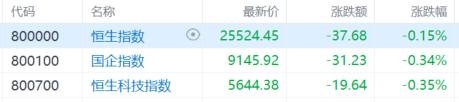
港股今日低开低走,三大指数盘中均一度跌超1%,尾盘跌幅则有所收窄。截止收盘,恒生指数跌0.15% 或37.68点,报25524.45点,全日成交额为2670.1亿港元;恒生国企指数跌0.34%,报9145.92点;恒生科 技指数跌0.35%,报5644.38点。 申万宏源认为,近期国内中长期改革政策加速兑现,供给侧政策(以反内卷为代表)和需求侧政策(以 生育支持政策为代表)相互配合,将有效改善宏观经济和企业盈利预期,显著提振中国资本市场的长期 信心。继续看好港股是潜在牛市中领涨市场,"牛市氛围"强化后,投资者在港股进行行业轮动会更加积 极。 蓝筹股表现 药明康德(603259)(02359)领涨蓝筹。截至收盘,涨11.25%,报111.7港元,成交额30.23亿港元,贡献 恒指6.33点。药明康德发布2025年上半年业绩,公司实现收入207.99亿元(人民币,下同),同比增加 20.6%;母公司持有者的应占净溢利82.87亿元,同比增加95.5%。报告期内,公司持续经营收入204.1亿 元,其中来自美国客户收入140.3亿元,同比增长38.4%。此外,公司还宣布上调全年业绩指引。 其他蓝筹股方面,石药集团(0 ...

港股收评:三大指数齐跌,恒指跌0.15%,创新药逆市活跃
Ge Long Hui A P P· 2025-07-29 08:41
Market Overview - The Hong Kong stock market indices showed a recovery in the afternoon, with the Hang Seng Index and the Hang Seng China Enterprises Index down by 0.15% and 0.34% respectively, while the Hang Seng Tech Index fell by 0.35% after a larger drop of 2% during the day [1][2] - Despite the index adjustments, southbound funds significantly net bought over 10 billion HKD in Hong Kong stocks [1] Sector Performance - Large tech stocks saw a narrowing of losses in the afternoon, with Alibaba slightly turning positive, while Tencent, JD.com, Meituan, and Kuaishou experienced declines within 1%. Xiaomi continued to decline by 2.6% [2] - Biopharmaceutical stocks performed strongly, particularly in the innovative drug sector, with WuXi AppTec rising over 11%, and both CSPC Pharmaceutical and Luye Pharma increasing by over 8% [2] - The "anti-involution" sectors, including steel and photovoltaic stocks, showed a notable recovery, while oil, gambling, and semiconductor stocks mostly rose [2] - The three-child policy subsidy of 3600 yuan led to a mixed performance in related stocks, with some experiencing declines [2][6] Banking Sector - The banking sector faced declines, with several banks such as Chongqing Rural Commercial Bank and China Everbright Bank dropping over 3% [4][5] - Major banks like Industrial and Commercial Bank of China, China Construction Bank, and Agricultural Bank of China also saw declines [4] Biopharmaceutical Sector - WuXi AppTec reported a strong performance with a revenue of 20.8 billion yuan for the first half of 2025, a year-on-year increase of 20.64%, and a net profit surge of 101.92% [8] - The company expects continued double-digit growth in operating revenue, adjusting its growth forecast from 10-15% to 13-17% [8] Automotive Sector - Automotive dealership stocks rose against the trend, with Guanzhong Holdings increasing over 9% and Zhongsheng Holdings up over 6% [9][10] - UBS reported that the rebound in stock prices for Zhongsheng and Yongda Automotive is attributed to expectations of improved profit margins from new car sales due to government policies [10] Steel Sector - Steel stocks experienced gains, with Maanshan Iron & Steel rising over 8% and several other companies like Ansteel and Asia Pacific Resources also seeing increases [11][12] Apple-Related Stocks - Apple-related stocks were active, with AAC Technologies rising over 3% and other companies like GoerTek and BYD Electronics also showing gains [13] Future Outlook - Haitong Securities expressed optimism about the Hong Kong stock market, particularly in the technology sector, suggesting a focus on sectors with improving conditions and low valuations [15]


异动盘点0729|婴童概念高开,医药强劲,券商股低迷;特斯拉涨超3%、SMCI涨超10%(附本周业绩日历)
贝塔投资智库· 2025-07-29 04:14
Group 1: Baby and Childcare Sector - The baby and childcare concept stocks mostly opened higher, with notable increases in shares of companies such as Jinxin Reproductive Medicine (1951.HK) up 8.93%, H&H International Holdings (1112.HK) up 7.33%, and China Feihe (6186.HK) up 5.12% following the announcement of a new childcare subsidy policy [1] - The new policy, effective from January 1, 2025, provides an annual subsidy of 3,600 yuan for each child until they reach three years old, which is expected to boost the sector [1] Group 2: Pharmaceutical Sector - WuXi AppTec (2359.HK) opened over 4% higher after reporting a revenue of 20.799 billion yuan for the six months ending June 30, 2025, a year-on-year increase of 20.6%, with a net profit of 8.287 billion yuan, up 95.5% [1] - Fosun Pharma (2196.HK) saw a 1.37% increase after signing a licensing agreement for AR1001, aimed at treating Alzheimer's disease and other neurological disorders [2] - Deqi Pharmaceutical (6996.HK) rose 4.70% after receiving approval for a new indication of its drug, Xivio, for treating multiple myeloma [2] - Kangzheng Pharmaceutical (0867.HK) increased over 2% after announcing the acceptance of its new drug application for ZUNVEYL, aimed at treating Alzheimer's symptoms [4] - BeiGene (6160.HK) rose over 3% following a positive recommendation from the European Medicines Agency for its drug, Tislelizumab, for non-small cell lung cancer [4] Group 3: Automotive Sector - Hong Kong automotive dealer stocks rose, with Zhongsheng Holdings (0881.HK) up nearly 6% and Yongda Automotive (3669.HK) up over 4%, driven by expectations of improved profit margins from new car sales due to government policies [2] - UBS reported that Zhongsheng and Yongda's stock prices rebounded approximately 20% and 5% respectively, as the market anticipates industry consolidation and improved profitability [2] Group 4: Beverage Sector - Hong Kong Brewery (0236.HK) surged 26% after reporting a revenue of approximately 390 million HKD for the first half of 2025, a year-on-year increase of 3.22%, with a net profit of 49.644 million HKD, up 31.97% [3] Group 5: Securities Sector - Chinese brokerage stocks collectively declined, with Shenwan Hongyuan (6806.HK) down nearly 5%, amid tightening regulatory scrutiny in the securities industry, which has seen over 30 fines issued recently [3]






瑞银:“反内卷”下的中国汽车经销商、保险业、互联网巨头们
Zhi Tong Cai Jing· 2025-07-25 10:30
Group 1: Chinese Luxury Car Dealers - UBS analysts noted a recent stock price increase for Zhongsheng Group and Yongda Automotive, with respective rises of approximately 20% and 5% over the past five days, attributed to expectations of improved new car profit margins and market speculation on industry consolidation [2][3] - The Chinese government's crackdown on irrational competition is expected to stabilize retail prices and improve profit margins for dealers, which are sensitive to changes in new car profit margins [3][4] - Traditional luxury car brands are facing declining sales, with a 14% year-on-year drop in the first half of 2025, as domestic brands capture a larger market share, leading to potential further retail price discounts [4][5] Group 2: Chinese Insurance Industry - Following recent anti-involution measures, the Chinese life insurance sector saw a 9.1% increase in H-shares over four trading days, outperforming the Hang Seng Index [7] - Rising interest rates are expected to benefit life insurance companies in the long term, enhancing net asset value and reducing risks associated with interest spreads [8] - UBS anticipates that the upcoming lower pricing interest rate benchmark may make dividend-type policies more attractive, benefiting insurers with strong investment and distribution capabilities [8][9] Group 3: Chinese E-commerce Industry - The second quarter saw a 6.3% year-on-year increase in online retail sales, indicating a shift towards high-quality growth, with improved return rates attributed to policy changes on e-commerce platforms [11][12] - Instant retail investments by Alibaba and JD.com have led to a recovery in daily active users, although the conversion rate of new traffic remains lower compared to traditional channels [13][14] - UBS favors Alibaba in the e-commerce sector due to its potential in artificial intelligence-related businesses and expects significant value realization if execution is successful [18]
观车 · 论势 || 汽车经销商的“求救”,最该让谁听到
Zhong Guo Qi Che Bao Wang· 2025-07-21 01:27
Core Viewpoint - Automotive dealers are collectively urging manufacturers to improve their relationships and support mechanisms to alleviate the operational difficulties faced by dealers in the Yangtze River Delta region [1][4]. Group 1: Industry Challenges - The automotive market is experiencing high inventory levels and price inversions, which are eroding the profit margins of dealers [1]. - Manufacturers are prioritizing market share over profitability, leading to situations where they sell vehicles at a loss, further complicating the financial viability of dealers [1][2]. - New energy vehicle manufacturers have adopted aggressive pricing strategies, often selling below cost to capture market share, which has created significant pressure on traditional dealers [2][3]. Group 2: Regulatory and Legal Aspects - The practice of selling vehicles below cost may constitute dumping, which could violate the Anti-Unfair Competition Law of the People's Republic of China [3]. - The Ministry of Commerce and market regulatory authorities are urged to clarify the legality of these practices and take necessary actions against them [3]. - The Automotive Sales Management Measures, implemented eight years ago, prohibit manufacturers from imposing certain restrictions on dealers, yet compliance remains an issue [4]. Group 3: Recommendations and Future Outlook - There is a call for the establishment of a dealer exit mechanism that is mutually recognized by both manufacturers and dealers, allowing for timely decisions based on market conditions [4]. - Regulatory bodies are encouraged to actively investigate and penalize violations to ensure fair competition in the automotive market [4].
港股午评:恒指收涨0.28% 大市一度涨至近四个月高位
news flash· 2025-07-16 04:21
Group 1 - The Hang Seng Index (HSI) closed up 0.28%, reaching a nearly four-month high of 24,867 points during the session [1] - The market experienced a total increase of 697 points over the past four days, with a morning high of 113 points [1] - The trading volume for the HSI was 157.94 billion HKD, indicating active market participation [1] Group 2 - Sectors such as media and entertainment, domestic retail, and rare earth concepts showed strong performance, while building materials, consumer electronics, and automotive dealership stocks declined [1] - Notable individual stock performances included SanSan Media rising nearly 49%, and both Tongcheng Travel and Tencent Music increasing over 3% [1] - Alibaba and Baidu both saw an increase of 1.6% in their stock prices [1]
汽车经销商如何穿越周期?易车志解码“稳扎稳打”下的韧性增长逻辑
Zhong Guo Chan Ye Jing Ji Xin Xi Wang· 2025-07-15 03:59
Core Insights - Jietongda Group has achieved over 10 billion RMB in revenue and sold over 70,000 new vehicles in 2024, focusing on long-term development in the Tianjin and Yunnan markets [1][2][9] - The company operates 44 automotive brands and serves over 1.1 million car owners, emphasizing the importance of service capability in the automotive dealership sector [2][4] Group Strategy - Jietongda Group's strategy is centered on deepening its presence in the Tianjin and Yunnan markets, avoiding blind expansion and focusing on the quality of individual stores [6][19] - The company has maintained a sales growth rate of over 10% in recent years despite fierce competition in the automotive market [6][9] Business Performance - In 2024, Jietongda Group's new car sales exceeded 70,000 units, with used car sales reaching 17,000 units and vehicle maintenance exceeding 660,000 instances, resulting in approximately 14 billion RMB in revenue [9][14] - The used car segment has shown strong performance, with sales reaching 17,000 units and revenue surpassing 480 million RMB [14] Growth Engines - The company has been actively developing its new energy vehicle (NEV) business since 2018, collaborating with several NEV brands and establishing a comprehensive NEV shopping mall in Tianjin [10][12] - The used car business is also a critical growth area, with plans to enhance brand influence through quality assurance services and retail outlets [14] Industry Perspective - Jietongda Group's chairman believes that traditional dealership models will not disappear, as they provide localized service capabilities that are essential in the automotive market [15][17] - The automotive industry is undergoing significant changes, and companies must adapt to new sales models while maintaining integrity and professional service [17][19] Future Directions - The company is exploring new media strategies, such as live streaming and short videos, to engage online customers and activate its existing client base [20] - Jietongda Group aims to focus on long-term customer value and believes that the automotive market, valued in trillions, will present new opportunities for those who adhere to a long-term strategy [22]