
电信设备

Search documents
AI热潮会不会重蹈互联网泡沫的覆辙?|全球贸易观察
Di Yi Cai Jing· 2025-10-10 10:38
Core Insights - The excitement surrounding AI's potential to drive growth is causing a surge in the tech sector, but there are warnings that this may lead to a bubble similar to the internet bubble of the late 1990s [1][6] - Major financial institutions, including the IMF and Deutsche Bank, caution that the current valuations in the tech sector are nearing levels seen during the internet boom, which could lead to a significant market correction and impact global growth [1][6] - The Oxford Economics report highlights that the tech sector has been a key driver of recent U.S. economic growth, but warns that a downturn in this sector could severely affect GDP growth and business investment [2][6] Group 1: Economic Impact of AI - AI-related products have significantly contributed to global trade growth, accounting for nearly half of the overall trade increase in the first half of 2025, with a year-on-year value increase of 20% [4] - The U.S. economy is currently avoiding recession largely due to investments in AI data centers, but this situation is not sustainable without continued large-scale investments [1][5] - The investment growth in information processing equipment and software is projected to reach an annual growth rate of 20% to 40% in the first half of 2025, marking the fastest growth since the late 1990s [7] Group 2: Risks of Tech Sector Decline - The concentration of market value in the top five tech companies (Apple, Microsoft, Alphabet, Amazon, and Nvidia) is at a 50-year high, making the market particularly vulnerable to shocks if AI expectations cool [6][7] - If the tech sector experiences a downturn, it could lead to a significant drop in U.S. GDP growth, potentially falling to 0.8% by 2026 under certain recession scenarios [6][7] - Historical parallels are drawn to the 2001 tech bubble, where a similar decline in tech stocks led to a 70% drop in stock prices and a decrease in business investment [7][8]


通信行业双周报(2025、9、26-2025、10、9):全球电信设备市场止跌复苏-20251010
Dongguan Securities· 2025-10-10 09:31
Investment Rating - The report maintains an "Overweight" rating for the telecommunications industry, expecting the industry index to outperform the market index by over 10% in the next six months [2][40]. Core Insights - The global telecommunications equipment market has shown signs of recovery in the first half of 2025 after two years of investment decline, with significant growth in mobile core networks, optical transmission, and service provider routers and switches [3][15]. - Huawei has maintained its position as the leading telecommunications equipment supplier, capturing 31% of the market share and continuing to expand its market advantage [3][36]. - The telecommunications industry is currently in a phase of technological iteration and policy benefits, with new growth drivers emerging from AI, quantum communication, and low-altitude economy sectors [3][36]. - The report suggests focusing on companies that align with the themes of "technology commercialization + policy catalysis + earnings certainty" [3][36]. Summary by Sections 1. Industry Market Review - The Shenyuan telecommunications sector index fell by 2.70% over the past two weeks (9/26-10/9), underperforming the CSI 300 index by 5.22 percentage points, ranking 29th among 31 sectors [11][12]. - Year-to-date, the telecommunications sector has risen by 63.39%, outperforming the CSI 300 index by 43.70 percentage points [11][12]. 2. Industry News - Dell'Oro Group reported a 4% year-on-year increase in global telecommunications equipment revenue in the first half of 2025, driven by various factors including a lower year-on-year base and stable inventory levels [15]. - LightCounting indicated that AI is taking a dominant role in the market [16]. - The 2025 World Intelligent Connected Vehicle Conference will be held in Beijing, focusing on AI and telecommunications applications in the automotive industry [20]. - The number of AI companies in China has exceeded 5,300, with the industry scale surpassing 900 billion yuan, growing by 24% year-on-year [21]. - The Ministry of Industry and Information Technology has granted China Mobile a license for satellite mobile communication services, enhancing communication capabilities in various scenarios [22]. 3. Company Announcements - Guanghe Communication has approved the global issuance and listing of H shares [23]. - Tianyi Co. signed a procurement framework agreement with China Telecom for dual-band broadband integrated terminals [24]. - Hainengda announced a share transfer agreement involving 5% of its equity [25]. 4. Industry Data Updates 4.1 Telecommunications User Scale Data - As of August 2025, the mobile phone user base reached approximately 1.819 billion, a year-on-year increase of 2.67% [26]. - The internet broadband access user base reached about 689 million, up 4.97% year-on-year [26]. 4.2 Optical Fiber and Cable Data - The length of optical cable lines reached approximately 73.77 million kilometers in Q2 2025, a year-on-year increase of 9.91% [28]. - The optical cable production in August 2025 was 20.44 million core kilometers, a decrease of 10.70% year-on-year [29]. 4.3 5G Development Status - By August 2025, the total number of 5G base stations reached 4.646 million, with a net increase of 395,000 from the end of the previous year [33]. 5. Investment Recommendations - The report recommends focusing on companies such as China Mobile, China Telecom, FiberHome, Yangtze Optical Fibre, and Weisheng Information, which are well-positioned to benefit from the current market dynamics [36].





港股早评:三大指数低开 科技股普跌 金叶国际集团首日上市高开500%
Ge Long Hui· 2025-10-10 01:42
Market Overview - US stock indices collectively declined overnight, with the Chinese concept index dropping by 2.03% [1] - Hong Kong's three major indices opened lower, with the Hang Seng Index down by 0.85%, the National Index down by 0.94%, and the Hang Seng Tech Index down by 1.4% [1] Sector Performance - Major technology stocks experienced a collective decline, with Alibaba, Baidu, and JD.com falling over 2%, and NetEase, Kuaishou, Meituan, and Xiaomi dropping over 1% [1] - Tencent saw a decrease of 0.96% [1] - Gold stocks led the decline in the non-ferrous metal sector, with China Gold International, Zijin Mining International, and Shandong Gold each falling nearly 4% [1] - Lithium battery stocks, automotive stocks, home appliance stocks, semiconductor stocks, Chinese brokerage stocks, and biopharmaceutical stocks also saw declines [1] Rising Stocks - Conversely, telecom equipment stocks, new consumption concept stocks, and rare earth concept stocks generally rose, with ZTE Corporation increasing by 3.4% and Jinli Permanent Magnet and Hu Shang Ayi rising over 2.4% [1] New Listings - Two new stocks debuted on the Hong Kong market, with Jinye International Group opening 500% higher, achieving an oversubscription rate of over 9030 times, marking the highest oversubscription rate for a new stock in Hong Kong history [1] - Zhida Technology opened 183% higher, with a global offering of 597.89 million shares, where the Hong Kong public offering accounted for 10% and international offering for 90% [1]



WTO上调2025年全球贸易增长预期:人工智能成核心引擎,南南贸易亮眼
Xin Lang Cai Jing· 2025-10-07 14:45
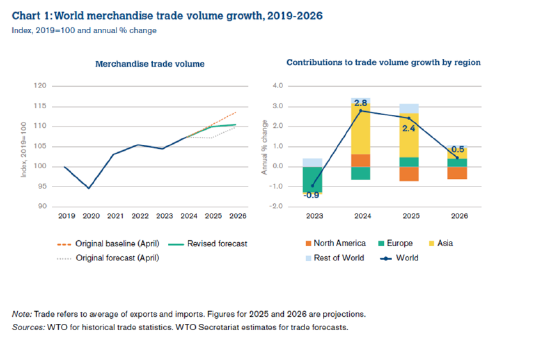
Core Insights - The World Trade Organization (WTO) has revised its global goods trade growth forecast for the first half of 2025 from 0.9% to 2.4%, driven by strong demand for AI-related products, early imports in North America to avoid tariffs, and active trade among emerging economies [1][3] Group 1: Global Trade Growth - The global goods trade volume is expected to grow by 4.9% year-on-year in the first half of 2025, with trade value in USD increasing by 6% [3] - AI-related products, including semiconductors, servers, and telecommunications equipment, are key drivers of this growth, contributing nearly half of the overall increase with a 20% year-on-year rise in trade value [3][4] Group 2: Emerging Economies and Regional Performance - Trade among emerging economies (South-South trade) grew by 8% in the first half of 2025, surpassing the global average growth rate of 6% [4] - Asia and Africa are projected to achieve the fastest export growth in 2025, while Europe may experience a slowdown and North America could see a decline in export trade [4] Group 3: Economic Outlook - Global GDP is expected to grow by 2.7% in 2025, slightly decreasing to 2.6% in 2026, with short-term trade growth supported by inventory accumulation and AI-related products [5] - The growth momentum for global services trade is anticipated to weaken, with commercial services export growth expected to drop from 6.8% in 2024 to 4.6% in 2025 [5]
大摩:爱立信(ERIC.US)Q3业绩或受北美市场拖累,维持“中性”评级
Zhi Tong Cai Jing· 2025-09-29 10:07
Core Viewpoint - Morgan Stanley maintains a "neutral" rating on Ericsson (ERIC.US) ahead of its Q3 2025 earnings report, with a target price of 80.00 SEK, citing a mixed market environment characterized by both softness and resilience in business operations [1] Group 1: Q3 Performance Expectations - The overall market growth remains weak, with telecom customers strictly controlling capital expenditures, which is a major pressure on revenue growth [1] - North America, accounting for 30-40% of Ericsson's revenue, faces high base comparison pressure, leading to a projected Q3 revenue decline of 9.2% year-on-year to 56.108 billion SEK [1] - Mobile network business is expected to be a key highlight, with management guiding a gross margin of 48%-50%, up from 47%-48% in Q2, potentially serving as a positive surprise for Q3 performance [1] Group 2: Impact of Iconectiv Sale - The sale of iconectiv, completed in mid-August 2025, will contribute approximately 9.9 billion SEK in revenue and 7.6 billion SEK in one-time EBIT profit, impacting core profitability metrics without separating from underlying business trends [2] - Q3 EBITA is expected to reach 13.8 billion SEK, significantly higher than Q2's 7.4 billion SEK, with net cash projected to increase to 4.5 billion SEK [2] - Management has not committed to special dividends or stock buybacks, postponing discussions on cash return plans until the full-year 2026 financial report [2] Group 3: Financial Model Adjustments - The financial model has been adjusted due to the sale of iconectiv, which previously contributed about 4 billion SEK in annual revenue and 2 billion SEK in EBIT [3] - For 2025, revenue is expected to be 23.3 billion SEK, with EBIT projected at 3 billion SEK and EPS at 7.10 SEK, a significant improvement from 2024 [3] - Starting in 2026, revenue and EBIT are expected to decline in the mid-single digits due to the exclusion of iconectiv from consolidated financials, with EPS projected at 5.94 SEK [3] Group 4: Valuation and Scenario Analysis - Morgan Stanley uses a 2026 expected EV/EBIT multiple of 8x to estimate the target price, reflecting a stable 5G capex environment similar to the 4G maturity phase [4] - Three scenarios are established: a bull case with a target price of 95.00 SEK if the 5G cycle extends, a base case of 80.00 SEK assuming market stabilization, and a bear case of 58.00 SEK if telecom capex declines sharply [4]

美股前瞻 | 三大股指期货齐跌,金价再创纪录,本周美联储官员讲话将成市场焦点
智通财经网· 2025-09-22 12:04
Market Overview - US stock index futures are all down ahead of the market opening, with Dow futures down 0.30%, S&P 500 futures down 0.26%, and Nasdaq futures down 0.32% [1] - European indices show mixed results, with Germany's DAX down 0.75%, UK's FTSE 100 up 0.01%, France's CAC40 down 0.32%, and the Euro Stoxx 50 down 0.41% [2][3] - WTI crude oil prices fell by 0.82% to $61.89 per barrel, while Brent crude oil dropped by 0.79% to $66.15 per barrel [4] Federal Reserve and Economic Indicators - The US stock market reached historical highs last week, driven by expectations of interest rate cuts from the Federal Reserve, with key speeches from Fed officials expected this week [5] - The market is closely watching the upcoming inflation data, with expectations that the core PCE price index will show a month-on-month increase of 0.2% and a year-on-year increase of 2.9% [5] Technology Sector Impact - The increase in H-1B visa fees to $100,000 has raised concerns in the tech industry, particularly in California, where companies rely heavily on skilled foreign workers [5] - Despite this, optimism remains in the tech sector, with analysts suggesting that the recent market rally could continue, particularly for large tech stocks [5] Investment Strategies - Goldman Sachs predicts that the Fed's rate cuts will extend the bull market in US stocks, recommending investments in interest-sensitive sectors like real estate and finance [6] - The S&P 500 index is projected to reach 6200 points by the end of 2025, indicating potential for further gains if inflation continues to decline [6] Cryptocurrency Market - The cryptocurrency market faced significant sell-offs, with over $15 billion in long positions liquidated, leading to a drop in total market capitalization below $400 billion [7] - Ethereum and Bitcoin experienced sharp declines, with Ethereum's price dropping nearly 9% at one point [7] Precious Metals - Gold prices reached a new record high of $3728.26 per ounce, driven by rising expectations for interest rate cuts, while silver also saw significant gains, reaching a 14-year high [8] Corporate News - Pfizer announced a $4.9 billion acquisition of Metsera to strengthen its obesity drug pipeline, with a 43% premium over Metsera's last closing price [9][10] - Nvidia partnered with Abu Dhabi's TII to establish the first AI technology center in the Middle East, focusing on next-generation AI models and robotics [10] - Vodafone signed a £2 billion contract with Ericsson and Nokia to expand its network coverage in the UK, addressing the need for revenue in a sluggish mobile market [11] - BBVA increased its offer by 10% to acquire Banco Sabadell, valuing the deal at approximately €17 billion ($20 billion) [12] - Roche's new breast cancer drug showed positive results in a Phase III trial, potentially extending progression-free survival for patients [13] Strategic Focus - HSBC is shifting its strategic focus towards Asia and the Middle East, recognizing the significant capital flow and wealth in these regions [13]



Open RAN已死?
半导体行业观察· 2025-09-16 01:39
Core Viewpoint - Mavenir's CEO warns that without support from "brownfield" operators, Open RAN may face extinction, leading to a monopoly by Ericsson and Nokia outside of China [1][4] Group 1: Open RAN Development - Open RAN was officially launched in early 2018 with the establishment of the O-RAN Alliance, aimed at creating more open interfaces to foster competition among suppliers [3] - Since the formation of the O-RAN Alliance, there have been few new "greenfield" network projects, with the largest network owned by Echostar set to retire after selling spectrum licenses to AT&T and SpaceX [3][4] - Major existing "brownfield" operators show a lack of interest in Open RAN, preferring traditional suppliers like Huawei, Ericsson, and Nokia, whose RAN market share increased from 75.1% in 2023 to 77.4% [4] Group 2: Market Competition - Nokia's mobile networks president asserts that competition in the market is more intense than critics suggest, with companies like Samsung, Fujitsu, and NEC also participating [5] - Omdia reports that Samsung held a 4.8% share of the RAN market last year, ranking as the fifth-largest supplier, while NEC and Fujitsu had shares of 0.9% and 0.5%, respectively [5] Group 3: Technological Integration - Nokia claims to have integrated its baseband technology with multiple manufacturers' radio units, including Mavenir and a Korean RF unit manufacturer [6] - Nokia's MantaRay platform allows operators to manage RAN from different suppliers, addressing concerns about multi-vendor integration in Open RAN [8][9] Group 4: Future Outlook - Despite positive remarks from Nokia regarding Open RAN's progress, concerns remain among large telecom operators about the sub-industry's prospects, with projected annual spending on RAN products declining by 22% from 2022 to 2024 [12] - Smaller suppliers like Mavenir may struggle to compete against larger companies like Fujitsu and NEC, which have the backing of larger electronic firms [12][13]


中兴半年报:AI驱动业绩增长,“连接+算力”蓄势而发
Feng Huang Wang· 2025-09-02 04:10
Core Viewpoint - ZTE Corporation has reported a double-digit revenue growth in its semi-annual report, indicating a strategic shift towards "connection + computing power" amidst a challenging global telecom equipment market, with AI playing a crucial role in this transformation [1][2]. Revenue Growth - In the first half of 2025, ZTE achieved revenue of 71.55 billion yuan, marking a year-on-year increase of 14.5%, with second-quarter revenue and net profit both showing growth compared to the first quarter [1]. - The revenue gap between ZTE and Nokia has narrowed to 5%, approximately 3.5 billion yuan, suggesting a potential for ZTE to surpass Nokia in the near future [2]. Strategic Development - ZTE's "connection + computing power" strategy has allowed the company to diversify its revenue streams, with computing power and terminal revenues growing nearly 100% year-on-year, now accounting for over 35% of total revenue [1][3]. - The company has maintained its market share in traditional operator network business while expanding into future technology areas such as 5G-A and 10G access, thereby stabilizing its revenue base [3]. AI Integration - ZTE has integrated AI into its network and computing infrastructure, enhancing product competitiveness and establishing a comprehensive AI empowerment system [5]. - The company has filed nearly 5,500 AI-related patents globally, with about 50% granted, indicating a strong commitment to innovation [5]. Market Opportunities - The AI infrastructure market is projected to grow significantly, with capital expenditures expected to remain strong, and the AI hardware and software market anticipated to grow at an annual rate of 40%-55% [4]. - Major tech companies are increasing their investments in AI infrastructure, with Google, Microsoft, Amazon, and Meta expected to spend over $300 billion by 2025 [4]. Product Development - ZTE has launched various AI-integrated products targeting both individual consumers and enterprises, including smartphones and AI home devices, while also developing solutions for over 18 vertical industries [7]. - The company has achieved significant sales milestones, such as over 1 million units of its cloud computer and a 70% market share in operator services [3][7]. Challenges and Strategies - ZTE faces challenges similar to other companies, including pressure on profit margins due to intense competition in the computing power market [8]. - The company plans to enhance revenue scale in computing products, increase self-research ratios, and shift from single product sales to comprehensive solutions to improve profit margins [8].
超10亿资金逢跌布局!恒生科技ETF(513130)成交持续放量,最新规模超358亿元,创历史新高
Xin Lang Ji Jin· 2025-08-29 03:18
Group 1 - The core viewpoint of the articles highlights the significant underperformance of major companies in the takeaway industry, leading to pressure on the Hong Kong tech sector, despite increased market investment activity [1][2] - The Hang Seng Tech ETF (513130) experienced a net inflow of 1.028 billion yuan on August 28, 2025, with a total of 1.794 billion yuan accumulated over three days, pushing its scale to a historical high of 35.887 billion yuan [1] - The average daily trading volume of the Hang Seng Tech ETF over the last five trading days reached 7.670 billion yuan, significantly higher than the average of 3.9 billion yuan in July, indicating strong market interest [1][2] Group 2 - The overall adjustment in the Hong Kong tech sector is primarily driven by the performance disruptions in the takeaway business, with current stock prices likely reflecting this negative factor [2] - The Hang Seng Tech Index, closely tracked by the Hang Seng Tech ETF, is diversified with a weight of only 39.67% in its top five constituent stocks, which may help mitigate individual stock volatility risks [2] - As of August 28, 2025, the price-to-earnings ratio of the Hang Seng Tech Index stands at 21.89, which is at a relatively low percentile of 23.77% over the past five years, suggesting potential for valuation recovery [2]
恒生科技ETF(513130)两个交易日累计“吸金”超7.6亿元!政策与资金面共振助推港股科技板块回暖
Mei Ri Jing Ji Xin Wen· 2025-08-28 06:22
Core Viewpoint - The Hong Kong stock market, particularly the technology sector, has shown flat performance due to rising Hibor rates, but recent dovish signals from the Federal Reserve and stabilizing Hibor rates may lead to a marginal improvement in liquidity, supporting a potential rebound in the market [1] Group 1: Market Conditions - The Hong Kong stock market has been affected by tightening liquidity due to rapidly rising Hibor rates, but recent developments suggest a possible easing of this narrative [1] - The release of the "Artificial Intelligence +" action plan by the State Council on August 26, 2025, is expected to create more opportunities for the AI industry [1] Group 2: ETF Performance - The Hang Seng Technology ETF (513130) has seen significant volume growth, with a recent scale of 35.189 billion, supporting T+0 trading [1] - As of August 27, 2025, the average daily trading volume of the Hang Seng Technology ETF reached 4.957 billion, a notable increase from 3.922 billion in July [1] - The ETF's year-to-date scale and share growth have exceeded 10 billion [1] Group 3: Index Composition - The Hang Seng Technology Index, closely tracked by the ETF, includes a diverse range of sectors, mitigating individual stock volatility risks while capturing broad opportunities in the AI industry [1] - The top five constituent stocks of the Hang Seng Technology Index account for only 38.90% of its weight, indicating a relatively diversified index [1] Group 4: Valuation and Fund Flows - As of August 27, 2025, the price-to-earnings ratio of the Hang Seng Technology Index is 22.30, which is at a mid-low percentile level compared to the past five years [1] - Southbound capital has maintained a net inflow exceeding 10 billion HKD in the last two trading days, providing solid support for the Hong Kong stock market [1] - The combination of easing liquidity expectations in both the Hong Kong and overseas markets, along with accelerated commercialization of the AI industry, is likely to improve the fundamentals of the index [1]