AI芯片

Search documents
摩尔线程IPO后75亿额度理财遭质疑,还能成“中国英伟达”吗?
首席商业评论· 2025-12-18 05:12
Core Viewpoint - The article discusses the recent developments surrounding Moore Threads, particularly its decision to allocate up to 7.5 billion yuan of raised funds for cash management rather than direct R&D, raising concerns among investors about its commitment to innovation and growth [7][9][10]. Group 1: Company Overview - Moore Threads aims to become "China's NVIDIA," with a strong founding team that includes several former NVIDIA executives, establishing a solid technical and commercial foundation [14][31]. - The company has raised over 10 billion yuan since its inception in 2020, with a significant focus on developing full-function GPUs that can support various applications, including AI training and rendering [14][20]. Group 2: Financial Performance - Moore Threads reported a revenue increase from 46 million yuan in 2022 to 785 million yuan in the first three quarters of 2025, although it still faced a loss of 724 million yuan during the same period [24][28]. - The company is projected to achieve profitability by 2027, but this includes government subsidies, indicating a challenging path ahead without such support [37]. Group 3: Market Position and Challenges - The company currently holds less than 1% market share in the domestic AI chip market, while major competitors like NVIDIA and Huawei dominate with shares of 54.4% and 21.4%, respectively [28]. - Moore Threads faces significant challenges in scaling its full-function GPU products due to high technical barriers, reliance on imported GPUs, and recent geopolitical pressures, including being placed on the U.S. entity list [26][27][23]. Group 4: Investor Sentiment and Valuation - The market has high expectations for Moore Threads, reflected in its dynamic price-to-sales ratio nearing 300, which is significantly higher than its peers [30]. - Investors are cautious, drawing parallels to the past performance of similar companies like Cambricon, which faced valuation corrections after initial hype [30].



寒武纪入列,上市公司掀起“补亏”潮
3 6 Ke· 2025-12-17 12:16
作为当前市场上炙手可热的科技龙头品种,寒武纪因受益于国内算力需求的持续释放,今年 前三季度业绩大幅增长,但在此之前,该公司的业绩其实是一直处于亏损困境的。由于业绩 的持续亏损,导致其未分配利润出现了负数,截至2024年12月31日,母公司财务报表累计未 分配利润高达-27.78亿元。 2025年12月15日晚,国内AI芯片领域头部厂商寒武纪(688256.SH)发布公告称,《关于使用公积金弥 补亏损的议案》在当天召开的临时股东大会上获审议通过。根据议案,该公司拟使用母公司资本公积 27.78亿元用于弥补母公司累计亏损,本次公积金弥补亏损以该公司2024年末母公司未分配利润负数弥 补至零为限。 经济观察报记者留意到,除了寒武纪,统一股份(600506.SH)、经纬恒润(688326.SH)、中关村 (000931.SZ)、保变电气(600550.SH)、冠捷科技(000727.SZ)、金杯汽车(600609.SH)等公司均 在近期内发布了与"资本公积弥补亏损"相关的公告。 备受上市公司青睐的"资本公积弥补亏损",究竟是怎么一回事? 为何要"补亏"? 作为当前市场上炙手可热的科技龙头品种,寒武纪因受益于国内算力需 ...


寒武纪入列 上市公司掀起“补亏”潮
经济观察报· 2025-12-17 11:12
Core Viewpoint - The article discusses the recent financial maneuver by Cambricon (寒武纪) to use its capital reserve to offset accumulated losses, which has raised questions about the implications for the company's financial health and investor confidence [2][5][12]. Group 1: Company Performance and Financial Maneuver - Cambricon has experienced significant growth in its performance due to the increasing domestic demand for computing power, but it has faced continuous losses prior to this year [1][4]. - The company's net profits from 2020 to 2024 were -4.35 billion, -8.25 billion, -12.56 billion, -8.48 billion, and -4.52 billion respectively, leading to a cumulative undistributed profit of -27.78 billion by the end of 2024 [4]. - Despite the losses, Cambricon's capital reserve has grown from 73.21 billion at the end of 2020 to 96.25 billion at the end of 2024, prompting the decision to use 27.78 billion from this reserve to offset losses [4][9]. Group 2: Rationale Behind the Loss Offset - The primary reason for using capital reserves to offset losses is to eliminate historical losses from a financial perspective, which can enhance the company's ability to provide returns to investors [5][9]. - If the undistributed profits are negative, the company cannot distribute dividends even if it achieves profitability in the current year. By offsetting losses, Cambricon aims to meet the conditions for potential dividends in the future [5][9]. Group 3: Market Reactions and Concerns - The announcement of using capital reserves to offset losses has led to skepticism among market participants, with some investors expressing concerns about the potential for financial statement distortion and the implications for the company's long-term growth [7][8]. - There is a belief that focusing on dividend preparations at this stage may weaken the company's competitive edge, especially for a tech company like Cambricon that requires substantial investment for growth [8][12]. Group 4: Industry Trends - The practice of using capital reserves to offset losses is becoming more common among listed companies, with many firms following Cambricon's lead in recent announcements [11][12]. - A significant number of companies have issued announcements regarding the use of capital reserves to offset losses, indicating a growing trend in the market [12].

从摩尔线程到沐曦:京沪千亿资本押注,AI 芯片第一城争夺战升级
Xin Lang Cai Jing· 2025-12-17 04:36
一、为何他们走上IPO快车道:千亿资本狂背后的城市力量 上市首日,"GPU芯片第二股"、上海的沐曦股份今日登陆科创板,股价一度暴涨超过700%,最新市值超3300亿元。 实际上,除沐曦117天完成上市外,多家北京和上海的国产AI芯片龙头都行驶在IPO的快车道上。 12月5日,"国产GPU第一股"摩尔线程用时88天登陆科创板,市值更是一度超4400亿元;12月15日,上海壁仞科技获得境外发行上市备案通知书,拟发行 不超过3.72458亿股普通股,港股或将迎来"GPU第一股",用时仅4个月。 随着美国对华实施AI和半导体出口管制,让英伟达在华AI芯片市场份额从95%骤降至近乎为 0,这为国产 AI 芯片产业打开了宝贵的发展窗口期,背后是 一个万亿级(沙利文数据,到2029年中国AI芯片市场规模达13367.92亿元)的产业大盘。 无论是摩尔线程,还是沐曦、壁仞,这些公司能够"高速IPO"的背后,离不开京沪两地国有资本和产业资本的支持——摩尔线程拥有北京海淀、中关村科 学城管委会的资金支持,沐曦股份拥有上海国盛资本、上海国调基金等上海资本的支持。 如今,一场围绕 AI 芯片领域的城市竞争悄然展开。 | | 京沪 A ...

国产GPU第二股来了,营收狂飙13倍3年却亏损30亿
2 1 Shi Ji Jing Ji Bao Dao· 2025-12-16 23:47
Core Viewpoint - Muxi Co., Ltd. is set to be listed on the Shanghai Stock Exchange's Sci-Tech Innovation Board on December 17, 2025, marking its entry as a non-profitable company into the Sci-Tech Growth Tier [1] Group 1: Company Overview - Muxi Co., Ltd. aims to become the second domestic GPU company to go public after Moore Threads, which has already gained significant market attention [1] - The company was founded in 2020 by former AMD employees and focuses on AI chips, particularly in the inference segment [3][4] - Muxi's first inference chip, Xisi N100, was delivered in January 2022 and began mass production in April 2023 [5] Group 2: Market Context - The AI chip market in China is experiencing rapid growth due to U.S. export controls and the need for domestic alternatives, with Muxi entering a competitive landscape dominated by NVIDIA and AMD [4][11] - Muxi's strategy involves developing its own core GPU IP to enhance flexibility and independence in a market where NVIDIA and AMD hold over 70% of the share [11][12] Group 3: Product Development - Muxi has launched several products, including the Xisi N series for inference and the Xiyun C series for training and inference, with plans for further development of the Xiyun C600 and C700 series [9][12] - The company has also developed a high-speed interconnect technology, MetaXLink, to improve performance and compatibility with existing ecosystems [15] Group 4: Financial Performance - Muxi's revenue has shown exponential growth, with reported revenues of 42.64 million yuan in 2022, 530.21 million yuan in 2023, and 743 million yuan in 2024, reflecting a compound annual growth rate of 4074.52% [21] - Despite revenue growth, Muxi has not yet achieved profitability, with cumulative losses exceeding 3 billion yuan over the past three years [23] Group 5: Future Outlook - Muxi anticipates reaching a breakeven point by 2026, driven by increasing sales of its training and inference products [24] - The company is positioned to compete effectively in the AI chip market, but its long-term success will depend on its ability to build a robust technology moat and ecosystem [28]

寒武纪资本公积金补亏的双面性
Bei Jing Shang Bao· 2025-12-16 16:19
然而,也不能忽视资本公积金补亏的局限性。最核心的问题在于,这一操作并未触及企业经营的根本。 资本公积金补亏本质上是一种财务手段,是对企业财务指标的调整,而非对企业经营模式、技术水平、 市场竞争力等根本因素的改变。资本公积金补亏既不能带来实际的经营现金流增长,也无法直接提升企 业的盈利能力。 更进一步看,资本公积补亏也消耗了企业的"风险缓冲垫"。此次补亏动用的27.78亿元资金,源于股东 货币出资形成的股本溢价,这部分资本公积也是企业抵御市场风险的重要保障。同时,根据新公司法相 关规定,债权人可在公告披露后45日内要求公司清偿债务或提供相应担保,这无疑给寒武纪带来了短期 的债务沟通压力。 在资本市场中,分红能力是企业价值的重要体现,也是吸引长期投资者的重要因素,证监会也多次发文 鼓励上市公司一年多次分红。寒武纪资本公积金补亏也有助于吸引更多追求稳定收益的投资者。 另外,长期以来,持续亏损导致的未分配利润为负,成为制约企业再融资的核心枷锁。根据科创板再融 资规则,企业若存在累计未弥补亏损,将直接影响定增、发行可转债等融资渠道的开启。而此次补亏完 成后,也为寒武纪后续融资铺平了道路。 健康的财务状况是企业获得融资的 ...
侃股:寒武纪资本公积金补亏的双面性
Bei Jing Shang Bao· 2025-12-16 13:42
更进一步看,资本公积补亏也消耗了企业的"风险缓冲垫"。此次补亏动用的27.78亿元资金,源于股东 货币出资形成的股本溢价,这部分资本公积也是企业抵御市场风险的重要保障。同时,根据新公司法相 关规定,债权人可在公告披露后45日内要求公司清偿债务或提供相应担保,这无疑给寒武纪带来了短期 的债务沟通压力。 另外,长期以来,持续亏损导致的未分配利润为负,成为制约企业再融资的核心枷锁。根据科创板再融 资规则,企业若存在累计未弥补亏损,将直接影响定增、发行可转债等融资渠道的开启。而此次补亏完 成后,也为寒武纪后续融资铺平了道路。 健康的财务状况是企业获得融资的关键条件之一。无论是股权融资还是债权融资,投资者和债权人都会 重点关注企业的财务健康程度。对于高度依赖研发投入的AI芯片企业而言,融资渠道的畅通意味着可 以获取更多资金用于技术攻坚,为公司的研发、扩张等战略行动提供有力的资金保障。 然而,我们也不能忽视资本公积金补亏的局限性。最核心的问题在于,这一操作并未触及企业经营的根 本。资本公积金补亏本质上是一种财务手段,是对企业财务指标的调整,而非对企业经营模式、技术水 平、市场竞争力等根本因素的改变。资本公积金补亏既不能带 ...
14家生物科技,3家AI芯片企业上市,香港制度创新有多敢?
Sou Hu Cai Jing· 2025-12-16 11:25
Group 1 - The core viewpoint of the article highlights the remarkable resurgence of the Hong Kong capital market in 2025, with a total of 100 IPOs raising $34.3 billion, surpassing major exchanges like New York and Nasdaq [2][3] - The structure of the IPOs shows a significant shift, with 82 companies listed on the main board and 18 on the growth enterprise market, predominantly featuring emerging technology firms [3][5] - The market's appetite has changed, with a notable increase in listings from sectors such as biotechnology, AI, and smart driving chips, contrasting with the previous dominance of real estate and finance [5][7] Group 2 - The number of companies waiting to go public has surged, with 316 firms on the main board's queue by the end of 2025, nearly tripling from 2023, indicating a strong demand for IPOs [8][9] - Over 60% of the queued companies are in technology and biotechnology sectors, reflecting a significant market shift [9] - The Hong Kong Stock Exchange has introduced a "technology validation" pathway for unprofitable companies, allowing them to list if their core technology is recognized by third-party institutions, which has changed investor attitudes towards unprofitable biotech firms [11][13] Group 3 - The introduction of the 18A chapter in 2018 has facilitated the IPO process for unprofitable biotech companies, with 14 such companies going public in 2025, raising 45 times more capital than in 2018 [13][15] - The 18C chapter, introduced in 2023, allows unprofitable hard tech companies to list, covering various cutting-edge sectors, and has already seen successful IPOs, including a smart driving chip company that surged 70% on its debut [15][17] - The financial ecosystem in Hong Kong is evolving towards "hard tech services," with increased demand for professionals who understand technology valuation and patent assessment [19][21] Group 4 - The transformation of Hong Kong's capital market is attributed to its willingness to reform, with the 18A and 18C chapters demonstrating a commitment to continuous improvement in regulations [21][23] - The article suggests that Hong Kong's unique approach to accommodating emerging tech companies may provide a competitive edge over other global financial centers like New York and London [21][23] - Looking ahead, there are expectations for more AI and quantum computing firms to list in Hong Kong, with regulatory bodies exploring dedicated pathways for green technology companies [23]
寒王大动作!资本公积金弥补亏损!如何解读?科创人工智能ETF(589520)宽幅溢价,资金积极进场!
Xin Lang Cai Jing· 2025-12-16 03:27
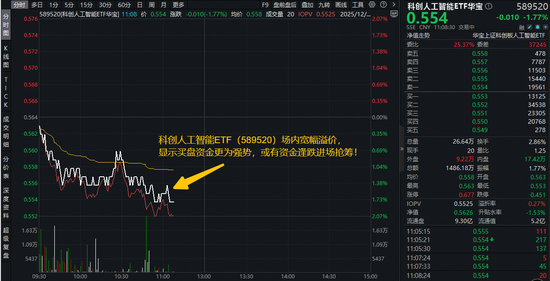
Group 1 - The core point of the article is that AI chip manufacturer Cambricon plans to use 2.778 billion yuan from its capital reserve to offset accumulated losses, which will not affect its net assets or cash flow, and will allow for potential dividend distribution after the adjustment [1][6] - Analysts noted that the capital reserve adjustment is an internal accounting measure that increases retained earnings without actual cash flow impact, thus posing no operational risks [1][6] - Cambricon's performance has been strong, with significant revenue and net profit growth expected in the first three quarters of 2025, driven by the increased sales of its cloud products [1][6] Group 2 - The AI application sector is seen as having greater potential compared to computing power, with the investment logic shifting from hardware to actual applications and commercialization [2][7] - The Sci-Tech Innovation AI ETF (589520) is strategically positioned to capture the AI industry chain, focusing on software applications, terminal applications, and chips, indicating a shift towards domestic technology [2][7] - On December 16, the ETF experienced a price drop of 1.77%, but still showed strong buying interest, indicating potential for future investment [2][8] Group 3 - The importance of information and industrial security has been highlighted in the context of technological friction, emphasizing the need for self-reliance in core technologies like AI [4] - The ETF and its associated funds are heavily invested in the domestic AI industry, with over 70% of the top ten holdings focused on semiconductor sectors, indicating a high concentration and aggressive investment strategy [4]
寒武纪拟用近28亿资本公积弥补亏损,前三季净利扭亏为盈
Xin Lang Cai Jing· 2025-12-16 02:12
智通财经记者 | 宋佳楠 12月15日晚间,AI芯片企业寒武纪(688256.SH)发布公告称,公司已通过股东会决议,拟使用27.78亿元资本公积弥补 母公司累计亏损,将截至2024年末的负未分配利润清零。 上述消息公布后,截至12月16日发稿,寒武纪股价报1306.98元,跌1.87%,总市值为5511亿元。 今年8月以来,寒武纪股价多次超越贵州茅台,成为新"股王"。公司2025年半年报披露后,寒武纪因上半年营收同比暴 增43倍、归母净利润10.38亿元实现扭亏,股价一度冲高至1595.88元的年度峰值,首次超越茅台收盘价。 所谓资本公积,是企业收到投资者超出注册资本的出资部分及其他资本性投入形成的准备金,与经营利润无关,主要来 源于股本溢价、资产重估增值等。 10月下旬,寒武纪股价连续4个交易日站稳茅台之上,并在10月27日领先幅度达到最大,当日股价较茅台溢价超3%。 据证券日报报道,中央财经大学郑登津副教授曾指出,资本公积补亏本质是"账面修复",通过冲减累计亏损改善财务报 表结构,但不直接提升企业盈利能力。 对寒武纪而言,此举短期内可消除累计亏损对利润分配的限制,为后续实施分红创造条件,契合监管层鼓励上 ...