贵金属

Search documents
A股三大指数均跌超1%!黄金股重挫,白酒股再度走强
Hua Xia Shi Bao· 2026-02-02 05:26
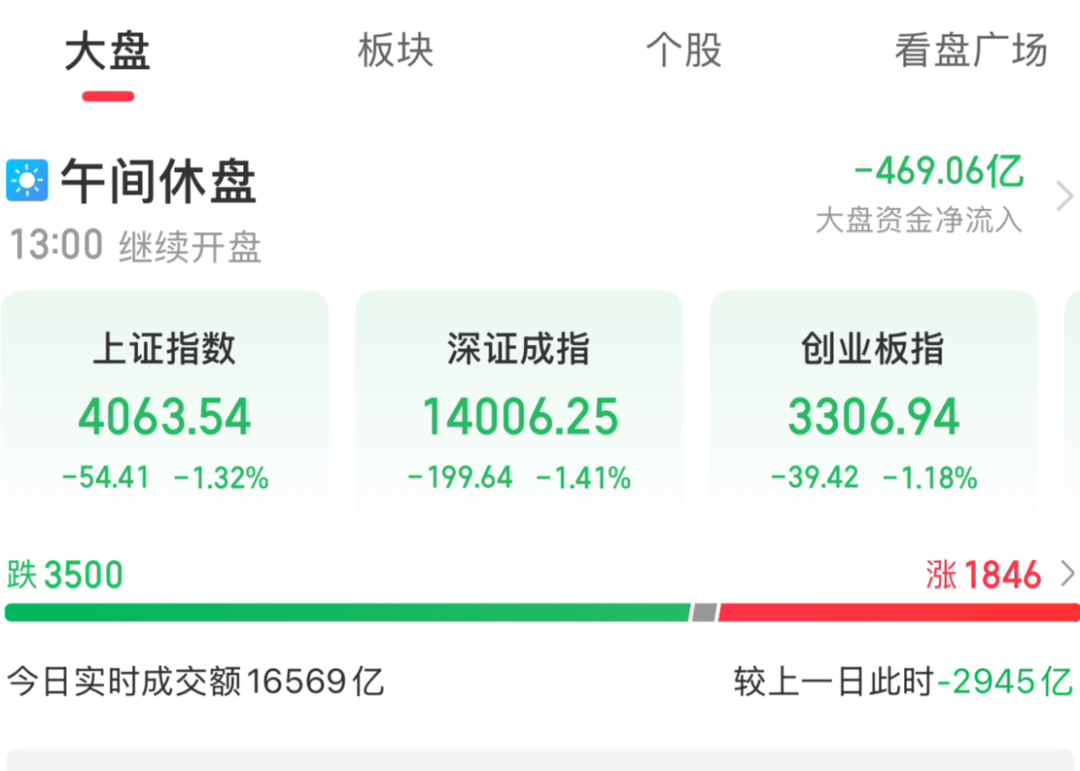
2月2日早盘,A股低开震荡,截至午间收盘,沪指跌1.32%,深成指跌1.41%,创业板指跌1.18%,北证50指数跌1.12%。市场成交呈萎缩趋势,全市场 3500只个股下跌。 其中上证指数盘中跌破4100点大关,包括上证指数在内的多个主要市场指数盘中跌幅超过1%。 贵金属板块开盘大跌,四川黄金(001337)、中金黄金(600489)等10余股跌停。 | 代码 | 名称 | 现价 | 涨跌幅 | 总市值1▼ | | --- | --- | --- | --- | --- | | 600519 | 贵州茅台 | 1438.00 | 2.64% | 18008亿 | | 000858 | 五 | 107.81 | 2.68% | 4185亿 | | 600809 | 山西汾酒 | 174.70 | 2.16% | 2131亿 | | 000568 | 泸州老窖 | 122.65 | 1.45% | 1805亿 | | 002304 | 洋河股份 | 56.01 | 1.25% | 844亿 | | 600600 | 青岛啤酒 | 62.01 | 3.21% | 735亿 | | 000596 | 古井贡酒 | ...


【UNforex财经事件】美元与利率同步走强 黄金在主席提名冲击下剧烈回调
Sou Hu Cai Jing· 2026-02-02 05:24
Core Viewpoint - The nomination of Kevin Walsh as the next Federal Reserve Chairman has led to significant market reactions, including a stronger dollar and rising long-term U.S. Treasury yields, while gold prices have experienced notable declines, raising discussions about a potential "gold bubble" [1] Group 1: Market Reactions - Following Walsh's nomination, the market quickly adjusted its expectations regarding future monetary policy, interpreting Walsh's critical stance on the Fed's balance sheet as a signal for tightening [1] - The dollar strengthened and long-term U.S. Treasury yields increased, putting pressure on precious metals, with gold prices dropping below $4,800 per ounce [1] - Gold's recent price volatility reflects a significant release of profit-taking from high levels, with a nearly historical daily decline observed on January 30 [1] Group 2: Valuation Concerns - Prior to the gold price fluctuations, concerns about gold's valuation were already emerging, with Cathie Wood of Ark Invest noting that the ratio of gold's market cap to the U.S. M2 money supply has reached extreme levels not seen since the Great Depression, indicating a potential trend reversal [2] - Wood emphasized that the current macroeconomic environment does not support such high gold valuations, especially if the dollar enters a recovery phase, which would exert further pressure on gold prices [2] - Robin Brooks, a senior researcher at Brookings, echoed similar sentiments, suggesting that the recent price increases in precious metals are primarily driven by retail trading rather than institutional investment, indicating bubble-like characteristics [2] Group 3: Future Policy Outlook - As gold prices retreat, the market is reassessing potential policy combinations from the Federal Reserve, with Walsh's framework prioritizing balance sheet reduction, which could tighten financial conditions and create upward pressure on long-term rates [3] - Analysts noted that if the Fed reduces support for the bond market, long-term rates may rise, structurally constraining gold and other non-yielding assets [3] - Despite Walsh's nomination, it is important to note that he holds only one vote on the Federal Open Market Committee, and significant policy shifts are unlikely in the short term, although uncertainty around policy has increased [3] Group 4: Overall Market Sentiment - The nomination of Walsh has prompted a reevaluation of the Fed's future policy direction, serving as a key trigger for gold's decline from recent highs [4] - In an environment of a stabilizing dollar and rising rate expectations, the previous logic of gold's unilateral rise is being reconsidered [4] - The interplay of policy uncertainty, market sentiment, and macroeconomic data is expected to maintain high volatility in precious metals and risk assets in the short term, with market pricing shifting towards a more cautious balance [4]
贵金属:欲戴王冠,必承其重
Fang Zheng Zhong Qi Qi Huo· 2026-02-02 05:18
Group 1: Report Industry Investment Rating - Not provided in the content Group 2: Core Viewpoints of the Report - The underlying logic of the current precious metals bull market is global de - dollarization, which remains intact. Central bank gold purchases continue [81]. - Despite Trump's nomination of Warsh as the new Fed chair, the Fed is expected to continue cutting interest rates, leading to a decline in real US Treasury yields and benefiting gold and silver. Fed balance - sheet reduction is difficult to implement [81]. - The impairment of the US dollar's credit is due to multiple factors and is likely to enter a medium - to - long - term decline. 2026 is a big year for US Treasury issuance, with the total scale expected to exceed $40 trillion [81]. - Gold and silver are being redefined as anti - inflation assets and important components of global asset allocation. Silver's supply - demand contradiction remains unresolved, and it may have better price elasticity and return in 2026 [81]. - In the short term, there is a need for a technical correction, but the medium - to - long - term upward trend remains unchanged [81]. Group 3: Summary by Directory I. Market Review 1. Gold - In January 2026, the global gold market had a spectacular performance. London gold broke through the $5000 mark and reached nearly $5600, then had a significant drop. However, both London gold and Shanghai gold had cumulative gains of over 10%. Factors influencing the market included increased geopolitical uncertainty, accelerated de - dollarization, the Fed's inaction, the end of a series of negative factors, and Trump's appointment of a new Fed chair [14]. 2. Silver - In January 2026, the silver market also had an epic performance, with a more violent fluctuation. It had a cumulative gain of over 30%. The driving factors were similar to those of gold, and the potential risk of overseas delivery was also priced in. It also had a significant correction at the end of the month [17]. II. Macro Logic 1. Change in the Pricing Logic of Precious Metals - The traditional relationship between US Treasury real yields and gold has changed since 2023. The US debt, deficit, and the impairment of the US dollar's credit are becoming the new pricing anchors for gold. The pricing logic has shifted from the financial to the monetary attribute [21]. 2. De - dollarization Trend - The US dollar index has been declining since 2025, indicating a long - term decline in the US dollar premium. The "Triffin Dilemma" and the "Sea Lake Manor Agreement" are related to the US's economic strategy, which may lead to a reduction in the US dollar's status as a reserve currency. Global central banks have been de - dollarizing and increasing their gold holdings [24]. 3. Weakening of the Safe - haven Attributes of the US Dollar and US Treasuries - The US dollar and US Treasuries have started to show risk - asset characteristics, with the US stock, bond, and currency markets experiencing multiple sell - offs. Gold and silver's safe - haven attributes have been highlighted [28]. 4. Expansion of US Treasury Debt - The US Treasury debt has been expanding rapidly, with the total expected to exceed $40 trillion in 2026. This has led to a diversion of global safe - haven funds to gold, silver, and other assets [30]. 5. Gold as a Hedge against Credit Risk - Gold and silver have become the ultimate choice to hedge against the risks of the global credit currency system due to high global debt and the weakening of the US dollar's credibility [32]. 6. US Dollar Cycle - The US dollar has an approximately 17 - year cycle, and currently, it is at the start of a downward cycle. A decline in the US dollar index is expected to boost gold prices [34]. 7. US Economic and Policy Situation - The US GDP showed certain growth in 2025, consumer confidence improved in January 2026, the labor market cooled down, and inflation remained above the Fed's target. The Fed's independence has been challenged, and the market has different expectations for its policy [37][39][40]. 8. Redefinition of Gold - Gold has both "safe - haven" and "risk - asset" attributes. It can resist inflation and is an important part of global asset allocation [43]. III. Fundamental Logic 1. Central Bank Gold Purchases - In 2025, global central bank gold purchases reached a high level, though the pace slowed down. Some central banks increased their holdings, while others sold gold. De - dollarization is expected to continue in 2026, and central bank gold purchases will remain a fundamental demand for gold [49]. 2. Gold Investment Demand - In 2025, global gold total demand reached a record high, mainly driven by investment demand. Gold ETFs and physical gold investment demand increased, while gold jewelry demand declined in quantity but increased in value. Gold supply also increased [52]. 3. Silver Supply - The silver supply side has strong constraints, with limited growth in mineral and recycled silver. In 2025 and 2026, the total supply is expected to increase slightly [55]. 4. Silver Demand - Industrial demand accounts for nearly 60% of total silver demand. In 2025, total silver demand is expected to decline slightly, and industrial demand has different trends in different fields. AI is expected to be an important source of future demand growth [58]. 5. Silver Supply - Demand Gap - The silver market has been in short supply for five consecutive years, and the gap is expected to continue in 2026. The available inventory is extremely limited, and the price elasticity is high [62]. 6. Gold - Silver Ratio - The gold - silver ratio reflects the premium of gold over silver in terms of safe - haven demand. It is affected by economic cycles, inflation, and other factors. Currently, the ratio has dropped to a relatively low level, and there is room for further adjustment [63][64]. 7. Asset Management and ETF Holdings - For gold, the non - commercial net long position in the COMEX market has decreased, while the holdings of the largest gold ETF have increased. For silver, both the non - commercial net long position in the COMEX market and the holdings of the largest silver ETF have decreased [68][71]. 8. Technical Analysis - The monthly chart of London gold shows an upward trend, and the weekly chart of London silver shows a correction within the upward channel [76][77]. IV. Summary and Outlook - In February, the price ranges of London gold, Shanghai gold, London silver, and Shanghai silver are predicted. After the adjustment, there may be medium - to - long - term investment opportunities, and it is recommended to buy on dips [80].
“涨停潮”!这些板块 逆市走强!
Zhong Guo Ji Jin Bao· 2026-02-02 04:46
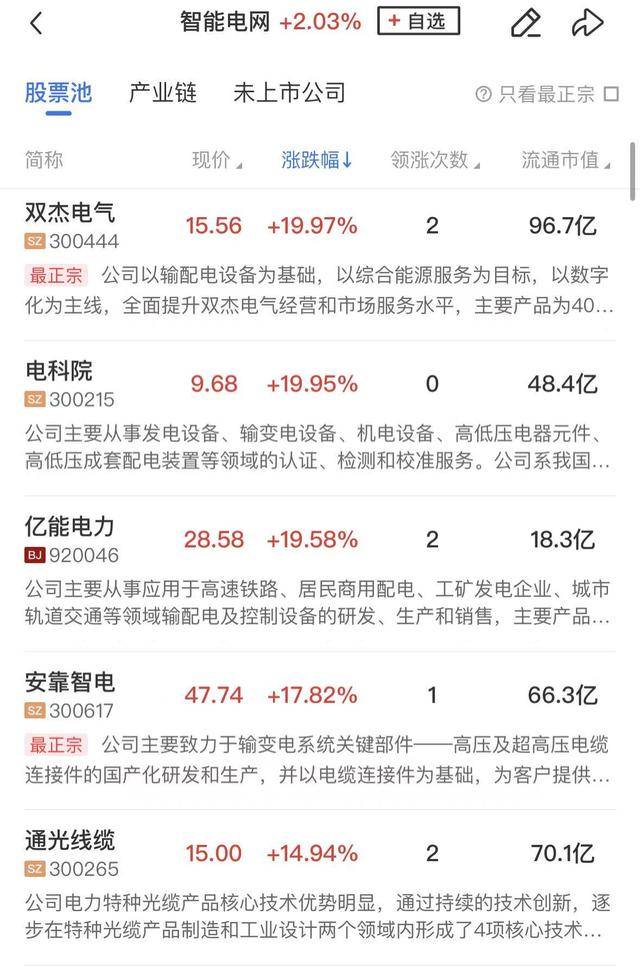
Market Overview - The A-share market experienced a collective decline of over 1% across the three major indices, with the Shanghai Composite Index down 1.32% to 4063.54 points, the Shenzhen Component down 1.41%, and the ChiNext Index down 1.18% [3][4] - A total of 3496 stocks fell, while only 1844 stocks rose, with 87 stocks hitting the daily limit up [4] Sector Performance - The gold stock index dropped by 8.2%, while indices for non-ferrous metals, industrial metals, and A-share resources all fell by over 5% [1] - The coal index decreased by over 4%, and the semiconductor index fell by 3% [1] - Conversely, the liquor sector showed resilience, with major brands like Kweichow Moutai and Wuliangye rising by 2.64% and 2.68% respectively [5][6] - The banking sector also saw gains, with CITIC Bank rising over 3% and several other banks increasing by more than 1% [9][10] - The electric grid equipment sector experienced a "limit-up" trend, with multiple stocks hitting the daily limit [11] Liquor Sector Insights - Kweichow Moutai's stock price reached 1438 CNY, with a market capitalization of 18008 billion CNY [5][7] - The wholesale price of Feitian Moutai rose to 1710 CNY per bottle on January 30, before retreating to 1630 CNY on February 1 [8] Banking Sector Developments - The China Securities Regulatory Commission (CSRC) proposed allowing various institutional investors, including public funds and bank wealth management products, to participate as strategic investors in stock issuances [10] Electric Grid Equipment Sector - The electric grid equipment sector is experiencing a surge due to increased demand for power transformers, with many factories operating at full capacity [11] Precious Metals and Industrial Metals - The precious metals sector faced significant declines, with multiple stocks hitting the daily limit down, including major players like Zhaojin Mining and Sichuan Gold [13][14] - The industrial metals sector also saw substantial drops, with companies like Tongling Nonferrous Metals and Jiangxi Copper recording limit down [15][16]

午报三大指数均跌超1%,电网设备逆势走强,贵金属、半导体集体调整
Sou Hu Cai Jing· 2026-02-02 04:34
Market Overview - The market experienced a downward adjustment with all three major indices falling over 1%, and the ChiNext index dropping over 2% [1] - The total trading volume in the Shanghai and Shenzhen markets was 1.64 trillion yuan, a decrease of 290.4 billion yuan compared to the previous trading day [1] - Over 3,400 stocks in the market declined, while the electric grid equipment sector showed strength with several stocks hitting the daily limit [1] Sector Performance - The electric grid equipment sector saw significant gains, with stocks like Sanbian Technology and Baobian Electric hitting the daily limit [1] - The liquor sector rebounded, highlighted by Huangtai Liquor achieving three consecutive limit-ups and Shui Jing Fang reaching the daily limit [3] - The film and theater sector was active, with Hengdian Film and Television also achieving three consecutive limit-ups [1] - AI applications saw localized increases, with stocks like Yaowang Technology hitting the daily limit and Tongda Hai rising over 15% [1] Downward Trends - Resource stocks collectively adjusted, with non-ferrous metals and oil and gas sectors leading the decline, including multiple stocks like Zhaojin Gold and Sichuan Gold hitting the daily limit [1] - The semiconductor industry chain experienced a collective downturn, with stocks like Wentai Technology hitting the daily limit and others like Kaipu Cloud and Mingwei Electronics dropping over 10% [1] AI and Power Equipment - The global AI computing power construction is entering an explosive phase, with transformers becoming a core infrastructure for computing power [2] - In regions like Guangdong and Jiangsu, transformer factories are operating at full capacity, with some orders for data center-related businesses extending to 2027 [2] - The transformer industry in China consists of approximately 3,000 companies, with exports expected to reach 64.6 billion yuan by 2025, a nearly 36% increase from 2024 [3] Liquor Sector Insights - The liquor sector is experiencing a rebound, with stocks like Huangtai Liquor and Shui Jing Fang showing significant gains [3] - Despite a generally pessimistic market outlook for the liquor industry due to macroeconomic conditions, there are indications of potential investment opportunities as the sector approaches a valuation bottom [5] AI Computing Rental - The AI computing rental sector is also showing resilience, with companies like Litong Electronics and Qunxing Toys hitting the daily limit [5] - Litong Electronics has a rental scale of over 10,000 P, with approximately 4,000 P from self-owned computing power [6] Market News - Tencent's Yuanbao app launched a 10 billion yuan Spring Festival red envelope campaign, which has boosted its ranking in app stores [13] - The Qianwen app announced a 3 billion yuan investment for a Spring Festival initiative, set to launch on February 6, 2024 [23]


“涨停潮”!这些板块,逆市走强!
Zhong Guo Ji Jin Bao· 2026-02-02 04:32
【导读】上午A股三大指数集体跌超1%,酒类、银行板块逆市走高,电网设备板块掀"涨停潮" 中国基金报记者张舟 2月第一个交易日,A股市场早盘震荡调整,三大指数均跌超1%。 热门行业指数集体重挫,黄金股票指数盘中下跌8.2%,有色矿业指数、工业有色指数、A股资源指数、大宗商品指数盘中跌幅均超5%,煤炭指数盘中跌 幅超4%,半导体指数盘中下跌3%。 从市场结构看,杀跌的主力,主要还是前期大涨的资源股。贵金属热门个股普遍跌停,工业金属概念板块多只个股跌停,洛阳钼业跌超7%,化工股里的 万华化学跌超7%。 而白酒股逆势走强,电网设备板块掀"涨停潮",银行板块异动拉升。互联网、文化传媒、公路等板块涨幅居前。 截至午间收盘,沪指报4063.54点,跌1.32%;深证成指走弱,跌1.41%;创业板指跌1.18%。 | 4063.54 | war | 4006.25 - - - - - | 3306.94 | A m | | --- | --- | --- | --- | --- | | 上证指数 -1.32% | | 深证成指 -1.41% | 创业板指 -1.18% | | 个股跌多涨少,全市场共有3496只个股下跌,仅有 ...





VIX指数失灵 恐慌转向大宗商品与汇率战场:黄金创80年代来最大单日跌幅、1999年来最大月度涨幅
Sou Hu Cai Jing· 2026-02-02 04:28
Group 1 - The global asset classes have shown significant divergence this year, with stock market volatility remaining low while volatility in precious metals, foreign exchange, and commodities has increased [1] - The Chicago Board Options Exchange Volatility Index (VIX) has not adequately reflected current macro-level risk signals, indicating a shift in market fear from equities to commodities and currencies [1] - Gold prices reached a historical high earlier this year but experienced the largest single-day drop since the 1980s last week, while the dollar's exchange rate saw its largest single-day decline since April [1] Group 2 - Despite concerns over an artificial intelligence stock bubble, core volatility has concentrated in non-equity areas, with gold and oil prices showing significant fluctuations [1][2] - The volatility in individual stocks has decreased overall market correlation, leading to a lower overall volatility index, as investors focus on earnings and the sustainability of AI trading [2] - The demand for gold ETFs has surged, with a growth of over $20 billion in the past eight months, although the safe-haven attribute of precious metals has weakened due to significant price fluctuations [2]
特朗普提名鹰派美联储主席触发贵金属跳水 A股三十余只有色股跌停
Sou Hu Cai Jing· 2026-02-02 04:24
Group 1 - The international gold and silver prices experienced a significant correction, erasing previous gains due to the hawkish monetary policy stance of Kevin Walsh, nominated by President Trump as the next Federal Reserve Chair [1] - The A-share market saw a broad decline in the non-ferrous sector, with over thirty stocks in the precious metals sector hitting the daily limit down, and multiple gold ETF stocks also facing similar declines [1] - Domestic trading institutions have increased risk control measures, raising margin ratios and price fluctuation limits for precious metal contracts to mitigate market volatility risks [1] Group 2 - The physical gold market showed a polarized trend, with increased buying and selling activity in Shenzhen's Shui Bei trading market following the price correction, as some investors sold holdings to lock in profits while others took the opportunity to buy physical gold [1] - Goldman Sachs' trading department indicated that the market adjustment is primarily a technical position clean-up, with no substantial changes in the core driving factors since the beginning of the year [2] - UBS raised its gold price targets for March, June, and September 2026 to $6,200 per ounce, while cautioning that a hawkish shift in Federal Reserve policy could suppress gold prices [2]
机构:今年银价或将大幅波动
Xin Lang Cai Jing· 2026-02-02 04:18
Core Viewpoint - Silver prices are expected to experience significant volatility this year, particularly following a recent drop of over 30% alongside falling gold prices [1] Group 1: Market Conditions - The silver market continues to face liquidity challenges, indicating potential shortages in supply this year [1] - The current supply-demand dynamics suggest that silver will be in short supply, despite a year-to-date increase in silver prices [1] Group 2: Demand Factors - Industrial demand, which accounts for approximately 60% of total silver demand, is currently weak [1] - A reduction in speculative positions indicates that speculation is unlikely to be a driving factor for recent increases in silver prices [1] Group 3: Future Outlook - The volatility in silver and the broader metals market is likely to persist due to the ongoing challenges in both liquidity and demand [1]
跌麻了!沃什风暴,金银“失血休克”
Ge Long Hui A P P· 2026-02-02 04:18
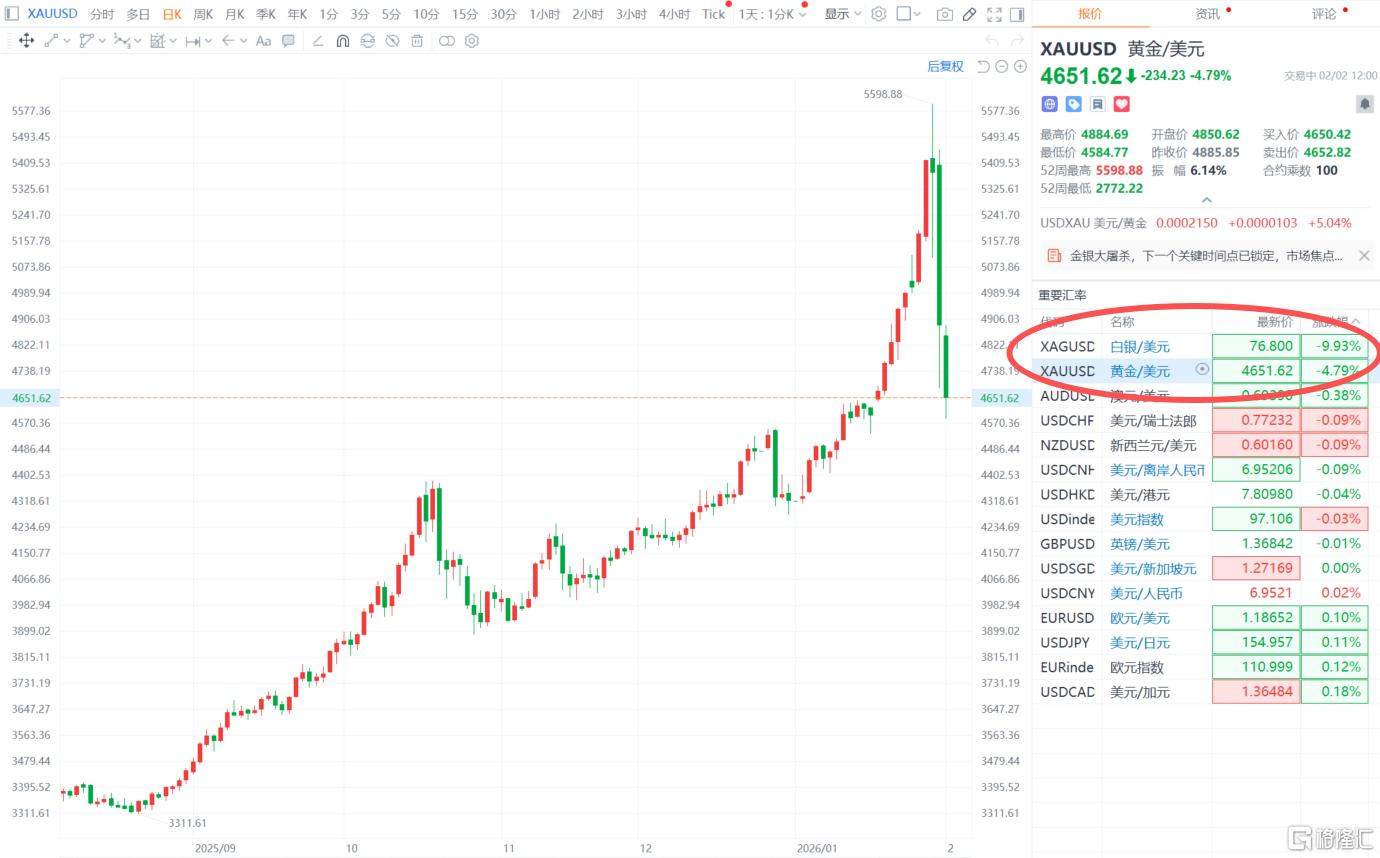
Group 1 - The core viewpoint of the article highlights a significant decline in gold and silver prices, with gold dropping over 6% to below $4600 per ounce, marking a decline of over $1000 from its historical high of $5598.88 per ounce set on January 29, representing the largest single-day drop in nearly 40 years [1][9][10] - Silver prices also experienced a sharp decline, with spot silver falling below $77 at one point, and later reported to be down over 9% to $76.8 per ounce [2][3] - Futures markets showed widespread declines, with various precious metals such as silver, platinum, and palladium hitting their daily limit down, and gold futures dropping over 11% [5][6] Group 2 - The article describes the "Walsh Storm" as a catalyst for the extreme market panic, with silver prices plummeting by 26% and gold by 9% on a single day, marking the worst performance in a decade [9][10] - The appointment of the hawkish Walsh as the Federal Reserve Chair led to a cooling of interest rate cut expectations, resulting in a strong dollar and a rapid reversal of the bullish trend in precious metals [10][11] - Major exchanges have responded to the volatility by raising margin requirements for gold and silver trading, indicating a tightening of market conditions [15][16] Group 3 - The article raises concerns about a potential bubble in the gold market, with warnings from analysts that the recent surge in gold prices may be speculative and could lead to a significant price correction [19][20][21] - Citigroup has cautioned that gold valuations have reached extreme levels, with global gold expenditure as a percentage of GDP hitting a 55-year high, suggesting a risk of a price halving if the allocation returns to historical norms [23][24] - Despite the bearish outlook, some analysts believe that the fundamental support for gold remains strong due to ongoing currency devaluation and geopolitical risks, suggesting a complex market environment [26][28]