
电子

Search documents
近300家上市公司预喜,如何抓住“预增”主题投资机会?
Sou Hu Cai Jing· 2026-01-23 07:11
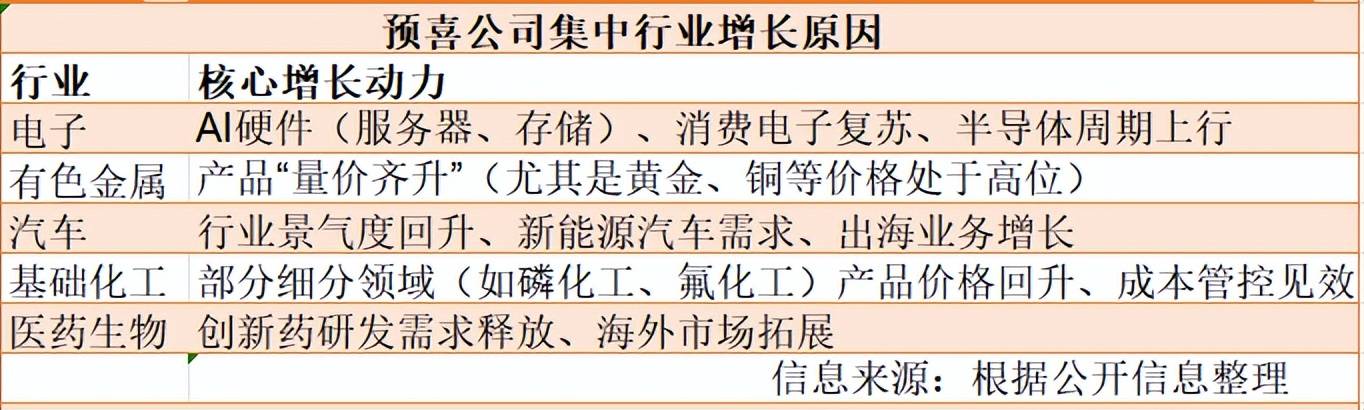
出品|公司研究室 å文|雪岩 据不完全统计,截至1月21日收盘时,A股共有587家上市公司披露了2025年度业绩预告。从净利润增幅上限来看,超五成上市公司业绩预喜(包括预增、略 增、续盈、扭亏)。 二级市场对个股业绩关注度升温,但 不少投资者不知道如何参与。目前,参与预喜机会的高效工具当属买进对应主题的投资基金。究竟哪些行业预喜公司 较为集中?哪些基金值得关注?应该如何买入? 业绩预喜公司 主要集中在哪些行业? 根据沪深两市业绩预告(尤其是2025年三季度及全年预告),A股预喜公司数量排名前五的行业是:电子、基础化工、汽车、医药生物、机械设备。这五大 行业的预喜公司合计数量,占目前已披露预喜公司总数的近56.6%。这主要反映了上述行业上市公司基数大、景气面广的特点。 从预喜率看,有色金属、钢铁、汽车、家用电器、基础化工这五大行业非常高。 此外,随着国家电网"十五五"期间投资4万亿更新设备的消息发布,电力设备&电网/核电相关公司成为市场热点。除了国家电网"十五五"投资预期升温,AI 数据中心高耗电推动核电采购(谷歌、微软、Meta布局),特高压、柔性直流输电项目落地也是重要原因。 业内人士分析,眼下正处于年报季 ...

顶压前行、逆势增长 出口商品清单看中国外贸新变化
Yang Shi Xin Wen Ke Hu Duan· 2026-01-23 07:04
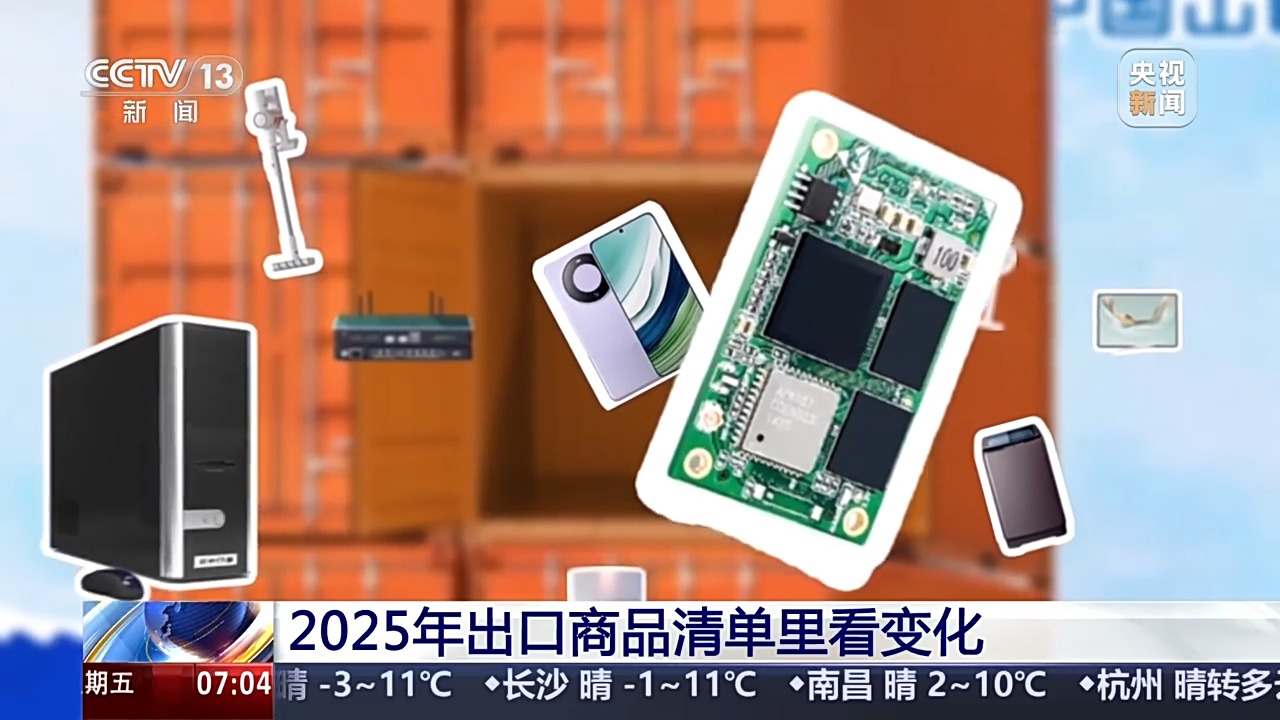
Core Insights - China's foreign trade has shown resilience and growth over the past year, with notable changes in export products, particularly a trend of "five increases and one decrease" in export volumes [1] Group 1: Export Trends - Exports to Asia have seen the most significant growth, followed by Africa and Europe, with the scale of growth in Africa and Europe being relatively similar [1] - High-tech products such as integrated circuits, smartphones, and data processing equipment are increasingly in demand in Asia due to the region's push for green, smart, and digital transformation [3] - In 2025, exports to Europe have shown new characteristics, with notable increases in products like transformers, air conditioners, and ice cream, contributing to a refreshing summer in Europe [5] Group 2: Key Products - Among over 200 major export products, electrical machinery remains a significant category, with transformers experiencing a 35.6% year-on-year increase in exports in 2025 [5] - The demand for transformers is driven by a long-term supply gap in the US and Europe, as many electrical grid facilities are outdated and require upgrades [11] - Drones have outperformed transformers with a 45% increase in exports in 2025, being utilized in various professional applications beyond just aerial photography [13] Group 3: Market Dynamics in Africa - China's exports to Africa increased by 26.5% year-on-year, with a diverse range of products from textiles to major projects like offshore production platforms [5] - In South Africa, multifunctional Bluetooth speakers have gained popularity, reflecting local consumer preferences for portable and multifunctional devices [15] - Nigeria has seen a surge in solar product sales, with a 75% increase in the previous year, indicating a growing acceptance and integration of solar energy solutions in daily life [17][19]
商业航天引爆太空光伏需求!科创50ETF(588000)午后翻红,光伏股集体大涨,晶科能源涨停,天合光能涨超14%!
Mei Ri Jing Ji Xin Wen· 2026-01-23 06:50
Group 1 - The A-share market experienced fluctuations on January 23, with the Sci-Tech 50 ETF (588000) rebounding in the afternoon, showing a gain of 0.43% and a trading volume exceeding 3.5 billion yuan, indicating a significant increase in trading activity [1] - Solar energy stocks surged, with JinkoSolar hitting the daily limit, Trina Solar rising by 14.92%, GuoBo Electronics increasing by 13.83%, and Canadian Solar up by 10.51%. Other companies like ZhongKong Technology and Daqo New Energy also saw gains exceeding 7% [1] - Trina Solar announced a price increase for its distributed photovoltaic standard components by 0.03 yuan/W, with the new price range set at 0.88-0.92 yuan/W. This marks the third price adjustment since 2026, with an overall increase of 0.06 yuan/W in less than a month [1] Group 2 - The outlook for the solar industry is optimistic, with brokerage reports indicating that the application for 200,000 satellites in China is accelerating the entire commercial space industry chain, leading to a surge in demand for space-based photovoltaics [1] - The planned constellation of thousands of satellites is expected to exponentially increase the demand for photovoltaic cells, while the complexity of satellite equipment is driving up the energy supply requirements per satellite [1] - Technological advancements are pushing the photovoltaic cell industry towards low-cost HJT and perovskite tandem routes, driven by commercialization [1] Group 3 - The Sci-Tech 50 ETF (588000) tracks the Sci-Tech 50 Index, with over 70% of its holdings in the electronics sector, aligning well with the current development trends in artificial intelligence and robotics [2] - The ETF also covers multiple sub-sectors, including medical devices, software development, and photovoltaic equipment, indicating a high content of hard technology [2] - Investors optimistic about the long-term development prospects of China's hard technology are encouraged to continue monitoring this ETF [2]




2025Q4公募基金持仓分析:资源品仓位创历史新高
Soochow Securities· 2026-01-23 05:49
1. Report Industry Investment Rating No relevant content provided. 2. Core Viewpoints of the Report - In Q4 2025, there were five major highlights in the holdings of public - offering funds, including the contraction of active equity scale with eased redemption pressure, the differentiation of A/H - share positions, the continuation of the "passive > active" situation, the record - high position of resource products and the record - low position of consumer services, and no subscription or redemption operations of Huijin for ETFs [6]. - The stock positions of all mainland public - offering funds declined, and from both overall and median perspectives, the stock positions of active equity - biased funds in Q4 2025 also declined [6]. - From the perspective of the fund allocation side of stocks, the shareholding scale of index and "fixed - income +" products increased. Compared with Q3 2025, in Q4 2025, the number of top - holding stocks of mainland public - offering funds increased, the market value slightly shrank, and the concentration of the top 100 top - holding stocks decreased [6]. 3. Summary by Relevant Catalogs 3.1 2025Q4 Public - Offering Fund Holdings: Five Major Highlights - **Active equity scale contraction with eased redemption pressure**: In Q4 2025, the scale of active equity funds shrank, but the redemption pressure eased. The scale of active equity - biased funds was 3.9 trillion yuan, a 4% quarter - on - quarter contraction; the share was 2.65 trillion shares, a decrease of 71.6 billion shares quarter - on - quarter. The net redemption share was 125.6 billion shares, a contraction of 91.9 billion shares quarter - on - quarter [15]. - **Differentiation of A/H - share positions, reduction of Alibaba in Hong Kong stocks**: In Q4 2025, the A/H - share positions of mainland active equity - biased funds were differentiated. The A - share position slightly increased, while the Hong Kong - share position significantly declined. The active equity - biased funds held about 483.6 billion yuan of Hong Kong stocks, accounting for 23.4% of the scale of active equity - biased funds that could invest in Hong Kong stocks (a 3.9 - percentage - point quarter - on - quarter decrease). Tencent Holdings remained the largest Hong Kong - stock top - holding of mainland active equity - biased funds, with a reduction of 3.9 billion Hong Kong dollars in Q4. Alibaba and other software and hardware technology directions were under - allocated, with the largest under - allocation scale of Alibaba reaching 11.2 billion Hong Kong dollars [20]. - **Continuation of the "passive > active" situation, "fixed - income +"承接 residents' entry into the market**: In Q4 2025, the scale of "fixed - income +" funds reached 2.6 trillion yuan, a 9.8% quarter - on - quarter increase. Index funds became an important channel for funds to enter the market, and the gap between passive and active funds widened. The scale expansion of "fixed - income +" funds might be an important carrier for the transfer of residents' deposits [22][24]. - **Record - high position of resource products and record - low position of consumer services**: In Q4 2025, active equity - biased funds significantly increased their positions in resource products and reduced their positions in TMT. The position of resource products reached 13.3%, and the under - allocation margin narrowed to a record high; the position of consumer services was 9.8%, reaching a record low [29]. - **No subscription or redemption operations of Huijin for ETFs**: As of the end of Q4 2025, Huijin's holding shares of the 12 "preferred" ETFs were the same as those in H1 and Q3, with no subscription or redemption operations during the period [32]. 3.2 Mainland Public - Offering Fund Asset Allocation - **All mainland public - offering funds**: In Q4 2025, the stock positions of mainland public - offering funds declined, and the bond positions increased. The total asset value of mainland public - offering funds was 39.48 trillion yuan, a 3.5% quarter - on - quarter increase; the net asset value was 36.35 trillion yuan, a 2.7% quarter - on - quarter increase. The stock position was 22.87%, a decrease of 0.71 percentage points quarter - on - quarter [36]. - **Active equity - biased funds**: In Q4 2025, the net asset value and stock market value of active equity - biased funds declined compared with Q3, and the stock position decreased synchronously, while the A - share position slightly increased. The stock position of active equity - biased funds was 84.37%, a decrease of 1.41 percentage points quarter - on - quarter; the A - share position was 72.26%, an increase of 0.66 percentage points quarter - on - quarter [40]. - **"Fixed - income +" funds**: In Q4 2025, the net asset value of "fixed - income +" funds increased by 9.8%, the stock market value continued to grow, and both the stock and bond positions increased slightly. The stock position was 10.04%, an increase of 0.17 percentage points quarter - on - quarter; the bond position was 86.02%, an increase of 0.19 percentage points quarter - on - quarter [44]. - **Median of fund positions**: From the median perspective, in Q4 2025, the stock positions of active equity - biased and "fixed - income +" funds declined, while the position of index funds remained stable. The median stock position of active equity - biased funds was 87.90%, a decrease of 1.01 percentage points quarter - on - quarter [48]. - **Stock allocation side**: The shareholding scale of index and "fixed - income +" products increased. In Q4 2025, the stock market value of active equity - biased funds was 3.37 trillion yuan, a 5.2% quarter - on - quarter decrease; the stock market value of index funds was 4.70 trillion yuan, a 3.4% quarter - on - quarter increase; the stock market value of "fixed - income +" funds was 301.501 billion yuan, a significant 14.1% quarter - on - quarter increase [53]. 3.3 A - Share Top - Holding Stock Analysis of Mainland Public - Offering Active Equity - Biased Funds - **Overall situation**: Compared with Q3 2025, in Q4 2025, the number of top - holding stocks increased, the market value slightly shrank, and the concentration of the top 100 top - holding stocks decreased. The number of top - holding stocks was 2,429, an increase of 117 quarter - on - quarter; the market value was 1.61 trillion yuan, a 2.72% quarter - on - quarter decrease [58]. - **Sector allocation**: The over - allocation ratio of the GEM increased, and the under - allocation ratio of the main board expanded. In Q4 2025, the allocation ratios of the main board, GEM, STAR Market, and Beijing Stock Exchange were 58.5%, 24.8%, 16.5%, and 0.3% respectively [63]. - **Style allocation**: The allocation ratio of large - cap stocks continued to rise, while the positions of mid - and small - cap stocks declined. In Q4 2025, the allocation ratios of CSI 100 and CSI 300 increased by 1.35 and 1.87 percentage points quarter - on - quarter respectively, while those of CSI 500 and CSI 1000 decreased by 0.42 and 0.40 percentage points quarter - on - quarter respectively [66]. - **Large - category allocation**: The allocation ratio of TMT declined from a high level, while the allocation ratio of resource products increased significantly. In Q4 2025, the top three allocation ratios of active equity - biased funds among large - category industries were TMT (37.8%), mid - stream manufacturing (25.7%), and resource products (13.3%) [70]. - **First - level industry allocation**: The positions of cyclical products increased, while the positions of TMT decreased significantly. The top five industries with increased positions were non - ferrous metals, non - bank finance, basic chemicals, machinery and equipment, and food and beverages; the top five industries with decreased positions were electronics, media, computers, national defense and military industry, and communications [78]. - **Second - level industry allocation**: The positions of insurance and industrial metals increased significantly. After excluding the impact of stock prices, the positions of insurance, industrial metals, and auto parts increased, while consumer electronics, games, and batteries were relatively under - allocated [84]. - **Individual stocks**: Zhongji Innolight became the new top - holding stock of institutions. China Ping An, Dongshan Precision, and Baiwei Storage were significantly increased in position; Industrial Foresight, EVE Energy, and Ninebot were significantly reduced in position [88].
科创板系列指数震荡分化,关注科创200ETF易方达(588270)、科创50ETF易方达(588080)等投资机会
Sou Hu Cai Jing· 2026-01-23 05:10
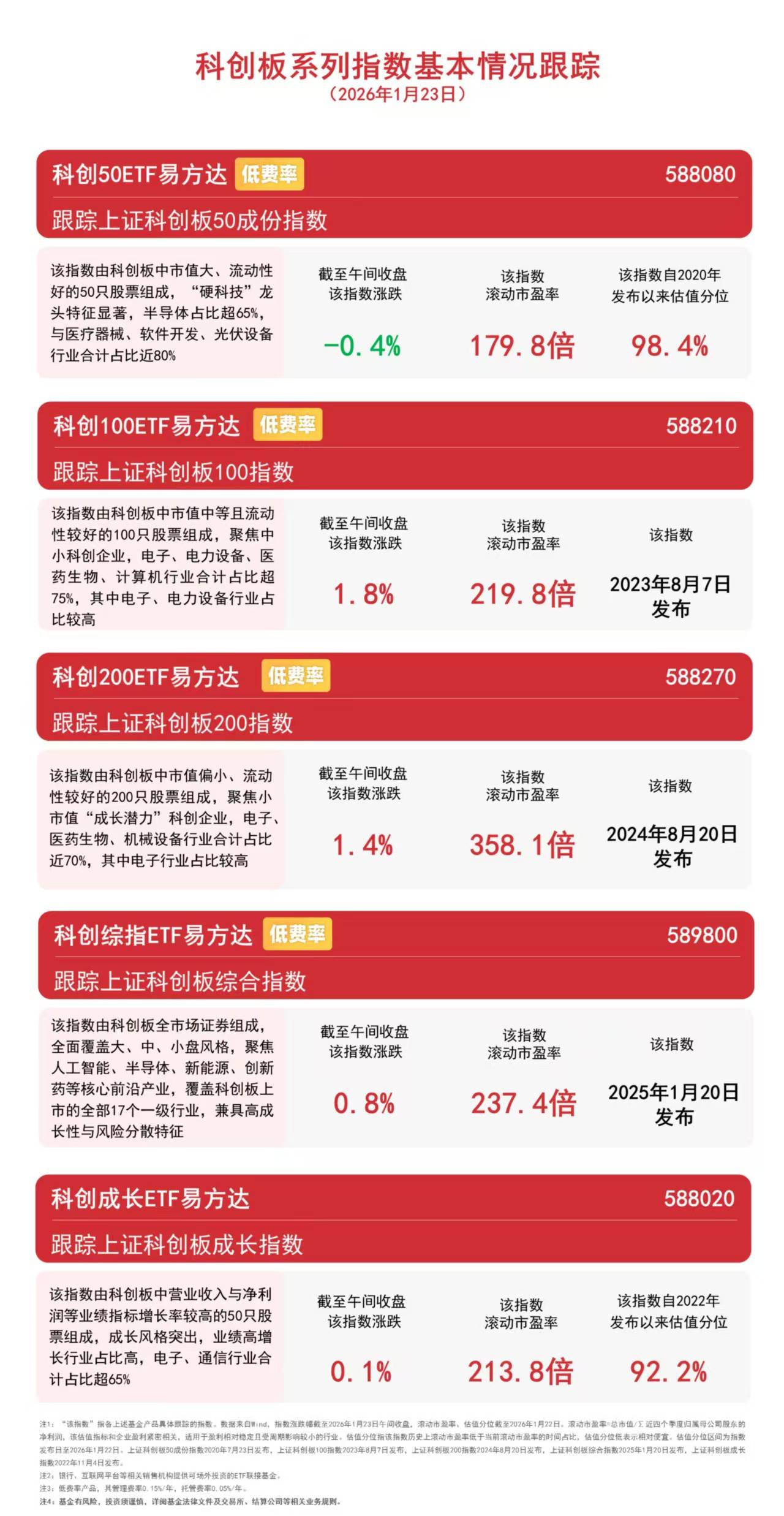
Group 1 - The core focus of the news is on the performance and characteristics of various ETFs tracking the STAR Market indices, highlighting their composition and sector allocations [2][3][4]. - The STAR 50 ETF consists of 50 large-cap stocks with a significant focus on "hard technology," particularly in the semiconductor sector, which accounts for over 65% of the index [2]. - The STAR 100 ETF is composed of 100 mid-cap stocks, with over 75% of its composition in the electronics, power equipment, and pharmaceutical sectors, indicating a strong emphasis on small and medium-sized innovative enterprises [3]. - The STAR 200 ETF includes 200 smaller-cap stocks, with nearly 70% of its composition in electronics, pharmaceuticals, and machinery sectors, showcasing a focus on growth potential in smaller companies [4]. Group 2 - The STAR 50 ETF has a rolling P/E ratio of 179.8 times, while the STAR 100 ETF has a rolling P/E ratio of 219.8 times, and the STAR 200 ETF has a rolling P/E ratio of 358.1 times, indicating varying valuations across these indices [2][3][4]. - The STAR 50 ETF experienced a slight decline of 0.4%, while the STAR 100 ETF increased by 1.8%, and the STAR 200 ETF rose by 1.4%, reflecting different market dynamics among these ETFs [2][3][4].
今日80只A股封板 国防军工行业涨幅最大
Zheng Quan Shi Bao Wang· 2026-01-23 04:48
Market Overview - The Shanghai Composite Index rose by 0.27% today, with a trading volume of 1,077.28 million shares and a transaction value of 19,136.04 billion yuan, an increase of 6.97% compared to the previous trading day [1] Industry Performance - The top-performing sectors included: - Defense and Military Industry: Increased by 2.60%, with a transaction value of 1,331.82 billion yuan, led by Ruichuang Micro-Nano, which rose by 20.00% [1] - Electric Equipment: Increased by 2.58%, with a transaction value of 2,372.13 billion yuan, led by Oputai, which rose by 29.98% [1] - Nonferrous Metals: Increased by 2.24%, with a transaction value of 1,386.96 billion yuan, led by Western Materials, which rose by 10.00% [1] Declining Sectors - The sectors with the largest declines included: - Electronics: Decreased by 1.10%, with a transaction value of 3,393.87 billion yuan, led by Jucheng Co., which fell by 7.96% [2] - Communication: Decreased by 1.06%, with a transaction value of 1,080.24 billion yuan, led by Xinyi Sheng, which fell by 6.71% [2] - Coal: Decreased by 1.00%, with a transaction value of 69.42 billion yuan, led by Jinkong Coal Industry, which fell by 1.81% [2]


2026存储产值达5516亿美元!科创50ETF(588000)回调0.67%,光伏股强势领涨
Mei Ri Jing Ji Xin Wen· 2026-01-23 04:48
1月23日,A股三大指数高开,科创50ETF(588000)早盘冲高后震荡回落,回调0.67%。盘面上, 光伏概念股反复走强,国博电子大涨13.43%,天合光能上涨10.45%,晶科能源上涨9.74%,阿特斯上涨 6.86%;截至发文,科创50ETF(588000)成交额达19.41亿元。 每日经济新闻 (责任编辑:张晓波 ) 【免责声明】本文仅代表作者本人观点,与和讯网无关。和讯网站对文中陈述、观点判断保持中立,不对所包含内容 的准确性、可靠性或完整性提供任何明示或暗示的保证。请读者仅作参考,并请自行承担全部责任。邮箱: news_center@staff.hexun.com 展望后市,招商证券指出,存储价格上涨,AI需求驱动供需再平衡。截至2026年1月19日,全球存 储产业(以SSD/NAND Flash为主,兼顾DRAM)正处在一轮明显的涨价上行期。与过去"消费旺季—补 库存"式的短周期波动不同,本轮更像结构性紧缺:上游报价强势回归,下游被迫在提价、改配置、锁 单和备货之间重新取舍。 科创50ETF(588000)追踪科创50指数,指数持仓电子行业69.39%,计算机行业4.88%,合计 74.27% ...
港股午评:恒指涨0.32%、科指涨0.12%,商业航天、光伏及有色金属股集体走高,新消费概念股走势分化,泡泡玛特涨超6%
Jin Rong Jie· 2026-01-23 04:15
Market Overview - The Hong Kong stock market showed a high opening followed by a pullback, with the Hang Seng Index up 0.32% at 26,715.73 points, the Hang Seng Tech Index up 0.12% at 5,769.23 points, and the China Enterprises Index up 0.33% at 9,144.17 points, while the Red Chip Index fell 0.48% to 4,203.47 points [1] Company News - Prudential (02378.HK) invested approximately $375 million to increase its stake in PAMB to 70%, focusing on traditional life insurance business in Malaysia [2] - Nanjing Panda Electronics (00553.HK) expects a net profit of 10 million to 15 million yuan for 2025, marking a turnaround from losses [3] - Delta Electronics (00179.HK) reported a revenue of $2.726 billion for the nine months ending December 31, 2025, a decrease of approximately $4 million compared to the same period last year [3] - AsiaInfo Technologies (01675.HK) anticipates revenue of approximately 6.2 billion to 6.35 billion yuan for 2025, with profits expected between 70 million to 110 million yuan [3] - Minmetals Resources (01208.HK) projects a total copper production of 506,900 tons in 2025, representing a 27% year-on-year increase [4] - Charoen Pokphand International (03839.HK) issued a profit warning, expecting a net profit of approximately $32 million for 2025 [5] - Fosun Pharma (02196.HK) plans to spin off its subsidiary Fosun Antengene for a listing on the Hong Kong Stock Exchange [6] - Hisense Home Appliances (00921.HK) and its subsidiaries subscribed to a trust financial product worth 2.035 billion yuan [7] - Xiaomi Group (01810.HK) repurchased 5.7138 million shares for approximately HKD 201 million at prices ranging from HKD 34.92 to HKD 35.24 [8] - Sunny Optical Technology (02382.HK) repurchased 1.25 million shares for approximately HKD 79.26 million at prices between HKD 62.45 and HKD 63.85 [9] - Kuaishou Technology (01024.HK) repurchased approximately 380,000 shares for about HKD 29.97 million at prices ranging from HKD 78.55 to HKD 79.15 [10] - Jiangsu Ninghu Expressway (00177.HK) saw its controlling shareholder increase holdings by 28.4 million H-shares between January 9 and 21, 2026 [11] - Kanglong Chemical (03759.HK) completed a placement of 58.4408 million shares, raising a net amount of HKD 1.319 billion [12] - Ying Tai Medical (01501.HK) completed a placement of 35.20 million shares, raising approximately HKD 884 million [12] Institutional Insights - Industrial Securities suggests that the Hong Kong stock market may continue to trend upwards, with domestic capital inflows expected to persist [13] - Guolian Minsheng expresses strong optimism regarding the revaluation of AI in China, supported by a solid industrial catalyst timeline [13] - JPMorgan forecasts that the upward trend in A-shares and Hong Kong stocks will continue until the Lunar New Year, with Hong Kong stocks expected to outperform A-shares [13][14]

北证50强势涨超3.2%,板块汇聚“专精特新”标的具有结构性机会
Sou Hu Cai Jing· 2026-01-23 03:31
Group 1 - The Beizheng 50 index continues its strong momentum from the end of 2025, showing a "volume increase and price rise" pattern, with a notable increase of 3.29% as of January 23, 2026 [1] - Key stocks contributing to this rise include Liancheng Numerical Control, which increased by 25.85%, Minshida by 14.89%, and Xingtum Measurement and Control by 13.55% [1] - The Beizheng 50 index is heavily concentrated in strategic emerging industries such as power equipment, machinery, computers, and electronics, which are aligned with advanced manufacturing and are expected to benefit from policy support and market demand [1] Group 2 - Since the implementation of the "19 measures for the deep reform of the Beijiao Exchange," the institutional supply has been continuously optimized, including a "small and fast" review channel for mergers and acquisitions, significantly shortening resource integration cycles [2] - The introduction of differentiated institutional frameworks aligns with the growth patterns of small and medium-sized enterprises, enhancing liquidity through the launch of market-making transactions [2] - Structural opportunities remain for "specialized, refined, unique, and innovative" companies in sectors like semiconductors and robotics, with a focus on strong performance certainty and clear policy benefits [2]
主力资金监控:金风科技净买入超14亿
Xin Lang Cai Jing· 2026-01-23 03:12
Group 1 - The main point of the article highlights that the new energy sector, particularly companies like Goldwind Technology, has seen significant capital inflow, with Goldwind's net buying exceeding 1.446 billion yuan [1] - The article notes that the electric power equipment and non-ferrous metals sectors also experienced net inflows, while the electronics, semiconductors, and communications sectors faced substantial outflows, with the electronics sector alone seeing over 12.4 billion yuan in net outflows [1] - Goldwind Technology's stock reached the daily limit increase, indicating strong market confidence and interest from major investors [1] Group 2 - Other companies that attracted significant net inflows include Longi Green Energy, Lens Technology, and Fenghuo Communication, suggesting a positive trend in the new energy and related sectors [1] - Conversely, companies like Liou Co. faced heavy net selling, with over 1.8 billion yuan in outflows, indicating potential concerns or reduced investor confidence in those stocks [1] - Industrial Fulian, New Yisheng, and Zhongji Xuchuang also experienced notable net outflows, reflecting a broader trend of capital moving away from certain technology and communication stocks [1]
