银行业

Search documents
广东近400万人完成信用修复 14.5万人再获批新贷款
Zhong Guo Xin Wen Wang· 2026-02-13 06:40
Core Insights - Guangdong Province has successfully implemented a one-time credit repair policy, resulting in nearly 4 million individuals completing credit restoration, with approximately 145,000 receiving new loan approvals [1][2] Group 1: Policy Implementation - The People's Bank of China Guangdong Branch has enhanced system processing capabilities and expanded credit inquiry service nodes, conducting comprehensive inspections and maintenance on 714 personal self-service inquiry machines [1] - The bank has increased online inquiry service capacity tenfold and is dynamically monitoring high-demand areas such as Guangzhou, Foshan, Dongguan, and Huizhou [1] - Since the policy's implementation, over 370,000 personal credit inquiry services have been provided [1] Group 2: Customer Outreach - Financial institutions have been actively pushing policy information to eligible customers through SMS, app notifications, and other channels, reaching 911,000 individuals [1] - Multiple consultation channels have been established, including hotlines, online customer service, and WeChat public accounts, with over 10,000 consultations provided [1] Group 3: Dispute Resolution and Credit Culture - The bank is addressing credit complaints and administrative review cases by guiding applicants to verify their credit reports and using a follow-up mechanism to resolve disputes [2] - There is a focus on promoting credit value through error correction, repair, and performance practices to foster a culture of trust and integrity within society [2] - The bank will continue to uphold the "credit for the people" service philosophy, enhancing credit service guarantees and resolving disputes at their source [2]
亚洲股市春节前回落,韩股逆势上涨0.9%,黄金小幅反弹,市场聚焦美国通胀数据
Hua Er Jie Jian Wen· 2026-02-13 06:24
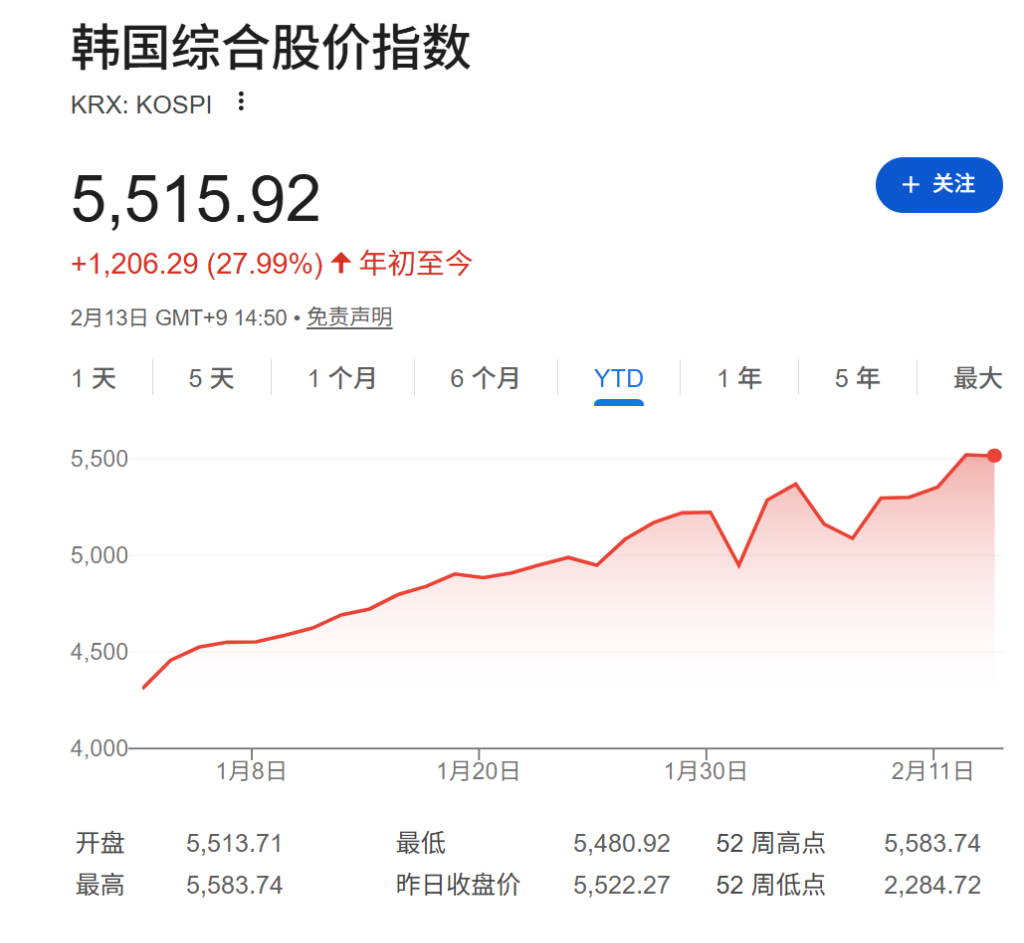
Market Overview - Asian stock markets retreated from record highs as investors locked in profits ahead of the Chinese New Year, with the MSCI Asia-Pacific index falling 0.9%, marking its first decline in six trading days [1] - The South Korean Kospi index rose 0.9%, showcasing resilience amid concerns over U.S. tech stocks due to AI-related anxieties [1][2] - The U.S. 10-year Treasury yield increased by 1 basis point to 4.11%, partially recovering from gains driven by risk aversion [1][5] Commodity Performance - Gold prices rose by 0.7% to approximately $4,950 per ounce, while silver saw a daily increase of 3%, reaching $77.46 per ounce [1][5] - Bitcoin rebounded after four consecutive days of decline, trading at $66,335.45 [5] Inflation and Interest Rate Expectations - The market is focused on the upcoming U.S. January inflation data, with expectations for the core Consumer Price Index (CPI) to rise by 2.5% year-on-year [1][8] - Traders have pushed back expectations for a Federal Reserve rate cut from June to July, with minimal likelihood of a cut in March [1][8] - Citigroup's Benjamin Wiltshire cautioned that the market may be overly optimistic about U.S. inflation prospects, suggesting that inflation expectations could be revised upward [8] AI Market Impact - The volatility in U.S. markets reflects the high risks associated with the AI boom, but the impact on Asian markets has been relatively contained so far [7] - Applied Materials' strong post-market performance indicates potential easing of AI-related concerns [7] Regional Stock Performance - The MSCI Asia-Pacific index has risen approximately 12% year-to-date, while the S&P 500 index has erased all its gains for the year, currently down 0.2% [2] - The South Korean Kospi index has surged 32% this year, making it the best-performing stock market globally [2]

中国造价最贵的超级大楼,你知道有多高级吗?光是买地就花了63亿
Sou Hu Cai Jing· 2026-02-13 05:42
Group 1 - The article discusses the acquisition of a prime land parcel in Beijing's Central Business District (CBD) by CITIC Group for 6.3 billion yuan, highlighting the strategic importance of the location and its potential for development [2][4] - The land is the last core site in the CBD, with a high plot ratio allowing for the construction of super tall buildings, which further enhances its value [4][6] - The construction of the building, known as China Zun, began in July 2013 and was marked by significant technological advancements and a focus on earthquake resistance, making it a landmark project in China's architectural landscape [8][10] Group 2 - China Zun stands at 528 meters with a total construction area of 437,000 square meters, designed to accommodate 12,000 office workers, and its construction cost reached 24 billion yuan due to high land prices and technological investments [8][19] - The building features advanced seismic design, utilizing a giant frame core system and a significant amount of steel, ensuring structural integrity in an earthquake-prone area [10][17] - The operational phase began on January 1, 2020, and it has since become the first commercial building in Beijing to generate over 10 billion yuan in tax revenue, significantly contributing to the local economy [21][23] Group 3 - The project reflects the rapid urbanization process in China, with Beijing's land resources being scarce, leading to high-value transactions that stimulate surrounding developments [6][19] - The building's management system incorporates smart technology for real-time monitoring, enhancing operational efficiency and maintaining the building's appearance [17][23] - Overall, the investment of 24 billion yuan is seen as a long-term value creation, not just in terms of the physical structure but also as an economic engine for the region [23]


AI股暴跌且黄金竟成“提款机”! 金银同步崩跌
Jin Tou Wang· 2026-02-13 05:41
Core Viewpoint - The financial market experienced a significant sell-off, leading to a sharp decline in gold and silver prices as traders liquidated metals to cover stock market losses, indicating a "de-risking" trend in the market [1][2]. Market Dynamics - The sell-off in gold and silver was partly due to profit-taking after recent speculative buying drove prices up [1]. - The volatility in the market has been exacerbated by concerns over AI investments, leading to a flight to safety in U.S. Treasury bonds [2]. - Despite recent setbacks, several banks remain bullish on gold, with JPMorgan predicting gold prices could reach $6,000 to $6,300 per ounce by year-end [2]. Technical Analysis - Gold - Gold has broken below the short-term support level of $5,000 to $4,990, indicating a potential downward adjustment [3]. - Key resistance levels for gold are identified at $5,080 to $5,070 and $5,150 to $5,140, while support levels are at $4,880 and $4,850 to $4,840 [3]. Technical Analysis - Silver - Silver is currently in a wide-ranging oscillation phase, with indications of a potential shift from a bullish to a bearish trend [4]. - The recent sharp decline in silver prices, dropping $10 and breaking key support levels, suggests a cautious approach to long positions, with resistance levels at $79 to $80 and $85 to $86 [4].
满城区市场监督管理局:春节期间消费提示请收好!
Sou Hu Cai Jing· 2026-02-13 05:21
Group 1: Consumer Guidance for the Spring Festival - The market supervision bureau emphasizes the importance of rational consumption and consumer rights protection during the festive season, encouraging consumers to plan their dining and purchasing to avoid waste [1] - Consumers are advised to practice frugality and avoid food waste by planning meals according to actual needs and participating in initiatives like the "Clean Plate Campaign" [1] - The bureau highlights the need for consumers to be cautious with health food purchases, ensuring they buy from reputable sources and understand the product's claims and suitability [2] Group 2: Financial Precautions - Consumers are warned against making large prepayments or deposits during the holiday season, urging them to assess their actual needs and the credibility of merchants before committing [3] - It is recommended that consumers read contracts carefully when dealing with prepaid services, ensuring they understand their rights regarding refunds and transfers [3] Group 3: Environmental Awareness - The importance of green and minimal packaging is stressed, encouraging consumers to choose environmentally friendly products and resist excessive packaging [4] - Consumers are urged to focus on the intrinsic value of gifts rather than their packaging, promoting a culture of resource conservation and environmental protection [4] Group 4: Quality Assurance - The bureau advises consumers to be vigilant about product quality when selecting gifts, avoiding overly extravagant packaging and ensuring compliance with quality standards [5] - It is recommended that consumers keep receipts and records of transactions to safeguard their rights in case of disputes [6]
中方持续抛售美债后,美财长对华措辞变了,中美绝不能脱钩断链
Sou Hu Cai Jing· 2026-02-13 05:19
Core Viewpoint - The recent data from the People's Bank of China indicates a significant shift in asset allocation, with gold reserves surpassing 74.19 million ounces while U.S. Treasury holdings have been halved, signaling a long-term strategic withdrawal from U.S. debt [3][5][12]. Group 1: Asset Allocation Changes - China's gold reserves have reached 74.19 million ounces, with an increase of 40,000 ounces in a single month, reflecting a decade-long trend of reducing U.S. Treasury holdings [3][4]. - The reduction in U.S. Treasury holdings by 50% represents a decisive asset swap, highlighting a strategic pivot towards gold as a more secure asset [5][12]. Group 2: Implications for U.S.-China Relations - The U.S. Treasury Secretary's remarks about not wanting to decouple from China suggest a desire for continued financial cooperation, despite the underlying tensions in other areas [5][17]. - The contrasting actions of financial operators in the U.S. and the rhetoric from U.S. officials illustrate the complexities of international relations, where public statements may not align with actual financial strategies [8][20]. Group 3: Strategic Considerations - The shift from U.S. debt to gold is framed as a defensive strategy for China, aimed at ensuring economic security in an unpredictable geopolitical landscape [10][12]. - The reliance on gold, which does not depend on any sovereign credit, is seen as a move towards structural security, especially in light of potential disruptions in the global financial system [10][12]. Group 4: Market Reactions and Future Outlook - The potential ripple effects of China's actions on global markets are significant, as other major economies like Europe and Japan may follow suit if China continues to reduce its U.S. Treasury holdings [19][20]. - The ongoing asset migration from 2013 to 2026 is expected to be a pivotal moment in financial history, emphasizing the importance of tangible assets in an era of uncertainty [22].

央行加量续作5000亿元买断式逆回购,降准可能性降低
Hua Xia Shi Bao· 2026-02-13 04:37
Group 1 - The central bank announced a significant increase in the scale of reverse repos, with a planned operation of 1 trillion yuan (approximately 100 billion) on February 13, aimed at maintaining ample liquidity in the banking system [1] - The operation includes a 6-month reverse repo, which is a continuation of the previous month's operations, marking the sixth consecutive month of increased scale for this term [1] - In February, the total net injection through reverse repos is 600 billion yuan, an increase of 300 billion yuan compared to the previous month, indicating a sustained effort by the central bank to inject medium-term liquidity into the market for nine consecutive months [1] Group 2 - Analysts suggest that the central bank's actions signal a commitment to maintaining liquidity and financial market stability, with expectations for further operations, including MLF, around February 25 [2] - The combination of reverse repos and MLF is seen as a continuation of the moderately loose monetary policy, reflecting the central bank's strategy to ensure sufficient liquidity in the market [2] - The increase in reverse repo scale in February suggests a reduced likelihood of a reserve requirement ratio cut in the near term [2]
人民银行:2月25日将在香港发行两期人民币央票,规模共计500亿元
Bei Jing Shang Bao· 2026-02-13 04:06
Core Viewpoint - The People's Bank of China (PBOC) is set to issue two new central bank bills in Hong Kong to enhance the availability of high-credit-rated RMB financial products and improve the RMB yield curve in Hong Kong [1] Group 1: Issuance Details - The first issuance will be a 3-month (91 days) fixed-rate central bank bill with a total issuance amount of RMB 30 billion, starting from February 27, 2026, and maturing on May 29, 2026 [1] - The second issuance will be a 1-year fixed-rate central bank bill with a total issuance amount of RMB 20 billion, also starting from February 27, 2026, and maturing on February 27, 2027 [1] - Both bills will have a face value of RMB 100 and will be issued through a Dutch auction method, with the bidding focused on the interest rate [1]
远东国际观察:欧洲央行维持三大关键利率不变 中期内货币政策保持观望立场
Xin Lang Cai Jing· 2026-02-13 03:49
2月5日,欧洲中央银行召开货币政策会议,决定将欧元区存款机制利率、主要再融资利率和边际借贷利 率三大关键利率分别维持在2.00%、2.15%、2.40%不变,这是欧洲央行自2025年7月以来连续第五次按 兵不动。欧洲央行当天发布的政策声明表示,欧洲央行的政策目标仍是确保欧元区中期通胀目标稳定在 2%。 远东点评: 2月5日,欧洲中央银行召开货币政策会议,决定将欧元区存款机制利率、主要再融资利率和边际借贷利 率三大关键利率分别维持在2.00%、2.15%、2.40%不变,这是欧洲央行自2025年7月以来连续第五次按 兵不动。欧洲央行当天发布的政策声明表示,欧洲央行的政策目标仍是确保欧元区中期通胀目标稳定在 2%。 远东点评: 欧洲央行此次维持利率不变的决策符合市场预期。当前欧元区通胀水平在能源价格波动影响下明显走 低,1月通胀率由去年12月的2.0%下降至1.7%,达到2024年9月以来最低水平,首次跌破2%的中期目 标;核心通胀率降至2.2%,创下2021年10月以来新低;服务业通胀率放缓至3.2%,整体通胀走势仍符 合央行的中期判断。另一方面,在全球贸易政策存在高度不确定性、地缘政治紧张局势持续的环境下, ...
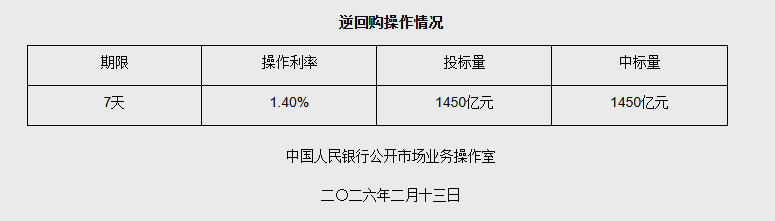
2月13日央行开展1450亿元7天期逆回购操作
Zhong Guo Xin Wen Wang· 2026-02-13 03:34
Core Viewpoint - The People's Bank of China conducted a reverse repurchase operation of 145 billion yuan with a fixed interest rate of 1.40% for a 7-day term on February 13, 2026 [1] Group 1: Reverse Repo Operation Details - The total amount of the reverse repo operation was 145 billion yuan [1] - The operation was conducted with a 7-day maturity period [1] - The interest rate for the operation was set at 1.40% [1]