
钢铁

Search documents
房地产、建材板块迎来政策托底与供需改善,相关ETF怎么选?
市值风云· 2026-02-25 10:10
Core Viewpoint - The article highlights a structural improvement in the real estate and building materials sectors, indicating a potential recovery after a prolonged adjustment period [3]. Policy Changes - The policy stance has shifted significantly since the beginning of 2026, with clear signals from the government aimed at stabilizing the real estate market. Key measures include a reduction in interest rates for various loans and adjustments to down payment requirements for commercial properties [4][5]. - The government recognizes real estate as a core asset for household wealth and emphasizes the need for substantial policy support rather than incremental measures [4]. Market Fundamentals - Despite a challenging 2025, where real estate investment dropped by 17% and new construction fell by 20.4%, early 2026 data shows signs of recovery, particularly in core cities where second-hand housing transactions have increased significantly [6]. - In January 2026, key cities reported a 16% month-on-month increase in second-hand housing transaction volume, with year-on-year growth of 33% [6]. Building Materials Sector - The building materials sector is experiencing a price increase driven by supply-side improvements, despite weak new construction data. The competitive landscape has improved due to industry consolidation [7]. - Leading companies in the building materials sector have begun to raise prices, reflecting a recovery in supply dynamics and a shift towards quality over quantity [7]. Market Performance - Notable companies in the building materials sector, such as Oriental Yuhong and Beixin Building Materials, have shown a positive upward trend in the secondary market [8]. - The real estate ETF (512200.SH) has a significant scale of 7.39 billion yuan, while the building materials ETF (159745.SZ) has a scale of 2.24 billion yuan, both showing strong performance in recent months [10][12][13]. Investment Trends - The building materials ETF has seen a rapid increase in shares, indicating a strong influx of market capital since mid-January 2026 [17].

瑞达期货热轧卷板产业链日报-20260225
Rui Da Qi Huo· 2026-02-25 09:55
1. Report Industry Investment Rating - No information provided 2. Core Viewpoints - On Wednesday, the HC2605 contract first declined and then rebounded. The US has officially imposed a 10% global tariff, and the White House is preparing a formal order to raise the tariff rate to 15%. The US government is considering imposing a new round of tariffs on about six industries on the grounds of "national security". Fundamentally, the weekly output of hot-rolled coils increased steadily, and the capacity utilization rate was raised to 79.14%. Due to the shrinking demand in the off-season, the inventory accumulation was obvious. The subsequent resumption of work at the terminal was orderly, but the release of demand might be delayed. Overall, tariff disturbances still affected market sentiment, but as commodities generally rose, the rebound of furnace materials drove up steel prices. Technically, the 1-hour MACD indicator of the HC2605 contract showed that DIFF and DEA rebounded at a low level, and the green column turned red. It is recommended for short-term trading and attention should be paid to risk control [2]. 3. Summary by Directory 3.1 Futures Market - The closing price of the HC main contract was 3,236 yuan/ton, up 41 yuan; the position volume was 1,501,203 lots, up 323 lots; the net position of the top 20 in the HC contract was 63,184 lots, down 1,870 lots; the HC5 - 10 contract spread was -11 yuan/ton; the HC previous - period warehouse receipt was 349,905 tons, up 13,825 tons; the HC2605 - RB2605 contract spread was 160 yuan/ton, down 8 yuan [2]. 3.2 Spot Market - The price of 4.75 hot - rolled coils in Hangzhou was 3,260 yuan/ton, up 20 yuan; in Guangzhou it was 3,230 yuan/ton, unchanged; in Wuhan it was 3,310 yuan/ton, unchanged; in Tianjin it was 3,150 yuan/ton, up 20 yuan. The basis of the HC main contract was 24 yuan/ton, down 21 yuan; the spread between Hangzhou hot - rolled coils and rebar was 30 yuan/ton, up 20 yuan [2]. 3.3 Upstream Situation - The price of 61.5% PB powder ore at Qingdao Port was 745 yuan/wet ton, down 6 yuan; the price of Hebei quasi - first - grade metallurgical coke was 1,540 yuan/ton, unchanged; the price of 6 - 8mm scrap steel in Tangshan was 2,170 yuan/ton, unchanged; the price of Hebei Q235 billet was 2,910 yuan/ton, up 30 yuan. The inventory of iron ore at 45 ports was 169.4233 million tons, down 1.9464 million tons; the inventory of coke at sample coking plants was 553,800 tons, up 116,900 tons; the inventory of coke at sample steel mills was 6.8858 million tons, down 94,900 tons; the inventory of Hebei billets was 1.7422 million tons, up 181,300 tons [2]. 3.4 Industry Situation - The blast furnace operating rate of 247 steel mills was 80.15%, up 0.60%; the blast furnace capacity utilization rate was 86.43%, up 0.72%. The weekly output of hot - rolled coils at sample steel mills was 3.0981 million tons, up 20,500 tons; the capacity utilization rate of hot - rolled coils at sample steel mills was 79.14%, up 0.52%. The factory inventory of hot - rolled coils at sample steel mills was 933,800 tons, up 135,300 tons; the social inventory of hot - rolled coils in 33 cities was 3.4047 million tons, up 495,500 tons. The monthly output of domestic crude steel was 68.18 million tons, down 1.69 million tons; the monthly net export volume of steel was 1.078 million tons, up 130,000 tons [2]. 3.5 Downstream Situation - The monthly output of automobiles was 2.4499 million vehicles, down 846,100 vehicles; the monthly sales of automobiles were 2.3465 million vehicles, down 925,800 vehicles. The monthly output of air conditioners was 21.6289 million units, up 6.6029 million units; the monthly output of household refrigerators was 10.0115 million units, up 569,500 units; the monthly output of household washing machines was 11.975 million units, down 38,000 units [2]. 3.6 Industry News - On February 23, Mysteel information showed that the actual output of hot - rolled coils this period was 3.0981 million tons, a week - on - week increase of 20,500 tons; the factory inventory was 933,800 tons, a week - on - week increase of 135,300 tons; the social inventory was 3.4047 million tons, a week - on - week increase of 495,500 tons; the total inventory was 4.3385 million tons, a week - on - week increase of 630,800 tons; the apparent demand was 2.4673 million tons, a week - on - week decrease of 494,600 tons. Regarding whether US President Trump will visit China at the end of March or early April, Foreign Ministry Spokesperson Mao Ning said that China and the US are maintaining communication on President Trump's visit to China, and there is currently no information available on specific issues [2]. 3.7 Key Points to Watch - Weekly output, in - plant inventory and social inventory of hot - rolled coils [2]
龙虎榜 | 多路游资抢入包钢股份超6亿,涪陵广场路砸盘华胜天成近2亿
Ge Long Hui A P P· 2026-02-25 09:49
Market Overview - The A-share market continued to rise, with the Shanghai Composite Index increasing by 0.72% to 4147 points, the Shenzhen Component Index rising by 1.29%, and the ChiNext Index up by 1.41% [1]. High-Performance Stocks - YN Holdings achieved a five-day consecutive rise with a 49.97% increase, closing at 11.03, driven by its involvement in computing power and energy storage [4]. - Jiangxi Tungsten's stock rose by 9.98% over five days, attributed to its acquisition of tungsten-lithium assets and magnetic separation technology [4]. - Hanlan Co. saw a 10.07% increase, benefiting from its focus on ultra-high voltage and offshore wind power projects [4]. - Guoan Co. increased by 9.91% over six days, supported by its background in AI data labeling and state-owned enterprise status [4]. - The price of tungsten has been rising, with Zhangyuan Tungsten's stock up by 10% due to price adjustments and performance improvements [4][15]. Trading Activity - The top three net purchases on the daily leaderboard were Baogang Co. (10.34 billion), Aerospace Development (7.08 billion), and Shanshan Co. (3.47 billion) [5][6]. - The top three net sales were dominated by Zangyue Technology (-3.15 billion), Fenghua Gaoke (-3.02 billion), and Xianglu Tungsten (-2.98 billion) [7][9]. Institutional Activity - Institutional net purchases were led by Tongyuan Petroleum (3.85 billion), Zhongtung High-tech (1.98 billion), and Aerospace Development (1.74 billion) [8]. - The top three net sales by institutions included Xianglu Tungsten (-3.40 billion), Tianqi Co. (-2.25 billion), and Yuxin Health (-660.59 million) [9]. Sector Highlights - The aerospace sector is gaining attention, with companies like Blue Arrow Aerospace planning to conduct rocket recovery tests in 2026 and achieving successful satellite launches [12]. - Zhongtung High-tech is expanding its production capacity for PCB drill bits, reinforcing its position in the tungsten industry [15]. - Tongyuan Petroleum is focusing on clean energy and CCUS business, with recent project wins in Algeria [18].



宏观专题:“双碳”政策有望提力加速
East Money Securities· 2026-02-25 09:45
Policy Overview - The "dual carbon" policy is expected to accelerate in 2026, focusing on three main areas: nationwide implementation of zero-carbon factories, expansion of the carbon emission rights market, and construction of a product carbon footprint factor database[2][16]. Policy Goals - By 2030, the proportion of non-fossil energy consumption is targeted to reach approximately 25%, an increase of 5 percentage points from the previous goal of 20% set for the 14th Five-Year Plan[11][12]. - The carbon emissions per unit of GDP are expected to decrease by over 65% compared to 2005 levels by 2030. As of 2024, emissions have already decreased by 52.4% compared to 2005, necessitating an average annual reduction of 5.0% from 2024 to 2030 to meet this target[11][12]. Implementation Mechanisms - 2026 marks the first year of transitioning from an "energy consumption dual control" system to a "carbon emission dual control" system, enhancing the precision and efficiency of carbon reduction efforts[14][15]. - Local governments will face formal carbon assessments for the first time in 2026, which is expected to strengthen the implementation of the dual carbon policy[15]. Key Initiatives - Nationwide promotion of zero-carbon factories will begin, with a focus on key industries such as automotive, lithium batteries, and photovoltaics, aiming to establish benchmarks for other sectors by 2027[17]. - The carbon emission rights market will expand to include industries such as steel, cement, and aluminum, with the first allocations for 2025 expected to be completed by the end of 2026[18]. - The construction of a product carbon footprint factor database is set to be initiated, with a preliminary version expected by early 2027 and a complete version by 2030[19]. Risks - Potential delays in the implementation of the dual carbon policy could lead to slower-than-expected improvements in carbon emissions[22]. - If fiscal policy support for the dual carbon initiatives is weaker than anticipated, it may hinder progress[22]. - Unforeseen geopolitical risks could impact commodity prices, affecting energy sectors closely tied to the dual carbon goals[22].
华为“制造智能体”为广东制造业破题 | 高质量大会第三分会场
Sou Hu Cai Jing· 2026-02-25 09:19
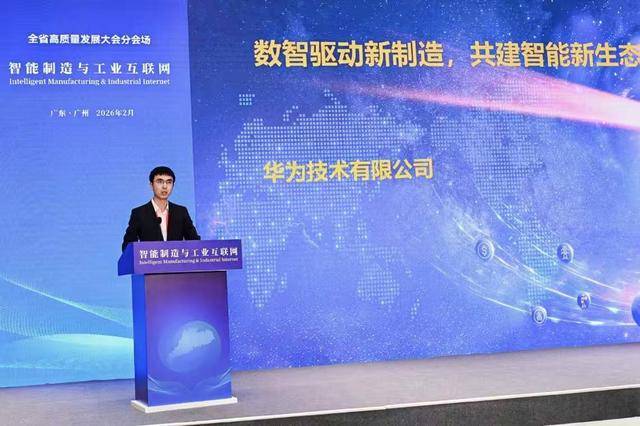
面对全球制造业"电动化、智能化、网联化、共享化"的"新四化"浪潮,王宁认为,中国制造业在坐拥规 模优势的同时,也普遍面临着效率瓶颈、数据孤岛以及技术迭代加速带来的严峻挑战。他以汽车产业为 例指出,中国汽车年产销3000万辆的庞大体量背后,是消费者对个性化定制需求的激增,以及头部企业 市场集中度日益提高带来的生存压力。"如何通过智能化手段提升生产柔性,成为摆在所有制造企业面 前的必答题。" 基于对行业痛点的深刻洞察,华为在此次大会上重点推介了其"制造智能体"的创新理念。这一方案旨在 通过"场景化+平台化+生态化"的融合,为企业提供全栈式的智能解决方案。王宁分享了多个在粤落地 的生动案例:某车企应用华为工业互联网平台后,订单交付周期从14天锐减至7天,库存周转率提升 25%;一家电子企业通过云化改造,IT资源利用率从30%跃升至70%;更有钢铁企业借助智能排产系 统,年节省能耗成本超5000万元。"这些实实在在的价值回报,正是智能制造生命力的最好证明。" 王宁介绍,华为已构建起覆盖"云-边-端-网-智"的全栈技术能力,在5G、AI、工业互联网等领域拥有超 过4万项全球专利。这些技术积累不仅是华为自身发展的基石,更 ...
湖南国企改革板块2月25日涨1.86%,华菱钢铁领涨,主力资金净流出3473.26万元
Sou Hu Cai Jing· 2026-02-25 09:09
Core Viewpoint - The Hunan state-owned enterprise reform sector experienced a rise of 1.86% on February 25, with Hualing Steel leading the gains [1] Market Performance - The Shanghai Composite Index closed at 4147.23, up by 0.72% [1] - The Shenzhen Component Index closed at 14475.86, up by 1.29% [1] Fund Flow Analysis - The main funds in the Hunan state-owned enterprise reform sector had a net outflow of 34.73 million yuan [1] - Retail investors experienced a net outflow of 61.39 million yuan [1] - Speculative funds saw a net inflow of 96.12 million yuan [1]


新春开工领涨!鹏华周期类ETF矩阵解锁石油化工复苏新机遇
Zhong Jin Zai Xian· 2026-02-25 08:55
Core Viewpoint - The A-share market experienced a strong start to the new year, particularly in the cyclical sectors, with the oil and petrochemical sector leading the gains at 5.53% [1] Group 1: Market Performance - The oil and petrochemical sector topped the Shenwan first-level industry rankings with a 5.53% increase, while the basic chemical sector ranked third with a 3.45% increase [1] - Institutional consensus indicates a positive outlook for cyclical assets post-holiday, with expectations of a market rebound supported by policy expectations and liquidity [1] Group 2: Investment Opportunities - Key investment themes include the "anti-involution" concept driven by improved supply-demand dynamics and industry profit recovery, with a focus on sectors benefiting from price increases such as precious metals, oil and petrochemicals, and basic chemicals [1] - The global landscape shows increased macro risks due to geopolitical tensions and tariff policies, prompting a focus on "weak dollar assets" like precious metals, non-ferrous metals, and oil and gas [1] Group 3: ETF Performance - Penghua Fund's oil ETF (159697) is the first in the market to track the National Oil and Gas Index, covering key companies in the oil and gas industry, with a one-year increase of 31.43% compared to the 19.34% rise of the CSI 300 index [2] - The chemical ETF (159870) tracks a refined chemical industry index, achieving a one-year growth of 51.79%, effectively capturing structural opportunities in the transition from traditional capacity to high-end and new energy materials [2] Group 4: Liquidity and Market Acceptance - As of February 13, 2026, the oil ETF (159697) and chemical ETF (159870) ranked first in their respective categories with sizes of 1.828 billion and 35.533 billion, indicating strong liquidity and market recognition [3] - These ETFs provide investors with low-cost, high-transparency, and risk-diversified investment tools, addressing the complexities and risks associated with direct investments in cyclical stocks [3]
A股收评:超3700只个股飘红,三大指数集体收涨
Xin Lang Cai Jing· 2026-02-25 08:42
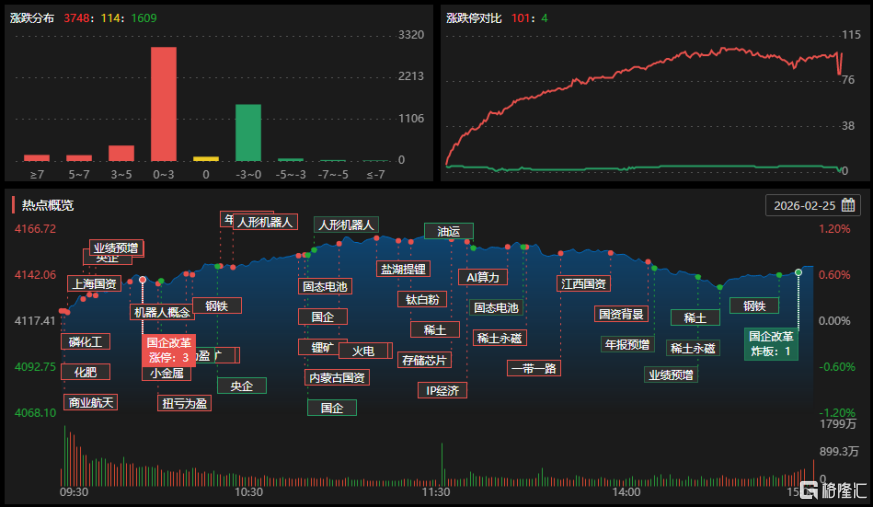
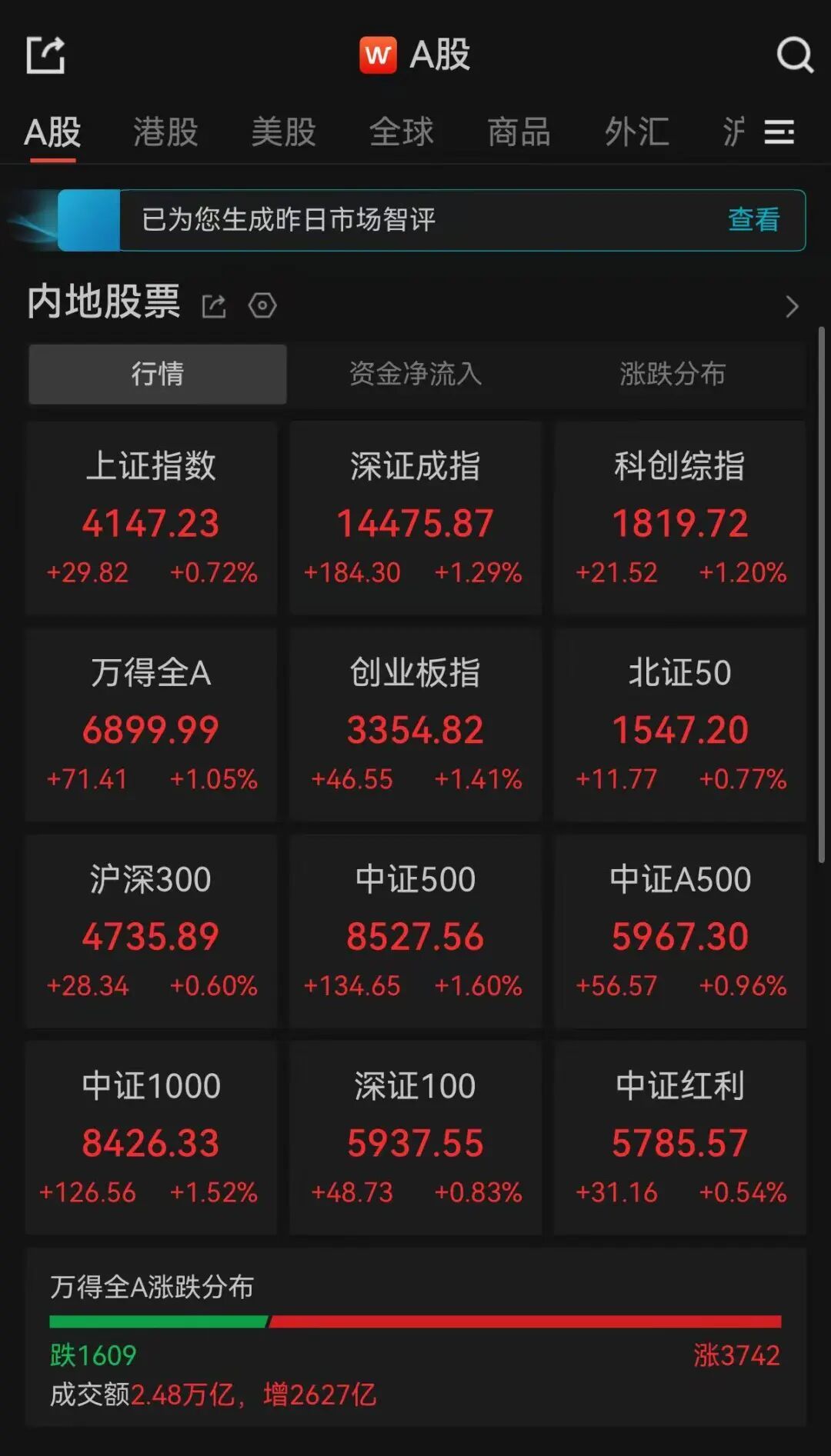
Group 1 - The A-share market experienced a positive trend with major indices rising, including the Shanghai Composite Index up by 0.72%, Shenzhen Component Index up by 1.29%, and ChiNext Index up by 1.41% [1][2] - The total trading volume in the market reached 2.48 trillion yuan, with over 3,700 stocks experiencing gains [4] - Key sectors that saw significant increases include chemicals, non-ferrous metals, steel, and building materials, while real estate, environmental protection, and semiconductor sectors also performed well [4] Group 2 - Active stocks included those in lithium batteries, commercial aerospace, and financial technology concepts, indicating a vibrant market for these sectors [4] - Conversely, AI applications and CPO themes weakened, and the banking and oil & gas sectors experienced a pullback after initial gains [4]
港股收盘,恒生指数收涨0.66%,恒生科技指数收跌0.19%
Mei Ri Jing Ji Xin Wen· 2026-02-25 08:29
Group 1 - The Hang Seng Index closed up by 0.66% on February 25, while the Hang Seng Tech Index fell by 0.19% [1] - The steel, non-ferrous metals, and rare earth sectors led the gains, with Chongqing Steel rising nearly 8%, China Aluminum International up 7.5%, and Jinchuan Group up 6.3% [1] - Conch Cement also saw an increase of over 5%, while China Aluminum rose by 5% [1] Group 2 - The semiconductor sector weakened, with Lattice Semiconductor dropping over 7% and GigaDevice down by 4.5% [1]
收评:沪指涨0.72%创指涨1.41% 化工板块延续强势
Jing Ji Wang· 2026-02-25 08:29
Market Performance - The Shanghai Composite Index closed at 4147.23 points, with an increase of 0.72% and a trading volume of 1,085.97 billion yuan [1] - The Shenzhen Component Index closed at 14,475.87 points, rising by 1.29% with a trading volume of 1,376.58 billion yuan [1] - The ChiNext Index ended at 3,354.82 points, up by 1.41% and a trading volume of 622.23 billion yuan [1] Sector Performance - The chemical sector showed strong performance, with stocks like Chuanjin Nuo and Yuntianhua hitting the daily limit [1] - The steel sector also performed well, with Baogang Co. reaching the daily limit [1] - The rare earth permanent magnet concept surged, with Northern Rare Earth hitting the daily limit [1] - The commercial aerospace concept saw afternoon fluctuations, with Aerospace Development hitting the daily limit [1] - The film and television sector continued to adjust, with Bona Film and Hengdian Film both hitting the daily limit down [1] - Other sectors with notable gains included building materials, real estate, lithium mining, and storage chips, while sectors like computing power leasing, AIGC concepts, and advertising packaging experienced declines [1]