
新能源车

Search documents
小鹏汽车(XPEV.US)涨逾3% 7月新能源车交付量同比增长229%
Zhi Tong Cai Jing· 2025-08-04 13:49
Group 1 - Xpeng Motors (XPEV.US) shares rose over 3%, closing at $18.72 [1] - In July 2025, Xpeng set a new monthly delivery record with 36,717 smart electric vehicles delivered, representing a year-on-year increase of 229% [1] - For the first seven months, Xpeng delivered a total of 233,906 smart electric vehicles, a 270% increase compared to the same period last year [1] - Xpeng announced the official launch of the next-generation P7 model on August 6 [1]
美股异动 | 小鹏汽车(XPEV.US)涨逾3% 7月新能源车交付量同比增长229%
智通财经网· 2025-08-04 13:49
Core Viewpoint - Xpeng Motors (XPEV.US) saw a stock increase of over 3%, reaching $18.72, following the announcement of record monthly deliveries in July 2025 [1] Delivery Performance - In July 2025, Xpeng Motors delivered a total of 36,717 smart electric vehicles, marking a year-on-year increase of 229% [1] - For the first seven months of the year, Xpeng Motors delivered 233,906 smart electric vehicles, which represents a 270% increase compared to the same period last year [1] Product Launch - Xpeng Motors announced that the next-generation Xpeng P7 will be officially launched on August 6 [1]

碰撞争议、销量滑坡、身家缩水……理想汽车的“戴维斯双杀”时刻是否到来?
Zheng Quan Shi Bao Wang· 2025-08-04 11:21
Core Viewpoint - Li Auto, once a sales champion, is facing controversies and challenges related to diversification and market performance [1] Group 1: Controversies and Responses - The recent safety test controversy involving Li Auto's i8 and Dongfeng Liuzhou's trucks has led to public responses from both parties, with Li Auto accused of serious infringement beyond normal competition [2] - Li Auto's response has softened, stating that the test aimed to validate the i8's safety performance rather than critique other brands [2] - The competitive landscape in the new energy vehicle market is intensifying, with Li Auto's previous advantages being challenged [3] Group 2: Market Performance and Sales - Li Auto's stock performance has been disappointing, with the recent launch of the i8 facing criticism for its price-to-performance ratio, leading to a significant drop in stock price, including a 13% decline on July 30 [2] - In July, Li Auto's sales unexpectedly dropped by 40% year-on-year, totaling only 30,731 vehicles, raising concerns about the company's ability to meet annual targets [3] - The competitive pressure is increasing as new models from competitors like Zeekr and NIO enter the market, further complicating Li Auto's position [3] Group 3: Executive Actions and Market Trust - Recent stock sales by executives, including significant cash-outs exceeding millions of RMB, have raised concerns about their confidence in the company's future prospects [3] - The challenges faced by Li Auto, from safety test controversies to declining sales and executive stock sales, indicate a growing list of obstacles for the company [3] - The ability of Li Auto to regain market and investor trust amidst fierce competition will be crucial for its future [4]
欧洲急了!你禁稀土违规,我禁光刻机合理,双标逻辑引争议
Sou Hu Cai Jing· 2025-08-04 10:11
不光光刻机,2022年10月,美国商务部还搞了个新规,禁止对华出口14纳米以下的芯片制造技术,理由还是那老一套"国家安全"。这直接让中国高科技企业 吃了大亏。可咱们一管稀土,他们就喊"地缘威胁"。专家张教授在近期采访中直言:"这种双标本质是西方想保持技术垄断,又不愿资源被反制。" 欧洲最近急得跟热锅上的蚂蚁似的,就因为中国说要管管稀土出口,立马跳脚喊"不公平"!可笑的是,他们自己卡着高科技设备不卖给咱们时,咋没见谁吭 声?这不是"只许我欺负你,不许你还手"嘛? #夏季图文激励计划#先说说稀土,这玩意儿可不是啥稀奇古怪的土,它是新能源车、风力发电、甚至军工装备的核心原料。简单讲,没它,你手机、电动车 都得"歇菜"。而中国呢?在全球稀土市场上那可是"大哥大",根据美国地质调查局2024年的数据,咱们的冶炼能力占了全球九成以上!这可不象吹牛,是几 十年砸钱砸技术硬拼出来的。 最近,中国一说要对稀土出口加点"门槛",欧洲那边立马炸锅了,嚷嚷着这会毁了他们的"绿色大计"。尤其是德国、法国这些国家,新能源车、电机厂几乎 都靠中国原料撑腰。据统计,2023年德国宝马和大众在华供应链依赖度超六成!现在原料一卡,他们急得满头大 ...


新能源车销量近况曝光:三家突破纪录,理想暴跌40%
Guo Ji Jin Rong Bao· 2025-08-04 08:04
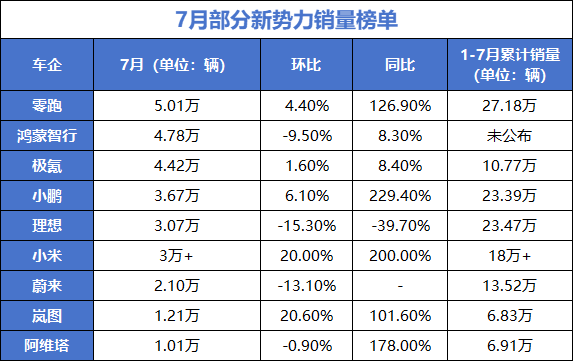
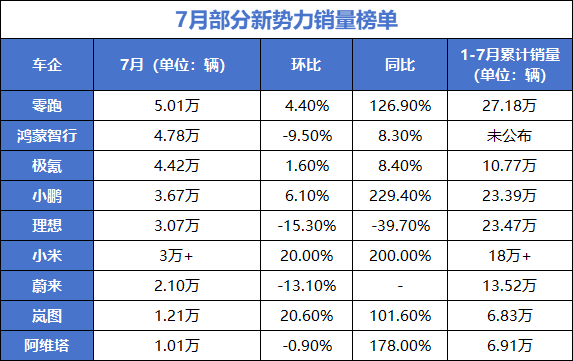
Core Insights - In July, several new energy vehicle companies reported record delivery numbers, with Leap Motor, Xiaomi, and Xpeng achieving significant growth, while Li Auto experienced a substantial decline in deliveries [1][4]. Group 1: Market Performance - The retail market for narrow passenger cars in July reached approximately 1.85 million units, representing a year-on-year increase of 7.6% but a month-on-month decrease of 11.2% [1]. - The new energy vehicle market showed strong performance, with a retail penetration rate rising to 54.6% and sales reaching 1.01 million units [1]. Group 2: Company Deliveries - Leap Motor led the July sales with 50,100 units, marking a month-on-month increase of 4.4% and a year-on-year increase of 126.9%, achieving a cumulative sales of 271,800 units in the first seven months, which is 54.4% of its annual target of 500,000 units [2][3]. - Xpeng's July deliveries reached 36,700 units, a month-on-month increase of 6.1%, with a cumulative total of 233,900 units in the first seven months, leading the new energy vehicle sector with a completion rate of 66.8% [3]. - Li Auto's deliveries fell to 30,700 units in July, a month-on-month decline of 15.3% and a year-on-year decline of 39.7%, with a cumulative total of 235,000 units, reflecting a completion rate of only 36.7% of its revised annual target of 640,000 units [4][5]. Group 3: Product Developments - Leap Motor's COO indicated that the new B01 model has received over 10,000 orders, and the factory is operating at full capacity to meet the growing demand [1]. - Xiaomi's delivery exceeded 30,000 units for the first time, with a cumulative total of over 180,000 units in the first seven months, achieving a completion rate of 51.4% of its revised annual target of 350,000 units [5]. - NIO's new model, the L90, has received positive market feedback, raising expectations for future sales [7].

7月传统淡季下新能源车市温和增长,预计8月环比改善
BOCOM International· 2025-08-04 07:52
Investment Rating - The report assigns a "Buy" rating to several companies in the automotive sector, including BYD (1211 HK), XPeng Motors (9868 HK), and Geely Automobile (175 HK) [8]. Core Insights - The report highlights that the new energy vehicle market maintained a year-on-year growth in July, despite a slowdown in delivery growth due to the traditional off-season for passenger car sales [2][4]. - The overall delivery volume for new energy vehicles in July showed a year-on-year increase of 11.2% but a month-on-month decrease of 6.2% [6]. - The report anticipates an improvement in overall sales in August as the traditional peak sales season approaches [4]. Summary by Relevant Sections Company Performance - BYD delivered 341,030 vehicles in July, a slight year-on-year increase of 0.1% but a month-on-month decrease of 9.7% [6]. - Li Auto delivered 30,731 vehicles in July, reflecting a significant year-on-year decrease of 39.7% and a month-on-month decrease of 15.3% [6]. - XPeng Motors achieved a record delivery of 36,717 vehicles in July, marking a year-on-year increase of 229.4% and a month-on-month increase of 6.1% [6]. - NIO delivered 21,017 vehicles in July, with a year-on-year increase of 2.5% but a month-on-month decrease of 15.7% [4]. - Leap Motor delivered 50,129 vehicles in July, showing a year-on-year increase of 127% and a month-on-month increase of 4% [4]. Market Trends - The report notes that the penetration rate of new energy vehicles has remained above 50% for four consecutive months, indicating a strong market presence [2]. - The report expects that the upcoming launch of new models from various manufacturers will enhance market supply and drive sales during the peak season [4]. Future Outlook - Analysts are optimistic about the performance of BYD, XPeng Motors, and Geely following their new model launches and strategic initiatives [4].
新能源车销量近况曝光:三家突破纪录,理想暴跌40%
Guo Ji Jin Rong Bao· 2025-08-04 07:37
Core Insights - In July, several new energy vehicle companies reported record delivery numbers, with Leap Motor, Xiaomi, and Xpeng achieving significant growth, while Li Auto experienced a substantial decline in deliveries [1][3]. Market Performance - The retail market for narrow passenger cars in July reached approximately 1.85 million units, marking a year-on-year increase of 7.6% but a month-on-month decrease of 11.2% [1]. - The new energy vehicle market showed strong performance, with a retail penetration rate rising to 54.6% and sales reaching 1.01 million units [1]. Company-Specific Performance - Leap Motor led the July sales with 50,100 units, reflecting a month-on-month growth of 4.4% and a year-on-year increase of 126.9%. Cumulatively, Leap Motor's sales for the first seven months reached 271,800 units, achieving 54.4% of its annual target of 500,000 units [2][3]. - Xiaopeng Motors reported a record delivery of 36,700 units in July, a month-on-month increase of 6.1% and a year-on-year increase of 229.4%. Cumulative sales for the first seven months reached 233,900 units, with a completion rate of 66.8% towards its annual target [3][4]. - Li Auto's deliveries fell to 30,700 units in July, down 15.3% month-on-month and 39.7% year-on-year, with cumulative sales for the first seven months at 235,000 units, reflecting a year-on-year decline of 2.2% [3][4]. - Xiaomi's deliveries exceeded 30,000 units for the first time in July, with cumulative sales surpassing 180,000 units in the first seven months, achieving 51.4% of its revised annual target of 350,000 units [4][5]. - NIO delivered 21,000 units in July, a month-on-month decline of 15.7%, with cumulative sales of 135,200 units for the first seven months [4][5]. - Zeekr and Lynk & Co combined sales reached 44,200 units in July, with Zeekr selling 17,000 units and Lynk & Co selling 27,000 units [5].

智驾≠自动驾驶!新能源车不敢说的秘密,智驾宣传话术将迎史上最严监管
Jin Rong Jie· 2025-08-04 07:36
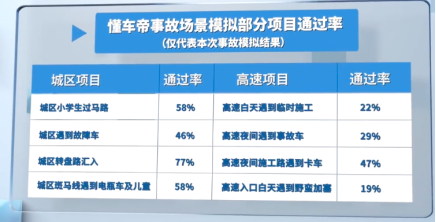
Core Insights - The Chinese smart driving market is currently facing both challenges and opportunities [1] - A recent simulation test revealed that the pass rate for advanced driver-assistance systems (ADAS) is below 60%, highlighting significant safety shortcomings [2][3] - The test results have prompted industry leaders to acknowledge the need for improvements in technology, particularly in extreme scenarios [2][5] Group 1: Test Results and Industry Response - In a simulation of various driving scenarios, the pass rates were alarmingly low, with only 47% of vehicles able to safely navigate a construction zone at night and 58% able to stop for a child unexpectedly crossing the road [2][3] - Industry executives, including those from Lantu Motors and Tesla, have commented on the test results, emphasizing the need for better technology and safety measures [2][5] - The test has sparked a debate about the marketing language used by car manufacturers, with many downplaying the necessity for driver intervention [4][6] Group 2: Regulatory Actions and Industry Standards - Following a serious accident involving an ADAS vehicle, the Ministry of Industry and Information Technology (MIIT) has mandated stricter regulations on the terminology used in marketing, prohibiting terms that may mislead consumers about the capabilities of these systems [5][7] - The MIIT's actions aim to address two main issues: exaggerated technical claims and the ambiguous assignment of safety responsibilities [7] - The automotive industry is now urged to focus on transparent communication regarding the limitations of their technology and to prioritize user safety [9] Group 3: Market Trends and Future Outlook - The rapid growth of the autonomous driving sector since 2015 has led to an influx of new companies, with many seeking public listings [8] - The evolution of terminology from L2 to "smart driving" has contributed to consumer confusion and misrepresentation of the technology's capabilities [8] - The recent testing and regulatory developments may encourage a more rational approach within the industry, steering focus back to genuine safety improvements rather than marketing gimmicks [9]
产业链淡季量价趋稳,关注固态商业化落地 | 投研报告
Zhong Guo Neng Yuan Wang· 2025-08-04 06:50
Core Insights - The lithium battery sector has shown significant activity since July 2025, outperforming the CSI 300 and SSE 50 indices, with the lithium mining segment leading with an 11% increase [1][2] - Lithium carbonate and lithium hydroxide prices have decreased by 8% and 7% respectively in July, indicating a downward trend in raw material costs [2] - The sales of new energy vehicles in China reached 1.11 million units in June, reflecting a year-on-year increase of 27% and a cumulative increase of 39% for the first half of the year [2][4] Lithium Battery Sector - The lithium battery sector has experienced a recovery in monthly transaction volumes, driven by active trading in solid-state battery segments [1][2] - The three-year historical valuation of over half of the lithium battery-related segments is at a high level, indicating increased market attention [2] New Technologies - Lithium metal anodes are identified as a long-term direction for battery technology, with the potential to achieve energy densities exceeding 500Wh/kg [3] - The first global test of a lithium metal anode solid-state battery was conducted by Mercedes, with predictions of a market size nearing 10 billion yuan by 2030 [3] Energy Storage - In June, domestic energy storage installations fell to 6.9 GWh, a year-on-year decrease of 41%, while cumulative installations for the first half of the year reached 49.0 GWh, a 162% increase [5] - The U.S. energy storage market remained relatively stable, with 3.7 GWh installed in June, reflecting a year-on-year increase of 32% for the first half of the year [5] Investment Recommendations - The lithium battery sector is expected to transition from broad market-driven growth to structural opportunities led by technological breakthroughs and new application areas in 2025 [7] - Key companies recommended for investment include CATL, EVE Energy, and Keda Technology, as well as Xiamen Tungsten [7]