石化

Search documents
L周报:旺季临近是否迎来反弹窗口-20250825
Zhe Shang Qi Huo· 2025-08-25 07:50
1. Report Industry Investment Rating - No information provided in the document. 2. Core Viewpoints of the Report - Polyethylene is likely to rise in the short - term but has limited upside potential, facing pressure at the [7600] price level for the 12601 contract. The demand is shifting from the off - season to the peak season, with marginal improvement in the pattern and short - term upward drivers. However, the supply pressure remains high, with new capacity being put into production and high existing production loads [6]. - For different participants in the industrial chain, different hedging strategies are recommended. For example, factories and coal - chemical enterprises with high inventory and concerns about PE price drops can buy put options and short futures contracts on the futures market; traders and end - customers can take corresponding actions according to their purchase and inventory management needs [4]. 3. Summary by Relevant Catalogs 3.1. Basis and Spreads - **Standard Basis**: The spot price of plastic standard products has risen synchronously, and the basis has weakened slightly. The basis in East China has weakened by 10 to around - 100 yuan/ton, in North China by 30 to around - 150 yuan/ton, and in South China by 30 to 20 yuan/ton [17]. - **Non - standard Basis**: The non - standard basis of plastics has a stronger trend than the standard basis [18]. - **Futures Spreads**: The 1 - 5 month spread has fallen back to the previous low of around - 10 this week. The L - PP01 spread has risen steadily and is currently close to 300 yuan/ton. Overall, the supply pressure of PP is greater, while L has more maintenance and the demand for agricultural films starts in September [42]. 3.2. Domestic Production - end Profits and Supply - **Cost Curve**: The oil - based process has the largest production capacity share (67.22%), with the East China oil - based cost at 7443 yuan/ton; the coal - based process (18.82%) is an important supplement with relatively high profits, and the Inner Mongolia coal - based cost is 5250 yuan/ton [54][55]. - **Production Profits**: This week, oil prices continued to fluctuate, and the oil - based end profits have recovered compared with the previous period. The Northeast Asian ethylene price has remained stable, and the profit from purchasing ethylene for production has weakened recently. The coal price has rebounded, but the CTO profit remains high, while the inland MTO profit has deteriorated under tight supply and demand [57]. - **Domestic Capacity and Production**: As of August 2025, the newly added domestic PE capacity is 370.5 million tons, with a capacity growth rate of 10.38%. The planned production capacity for 2025 is 613 million tons, with an estimated capacity growth rate of 17.17%. This week, the PE production was 61.81 million tons, a decrease of 4.31 million tons compared with the previous week, and the operating rate decreased by 8.1% to 78.72% due to many device overhauls [78][79][80]. 3.3. US Dollar Price and Import Profit - **US Dollar Price**: The northwest European price is at a high level, especially for LD and ED. The US dollar price in the Chinese market has shown mixed trends; the Southeast Asian price is stable with weak demand, and the South Asian price has declined due to poor rainy - season demand [102]. - **Import Profit**: The import windows for LD and some HD have opened, and the market offers have increased compared with the previous period [111]. 3.4. Downstream Operation and Profit - **Downstream Operation**: As the peak season approaches, the demand is gradually recovering. Some agricultural film enterprises have seen a slight increase in orders, but it is still in the off - season and weaker than previous years. The packaging film operation rate has increased by 0.8% month - on - month, and the operation rates of pipes, blow - molding, and injection - molding have also changed to different extents [128]. - **Downstream Profit**: The profits of plastic film products such as agricultural film and packaging film are also affected by factors such as raw material prices and market demand, but specific profit data are not comprehensively summarized in the text. 3.5. Inventory - This week, the inventory of production enterprises has increased by 5.74 million tons to 50.19 million tons, with the inventory of two major state - owned oil companies increasing by 5.8 million tons and the coal - based inventory decreasing by 0.06 million tons. The social inventory has decreased by 1.21 million tons to 55.65 million tons. The downstream restocking and transactions are weak, with the upstream inventory accumulating and the social inventory continuing to decline [151]. 3.6. Position, Transaction, and Warehouse Receipt Situation - **Position**: The positions of the plastic 01, 05, and 09 contracts on August 22, 2025, are 577,012, 571,625, and 600,000 respectively [161]. - **Transaction Volume**: The transaction volumes of the plastic 01, 05, and 09 contracts on August 22, 2025, are 900,022, 800,000, and 1,119,745 respectively [162][163][164]. - **Warehouse Receipts**: The number of L registered warehouse receipts on August 22, 2025, is also provided in the document, but specific analysis is not further elaborated [169].
信达证券给予荣盛石化买入评级,业绩短期承压,看好存量竞争背景下先进炼能的业绩弹性
Sou Hu Cai Jing· 2025-08-25 07:47
Group 1 - The core viewpoint of the report is that the company Rongsheng Petrochemical (002493.SZ) is given a "buy" rating by Xinda Securities due to its potential despite facing challenges in the aromatics sector [1] - The company's performance in the first half of the year was significantly pressured, primarily due to the drag from the aromatics segment [1] - The report highlights the arrival of a competitive era, suggesting optimism regarding the performance elasticity of advanced private refining capacities [1] Group 2 - The report mentions several risks that could impact the company, including significant fluctuations in crude oil prices and potential delays in new capacity construction [1] - There are concerns regarding the oversupply of refining capacity and the slow recovery of downstream product profits [1] - The report also notes the increasing risks associated with "carbon neutrality" policies and the possibility of a slower-than-expected global economic recovery [1]


聚烯烃周报:旺季陆续启动,逢低试多-20250825
Zhong Hui Qi Huo· 2025-08-25 07:26
Report Title - Weekly Report on Polyolefins: Peak Seasons Are Gradually Starting, Try to Go Long on Dips [1] Report Date - August 24, 2025 [2] Report Core View - The fundamentals of polyolefins have improved recently, with demand for agricultural films entering the peak season and inventory pressure not significant. It is recommended to go long on dips [4][6][8][9] Key Points by Section 1. L2601 Contract Review and Outlook - **Market Performance**: This week, the L2601 contract fluctuated widely between 7243 and 7413, with a 2 - week consecutive positive weekly line. It closed at 7380, up 29 points or 0.4% from last week [3] - **Position and Basis**: As of Friday, the position was 390,000 lots (weekly increase of 75,000), and the North China basis was - 140 yuan/ton (weekly decrease of 69) [15][18] - **Supply**: This week's PE production was 620,000 tons (weekly decrease of 43,000 tons), and next week's production is expected to increase by 23,000 tons [27] - **Import**: From January to July 2025, the cumulative PE import was 8.03 million tons (cumulative year - on - year increase of 2.5%) [30] - **Demand**: The downstream capacity utilization rate was 40%, with a continuous 4 - week improvement. The agricultural film operating rate was 14.5% (weekly increase of 0.7pct), with a continuous 5 - week improvement [33][36] - **Inventory**: The enterprise inventory was 500,000 tons (weekly increase of 60,000), and the social inventory was 560,000 tons (weekly decrease of 12,000), with continuous 6 - week destocking [41] - **Strategy**: Unilateral: Go long on dips, focusing on the range of [7350 - 7550]; Arbitrage: Hold the long LP01 arbitrage; Hedging: Industrial customers can choose the opportunity to sell - hedge [6] 2. PP2601 Contract Review and Outlook - **Market Performance**: This week, the PP2601 contract fluctuated widely between 6970 and 7081, with a 4 - week consecutive negative weekly line. It closed at 7038, down 46 points or 0.6% from last week [7] - **Position and Basis**: As of Friday, the position was 470,000 lots (weekly increase of 100,000), and the East China basis was - 33 yuan/ton (weekly decrease of 32) [53][56] - **Supply**: This week's PP production was 780,000 tons (weekly increase of 3,000 tons), and next week's production is expected to rise to 795,000 tons [61] - **Import**: From January to July 2025, the cumulative PP import was 1.92 million tons (year - on - year decrease of 8%), and the export was 1.83 million tons (year - on - year increase of 29%) [63] - **Demand**: The PP downstream operating rate was 50%, with a continuous 4 - week marginal improvement. From January to June 2025, the cumulative apparent consumption was 19.49 million tons (cumulative year - on - year increase of 13.6%) [69] - **Inventory**: This week's total commercial inventory was 800,000 tons (weekly decrease of 25,000), with continuous 2 - week destocking [72] - **Strategy**: Unilateral: Go long on dips, focusing on the range of [7000 - 7200]; Arbitrage: Wait and see mainly [9] 3. Propylene Market Review - **Market Performance**: This week, the PL2601 contract fluctuated widely between 6360 and 6529 and closed at 6470 [79] - **Price**: As of Friday, the Shandong propylene market price was 6300 yuan/ton (weekly increase of 95) [83] - **Supply**: This week's propylene production was 1.18 million tons (weekly increase of 14,000), and the in - plant inventory increased continuously [86] - **Demand**: The downstream comprehensive operating rate improved marginally [89]
产能削减超300万吨!10家石化企业签署业务重组协议
Zhong Guo Hua Gong Bao· 2025-08-25 07:02
Group 1 - The South Korean government is addressing the crisis in the petrochemical industry by urging major companies to reduce excess production capacity and improve competitiveness [1][2] - Ten major petrochemical companies in South Korea have signed a restructuring agreement to cut naphtha cracking capacity by 2.7 to 3.7 million tons, which is approximately 25% of the country's total capacity of 14.7 million tons [1] - The government has set three main directions for structural adjustment in the petrochemical industry: reducing excess capacity and shifting to higher value-added products, improving financial health of companies, and minimizing impacts on the economy and employment [1] Group 2 - The South Korean government has requested that the ten companies submit detailed plans by the end of the year, emphasizing a "self-rescue first, government support later" principle [2] - The petrochemical industry is facing its most severe survival crisis in recent years due to continuous new capacity additions leading to oversupply and significant declines in profit margins [2] - A report from Boston Consulting Group (BCG) warns that if the downturn in the petrochemical industry continues, half of the companies in the sector may not be able to sustain operations within three years, necessitating a 24% reduction in domestic capacity [2]
苯乙烯数据日报-20250825
Guo Mao Qi Huo· 2025-08-25 06:47
| | | | | | | 投资咨询业务资格:证监许可[ 2012 ]31号 [TG 国贸期货 | | --- | --- | --- | --- | --- | --- | --- | | | | | | | | ,烯数据 FR | | | | | | | 国贸期货研究院 | 投资咨询证:Z0017251 2025/08/25 | | | | | | | 能源化工研究中心 陈胜 | 从业资格证:F3066728 | | | 指标 | or C | 2025/08/21 | 2025/08/22 | 变动值 | 一现货综述 | | | 原油& | WTI | 62. 35 | 63.52 | 1. 17 | | | | 石脑油 | Brent | 65. 79 | 67.67 | 1.88 | | | | | 石脑油 | 574.5 | 584.5 | 110 | | | | | 乙烯 CFR东北亚 | | | | 苯乙烯:江苏市场涨价。成本存支撑,原油、纯苯整 | | 游 | | | 825 | 830 | 5 | 理,苯乙烯市场有装置检修消息和补货成交提振,现 | | | 纯苯 | CFR中国 | 747 ...
需求旺季即将到来 PX价格有望上涨
Qi Huo Ri Bao· 2025-08-25 00:23
自8月15日以来,PX期货主力合约开启了一轮上涨修复行情。聚酯行业"金九银十"需求旺季即将到来, PX期价能否保持强势? 永安期货中级分析师顾涵阳表示,从基本面看,供应方面,海内外PX装置均处于检修回归阶段,国内 开工率逐步回升,但在全行业"反内卷"的背景下,也有老旧产能整改的声音出现,例如有龙头企业总裁 表示,将淘汰一批低效炼油装置,控制投资节奏和规模。PX作为头部企业产能占比相对较高的品种, 市场更关注其未来的供应情况。 "需求方面,尽管部分PTA装置近期意外检修,但聚酯装置开工负荷持续回升,在库存持续去化的情况 下,预计开工负荷仍有提升空间。总的来说,当下PX供需基本平衡,远月供应则存在不确定性,因此 价格在化工品中表现相对强势。"顾涵阳说。 上周三,有市场消息称因为连续亏损,韩国10家最大的石化企业已同意进行业务重组,其中包括削减高 达25%的石脑油裂解产能。韩国石化行业承诺减少370万吨石脑油裂解产能。 进出口方面,我国PX进口依存度持续下降。截至2024年,我国PX进口依存度已降至19.76%,去年同期 进口量约为938万吨。其中,自韩国进口的PX高达405万吨,约占我国PX总进口量的43%。 " ...
我国规模最大的世界级石化产业基地建成
DT新材料· 2025-08-24 16:04
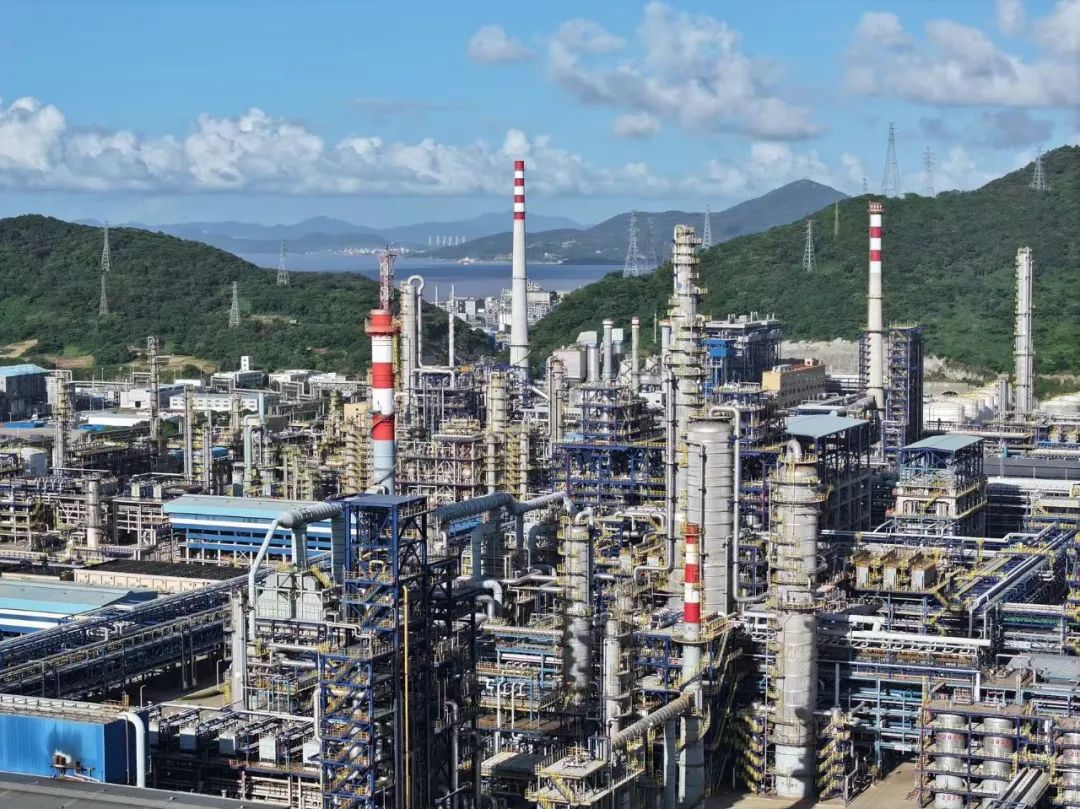
Core Viewpoint - China National Offshore Oil Corporation (CNOOC) announced the completion of the Dasha Petrochemical Refining and Chemical Integration Project in Ningbo, Zhejiang, marking the establishment of the largest world-class petrochemical industrial base in China, which is significant for enhancing the country's capability in high-end chemical materials and efficient conversion of heavy oil [2][3]. Group 1: Project Overview - The Dasha Petrochemical project has a total investment of 21 billion yuan and is the largest newly built petrochemical industrial base in China, featuring a core production facility that utilizes domestically developed technology for the direct cracking of heavy oil into chemical products, achieving a 100% domestic production rate [3]. - The project includes a 3.2 million tons per year catalytic cracking unit, which is the largest single unit for direct conversion of heavy oil to olefins in the country, producing 1.2 million tons of polymer-grade ethylene and propylene annually, essential for everyday products [5][7]. Group 2: Environmental Impact and Efficiency - The new production process reduces energy consumption per unit product by over 30% compared to traditional methods and is expected to decrease carbon dioxide emissions by 200,000 tons annually, significantly improving the efficiency of heavy oil resource utilization [7][10]. - The project aims to optimize China's petrochemical raw material structure and reduce carbon emissions from olefin products, contributing to the low-carbon transition of refining enterprises [7]. Group 3: Technological Innovations - The project team developed a novel "face-up lining construction technology" to address challenges in the installation of large equipment, which shortened the construction period by 90 days, setting a new record for the shortest installation time for such equipment in China [9][10]. - The use of new lining materials and segmented pouring techniques effectively resolved issues related to deformation and cracking during traditional construction methods [10]. Group 4: Industry Implications - The completion of the Dasha Petrochemical project enhances China's capability for independent construction of core chemical processes and equipment, accelerating the petrochemical industry's transition towards refinement and greening [10]. - This project supports the development of Ningbo as a world-class green petrochemical industrial base and contributes to the integrated development of the Yangtze River Economic Belt and the Yangtze River Delta [10].



马来西亚柔佛州连续发生两次地震
Zhong Guo Xin Wen Wang· 2025-08-24 14:43
马来西亚副总理扎希德当日表示,马来西亚气象局正对地震情况进行研究调查。他呼吁民众保持冷静。 据马新社报道,马来西亚科学院院士阿兹兰受访时表示,柔佛州此前被认为非地震活跃地区,此次地震 提醒马来西亚应加强抗震准备。(完) (文章来源:中国新闻网) 中新网吉隆坡8月24日电 (记者陈悦)马来西亚柔佛州24日上午连续发生两起地震,震级分别为里氏4.1级 和里氏2.8级,截至目前未有人员伤亡报告。 马来西亚气象局指出,上午6时13分发生在柔佛州昔加末的里氏4.1级地震震源深度约10公里,毗邻柔佛 州的马六甲州、森美兰州及彭亨州都有震感。另一起地震于上午9时许发生于柔佛州居銮附近。气象局 表示,两次地震震感较弱,民众无需过分忧虑。 柔佛州是马来西亚石化工业枢纽。马来西亚国家石油公司表示,地震未对该地区输气管及其他基础设施 造成影响。 ...
恒力石化(600346):油价和检修影响2Q25盈利
Xin Lang Cai Jing· 2025-08-24 12:29
Core Viewpoint - Hengli Petrochemical reported a decline in revenue and net profit for the first half of 2025, with a significant drop in profitability in the second quarter, indicating challenges in the refining and petrochemical industry due to falling oil prices and product prices [1][2]. Financial Performance - The company achieved revenue of 103.9 billion yuan in 1H25, a year-on-year decrease of 8% - Net profit attributable to shareholders was 3.05 billion yuan, down 24% year-on-year, with basic earnings per share of 0.43 yuan, aligning with performance forecasts - In 2Q25, net profit attributable to shareholders was 1 billion yuan, a year-on-year decline of 47% [1] - The company received government subsidies of 800 million yuan in 1H25, an increase of 230 million yuan year-on-year, while the non-recurring net profit was 2.3 billion yuan, down 35% year-on-year [1] - Inventory impairment losses amounted to 790 million yuan, primarily due to falling oil and refining product prices [1] - Operating cash flow increased by 55% year-on-year to 19.5 billion yuan [1] Industry Trends - The refining sector experienced a decline in profitability in 2Q25, attributed to a 9 USD/barrel decrease in crude oil prices, impacting raw material inventory for refining companies [2] - Aromatics profitability decreased, with the PX price spread down 40% year-on-year to 192 USD/ton, and pure benzene price spread down 49% quarter-on-quarter to 201 USD/ton, driven by weak oil prices and increased production from refineries [2] - PTA margins remained low, with gross profit of 1.1 billion yuan in 1H25, maintaining a unit gross profit of 134 yuan/ton [2] - The company’s new materials project in Nantong has begun trial production, with full production expected by August, leading to a reduction in capital expenditure to 3.8 billion yuan in 1H25, down 30% year-on-year [2] Cost Management - Coal prices decreased by 20% year-on-year to 567 yuan/ton in 1H25, with the company consuming approximately 18 million tons of coal annually; a 100-150 yuan/ton drop in coal prices could save costs by 1.8-2.7 billion yuan [2] Market Outlook - The trend of reducing inefficient capacity is expected to enhance the value of existing assets, with China planning to eliminate smaller, outdated refining facilities and South Korea restructuring its petrochemical industry with a 25% reduction in production [3] - The slowdown in new refining capacity under the anti-involution trend may lead to a recovery in the share of quality capacity and an improvement in olefin profitability [3] Profit Forecast and Valuation - Due to the weakened profitability in aromatics, the company has lowered its 2025 net profit forecast by 8% to 6.76 billion yuan, while maintaining the 2026 profit forecast [4] - The current stock price corresponds to a P/E ratio of 18x for 2025 and 16x for 2026, with an 11% increase in the target price to 17.8 yuan, reflecting a potential upside of 4.1% from the current stock price [4]

总投资210亿元!我国规模最大世界级石化基地全面建成
Guan Cha Zhe Wang· 2025-08-23 10:17
Core Insights - China National Offshore Oil Corporation (CNOOC) announced the successful commissioning of the Dasha Petrochemical Integration Project in Ningbo, Zhejiang, marking the completion of the largest world-class petrochemical industrial base in China, enhancing the country's capability for efficient heavy oil conversion and self-sufficiency in high-end chemical materials [1][2] Investment and Production Capacity - The total investment for the project is 21 billion yuan, making it the largest newly constructed petrochemical industrial base in China. The core production unit utilizes domestically developed technology for direct cracking of heavy oil into chemical products, achieving a 100% domestic production rate [2][3] - The project features a catalytic cracking unit with an annual capacity of 3.2 million tons, producing 1.2 million tons of polymer-grade ethylene and propylene, which are essential raw materials for everyday products such as mineral water bottles and food packaging [2][3] Environmental Impact and Efficiency - The new production process reduces energy consumption per unit product by over 30% compared to traditional methods, leading to a reduction of 200,000 tons of carbon dioxide emissions annually, significantly improving the efficiency of heavy oil resource utilization [2][3] - The project contributes to the low-carbon transition of refining enterprises and has profound implications for optimizing China's petrochemical raw material structure and reducing carbon emissions from single-unit olefin products [2][3] Technological Innovation - The construction faced challenges due to the unique design of the core equipment, which required innovative "upside-down lining construction technology" to install a giant steel bowl weighing 1,145 tons at a height of 25 meters, shortening the construction period by 90 days [4] - The project sets a new benchmark for the construction of large-scale petrochemical equipment in China, enhancing the country's capabilities in core chemical processes and equipment manufacturing [4]