CPO(光模块)

Search documents
帮主郑重:午盘震荡,个股普涨!市场在玩“跷跷板”?
Sou Hu Cai Jing· 2026-01-19 12:51
Core Viewpoint - The market is experiencing a structural shift from a "disorderly broad rise" to a "structured market" where funds are moving towards sectors with clear policy support and performance growth, indicating a healthy market adjustment [4][5]. Group 1: Market Dynamics - The market is currently characterized by a split, with over 3,300 stocks rising while major indices like the ChiNext Index and Shanghai Composite Index show mixed performance, indicating a "seesaw" effect in fund allocation [1][2]. - Sectors that previously saw excessive growth, such as AI applications and CPO, are undergoing significant corrections, with many popular stocks hitting their daily limit down [3][4]. Group 2: Key Sectors - The electric grid equipment sector is experiencing a surge, driven by a substantial investment plan from the State Grid, which anticipates fixed asset investments of 4 trillion yuan during the 14th Five-Year Plan, a 40% increase from the previous plan [3][4]. - Precious metals are benefiting from geopolitical tensions and risk-averse sentiment, while the tourism and hotel sector is seeing positive trends due to the upcoming Spring Festival and improving booking data [3][4]. Group 3: Investment Strategy - Investors are advised to focus on sectors with long-term policy backing, such as electric grid equipment, which offers opportunities for deeper exploration of core segments and quality companies [4]. - Caution is recommended for high-flying stocks that have seen significant price increases but are yet to deliver corresponding earnings, as these may face further adjustments [4]. - Balanced allocation is encouraged, with attention to sectors that may attract new capital as funds rotate out of overvalued areas, particularly in consumer and pharmaceutical niches that may be poised for recovery [4].


收评:放量突破2万亿!春季行情发令枪响了?
Sou Hu Cai Jing· 2025-12-08 11:45
Market Overview - The market experienced a significant increase in trading volume, reaching 2.05 trillion yuan, marking the first breakthrough in 16 trading days, indicating a return of incremental capital into the market [1][3]. Volume Significance - The surge in trading volume is likened to a starting gun in a race, signaling a shift in market dynamics after a period of low activity. This increase suggests that recent policies encouraging "patient capital" to enter the market are beginning to translate into institutional actions [3]. Capital Flow - There is a clear division in capital allocation, favoring technology growth sectors over traditional industries. The CPO (optical module) sector is leading the charge, with multiple stocks hitting the daily limit, reflecting strong investor confidence in AI-related infrastructure. The commercial aerospace sector is also active due to supportive government policies [3][4]. Traditional Sector Performance - In contrast, the traditional coal sector is experiencing a decline in investment, attributed to falling prices in the futures market and profit pressures on downstream steel manufacturers, indicating a potential turning point for this sector [4]. Investment Strategies - The focus should be on monitoring trading volume as a key indicator for market trends. A stable trading volume above 2 trillion yuan is essential for solidifying the current market rally [5]. - Investors are advised to concentrate on "hard technology" sectors, such as AI computing and commercial aerospace, while avoiding chasing already inflated stocks. Instead, they should look for opportunities in less appreciated segments of the supply chain [5]. - Portfolio optimization is recommended, with a shift towards stronger stocks in the main market themes, while maintaining patience with existing holdings in these sectors [5]. Future Outlook - The recent increase in trading volume is viewed as a positive signal for the market's year-end performance. However, it is crucial to remain focused and aligned with the movements of major capital, particularly in sectors with clear industry trends and policy support [6].
市场下杀藏玄机,跌势中三类“避风港”成关键
Sou Hu Cai Jing· 2025-10-14 21:44
Market Overview - The Shanghai Composite Index experienced a decline, with a drop of approximately half of the previous day's gains, nearing the 3850 point mark, which serves as a midpoint in the current range of fluctuations [2] - The Shenzhen Component Index opened at a price similar to the previous day's low, indicating uncertainty about future movements [2] - The ChiNext Index showed a bearish engulfing pattern, while the STAR 50 Index fell below the previous day's opening price, suggesting a continued downward trend [2] Sector Performance - Despite the overall market weakness, certain sectors showed resilience due to various news influences, acting as "safe havens" for investors. Notable sectors include: - The liquor sector, buoyed by news of Duan Yongping increasing his stake in Moutai, which boosted sentiment [4] - Defensive sectors such as insurance and banking performed well [4] - The photovoltaic equipment sector and cyclical energy sectors were active due to policy expectations from industry conferences [4] - Other sectors like cultivated diamonds and port shipping also showed strength, driven by defensive capital seeking stable cash flows and high dividends [4] Technology Sector Challenges - The technology growth sector faced significant pressure due to dual external factors: - A sudden negative impact on confidence from the overseas control of a subsidiary of Wentai Technology [5] - Profit-taking by investors after substantial prior gains, leading to concentrated selling pressure [5] - Key areas affected included semiconductors, optical modules, and consumer electronics, which collectively experienced declines [5] Investment Strategy - For cautious investors, focusing on certainty is crucial. Recommended strategies include: - Prioritizing high-dividend sectors such as banking, coal, and electricity as "ballast" [6] - Looking into sectors supported by policy, such as industrial software and rare earths, which are expected to have relatively controlled volatility [6] - Identifying high-quality domestic stocks that have been unfairly punished, viewing pullbacks as opportunities [6] Market Signals - Key signals to monitor for market stabilization include: - Continuous shrinkage in trading volume, indicating reduced selling pressure [7] - Policy developments, such as new industry support measures or monetary policy easing [7] - Foreign capital trends, particularly if northbound funds shift from outflows to inflows, especially in state-supported industries [7]

谨慎看涨?
第一财经· 2025-09-25 11:06
Core Viewpoint - The article highlights the strong performance of the Shenzhen Composite Index, driven by the robust growth of technology stocks, particularly in the AI sector and other emerging industries [4]. Market Performance - The Shenzhen Composite Index reached a new high, outperforming the Shanghai market, with the ChiNext Index leading the three major indices due to strong performance in technology growth stocks [4]. - The market saw a total trading volume of 2.3 trillion yuan, reflecting a 1.9% increase, indicating high overall market activity and participation enthusiasm [7]. Sector Analysis - Key sectors showing strength include CPO (light modules), liquid-cooled servers, AI applications, gaming and media, certain renewable energy stocks, and non-ferrous metals [5]. - Conversely, sectors such as precious metals, port shipping, oil and gas extraction, textiles, agriculture, home appliances, banking, liquor (baijiu), and real estate exhibited weak performance [5]. Capital Flow - There was a net outflow of funds from major players, while retail investors showed a net inflow, indicating a shift in investment strategies [8]. - Institutional investors are favoring technology and high-end manufacturing sectors driven by policy support and high economic activity, with significant capital flowing into power equipment, computer devices, and digital economy sectors [8]. Investor Sentiment - Retail investor sentiment is at 75.85%, with a notable portion of investors increasing their positions (30.74%) while others are reducing their holdings (21.34%) [9][12]. - The overall sentiment reflects a cautious optimism among retail investors, with many actively participating in the market despite the mixed performance of various sectors [9].

同志醒醒,又到3700点了!
Sou Hu Cai Jing· 2025-08-15 16:46
Group 1 - The market is currently experiencing volatility around the 3700-point level, which is considered a "no man's land" where profit-taking can lead to significant declines [1][4] - Historical comparisons show that previous bull markets have seen substantial pullbacks after reaching similar index levels, indicating potential for further fluctuations [3][4] - The macroeconomic environment differs significantly from previous peaks, with current expectations of continued interest rate cuts by the Federal Reserve, contrasting with the tightening seen in 2021 [7][9] Group 2 - Domestic savings have increased significantly, with the ratio of household savings to A-share market capitalization rising from 1.18 in January 2021 to 1.73 in July 2025, suggesting that there is still room for market growth [9] - Sector performance varies, with some industries like telecommunications and transportation showing strong gains, while others like food and beverage have underperformed compared to previous bull markets [12][13][15] Group 3 - Valuation metrics indicate that the current price-to-earnings (PE) ratio for the Shanghai Composite Index is 15.78, which is relatively high compared to historical averages, suggesting caution for investors [16][19] - The performance of major indices like the CSI 300 and ChiNext shows that while some sectors have seen growth, overall earnings have not kept pace with rising valuations, raising concerns about sustainability [22][24] Group 4 - Recent trading activity indicates a strong preference for technology and renewable energy sectors, with significant gains in stocks related to AI and solar energy, while traditional sectors like banking and consumer goods lag behind [43][50] - The market is characterized by a high degree of differentiation, making stock selection more challenging than in previous bull markets, with a recommendation for investors to consider broad-based indices for exposure [34][39]
一份牛市操作指南~
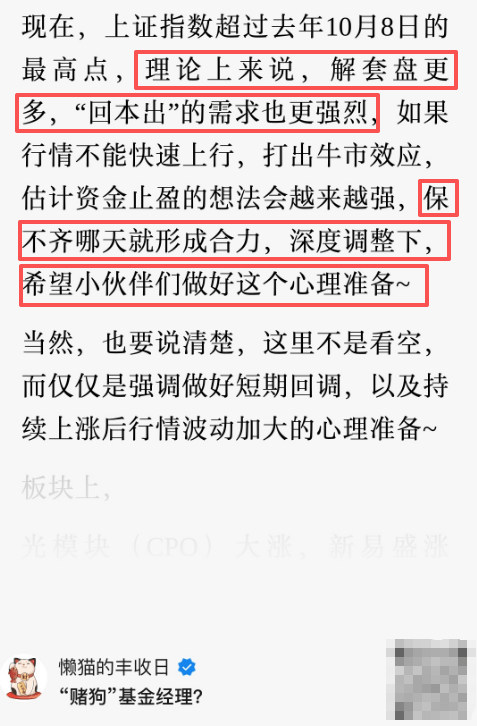
Sou Hu Cai Jing· 2025-08-05 16:30
Group 1 - The market has the potential to enter a bull phase, supported by the influx of external funds, as indicated by the "household savings / total stock market value" ratio, which is currently at 1.8, down from over 2 last September [1][3] - A significant amount of high-interest deposits from 2022-2023 will mature in the second half of this year and into next year, with the likelihood of these funds being redirected into the market through "fixed income+" products [3][6] - The Federal Reserve is expected to lower interest rates next year, which would be favorable for the stock market [8][10] Group 2 - The current market conditions suggest a "water bull" scenario, reminiscent of the bull market from 2013 to 2015, where small-cap and growth stocks are likely to benefit the most [10][12] - The shift in market style indicates a high probability of growth stocks outperforming value stocks, as the current underperformance of growth stocks is comparable to the end of 2018 [13][20] - Historical data shows that after the Shanghai Composite Index surpasses 3600 points, significant pullbacks are common, indicating high volatility in the current market [15][17] Group 3 - Investors are advised to adopt a "bull market mindset," focusing on holding positions during pullbacks rather than selling prematurely, as the market may experience fluctuations above 3600 points [22][23] - Two key indicators for exiting positions include the "household savings / total stock market value" ratio approaching 1.3 and the rolling three-year annualized return of the mixed equity fund index reaching 30% [23][25] - The current return of the mixed equity fund index is at -1.9%, suggesting there is still room for growth before reaching critical exit points [25][27] Group 4 - The market saw a slight increase today, closing at 3617.6 points, with significant contributions from the banking and insurance sectors, which rose by 1.52% and 1.25% respectively [29][32] - The banking sector's rebound after touching the 60-day moving average has helped lift the index back above 3600 points, indicating a potential shift in market sentiment [33][36] - Overall, the market is transitioning from previously high-performing sectors to those that have recently corrected, with a focus on large-cap stocks like banks and liquor, which are crucial for sustaining the bullish atmosphere [39][43]