矿业ETF

Search documents
ETF日报:在“反内卷”政策推进下,煤炭行业有望继续受益
Xin Lang Cai Jing· 2026-02-27 13:03
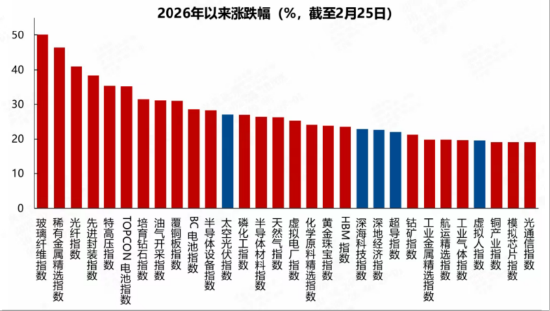
Core Viewpoint - The main theme in the capital market since the beginning of 2026 has been "price increases," which has permeated various industries and become a focal point for market transactions [10] Group 1: Market Performance - The A-share market showed divergence today, with the Shanghai Composite Index rising by 0.39% in the afternoon, while the ChiNext Index fell by over 1% [1] - The total trading volume in the Shanghai and Shenzhen markets was 2.51 trillion yuan, slightly lower than the previous trading day [1] Group 2: Price Increase Trends - Since the beginning of the year, 25 out of the top 30 concept indices have been related to the "price increase" logic, indicating a broadening trend across various sectors including oil and gas, chemicals, construction materials, and technology [10] - The "price increase" is expected to be a core factor driving market style diffusion throughout the year, reflecting industry prosperity [10] Group 3: Steel Sector Insights - The steel ETF has shown strong performance, with a cumulative increase of 10.64% this week, driven by both supply and demand catalysts [13] - Demand-side factors include favorable real estate policies in key cities, while supply-side factors indicate a contraction in 2026, leading to an accelerated phase of industry consolidation [13][14] - The steel sector is currently viewed as a bottoming area with significant elasticity potential, as low inventory levels could lead to price increases if demand catalyzes [14] Group 4: Rare Metals Surge - Rare metals such as tungsten and rare earths have seen a collective surge, with several stocks hitting historical highs, driven by four main factors [5][6] - The first factor is a dramatic increase in spot prices, with tungsten prices reaching 1.0225 million yuan per ton, up 3.7 times from the previous year [6] - The second factor is a tightening supply side, with mining quotas and environmental regulations limiting production capacity [6] - The third factor is the explosive demand from emerging industries, particularly in sectors like photovoltaics and semiconductors [6] - The fourth factor involves a global reassessment of critical mineral strategies, which has added a "safety premium" to these commodities [7] Group 5: Coal Sector Developments - The coal ETF rose by 2.82% today, influenced by production halts during the Spring Festival and ongoing reductions in Indonesian coal output [18] - The coal market is expected to benefit from policies aimed at reducing production capacity, with potential upward price elasticity if market conditions exceed expectations [19] - The coal sector is viewed as having room for a rebound, especially as other commodities have seen significant price increases [19]

ETF收评 | 稀有金属板块领涨,稀有金属ETF、稀土ETF嘉实涨4%
Ge Long Hui· 2026-02-27 07:35
Market Overview - The Shanghai Composite Index rose by 0.39%, while the ChiNext Index fell by 1.04% [1] - The total trading volume in the Shanghai, Shenzhen, and Beijing markets was 25,055 billion yuan, a decrease of 512 billion yuan compared to the previous day [1] - Over 3,200 stocks across the three markets experienced gains [1] Sector Performance - Rare metal stocks saw a surge, with significant increases in magnesium and tungsten stocks [1] - The rare metal ETFs, including the Rare Metal ETF and Rare Earth ETF, reported gains of 4.68% and 4.11% respectively [1] - The power sector showed strength, with the Power ETF and Green Power ETF rising by 2.73% and 2.53% respectively [1] - The steel sector also performed well, with the Steel ETF increasing by 2.45% [1] Declining Sectors - The ChiNext Growth ETF and the Deep Growth ETF both fell by 2% [1] - The semiconductor sector experienced declines, with the Semiconductor Equipment ETF and the Sci-Tech Semiconductor ETF dropping by 2.16% and 2.15% respectively [1]
有色金属领涨,矿业ETF、有色矿业ETF招商、有色金属ETF上涨
Ge Long Hui· 2026-02-24 05:18
Core Viewpoint - The A-share market has opened positively on the first trading day of the Year of the Horse, with all three major indices rising collectively, driven by the strong performance of the non-ferrous metals sector [1] Group 1: Market Performance - The non-ferrous metals sector led the market, with silver and Hunan Silver reaching the daily limit, while companies like Xingye Silver Tin and Tongling Nonferrous Metals rose over 6% [1] - Various non-ferrous ETFs, including those from Taikang, Minmetals, and Guotai, saw gains exceeding 3%, while others like Wanji and Tianhong also performed well, with increases over 2% [1] Group 2: ETF Coverage - There are eight indices related to non-ferrous metals ETFs in the market, including comprehensive indices like Non-Ferrous Metals, Subdivided Non-Ferrous, Guozheng Non-Ferrous, and Zhongzheng Non-Ferrous, which focus on basic metals like copper and aluminum [2] - These indices cover a complete industry chain from upstream mining to downstream processing, with a balanced weight distribution, making them suitable for investors looking to capture overall industry cycles and growth opportunities [2] Group 3: Specific Indices - The CS Rare Metals Index has a unique industry coverage, with 79.6% in non-ferrous metals, while also including basic chemicals and power equipment, focusing on rare metals without copper and aluminum [3] - The Industrial Non-Ferrous Index has fewer constituent stocks (30) and is more concentrated, closely reflecting demand changes in industrial applications like copper and aluminum [4] - The Shanghai Futures Exchange Metal Index tracks specific futures contracts and is influenced by short-term supply and demand, showing lower correlation with equity markets [5] Group 4: Future Outlook - According to Zhongyin Securities, entering 2026, the market is expected to enter a second phase of a bull market driven by profit, with strong cyclical attributes of non-ferrous metals likely to be highlighted [6] - The report suggests focusing on industrial metals and strategic minor metals, with copper prices expected to receive solid support amid a tight supply-demand balance [6] - The outlook for rare earth prices remains positive due to supply-side policy constraints and demand recovery, while gold is expected to maintain high prices in the medium term, providing opportunities for positioning [6]


不确定性强化,黄金资源品投资价值凸显,布局矿业ETF(561330)
Mei Ri Jing Ji Xin Wen· 2026-02-24 01:05
Group 1 - The global macro environment has been uncertain since the beginning of the year, highlighting the investment value of gold and resource commodities [1] - The metal sector has undergone significant repricing and is now considered a high-quality asset with strong data support, characterized by high prosperity and anti-inflation properties [1] - Gold ETFs and mining-related products have seen active trading, benefiting from global risk aversion and de-dollarization trends, maintaining high investment enthusiasm for gold [1] Group 2 - The copper and aluminum industries are experiencing cyclical benefits, with copper prices expected to rise due to tightening raw material supply from global smelting capacity expansion between 2025 and 2027 [1] - The aluminum sector is benefiting from domestic capacity policies and increased investments in new energy and power grids, with a long-term trend towards the value of "green electricity aluminum" [1] - Emerging demand driven by AI servers is pushing tin prices upward, with global refined tin supply and demand expected to remain in a tight balance through 2026 [1] Group 3 - Mining ETFs (561330) focus on upstream resources, covering various commodities such as copper, gold, lithium, rare earths, and aluminum, providing stronger performance elasticity and diversified risk management [2] - The constituent stocks are primarily leading companies that directly own mineral resources, benefiting significantly during commodity price upcycles [2] - Investors are advised to maintain rationality in high-volatility resource markets and consider a phased investment approach, balancing long-term growth logic with short-term volatility [2]
加仓!资金“盯上”这些方向
Zhong Guo Zheng Quan Bao· 2026-02-11 12:17
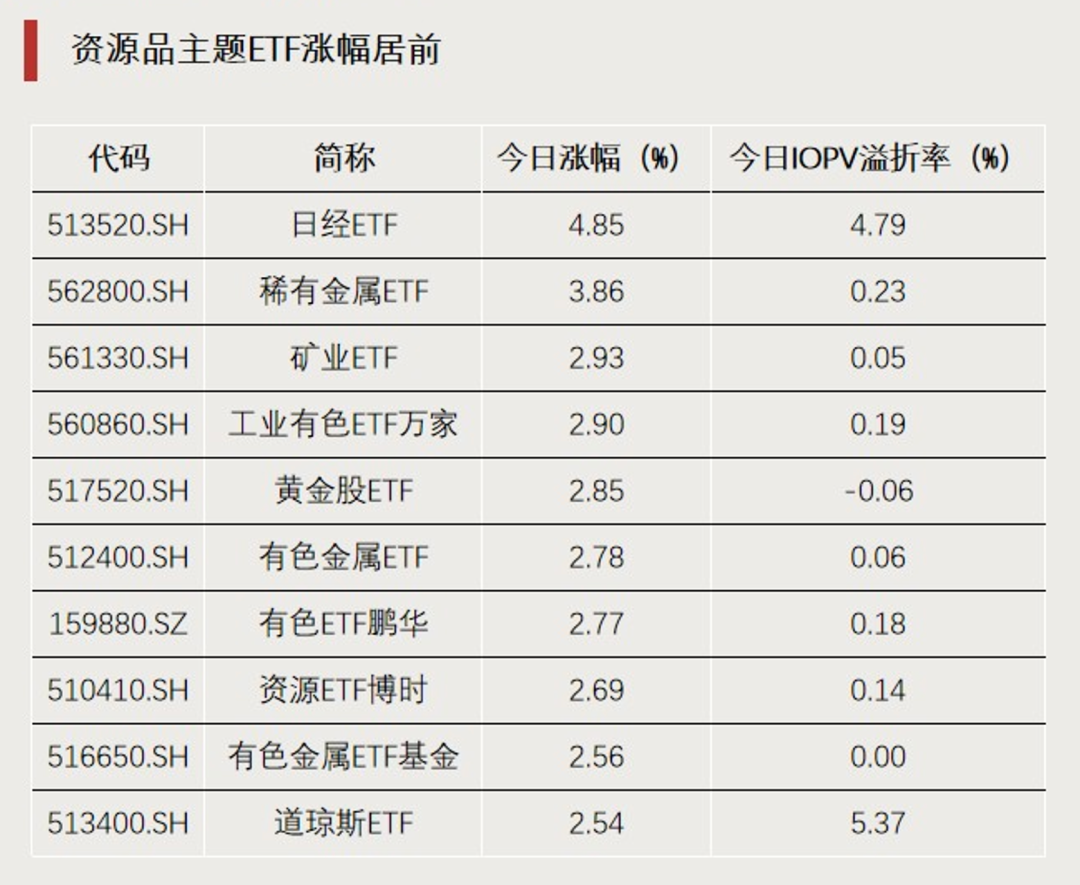
Group 1 - The resource sector, represented by non-ferrous metals, showed strong performance with multiple rare metal ETFs rising over 3% and mining, non-ferrous, gold, rare earth, and chemical ETFs generally increasing over 2% [1][2] - The Nikkei 225 theme ETF rose by 4.85%, with a premium rate increasing to 4.79%, while the Dow Jones ETF also saw a premium rate rise above 5% as the Dow Jones Industrial Average reached a new high [2][3] - Bond ETFs experienced significant trading activity, with total transaction volume increasing by over 90 billion yuan compared to the previous day, and the short-term bond ETF Hai Futong reached a historical high transaction volume of over 63 billion yuan [5][6] Group 2 - Recent market trends indicate a shift of funds from broad-based ETFs to industry-specific theme ETFs, with significant net outflows from the CSI 300 and CSI A500 theme ETFs, while the tourism ETF maintained a net inflow for 17 consecutive trading days, reaching a historical high in scale [7][8] - The film and media ETFs, which benefited from AI applications, experienced a collective pullback, with the film ETF dropping nearly 6% and the media ETF declining over 2% [3][4] - Fund managers are focusing on three key areas for investment: AI hardware driven by overseas trends, high-end manufacturing in new energy and innovative pharmaceuticals, and domestic price increase chains in chemicals, building materials, and steel [9]
昨天跌傻了,今天涨爽了,高波动率下进行技术性修正
Sou Hu Cai Jing· 2026-02-04 00:56
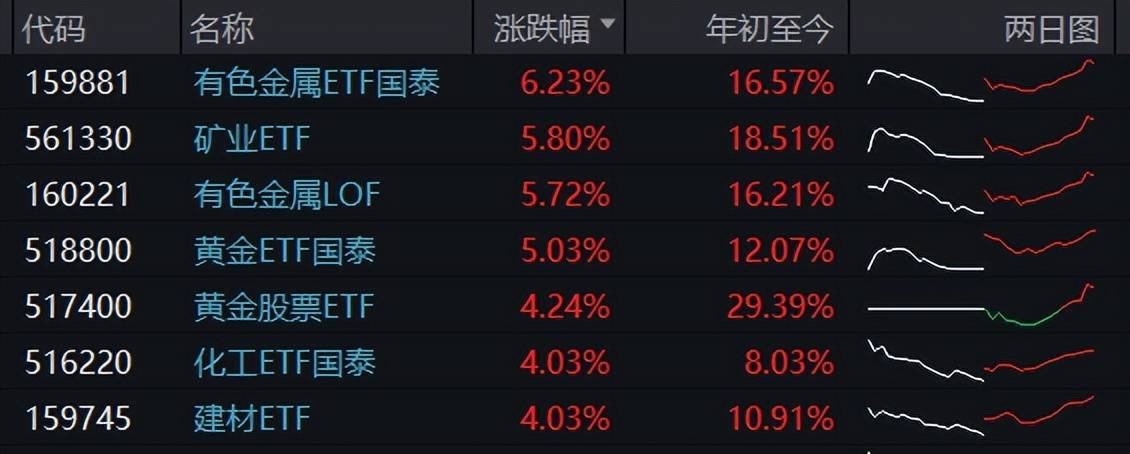
Core Viewpoint - The recent surge in various ETFs, particularly in the metals and mining sectors, indicates a recovery in market sentiment following a period of volatility, driven by technical corrections and strategic reserve initiatives by major economies [1][2][4]. ETF Performance - The following ETFs have shown significant gains: - Cathay Metals ETF: +6.23% YTD +16.57% - Mining ETF: +5.80% YTD +18.51% - Cathay Metals LOF: +5.72% YTD +16.21% - Cathay Gold ETF: +5.03% YTD +12.07% - Gold Stocks ETF: +4.24% YTD +29.39% - Cathay Chemical ETF: +4.03% YTD +8.03% - Building Materials ETF: +4.03% YTD +10.91% [1]. Market Dynamics - The rebound in gold prices, reaching a peak of $4,949.99, and silver prices above $87, reflects a shift in market dynamics, with short positions being closed and new buying interest emerging [2]. - The increase in holdings of the iShares Silver Trust by 1,023.23 tons marks the third-largest single-day increase in its history, indicating strong investor interest [3]. Strategic Reserve Initiatives - The Chinese government is exploring the expansion of its copper strategic reserve, which may support copper prices, similar to the U.S. strategic reserve initiatives [3]. - Trump's plan to initiate a $12 billion mineral reserve aims to bolster U.S. manufacturing against supply disruptions, reflecting a shift towards prioritizing security over efficiency in resource management [4]. Future Outlook - The expectation of a resource bull market remains, supported by historical patterns where extreme volatility in gold prices often precedes significant upward trends [5]. - Long-term factors such as monetary easing, the safe-haven appeal of gold, and the trend of de-dollarization are expected to sustain gold's upward trajectory [6]. - Investors are advised to adopt differentiated strategies, balancing short-term opportunities with long-term value, while being cautious of market volatility [7]. Related Investment Opportunities - Key ETFs to consider include: - Largest Oil ETF: 561360 - Unique Coal ETF: 515220 - Cathay Chemical ETF: 516220 - Largest Building Materials ETF: 159745 [9][10].
重生之我在大A开超市...
Xin Lang Cai Jing· 2026-02-02 12:52
Group 1 - The market witnessed significant volatility in February, with a notable decline in gold and silver prices, attributed to market reactions to potential changes in U.S. Federal Reserve leadership and monetary policy [8][6]. - Gold prices dropped from 5600 to 4682, while silver experienced a nearly 40% intraday pullback, indicating severe market stress and liquidity issues [6][8]. - The decline in gold is not fundamentally driven but rather a result of liquidity squeeze and increased implied volatility, with the market reacting to Trump's nomination of a Fed chair with a history of advocating for interest rate cuts and balance sheet reductions [8][10]. Group 2 - The telecommunications sector is facing increased tax burdens as the VAT rate for telecom services is set to rise from 6% to 9%, which will impact revenue and profit margins for major operators [14][15]. - Major telecom companies, including China Unicom, China Telecom, and China Mobile, experienced significant stock price declines following the announcement, with China Unicom's H-shares dropping over 11% at one point [14][15]. - The adjustment in tax policy may lead to a shift in industry dynamics, potentially reducing inefficient competition and encouraging a focus on technological innovation and high-quality services [14]. Group 3 - The real estate sector is under severe pressure, exemplified by Vanke's projected net loss of 82 billion, marking a 65.7% increase in losses compared to the previous year, which is expected to be the largest annual loss in A-share history [12][13]. - This situation reflects the broader challenges facing the real estate industry, with recovery dependent on both individual company strategies and overall market stabilization [12][13]. Group 4 - The liquor industry, particularly high-end brands like Moutai, is showing signs of recovery with price stabilization and potential for valuation improvement, despite ongoing challenges [17][18]. - The liquor sector is characterized by low expectations, low valuations, and low holdings, with public fund holdings in liquor stocks at a historical low of 3.93% [17][18]. - Analysts suggest that 2026 may present a bottoming opportunity for the industry, with expectations of a recovery phase beginning to emerge [18][19].





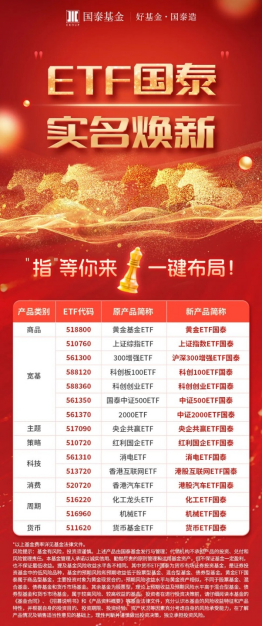
ETF简称批量焕新,认准“ETF国泰”
Xin Lang Cai Jing· 2026-02-02 07:39
Core Viewpoint - The recent renaming of ETF products by Guotai Fund aims to enhance investor experience by adopting a standardized naming convention that combines the underlying index with "ETF Guotai," facilitating easier identification and decision-making for investors [1][3][12]. Group 1: Naming Convention and Efficiency - The new naming convention "underlying index + ETF Guotai" provides clear identification of product attributes and management, significantly improving the efficiency of investment selection and decision-making for investors [4][12]. - The renaming covers a wide range of categories including broad-based, thematic, strategic, technology, consumer, commodity, and currency ETFs, allowing investors to quickly access core information from product names [1][10]. Group 2: Market Context and Growth - As of the end of 2025, China's ETF market is projected to reach a total size of 6.02 trillion yuan, making it the second-largest ETF market globally with nearly 1,400 products [3][12]. - The rapid expansion of the ETF market has led to challenges such as naming homogenization and unclear information, which the renaming initiative seeks to address [3][12]. Group 3: Product Management and Investor Support - Guotai Fund has been a pioneer in the ETF sector since launching China's first stock industry ETF in 2011, continuously enhancing its product offerings to meet diverse investor needs [5][15]. - The company emphasizes professional management through precise position control, refined capital management, and active product operation, ensuring that product performance remains competitive in the market [17]. Group 4: Performance and Recognition - As of December 31, 2025, Guotai Fund's non-currency ETF total size reached 286.1 billion yuan, ranking seventh in the industry, with its thematic ETFs holding the top position in the market [6][16]. - The performance of Guotai Fund's ETFs has been notable, with the communication ETF achieving over 125% annual growth, ranking first in the market, and the mining ETF ranking third with over 106% growth [6][16].
有色矿业回调或迎布局机会,资金抢筹布局,矿业ETF(561330)连续20日净流入超23亿元
Mei Ri Jing Ji Xin Wen· 2026-02-02 04:56
Group 1 - The core viewpoint is that the recent pullback in the non-ferrous mining sector may present a buying opportunity, with significant capital inflow into mining ETFs, which have seen over 2.3 billion yuan in net inflows for 20 consecutive days [1] - Short-term gold prices may experience a rebound due to extreme implied volatility levels, reminiscent of historical patterns following significant price corrections [1] - The market's pricing of "rate cuts + balance sheet reduction" may be overly anticipatory, as evidenced by the muted response in the U.S. Treasury market to recent news [1] Group 2 - The mining ETF (561330) tracks the non-ferrous mining index (931892), which includes companies involved in the development of copper, aluminum, lead, zinc, and rare metals, reflecting the overall performance of the non-ferrous metal mining industry [1] - According to Wind data, the mining ETF (561330) has achieved a year-to-date increase of 106.11% in 2025, ranking first among ten ETFs in the non-ferrous sector [2]
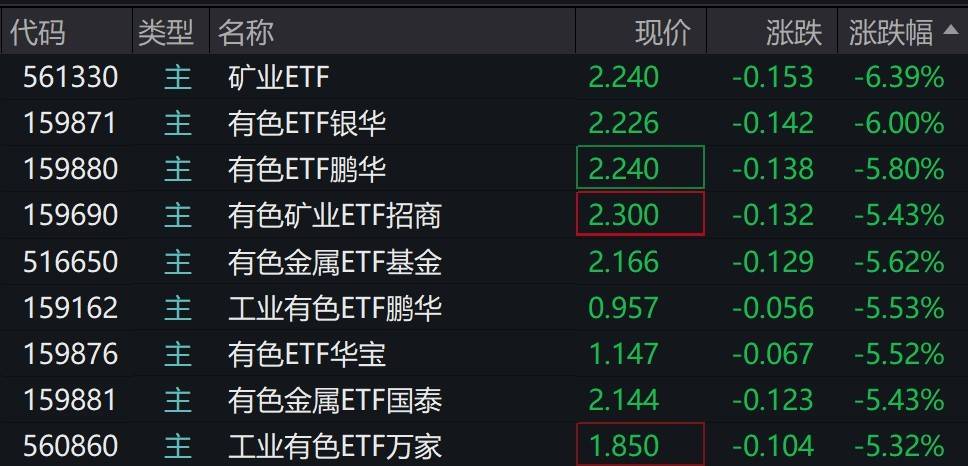
有色金属概念股走弱,矿业、有色相关ETF跌超5%
Sou Hu Cai Jing· 2026-02-02 02:08
Group 1 - The core viewpoint of the news highlights a significant decline in the performance of non-ferrous metal stocks, with companies like Shandong Gold and Zhongjin Gold hitting the daily limit down, and Northern Rare Earth dropping over 5% [1] - Mining and non-ferrous related ETFs have also seen a decline of over 5% due to market influences [1] Group 2 - Recent reports indicate that not only precious metals like gold and silver have risen significantly, but industrial metals such as copper and aluminum, as well as energy metals like cobalt and lithium, have also shown good growth, with multiple metals reaching historical or phase highs [2] - The super cycle of non-ferrous metals is attributed to three main factors: the weakening trend of the dollar due to the Federal Reserve's interest rate cuts, supply-demand gaps caused by declining ore grades and rising marginal costs in major mines, and domestic policies aimed at optimizing excess capacity [2]