半导体零部件

Search documents
超科林半导体股价大幅震荡,行业景气与公司基本面承压
Jing Ji Guan Cha Wang· 2026-02-13 22:45
Group 1: Stock Performance - As of February 13, 2026, UCTT's stock price closed at $55.47, with a single-day increase of 5.74% and a volatility of 6.71% [2] - Over the past five trading days (February 9 to 13), the stock has risen by 14.87%, with a price fluctuation of 38.53% [2] - The stock reached a peak of $58.70 on February 10 but experienced a significant drop of 6.20% on February 12, indicating high volatility [2] Group 2: Industry Outlook - The global semiconductor components market is projected to grow from $31.53 billion in 2025 to $52.96 billion by 2032, with a compound annual growth rate (CAGR) of 7.8% [3] - Recent advancements such as Samsung's 2nm chip technology breakthrough and expansion by ASE Technology Holding have boosted demand expectations within the industry [3] - Despite positive industry dynamics, the semiconductor sector is characterized by strong cyclicality, with the Philadelphia Semiconductor Index experiencing a 12.92% increase in January 2026 followed by a correction in February [3] Group 3: Company Fundamentals - For the third quarter of fiscal year 2025 (ending September 26, 2025), the company reported revenues of $510 million and a net loss of $10.9 million, resulting in a net profit margin of -2.14% [4] - The company's debt-to-asset ratio stands at 54.59%, indicating a high level of financial risk [4] - Although the price-to-sales ratio (TTM) is 0.57, which is below the industry average, the price-to-book ratio of 3.55 suggests that the market is assigning a premium, exacerbating the disconnect between fundamentals and valuation [4] Group 4: Market Sentiment and Trading Activity - On February 10, trading volume surged to 2.61 million shares, with a turnover rate of 5.75%, driving the stock price higher [5] - However, on February 12, trading volume dropped to $55.76 million, with a turnover rate of 2.31%, indicating a rapid decline in market participation and increased selling pressure [5] - The company's low market capitalization of approximately $2.518 billion means that small amounts of capital can lead to significant price fluctuations [5] Group 5: Price Target and Market Sentiment - After reaching a new high on February 10, profit-taking led to a price correction [6] - Institutional target prices average $38.75, which is below the current stock price, reflecting significant market divergence [6] - Overall sentiment in the tech sector remains cautious, with the Nasdaq index declining by 2.10% over the past five days, amplifying individual stock volatility [6]
强瑞技术:2025年净利同比预增38.39%-64.02%
Ge Long Hui A P P· 2026-01-27 09:45
Core Viewpoint - Strong瑞 Technology (301128.SZ) expects a net profit attributable to shareholders of 135 million to 160 million yuan in 2025, representing a year-on-year growth of 38.39% to 64.02% driven by increased operating revenue [1] Group 1: Financial Performance - The projected net profit for 2025 is between 135 million and 160 million yuan [1] - This represents a growth rate of 38.39% to 64.02% compared to the previous year [1] Group 2: Revenue Drivers - The growth in performance is primarily attributed to an increase in operating revenue [1] - Key factors contributing to revenue growth include deliveries of intelligent driving and lighting system production lines to B customers, deepening supply chain cooperation with A customers, expansion of subsidiary robot motor business, and significant revenue increases in niche areas such as liquid cooling radiators and semiconductor components [1]

日本出口四连增但未达预期!对华韧性成重要支撑,对美出口骤降11%
Zhi Tong Cai Jing· 2026-01-22 02:12
Group 1 - Japan's overall exports increased by 5.1% year-on-year in December, driven mainly by semiconductor components and non-ferrous metals, although this growth was below analysts' expectations of 6.1% [1] - Exports to China grew by 5.6% year-on-year, supported by raw materials and electronic components, while exports to the US saw a significant decline of 11.1% due to a drop in automotive and automotive parts [1] - Japan's trade balance recorded a surplus of 1,057 billion yen (approximately 6.67 billion USD), with imports rising by 5.3% year-on-year [1] Group 2 - Prime Minister Fumio Kishida announced the dissolution of the House of Representatives on January 23, with early elections scheduled for February 8, emphasizing the need for bold investment in risk management and a departure from excessive tightening [2] - Kishida's proposal to temporarily lower the food consumption tax rate has raised concerns among investors, as it lacks a clear funding source and could exacerbate fears regarding Japan's fiscal deterioration [2] - The bond market is reacting to Kishida's statements, viewing the upcoming election as a narrative of fiscal expansion, which has led to increased volatility in Japan's debt market [3]
日本出口四连增但未达预期!对华韧性成重要支撑 对美出口骤降11%
智通财经网· 2026-01-22 01:27
Group 1 - Japan's exports have increased for the fourth consecutive month, driven by stable demand from China, with a year-on-year growth of 5.1% in December, although below the expected 6.1% [1] - Exports to China grew by 5.6% due to raw materials and electronic components, while exports to the US fell sharply by 11.1% due to declines in automobiles and parts [1] - Japan's trade balance showed a surplus of 1,057 billion yen (approximately 6.67 billion USD), with imports rising by 5.3% [1] Group 2 - Prime Minister Fumio Kishida announced the dissolution of the House of Representatives on January 23, with early elections scheduled for February 8, emphasizing the need for bold investment in risk management and a departure from excessive tightening [2] - Kishida's proposal to temporarily lower the food consumption tax has raised concerns among investors, as it lacks a clear funding source and could exacerbate fears of fiscal deterioration [2] - The bond market is reacting negatively to Kishida's fiscal expansion plans, with rising bond yields causing significant turbulence in Japan's debt market, which already has the highest debt levels among major economies [3]
台湾第一大出口目的地由大陆变为美国
日经中文网· 2026-01-13 02:23
Group 1 - Taiwan's exports are projected to grow by 35% in 2025, reaching $640.7 billion, with exports to the US accounting for 31% and to mainland China for 27% [1][3] - Exports to the US are expected to increase by 78% year-on-year, reaching $198.2 billion, surpassing exports to mainland China, which are projected at $170.4 billion [1][3] - The trade surplus with the US is expected to swell to $150.1 billion, 2.3 times the previous year's figure, amid pressures from the Trump administration to correct trade imbalances [3] Group 2 - Taiwan's high-tech exports, particularly in AI infrastructure, are significantly impacting its export structure, with Taiwanese companies holding a 90% market share in AI server production and 70% in semiconductor foundry services [6] - Major Taiwanese manufacturers like Hon Hai Precision and Quanta Computer are shifting their focus to AI data center servers, moving production bases to Taiwan and Southeast Asia due to US IT giants' emphasis on information security [6][7] - The supply chain dynamics are changing, with the share of products sourced from mainland China and Hong Kong dropping from 50% in 2016 to 33% in 2024, while Taiwan's production is expected to exceed 50% [8] Group 3 - The strong export growth to the US is supporting rapid economic growth in Taiwan, with a projected GDP growth of 7.37% in 2025, the highest since the 2010 recovery from the global financial crisis [10] - The impact of US tariffs on Taiwan's exports is currently limited, as many semiconductor and server-related products are exempt from additional tariffs, contrasting with the declining exports from Japan and other major countries [10] - Concerns are raised about the potential for increased trade surplus to attract scrutiny from the Trump administration, with future export trends dependent on the sustainability of the AI boom [10][12]

受半导体短缺影响,本田将再次被迫减产停产
Guan Cha Zhe Wang· 2025-12-18 01:40
Core Viewpoint - Honda has announced production halts and reductions at its factories in Japan and China due to a shortage of semiconductor components, impacting its vehicle production plans from late December to early January [1] Group 1: Production Impact - Honda's joint venture factory with GAC Group in China will halt production for five days starting December 29 [1] - Japanese factories will stop production for two days on January 5 and 6, with reduced output from January 7 to 9 [1] - Specific Japanese factories affected may include Saitama and Suzuka plants, although Honda has not disclosed the full scale of the production adjustments [1] Group 2: Financial Implications - The production cuts due to semiconductor shortages have already resulted in significant financial losses for Honda [1] - Honda's consolidated financial forecast for the fiscal year ending March 2026 indicates a reduction in operating profit by 150 billion yen (approximately 6.8 billion RMB) due to lower-than-expected production [1]

对美出口八个月来首现回升 日本11月出口增长6.1%超预期
Zhi Tong Cai Jing· 2025-12-17 02:25
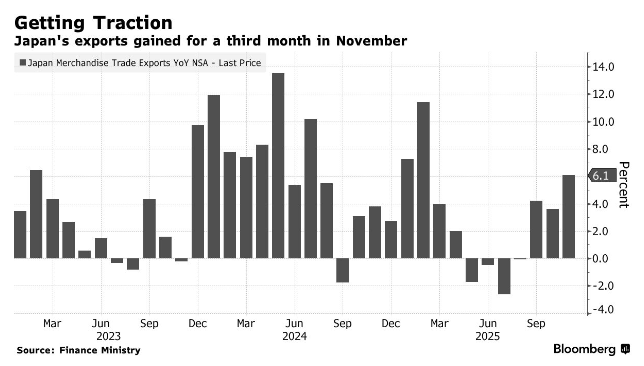
Group 1 - Japan's exports increased by 6.1% year-on-year in November, driven primarily by semiconductor components and medical supplies, exceeding economists' expectations [1][3] - Exports to the United States and the European Union saw significant growth, with increases of 8.8% and 19.6% respectively [1][3] - The trade surplus for Japan was recorded at 322.3 billion yen (approximately 2.1 billion USD), with imports rising by 1.3%, slightly below general expectations [3] Group 2 - The rebound in exports to the U.S. is seen as a positive signal for the Bank of Japan, which is expected to raise the benchmark interest rate to its highest level since 1995 [3][4] - Japan's trade with China declined by 2.4%, influenced by issues related to semiconductor manufacturing machinery and non-ferrous metals, as well as diplomatic tensions following comments made by Japan's Prime Minister [3][4] - The increase in exports of automobiles and parts to the U.S. was noted after the reduction of tariffs from 27.5% to 15%, with a 1.5% increase in export value and a 7.7% increase in export quantity [4]
投资者提问:董秘同志您好,新凯来公司致力于半导体装备及零部件、电子制造设备...
Xin Lang Cai Jing· 2025-11-07 08:48
Group 1 - The company focuses on the research, manufacturing, sales, and service of semiconductor equipment and components, as well as electronic manufacturing equipment [1] - The semiconductor components produced by the company are primarily used in the manufacturing of semiconductor equipment and semiconductor chips, covering core processes such as Physical Vapor Deposition (PVD), Chemical Vapor Deposition (CVD), etching, and ion implantation [2]

皖台共拓产业路:从传统制造向新兴赛道跨越的合作共赢
Xin Hua Wang· 2025-10-31 03:24
Core Insights - The collaboration between Taiwan and Anhui is transitioning from traditional manufacturing to emerging industries, highlighting a win-win partnership in economic development [1][2]. Group 1: Industry Development - Anhui province is evolving from a traditional agricultural base to a technology powerhouse, with significant growth in emerging industries such as new energy vehicles, integrated circuits, and artificial intelligence [1][2]. - By September 2025, Anhui is expected to have approved over 2,500 Taiwan-funded projects, attracting more than $20 billion in direct investments across various sectors [2]. Group 2: Business Expansion - Taiwanese businesses are shifting their focus from traditional sectors like textiles to high-tech industries, with a strong alignment between Taiwan's advantageous industries and Anhui's emerging sectors [2]. - Companies like 联宝 (Lianbao) have expanded their operations in Anhui, moving from producing laptop components to a broader range of products including automotive parts and precision bearings, with annual output exceeding 300 million RMB [2]. Group 3: Entrepreneurial Opportunities - Young Taiwanese entrepreneurs are increasingly establishing businesses in Anhui, drawn by the region's supportive environment and logistical advantages, as exemplified by a semiconductor company founded by three Taiwanese sisters [3][4]. - The local government provides comprehensive support for new businesses, enhancing the confidence of entrepreneurs in the region [3].
晶盛机电20251029
2025-10-30 01:56
Summary of Conference Call for Jingsheng Electromechanical Company Overview - Jingsheng Electromechanical is backed by a publicly listed company, providing significant advantages in capital, technology research and development, and operational management [2][4][5] Industry Insights - The silicon carbide sector is improving despite Jingsheng starting late, with the company currently keeping pace with clients in 18-inch products and leading in 12-inch products due to strong technical capabilities and capital support [2][4] - The photovoltaic industry is expected to reach a turning point around 2027, driven by government intervention, the elimination of outdated production capacity, and improvements in downstream profitability [2][7] Key Points and Arguments - Jingsheng has reduced investment and quickly responded to process iterations by self-manufacturing equipment, adopting Industry 4.0 automation to lower labor costs, and establishing a showroom in Yinchuan to reduce energy costs [2][6] - The company’s semiconductor components business, initiated in 2016, currently meets 80% of its own needs through advanced imported machine tools and is set to begin external supply in 2024, with recognition from leading equipment manufacturers [2][8] - Despite low prices in the photovoltaic dry pot market in 2025, Jingsheng's market share is projected to increase from 25% in 2024 to 40%, attributed to product quality, longevity, and the exit of smaller competitors [2][9] Future Development Focus - Future R&D priorities include customized semiconductor components, new packaging products, ion implantation equipment for wafers, and domestic substitution of auxiliary materials like quartz products [2][10] - The growth drivers for the next few years include advancements in silicon carbide materials and equipment, promotion of new photovoltaic technologies, capacity expansion for overseas clients, and the growth of the semiconductor components business [2][11] Additional Important Insights - Key factors for overseas clients when selecting suppliers are technological strength and capital strength, as they prefer suppliers with long-term stability and strong operational conditions [3] - Jingsheng has improved the yield of silicon carbide products through multiple rounds of technological iterations and is exploring cost reduction opportunities [5]