
原生铝合金

Search documents
华宝期货晨报铝锭-20260127
Hua Bao Qi Huo· 2026-01-27 03:17
1. Report Industry Investment Rating - Not provided in the content 2. Core Views - The price of steel products is expected to move in a range-bound manner, with its focus shifting downwards and showing a weak performance [1][3] - The price of aluminum ingots is expected to fluctuate at a high level in the short - term, and attention should be paid to macro - sentiment and mining - end news [4] 3. Summary by Relevant Content Steel Products - **Production Impact**: Yunnan and Guizhou short - process construction steel producers will halt production from mid - to late January and resume around the 11th to 16th day of the first lunar month, affecting 741,000 tons of output. In Anhui, 6 short - process steel mills, 1 stopped on January 5, most will stop in mid - January, and some after January 20, with a daily output impact of about 16,200 tons [2][3] - **Market Transaction**: From December 30, 2024, to January 5, 2025, the total transaction area of newly built commercial housing in 10 key cities was 2.234 million square meters, a 40.3% week - on - week decrease and a 43.2% year - on - year increase [3] - **Market Situation**: Steel products continued to decline yesterday, hitting a new low. In a weak supply - demand situation, market sentiment is pessimistic, and winter storage is sluggish, providing little price support [3] - **Later Concerns**: Macro policies and downstream demand [3] Aluminum Products - **Macro Factors**: The market expects the Fed to keep interest rates unchanged this week, but news of Powell's successor may impact the market [2] - **Raw Material Supply**: Some northern mining areas have reduced production due to weather. In Henan, bauxite mining in Xin'an stopped last weekend and is resuming, with an 80% drop in supply due to transportation issues. Southern domestic mines are stable, and domestic ore prices are expected to remain stable [3] - **Production Situation**: Domestic and Indonesian electrolytic aluminum projects are ramping up, and daily output is rising. The overall aluminum processing start - up rate was 60.9% last week, up 0.7 percentage points. Different sub - industries have different situations, with some affected by environmental protection, weather, and market demand [3] - **Inventory**: On January 26, the inventory of electrolytic aluminum ingots in major consumption areas was 777,000 tons, up 28,000 tons from last Monday [3] - **Price Outlook**: Due to macro uncertainty and weak dollar, non - ferrous metals are strong. Aluminum prices are expected to remain high in the short term, and attention should be paid to macro events and downstream feedback [4] - **Later Concerns**: Changes in macro expectations, development of geopolitical crises, mine resumption, and consumption release [4]
华宝期货晨报铝锭-20251225
Hua Bao Qi Huo· 2025-12-25 02:44
Group 1: Report Investment Ratings - No specific industry investment ratings are provided in the report. Group 2: Core Views - The price of finished steel products is expected to move downward with a weak trend, and the price of aluminum ingots is expected to remain high in the short - term with an oscillatory pattern, paying attention to the upper pressure [1][4] - The finished steel market is expected to be in an oscillatory and consolidating state, and the aluminum market is expected to have short - term high - level oscillations, focusing on macro - guidance [3][4] Group 3: Summary of Different Product Sections Finished Steel - Yunnan - Guizhou short - process construction steel producers will have a shutdown and maintenance period during the Spring Festival from mid - January, with a resumption around the 11th - 16th day of the first lunar month, affecting a total output of 741,000 tons. In Anhui, 1 out of 6 short - process steel mills stopped production on January 5th, and most others will stop around mid - January, with a daily impact of about 16,200 tons [2][3] - From December 30, 2024, to January 5, 2025, the total transaction area of newly - built commercial housing in 10 key cities was 2.234 million square meters, a 40.3% week - on - week decrease and a 43.2% year - on - year increase [3] - The finished steel market is in a situation of weak supply and demand, with a pessimistic market sentiment, and the price center has been continuously moving down. The winter storage this year is sluggish and provides little support for prices [3] Aluminum - Macroscopically, both domestic and international sentiment is positive, and the market's expectation of the Fed's interest - rate cut has increased, which is beneficial to aluminum prices and the non - ferrous metal sector [2] - The alumina market has a loose supply - demand pattern, with weak spot prices and cautious market sentiment. After the resumption of production in some enterprises in Guizhou and Guangxi, the production capacity has recovered, but the recovery in Henan is limited due to environmental protection. The weekly output increased by only 0.5 million tons, and the inventory increased by 0.5 million tons [3] - The weekly operating rate of domestic aluminum downstream processing leading enterprises decreased by 0.3 percentage points to 61.5%. The operating rates of different sub - industries vary: the primary aluminum alloy industry remained stable at 60%; the aluminum plate and strip industry remained at 65.0% but was under pressure; the aluminum cable industry decreased slightly by 0.4% to 62%; the aluminum profile industry decreased by 1.4 percentage points to 51.6% [3] - On December 22, the inventory of electrolytic aluminum ingots in domestic mainstream consumption areas was 600,000 tons, a 4,000 - ton increase from the previous Monday. In late December, the supply pressure of aluminum ingots increased, and the demand was affected by environmental protection control and high prices, with the inventory expected to increase slightly [3]
多晶硅:价格波动较大,注意风险控制,工业硅:短期偏强,中期逢高沽空
Yin He Qi Huo· 2025-12-22 01:34
Report Industry Investment Rating - Not provided in the given content Core Viewpoints - For polysilicon, in the long - term, anti - involution will drive price increases, and buying on dips is the best strategy. However, currently, terminal demand is weak, it takes time to implement price hikes across the industry chain. In the short - term, there is a combination of negative factors from increased warehouse receipts and positive factors from anti - involution in the industry chain, leading to large price fluctuations, so risk control is necessary [4][5]. - For industrial silicon, in the short - term, due to some manufacturers' planned joint production cuts to support prices and the strengthening of coking coal prices, the industrial silicon futures may rebound, but attention should be paid to the pressure at the 8800 level. In the medium - term, polysilicon enterprises may cut production, which may lead to a weakening of industrial silicon demand and a potential decline in prices. It is recommended to take profits on short - term long positions in time and sell short on rallies based on downstream demand changes [6][7]. Summary by Directory Chapter 1: Comprehensive Analysis and Trading Strategy Polysilicon - **Supply and demand**: In December, silicon wafer production scheduling decreased by 9GW month - on - month to 45GW, corresponding to a polysilicon demand of about 90,000 tons. In December, the polysilicon production was 112,000 tons, and the polysilicon inventory continued to accumulate. The current upstream inventory of polysilicon is about 2.9 million tons, the downstream raw material inventory is about 1.5 million tons, and the inventory of warehouse receipts and traders is about 400,000 tons [4]. - **Price and market sentiment**: Last week, some polysilicon enterprises raised the spot price to over 65,000 yuan/ton. At the Xi'an Photovoltaic Conference, all links in the upstream and downstream issued self - discipline initiatives to strictly control the operating rate and prices. The recent large - scale spot price adjustment of polysilicon has not led to short - term transactions. The increase in warehouse receipts of Orient Hope and Jinnuo on Friday last week has put some short - term downward pressure on the market [4]. - **Trading strategy**: - **Unilateral trading**: Long - term bullish, but large short - term fluctuations, need to control risks and participate with caution [5]. - **Arbitrage**: None [5]. - **Options**: None [5]. Industrial Silicon - **Supply and demand**: This week, the weekly output of DMC was 46,800 tons, a month - on - month increase of 1.30%; the weekly output of polysilicon was 26,200 tons, a month - on - month decrease of 0.19%; the operating rate of primary aluminum alloy was 60%, unchanged from the previous week, and the operating rate of recycled aluminum alloy was 59.8%, also unchanged from the previous week. The weekly output of industrial silicon was 80,100 tons, a month - on - month decrease of 2.52%. The social inventory of industrial silicon was 553,000 tons, a month - on - month decrease of 7,000 tons. The inventory of sample enterprises in Xinjiang, Yunnan, and Sichuan was 195,200 tons, a month - on - month increase of 10,100 tons. The downstream raw material inventory was 235,500 tons, a month - on - month increase of 1,900 tons [6]. - **Trading logic**: At the Guangzhou meeting, some manufacturers planned to jointly cut production to support prices. The strengthening of coking coal prices may lead to a short - term rebound in industrial silicon futures, with attention to the pressure at the 8800 level. In the medium - term, polysilicon enterprises may cut production, leading to a weakening of industrial silicon demand and a potential decline in prices [6]. - **Trading strategy**: - **Unilateral trading**: Take profits on short - term long positions and sell short near the pressure level [7]. - **Options**: Sell out - of - the - money call options [7]. - **Arbitrage**: None [7]. Chapter 2: Industrial Silicon Fundamental Data Tracking - **Market performance**: This week, the industrial silicon futures rebounded slightly, with the main contract closing at 8690 yuan/ton. The industrial silicon spot price remained stable this week [10]. - **Downstream demand**: The weekly output of DMC increased, the output of polysilicon decreased, and the operating rate of aluminum alloy was seasonally adjusted downwards. The weekly output of DMC was 46,800 tons, a month - on - month increase of 1.30%; the weekly output of polysilicon was 26,200 tons, a month - on - month decrease of 0.19%; the operating rate of primary aluminum alloy was 60%, unchanged from the previous week, and the operating rate of recycled aluminum alloy was 59.8%, also unchanged from the previous week [13]. - **Industrial silicon production**: This week, the industrial silicon output decreased. According to Baichuan Yingfu statistics, the weekly output of industrial silicon was 80,100 tons, a month - on - month decrease of 2.52%. The total number of open furnaces for industrial silicon this week was 245, a month - on - month decrease of 5. The number of open furnaces increased by 2 in Xinjiang, decreased by 2 in Yunnan, decreased by 4 in Gansu, and decreased by 1 in Sichuan [18]. - **Inventory situation**: The factory inventory increased slightly, the social inventory decreased, and the downstream raw material inventory increased. The social inventory of industrial silicon was 553,000 tons, a month - on - month decrease of 7,000 tons. The inventory of sample enterprises in Xinjiang, Yunnan, and Sichuan was 195,200 tons, a month - on - month increase of 10,100 tons. The downstream raw material inventory was 235,500 tons, a month - on - month increase of 1,900 tons [23][24]. - **Related product prices**: The industrial silicon spot price remained stable this week. The prices of DMC and terminal organic silicon products also remained stable. The price of aluminum alloy increased, and the operating rate remained stable. The industrial silicon raw material price remained stable this week [30][34][43][46]. Chapter 3: Polysilicon Fundamental Data Tracking - **Price trends**: The prices of polysilicon and its downstream main materials are shown in the table. For example, the average price of N - type dense material was 51 yuan/kg, and there was no change compared with the beginning of December and the end of November [52]. - **Component fundamentals**: In December, the component order situation was poor, and the manufacturer's production scheduling was significantly adjusted downwards compared with November. It is expected that the domestic photovoltaic component production scheduling in December will be adjusted down to around 42GW. In terms of inventory, the European photovoltaic component inventory increased to 33.1GW, and the domestic photovoltaic manufacturer's component inventory was 31.2GW, at a relatively low - medium level [60]. - **Battery chip fundamentals**: The export demand for batteries was good. The inventory of specialized battery manufacturers was 9.44GW, with a slight inventory accumulation. In November, the component production scheduling was adjusted downwards, and the battery production scheduling followed suit to 48GW [61]. - **Silicon wafer fundamentals**: This week, the operating rate of silicon wafer enterprises was adjusted downwards, and the weekly output of silicon wafers decreased to 10.67GW. Currently, the silicon wafer link basically schedules production according to demand, and the silicon wafer inventory is 21.5GW. The silicon wafer production scheduling in December was 45GW, a month - on - month decrease of 9GW [66]. - **Polysilicon fundamentals**: This week, the polysilicon output decreased slightly, and the factory inventory remained at 291,000 tons. In November, the total production suspension scale of Tongwei Co., Ltd. in Yunnan and Sichuan was 370,000 tons/year. In December, the third - phase project in Inner Mongolia increased the production cut intensity. Some production capacities of GCL Technology and Asia Silicon Industry were cut, while some production capacities of Daqo New Energy and Xinte Energy climbed to full production. It is expected that the polysilicon production in December will decrease by 2,000 tons month - on - month to 112,000 tons [71].
银河期货:多晶硅:关注平台公司落地情况,逢高沽空工业硅,区间震荡,高抛低吸
Yin He Qi Huo· 2025-11-24 12:36
Report Industry Investment Rating - For polysilicon, it is recommended to pay attention to the implementation of the platform company and sell on rallies [1]. - For industrial silicon, it is expected to trade in a range, with a strategy of high - selling and low - buying [1]. Core Viewpoints - In November, polysilicon was in a tight balance, but the silicon wafer and battery markets faced pressure. If the polysilicon platform company is launched as rumored, the polysilicon futures may rise, but the upside is limited due to pessimistic demand expectations. For now, it's better to wait and see [4]. - The industrial silicon market is in a tight balance. The price is expected to trade in the range of (8700, 9500) yuan/ton, with limited downside and upside space in the short term [7]. Summary by Directory Chapter 1: Comprehensive Analysis and Trading Strategies Polysilicon - From a supply - demand perspective, in November, the silicon wafer production schedule decreased by 1GW to 59GW compared to October, translating to a polysilicon demand of about 118,000 tons. The polysilicon production was 115,000 tons, resulting in a tight balance. There were about 270,000 tons of upstream inventory, approximately 160,000 tons of downstream raw material inventory, and about 45,000 tons of warehouse receipt and trader inventory. The silicon wafer and battery markets faced pressure due to increased hoarding risks and cash - flow needs of some manufacturers. If the polysilicon platform company is launched as rumored, the futures may rise, but the upside is limited. Currently, it's advisable to wait and see [4]. - Trading strategies: For the short term, wait for more certain opportunities; no arbitrage or option strategies are recommended [6]. Industrial Silicon - Supply - demand situation: This week, the DMC weekly production was 49,200 tons, a 1.03% increase; the polysilicon weekly production was 27,500 tons, a 3.24% decrease; the primary aluminum alloy operating rate was 59.8%, unchanged; the recycled aluminum alloy operating rate was 60.6%, unchanged. The industrial silicon weekly production was 89,100 tons, a 1.42% increase. The industrial silicon social inventory was 548,000 tons, a 2,000 - ton increase; the inventory of sample enterprises in Xinjiang, Yunnan, and Sichuan was 180,600 tons, a 5,200 - ton increase; the downstream raw material inventory was 232,600 tons, a 2,700 - ton decrease [7]. - Trading logic: After the silicone industry meeting, there was no expected production cut, and the industrial silicon market remained in a tight balance. Factories were reluctant to sell below 9,400 yuan/ton, and downstream acceptance of the price was high. The basis was at a relatively high level, limiting the downside of the futures price. Without a further reduction in supply, the upside momentum was also insufficient. It is expected to trade in the range of (8700, 9500) yuan/ton [7]. - Trading strategies: Trade in the range with high - selling and low - buying; no arbitrage or option strategies are recommended [7]. Chapter 2: Industrial Silicon Fundamental Data Tracking - **Market Trends**: This week, the industrial silicon futures first rose and then fell, with the main contract closing at 8,960 yuan/ton on Friday. The spot prices generally increased by 50 yuan/ton [11]. - **Downstream Demand**: This week, the DMC production increased by 1.03% to 49,200 tons, the polysilicon production decreased by 3.24% to 27,500 tons, the primary aluminum alloy operating rate remained at 59.8%, and the recycled aluminum alloy operating rate remained at 60.6% [14]. - **Production**: This week, the industrial silicon weekly production was 89,100 tons, a 1.42% increase. The total number of open furnaces was 261, a decrease of 3. An enterprise in Yili stopped production, and the number of open furnaces in Xinjiang decreased. There are no expected changes in Xinjiang, but some furnaces in Yunnan and Sichuan may stop, and the production is expected to decrease next week [25]. - **Inventory**: The industrial silicon social inventory was 548,000 tons, a 2,000 - ton increase; the inventory of sample enterprises in Xinjiang, Yunnan, and Sichuan was 180,600 tons, a 5,200 - ton increase; the downstream raw material inventory was 232,600 tons, a 2,700 - ton decrease [26]. - **Related Product Prices**: This week, the industrial silicon spot prices increased slightly; the DMC and terminal product prices of organic silicon also increased; the industrial silicon raw material prices remained stable [31][36][48]. - **Downstream Industry Data**: The operating rate of organic silicon intermediates increased slightly; the primary aluminum alloy operating rate increased slightly, and the recycled aluminum alloy operating rate strengthened [42][45]. Chapter 3: Polysilicon Fundamental Data Tracking - **Price Trends**: This week, silicon wafers and batteries saw significant price drops. The polysilicon prices were relatively stable, while the prices of silicon wafers and batteries decreased compared to the end of September and last weekend [53][54]. - **Component Data**: Recently, component enterprises started to implement the spirit of the association meeting and gradually raised component quotes. In November, some component enterprises reduced production, but terminal demand provided some support. The component production schedule was expected to be 46GW. European component inventory increased to 35.4GW, and domestic manufacturers' inventory was 30.3GW, at a moderately low level [62]. - **Battery Data**: Battery export demand was good, but specialized battery manufacturers' inventory reached 10.21GW, showing obvious inventory accumulation and pressuring battery prices. In November, the component production schedule decreased, and the battery production schedule was adjusted to 54GW [63]. - **Silicon Wafer Data**: This week, the silicon wafer enterprises' operating rate decreased, and the weekly production dropped to 12.78GW. Silicon wafers were produced on - demand, with an inventory of 18.72GW. The November production schedule was 59GW, a 1GW decrease from October [68]. - **Polysilicon Data**: This week, polysilicon production decreased slightly, and the factory inventory increased slightly to 271,000 tons. In November, Tongwei planned to gradually stop production in Yunnan, Sichuan, and Inner Mongolia, with a total annual production suspension scale of 370,000 tons. Its production is expected to decrease by 20,000 - 25,000 tons compared to October and another 10,000 tons in December. Some new capacities of Asian Silicon, Daquan Energy, and Xinte Energy are ramping up, while GCL Technology has a certain production cut plan. Overall, the November production is expected to decrease by about 20,000 tons compared to October [73].
工业硅:短期偏弱,关注前期低点支撑,工业硅:震荡偏强,多单持有
Yin He Qi Huo· 2025-11-10 08:19
Report Industry Investment Ratings - Polysilicon: Short - term weak, pay attention to the support at the previous low point [1] - Industrial silicon: Oscillating strongly, hold long positions [1] Core Viewpoints of the Report - Polysilicon is in a tight - balance state in November, but it is difficult for the spot price to rise further. The futures price is weak in the short - term, and there may be support at the (51000, 52000) level after the November delivery [4]. - The supply and demand of industrial silicon are in a tight - balance state. The current inventory structure is conducive to a positive feedback between futures and spot prices. There may be positive news from the silicone enterprise meeting next week, and there may be production restrictions in Xinjiang due to weather, so it is more cost - effective to hold long positions [6]. Summary According to the Directory Chapter 1: Comprehensive Analysis and Trading Strategies Polysilicon - **Supply and demand**: In November, the silicon wafer production schedule decreased by 1GW to 59GW compared with October, corresponding to a polysilicon demand of about 11.8 tons. The polysilicon production is 11.5 - 12 tons, showing a tight - balance state. The upstream inventory is about 25 tons, the downstream raw material inventory is about 17 tons, and the inventory of warrants and traders is about 4.5 tons [4]. - **Fundamentals**: The supply - demand situation of polysilicon has improved marginally this month, but the prices of downstream silicon wafers and batteries are under pressure, and the inventory of crystal - pulling factories is high. It is difficult for the spot price to rise further. The futures price is weak in the short - term due to the lack of upward momentum in the spot price and the non - implementation of the platform company. After the November delivery, the negative impact of warrants on the futures price is significantly reduced, and there may be support at the (51000, 52000) level [4]. - **Trading strategies**: Unilateral: Short - term weak, wait and see; Arbitrage: None; Options: Sell put options when the price pulls back to the support level [5]. Industrial Silicon - **Supply and demand**: This week, the weekly output of DMC increased by 5.51% to 4.79 tons, the weekly output of polysilicon decreased by 5.05% to 2.91 tons. The operating rates of primary and recycled aluminum alloys are 59.4% (up 0.2 percentage points) and 59.1% (unchanged) respectively. The weekly output of industrial silicon decreased by 7.85% to 9.09 tons. The social inventory decreased by 0.6 tons to 55.2 tons, the inventory of sample enterprises in Xinjiang, Yunnan, and Sichuan increased by 0.39 tons to 17.48 tons, and the downstream raw material inventory decreased by 0.26 tons to 23.66 tons [6][13][26][27]. - **Trading logic**: The current inventory structure of industrial silicon is "low at both ends and high in the middle", which is conducive to a positive feedback between futures and spot prices. The high operating rates of silicone and aluminum alloy provide certain support for the demand of industrial silicon. Although the production of polysilicon has decreased significantly this month, the large - scale production cuts of silicon factories in Yunnan and Sichuan have led to a tight - balance state in the supply and demand of industrial silicon. There may be positive news from the silicone enterprise meeting next week, and there may be production restrictions in Xinjiang due to weather, so it is more cost - effective to hold long positions [6]. - **Trading strategies**: Unilateral: Hold long positions; Arbitrage: None; Options: Sell out - of - the - money put options [7]. Chapter 2: Industrial Silicon Fundamental Data Tracking - **Market review**: This week, the industrial silicon futures price oscillated strongly, and the main contract closed at 9220 yuan/ton on Friday. The spot price remained stable [10]. - **Downstream demand**: The weekly output of DMC increased by 5.51% to 4.79 tons, the weekly output of polysilicon decreased by 5.05% to 2.91 tons. The operating rate of primary aluminum alloy increased by 0.2 percentage points to 59.4%, and the operating rate of recycled aluminum alloy remained unchanged at 59.1% [13]. - **Output**: The weekly output of industrial silicon decreased by 7.85% to 9.09 tons, and the total number of open furnaces decreased by 42 this week. The number of open furnaces in Yunnan and Sichuan decreased significantly, while that in Inner Mongolia, Henan, and Ningxia increased slightly. The operating rate of silicon factories in the northwest has reached a high level, and there is no significant room for production increase in the future. It is expected that the output of industrial silicon will continue to decrease next week [26]. - **Inventory**: The social inventory of industrial silicon decreased by 0.6 tons to 55.2 tons, the inventory of sample enterprises in Xinjiang, Yunnan, and Sichuan increased by 0.39 tons to 17.48 tons, and the downstream raw material inventory decreased by 0.26 tons to 23.66 tons [27]. - **Product prices**: The spot price of industrial silicon remained stable this week, and the prices of DMC and terminal products increased slightly [32][38]. - **Related product prices**: The prices of industrial silicon - related products remained stable, and the prices of silicone - related products increased slightly [32][38]. - **Intermediate fundamental data**: The operating rate of silicone intermediates increased slightly [43]. - **Aluminum alloy fundamental data**: The operating rate of primary aluminum alloy increased slightly, while that of recycled aluminum alloy remained unchanged [46]. - **Raw material prices**: The raw material prices remained stable [49]. Chapter 3: Polysilicon Fundamental Data Tracking - **Price trends**: This week, the spot price of polysilicon decreased slightly. The price of N - type re -投料 is 49.4 - 55 yuan/kg, the price of N - type dense material is 49 - 53 yuan/kg, and the price of N - type granular silicon is 50 - 51 yuan/kg [53][56]. - **Downstream product prices**: The prices of some silicon wafers and batteries decreased slightly, while the component prices showed a mixed trend [62][66]. - **Component fundamental data**: Component enterprises are gradually raising component quotes. The production of some component enterprises has decreased this month, but the terminal demand provides certain support. The planned production of components in November is 46GW. The inventory of European photovoltaic components has increased to 35.4GW, and the inventory of domestic photovoltaic manufacturers' components is 31.2GW, which is at a moderately low level [79]. - **Battery fundamental data**: The export demand for batteries is good, and the inventory of professional battery manufacturers is 3.85GW, which is at a moderately low level. The battery production schedule has been adjusted down to 54GW in November [80]. - **Silicon wafer fundamental data**: This week, the operating rate of silicon wafer enterprises decreased, and the weekly output decreased to 13.45GW. The silicon wafer inventory is 17.52GW. The planned production of silicon wafers in November is 59GW, a decrease of 1GW compared with October [86]. - **Polysilicon fundamental data**: This week, the polysilicon output decreased slightly, and the factory inventory increased slightly to 25.9 tons. The planned production cuts of Tongwei Co., Ltd. in November will lead to a decrease of about 2 tons in the polysilicon output compared with October. The new production capacity of some enterprises is ramping up, and there is a certain production - cut plan for GCL Technology. Overall, the polysilicon output in November will decrease by about 2 tons compared with October [94].
多晶硅:多单持有,工业硅:等待回调充分
Yin He Qi Huo· 2025-10-20 01:53
Report Industry Investment Rating - For polysilicon: Hold long positions [1] - For industrial silicon: Wait for a full correction [1] Core Viewpoints of the Report - In the polysilicon market, with progress in capacity integration and expected improvement in supply - demand, polysilicon futures are expected to rise and may hit a new high since listing. In the industrial silicon market, although the current inventory structure and production - demand situation lead to a weak price trend, the short - term downward space is limited, and long positions can be considered after a full correction [5][7] Summary by Relevant Catalogs Chapter 1: Comprehensive Analysis and Trading Strategies Polysilicon - **Supply - demand analysis**: In October, silicon wafer production increased by 3GW to 62GW, corresponding to a polysilicon demand of about 124,000 tons. Polysilicon production was around 130,000 tons, with a slight inventory build - up. The current total inventory is about 500,000 tons. In November, southwest polysilicon capacity may significantly reduce production, and silicon wafer production is likely to stay above 50GW [5] - **Trading logic**: The main short - term negative factor is the non - transferable warehouse receipts of the November contract, but their impact on prices is limited. High - inventory manufacturers have no incentive to lower prices, so the spot price is expected to be stable with an upward bias in the short and medium term [5] - **Operation strategy**: Hold long positions for single - side trading; conduct reverse arbitrage for the 2511 and 2512 contracts; sell put options and buy call options [6] Industrial Silicon - **Supply - demand analysis**: This week, DMC weekly production decreased by 2.73% to 46,300 tons, polysilicon weekly production decreased by 1.28% to 31,500 tons. The operating rate of primary aluminum alloy increased by 0.2 percentage points to 58.4%, and that of recycled aluminum alloy decreased by 0.3 percentage points to 58.6%. Industrial silicon weekly production increased by 2.09% to 97,500 tons. The total number of open furnaces remained at 318. Industrial silicon social inventory increased by 0.7 million tons to 562,000 tons, sample enterprise inventory increased by 0.57 million tons to 170,600 tons, and downstream raw material inventory decreased by 0.2 million tons to 23,900 tons [7][27][28] - **Trading logic**: The current inventory structure is "low at both ends and high in the middle", prone to positive feedback between futures and spot. The resumption of production by leading manufacturers and the expected decline in polysilicon production in November have led to weak futures prices. However, the acceptance of high - priced industrial silicon by downstream has increased, and the actual transaction price of spot has not significantly decreased. The short - term downward space is limited [7] - **Operation strategy**: Close short positions for single - side trading; no options or arbitrage strategies are recommended for now [8] Chapter 2: Industrial Silicon Fundamental Data Tracking - **Market trend**: This week, industrial silicon futures fluctuated weakly, with the main contract closing at 8,430 yuan/ton on Friday. The spot price decreased by 50 - 100 yuan/ton [11] - **Downstream demand**: DMC production decreased by 2.73%, polysilicon production decreased by 1.28%, the operating rate of primary aluminum alloy increased by 0.2 percentage points, and that of recycled aluminum alloy decreased by 0.3 percentage points [14] - **Production**: Industrial silicon production increased by 2.09% to 97,500 tons this week. Yunnan, Sichuan, and Gansu reduced the number of open furnaces, while Xinjiang's leading manufacturers increased the number of open furnaces, and there are rumors of further increases [27] - **Inventory**: Industrial silicon social inventory increased by 0.7 million tons to 562,000 tons, sample enterprise inventory increased by 0.57 million tons to 170,600 tons, and downstream raw material inventory decreased by 0.2 million tons to 23,900 tons [28] - **Related product prices**: Industrial silicon spot prices weakened this week, while DMC and terminal product prices of organic silicon increased slightly [33][38] - **Raw material prices**: The price of Xinjiang refined coal decreased [50] Chapter 3: Polysilicon Fundamental Data Tracking - **Price trend**: This week, polysilicon spot prices increased. N - type polysilicon prices were in the range of 49.5 - 55 yuan/kg, and some low - price ranges of N - type re -投料 increased by 500 yuan/ton. Silicon wafer and battery prices remained stable, while some component prices increased [56][63][72] - **Component fundamentals**: Domestic component orders are average, with a neutral to high inventory. Component production in October decreased slightly to 46GW [81] - **Battery fundamentals**: Battery export demand is good, with a neutral inventory of 6.63GW. Due to the decrease in component production in October, battery production increased to 56GW [88] - **Silicon wafer fundamentals**: This week, the operating rate of silicon wafer enterprises increased, with a weekly production of 14.35GW. Silicon wafer inventory is 17.31GW, and the production in October was 62GW, an increase of 3GW compared to August [93] - **Polysilicon fundamentals**: This week, polysilicon production slightly decreased, and factory inventory increased slightly to 253,000 tons. The expected production in October is about 130,000 tons [98]
薛鹤翔:政策预期仍在,警惕供应压力-工业硅期货
Sou Hu Cai Jing· 2025-09-20 02:50
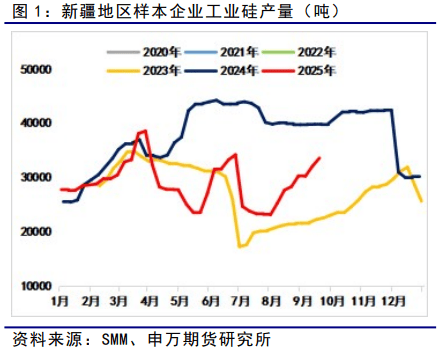
Core Viewpoint - The industrial silicon market is experiencing a short-term high-level fluctuation due to increased production in Xinjiang and strong coal prices providing cost support, despite overall inventory levels being high [3]. Supply - In Xinjiang, the weekly industrial silicon production increased by 0.15 million tons to 33.6 thousand tons, with the operating rate rising by 3.1% to 69.36% [2]. - In Yunnan, production slightly increased by 50 tons to 7,565 tons, while Sichuan's production remained stable at 2,135 tons [2]. Demand - The operating rates for recycled and primary aluminum alloys remained stable week-on-week, with a slight decrease in aluminum alloy spot prices [2]. - The weekly production of organic silicon DMC saw a minor increase, while spot prices remained stable; however, the production of polysilicon decreased by 200 tons to 31,000 tons, still at a high level [2]. Inventory - Social inventory of industrial silicon increased by 0.4 million tons to 543 thousand tons, remaining at a high level compared to the same period last year [2]. - Downstream industrial silicon inventory was stable at 221.5 thousand tons, and registered warehouse receipts totaled 49,874 hands, also stable week-on-week [2]. Price and Profit - As of September 19, the price in East China was 9,600 yuan/ton, up 100 yuan/ton week-on-week, with a basis of -1,705 yuan/ton, down 460 yuan/ton [2]. - The price of silicon coal in Xinjiang increased by 200 yuan/ton to 1,500 yuan/ton, leading to a decrease in industrial silicon production profits week-on-week [2].

多晶硅:短期震荡,工业硅:短期或有回调
Yin He Qi Huo· 2025-09-15 11:39
Report Industry Investment Rating - Not provided in the content Core Viewpoints - For polysilicon, the long - term price upward trend is certain, recommended to buy on dips in the medium - long term; short - term is volatile, and there may be a deep correction in futures prices. For industrial silicon, the short - term price may correct, but the decline is limited, and it is recommended to participate in long positions after a sufficient correction [4][6] Summary by Directory Chapter 1: Comprehensive Analysis and Trading Strategies - **Polysilicon**: In September, silicon wafer production is expected to increase by 6GW to 58GW, corresponding to a polysilicon demand of about 116,000 tons. The polysilicon production is expected to remain around 130,000 tons. The total inventory in the polysilicon industry is close to 400,000 tons, and the downstream inventory is about 180,000 - 200,000 tons. Long - term price is likely to rise, short - term is volatile. Operation strategies include buying on dips for far - month contracts, and conducting reverse arbitrage for 2511 and 2512 contracts [4][5] - **Industrial silicon**: This week, DMC weekly production increased by 0.62% to 48,900 tons, polysilicon weekly production decreased by 0.60% to 31,200 tons, primary aluminum alloy operating rate increased by 1 percentage point to 57.6%, and recycled aluminum alloy operating rate remained flat at 55.5%. Industrial silicon weekly production increased by 2.75% to 95,500 tons. Social inventory increased by 20,000 tons to 539,000 tons, sample enterprise inventory increased by 3,100 tons to 176,700 tons, and downstream raw material inventory decreased by 2,700 tons to 221,600 tons. The short - term price may correct, and it is recommended to avoid short - term long positions, sell out - of - the - money put options or participate in long positions after a sufficient correction, and conduct reverse arbitrage for 11 and 12 contracts [6][7] Chapter 2: Industrial Silicon Fundamental Data Tracking - **Market Performance**: This week, industrial silicon futures fluctuated strongly, with the main contract closing at 8,745 yuan/ton. Spot prices generally rose by 100 yuan/ton [10] - **Downstream Demand**: DMC production increased, polysilicon production slightly decreased, and aluminum alloy operating rate increased. DMC weekly production was 48,900 tons, polysilicon weekly production was 31,200 tons, primary aluminum alloy operating rate was 57.6%, and recycled aluminum alloy operating rate was 55.5% [13] - **Production**: This week, industrial silicon weekly production was 95,500 tons, a 2.75% increase. The number of furnaces in Xinjiang increased by 7, and it is expected that industrial silicon production will increase slightly in the future [25] - **Inventory**: Social inventory increased by 20,000 tons to 539,000 tons, sample enterprise inventory increased by 3,100 tons to 176,700 tons, and downstream raw material inventory decreased by 2,700 tons to 221,600 tons [26] - **Product Prices**: Industrial silicon spot prices strengthened, organic silicon - related product prices were stable, organic silicon intermediate operating rate increased slightly, and aluminum alloy operating rate increased slightly. Xinjiang refined coal prices and charcoal prices rose [31][35][41][45][48] Chapter 3: Polysilicon Fundamental Data Tracking - **Price**: This week, polysilicon spot prices decreased. N - type re - feedstock price was 49.1 - 54 yuan/kg, N - type dense material price was 48.1 - 52 yuan/kg, and N - type granular silicon price was 48 - 49 yuan/kg. The lower limit of rod - shaped silicon price decreased by 1,000 yuan/ton compared with last week, and granular silicon price remained stable [54][61] - **Silicon Wafer and Battery**: Silicon wafer and battery prices strengthened. Leading enterprises raised silicon wafer quotes, and battery prices increased accordingly. It is expected that battery quotes may continue to rise [62][68] - **Component**: Some component prices increased. Domestic photovoltaic component prices increased, and the cost - side supported the price increase. Some projects have accepted higher prices [69] - **Fundamental Data**: Component domestic orders are average, inventory is moderately high, and the production schedule in September is slightly increased to 45GW. Battery export demand is good, inventory is moderately high, and the production schedule is increased to 57GW. Silicon wafer enterprise operating rate increased, weekly production reached 13.88GW, inventory is 16.55GW, and the production in September is expected to be 58GW. Polysilicon production decreased slightly this week, and factory inventory increased to 234,200 tons. The production in September is expected to be flat compared with August, around 130,000 tons [77][83][88][93]
华宝期货晨报铝锭-20250826
Hua Bao Qi Huo· 2025-08-26 03:07
1. Report Industry Investment Rating - No relevant content found 2. Core Views -成材预计震荡整理运行,价格重心下移、偏弱运行 [1][2] -铝锭预计价格短期高位震荡,短期内消费仅边际改善,近期区间运行为主 [2][3] 3. Summary by Related Catalogs 3.1. Building Materials (Finished Products) -云贵区域短流程建筑钢材生产企业春节停产检修预计影响总产量74.1万吨,安徽省部分短流程钢厂停产日度影响产量1.62万吨左右 [1][2] -2024年12月30日 - 2025年1月5日,10个重点城市新建商品房成交面积环比降40.3%,同比增43.2% [2] -成材供需双弱、市场情绪悲观、冬储低迷,价格震荡下行创近期新低 [2] 3.2. Aluminum -宏观上美联储主席讲话强化9月降息预期,国内政策托底但传导至消费需时间 [1] -上周国内铝下游加工龙头企业整体开工率环比升0.8个百分点至59.5%,部分领域开工率有升有降 [2] -预计8月下旬铝线缆、铝板带延续回升,“金九银十”拉动铝箔、铝型材需求 [2] -8月25日国内主流消费地电解铝锭库存61.60万吨,较上周四增2.0万吨,较上周一涨0.9万吨,库存回升采购情绪转弱 [2]
工业硅周报:供需两旺,短期震荡偏强-20250819
Yin He Qi Huo· 2025-08-19 01:16
1. Report Industry Investment Rating - Not provided in the given content 2. Report Core Views Industrial Silicon - The industrial silicon market is in a situation of both supply and demand booming, with short - term oscillations showing a strong tendency. The core contradiction lies in the sentiment and the expected changes in fundamentals. Before the large - scale factory's actual resumption of production, the market is expected to be strong with oscillations, and it is advisable to participate by taking long positions on dips. After the actual resumption of production, short - term operations can be considered based on valuation [4]. Polysilicon - The polysilicon fundamentals are bearish, but the consensus of non - selling below cost provides strong support for the futures price. The downward decline of polysilicon futures is limited, and there will be continuous positive news disturbances. It is recommended to buy on dips, with the price range referring to (48000, 55000) [52]. 3. Summary by Directory Industrial Silicon Weekly Report Chapter 1: Comprehensive Analysis and Trading Strategies - **Supply and Demand**: This week, the weekly output of DMC was 51,400 tons, a 0.39% increase; the weekly output of polysilicon was 29,200 tons, a 2.85% increase; the operating rate of primary aluminum alloy was 56.6%, a 1 - percentage - point increase, and that of recycled aluminum alloy was 53.9%, remaining flat. The weekly output of industrial silicon was 84,700 tons, a 1.50% increase. The number of open furnaces increased by 10. The social inventory of industrial silicon was 545,000 tons, a 0.37% decrease. It is expected that the demand for industrial silicon in August will increase to 385,000 tons, and the production will be about 370,000 tons, with inventory reduction in August [4]. - **Trading Logic**: The production of silicone and polysilicon has increased significantly recently, leading to a significant increase in the demand for industrial silicon. The cost of industrial silicon has increased due to the rise in the price of Ningxia refined coal and thermal coal. The core contradiction in the current industrial silicon market lies in the sentiment and the expected changes in fundamentals [4]. - **Strategies**: Before the large - scale factory's confirmed resumption of production, take long positions on dips. For options, there is no recommendation. For arbitrage, look for opportunities to conduct reverse arbitrage on the 11th and 12th contracts [5]. Chapter 2: Core Logic Analysis - **Market Review**: This week, the industrial silicon futures oscillated weakly, with the main contract closing at 8805 yuan/ton on Friday. The spot prices of industrial silicon showed mixed trends, with prices in Yunnan generally decreasing by 50 - 150 yuan/ton and prices in other industrial areas slightly increasing [8]. - **Downstream Demand**: The output of DMC and polysilicon increased slightly, and the operating rate of aluminum alloy increased slightly. The short - term operating rate of silicone is gradually increasing, and the output of polysilicon is also slightly increasing [11][14]. - **Industrial Silicon Production**: This week, the weekly output of industrial silicon was 84,700 tons, a 1.50% increase. The number of open furnaces increased by 10. If the large - scale factory in Xinjiang increases the number of open furnaces as expected at the end of the month, the production of industrial silicon in September will increase to 380,000 - 390,000 tons [20]. - **Industrial Silicon Inventory**: The social inventory of industrial silicon decreased slightly, while the factory inventory increased slightly. The social inventory was 545,000 tons, a 0.37% decrease [21]. - **Related Product Prices**: The spot prices of industrial silicon showed mixed trends, and the price of silicon powder weakened. The prices of DMC and its terminal products also weakened [29][33]. - **Raw Material Prices**: The price of Ningxia refined coal increased slightly [45]. Polysilicon Weekly Report Chapter 1: Comprehensive Analysis and Trading Strategies - **Supply and Demand**: In August, polysilicon enterprises plan to increase production significantly, with an expected output of 125,000 tons. The silicon wafer production schedule in August is basically the same as that in July, resulting in an oversupply of 15,000 - 20,000 tons. The factory inventory of polysilicon is 267,000 tons, and it is expected to continue the inventory - building trend in August [52]. - **Price Analysis**: The spot price of polysilicon has upward pressure in the short term, but it is difficult to decline significantly before the consensus of non - selling below cost is broken. The downward decline of polysilicon futures is limited, and there will be continuous positive news disturbances. The short - term price range is expected to be (48000, 55000) [52]. - **Strategies**: It is recommended to buy on dips, with the price range referring to (48000, 55000). For arbitrage, conduct positive arbitrage on the 2511 and 2512 contracts, with the target range referring to (- 1500, - 1000) [53]. Chapter 2: Fundamental Situation - **Polysilicon Price**: This week, the spot quotes of polysilicon manufacturers remained stable. The transaction prices of N - type re - feedstock and N - type granular silicon increased slightly [69]. - **Silicon Wafer, Battery, and Component Prices**: The prices of silicon wafers and batteries showed mixed trends, and the prices of components showed both increases and decreases. The prices of some silicon wafers remained stable, while some decreased slightly. The battery prices showed a downward trend in some cases but may increase in the future. The component prices in distributed projects increased slightly in some cases, while those in centralized projects decreased slightly [73][74]. - **Component Fundamentals**: Overseas demand has decreased, and domestic component demand is weak in the short term. The domestic component inventory is 34.5GW, showing a slight increase. The production schedule of component enterprises has increased slightly to about 45GW [82]. - **Battery Fundamentals**: The overseas demand for small - sized batteries has improved, but manufacturers are cautious about production scheduling. The expected production schedule of photovoltaic batteries in August is about 50GW [88]. - **Silicon Wafer Fundamentals**: The operating rate of silicon wafer enterprises has changed little, and the weekly output has increased to 12.01GW. The silicon wafer inventory remains stable at around 20GW, and the expected output in August is 52GW, basically the same as that in July [92]. - **Polysilicon Fundamentals**: The weekly output of polysilicon has increased slightly, and the factory inventory has decreased to 267,800 tons. It is expected that the output in August will increase to 125,000 - 130,000 tons, and may further increase to 135,000 - 140,000 tons in September [97].