固态氧化物燃料电池(SOFC)

Search documents
北美缺电持续演绎-燃气机组迎-主电-新机遇
2026-03-01 17:23
Summary of Conference Call Notes Industry Overview - The conference call discusses the North American power shortage, particularly driven by the surge in data center installations, which is expected to reach approximately 65GW under neutral scenarios and up to 200GW in optimistic scenarios by 2030, leading to a potential power gap of 200GW, with an annualized shortfall nearing 40GW [1][3] Key Points and Arguments Power Supply Challenges - Traditional power grid integration has long lead times (3-6 years for thermal power, 3-8 years for geothermal, and 2-3 years for nuclear), making it difficult to meet the rapid demand growth from data centers [1][3] - Off-grid/distributed generation is becoming a crucial solution, projected to account for nearly 25% by 2027 and close to 30% by 2030 [1][3] Distributed Generation Technologies - The main technologies for distributed generation include: - Gas turbines (approximately 60% share) - Gas generator sets (approximately 30% share) - Solid oxide fuel cells (SOFC, approximately 10% share) [1][4] Economic Viability - Gas generator sets are more economically viable than gas turbines, with shorter delivery times (approximately six months) [1][6] - Major overseas players like Wärtsilä and Caterpillar are facing capacity constraints, with orders extending to 2028-2029, creating market opportunities for Chinese companies [1][8] Demand Projections - By 2026, there is an estimated demand gap of about 40GW for gas turbines, with data centers accounting for approximately 13GW of this gap, which will be shared by gas generator sets and SOFCs [2][8] - The demand for gas generator sets is projected to be around 9GW, translating to approximately 14GW of equipment demand, equating to thousands of units [2][8] Market Opportunities for Chinese Companies - Companies like Weichai are positioned to benefit from the North American market due to their existing capacity and technological foundation in diesel power generation [2][11] - Weichai has already exported 1.1MW gas generator sets to North America and plans to mass-produce M170 equipment by 2027 [2][12] Additional Important Insights Regulatory and Market Acceptance - Weichai's subsidiary has received North American certification, alleviating concerns about market entry barriers for AI data center-related equipment [2][14] - The company has established a solid customer base in the North American backup power sector, which could facilitate expansion into primary power generation [2][14] Supply Chain and Industry Dynamics - The gas generator set market is dominated by Caterpillar (approximately 55% market share), followed by Yanmar and others, with significant supply constraints [1][8] - The overall supply-demand gap in gas turbines is expected to drive demand for gas generator sets and SOFCs, with a projected need for around 9GW of gas generator sets by 2026 [8][19] Financial Projections - Weichai's market valuation is projected to reach approximately 350 billion, with significant contributions from gas generator sets and SOFCs expected to yield substantial profits [2][16] - The gas generator set segment is anticipated to generate around 150 billion in revenue, with a profit margin of 20%-30%, translating to approximately 40 billion in profits [2][16] Key Industry Players - Other notable companies in the supply chain include Silver Wheel, Tianrun Industrial, and Bohai Automobile, which are also expected to benefit from the growing demand for gas generator sets [2][19] Conclusion - The North American power shortage presents significant opportunities for distributed generation technologies, particularly gas generator sets, with Chinese companies like Weichai poised to capitalize on the market dynamics and supply constraints faced by established players. The ongoing demand for data centers and the shift towards cleaner energy solutions will drive growth in this sector.

北美缺电背景下如何看柴发产业链投资机遇
2026-02-11 05:58
Summary of Key Points from Conference Call Records Industry Overview - The global AIDC generator market is experiencing strong demand, particularly in the U.S., with an expected annual growth rate of 30% over the next five years. The Chinese market is projected to grow from 3,000 units in 2024 to 5,000 units in 2025, but at a slower pace than the U.S. [1][2] - Diesel generators are increasingly used as primary power sources due to severe electricity shortages overseas and insufficient gas turbine capacity. The demand for medium-speed gas units is also rising, indicating sustained demand for diesel generators in the next two to three years [3][4] Company Insights Weichai Power - Weichai Power is producing AIDC generators through Weichai Heavy Machinery and has close collaborations with major telecom operators and Huawei. The company plans to launch new 2-3 MW gas valve equipment and is developing medium-speed gas turbines and solid oxide fuel cells (SOFC), which have high unit prices and profit margins [1][5][6] - Traditional business segments, including heavy trucks and logistics, are expected to contribute approximately 1 billion RMB in profits, with an overall profit target of 14 billion RMB for 2026 deemed achievable. The growth in the heavy truck sector is primarily driven by overseas markets, and the high growth potential in the power generation business may lead to a revaluation of the company [7] Dongfeng Motor Corporation - Dongfeng is expected to launch a 1.5 MW gas valve product in 2026, with a combined production capacity of 5,000 units from its subsidiaries [8] Wuxi Zhenhua and Weifu High-Tech - Wuxi Zhenhua is involved in producing engine bases for diesel engines, with a low valuation that may lead to a valuation recovery. Weifu High-Tech provides fuel injection systems and turbochargers for AIDC, with an average selling price (ASP) of 80,000 to 100,000 RMB for fuel injection systems and 5,000 RMB for turbochargers [9][10] Zhongyuan Nepe - Zhongyuan Nepe is entering the AI-related power generation equipment supply chain, with significant increases in the value of its cylinder sleeves and pistons. The company anticipates revenues of over 200 million RMB from large-diameter steel sleeves in 2025, with Caterpillar as a major client. Recent acquisitions are expected to enhance profit margins [14][15][16] Silver Wheel Co. - Silver Wheel has secured a key order for gas engine radiators from Caterpillar, with expected annual sales of over 6,000 units due to increased demand from North America. The company is also expanding into data center liquid cooling solutions, which will contribute additional revenue [11][12][13] Market Dynamics - The domestic market share of Chinese companies in the AIDC generator sector is approximately 40%, with significant room for growth. Weichai leads in the North American market, while joint ventures and partnerships with established brands are helping to secure market positions abroad [4][5] Future Outlook - The overall market for AIDC generators is expected to grow significantly, with the U.S. market projected to increase from 3.1 billion USD in 2021 to 12.5 billion USD in 2025, representing a growth of over four times. The global market is anticipated to grow at a rate of 20% to 30% [2][3] This summary encapsulates the key insights and projections from the conference call records, highlighting the competitive landscape, company strategies, and market trends within the AIDC generator industry.
潍柴动力20260122
2026-01-23 15:35
Summary of Weichai Power Conference Call Company Overview - **Company**: Weichai Power - **Industry**: Heavy-duty truck and engine manufacturing Key Points and Arguments Market Challenges and Opportunities - Weichai Power faces challenges from the rapid development of the electric heavy-duty truck market, despite expanding its three-electric system integration capabilities. The trend of electric trucks replacing diesel engines poses pressure on traditional engine demand [2][4] - The domestic heavy-duty truck market is expected to remain stable in 2026, with electric truck sales projected to see a slight increase. Weichai aims to maintain profitability through new business ventures, including partnerships with Foton [2][6] Financial Performance and Projections - The collaboration with Kion Group in 2025 led to personnel optimization and expense provisions, impacting Weichai's financial statements in the short term. However, Kion's performance is expected to improve significantly in 2026, contributing several hundred million yuan to Weichai's profits, returning its contribution to around 10% [2][7] - Weichai's large-bore engine business has shown significant results, with shipments nearing 11,000 units in 2025 and expected to reach 14,000-15,000 units in 2026. The high profitability of this segment could lead to a valuation exceeding 80 billion yuan [2][8] Solid Oxide Fuel Cell (SOFC) Development - Weichai is actively investing in the SOFC sector, planning to achieve 10 MW capacity by 2026 and 1 GW by 2030. This area is anticipated to become a significant growth driver for the company [2][9] Business Transformation - The transformation from a traditional truck cycle stock to a diversified power supply platform is driven by changes in business and profit structures. In 2023, truck-related business accounted for 20% of revenue but contributed over 80% of net profit. This ratio is expected to decline significantly by 2025 and 2026 as diversification efforts take effect [3] Valuation and Market Position - Weichai's valuation differs from international peers like Cummins and Caterpillar due to variations in profit pool structure, the pace of electrification in the domestic truck market, and pricing mechanisms. The company is expected to see significant valuation upside in the next 1-2 years, with a projected market cap of 240-250 billion yuan by 2026 [4][11][12] - Currently, Weichai's valuation is considered low, with an expected performance exceeding 14 billion yuan in 2024, while its market cap is below 200 billion yuan, translating to a price-to-earnings ratio of about 14 times, compared to around 30 times for its overseas counterparts [13] Future Outlook - The market is expected to develop further post-2027 with the introduction of new models and battery swap infrastructure [5] - By 2030, Weichai's revenue could approach 20 billion USD, with profit margins expected to exceed 20%, indicating a substantial market potential [10]
中泰国际每日晨讯-20251107
ZHONGTAI INTERNATIONAL SECURITIES· 2025-11-07 11:40
Market Overview - The Hang Seng Index and the Hang Seng China Enterprises Index rose approximately 2.1% yesterday, driven by strong performance in the technology sector[1] - Major tech stocks like Tencent (700 HK), Alibaba (9988 HK), and JD.com (9618 HK) saw increases between 2.4% and 4.1%[1] - Semiconductor stocks also performed well, with SMIC (981 HK) and Hua Hong Semiconductor (1347 HK) rising 7.3% and 9.1%, respectively[1] - Despite the market rally, trading volume remained cautious at over HKD 230 billion[1] Economic Indicators - The U.S. stock market saw declines of 0.8% to 1.9% across major indices, amid concerns over the ongoing government shutdown entering its 37th day[2] - U.S. companies announced a significant increase in layoffs for October, with 153,000 job cuts reported, marking a month-on-month increase of over 1.8 times and the highest for the month in 22 years[2] Macro Dynamics - Australia's trade surplus for September was AUD 3.94 billion, significantly higher than August's AUD 1.11 billion and slightly above Bloomberg's forecast of AUD 3.93 billion[3] - Japan's October S&P Composite PMI rose slightly to 51.5 from 51.3 in September, indicating continued growth in the services sector, although the Services PMI fell to 53.1 from 53.3[3] Sector Performance - The renewable energy and utilities sectors saw broad gains, with Weisheng Holdings (3393 HK) surging 9.6% to a 52-week high, driven by increased demand for smart distribution services[4] - Weichai Power (2338 HK) experienced a significant stock price increase of 20.5%, following a production licensing agreement with Cares Power for solid oxide fuel cells[4] - The healthcare sector's Hang Seng Medical Care Index rose 0.7%, with notable gains for Jing Tai Holdings (2228 HK) due to its inclusion in the MSCI China Index and a strategic partnership with Eli Lilly[5]
海外算力电力短缺投资机会
2025-11-07 01:28
Summary of Key Points from Conference Call Industry Overview - The conference call discusses the **gas turbine** and **solid oxide fuel cell (SOFC)** industries, highlighting the significant demand increase driven by the surge in AIDC (Artificial Intelligence Data Center) requirements in the U.S. [1][3][4] Core Insights and Arguments - **Gas Turbine Demand Surge**: The demand for gas turbines has surged due to the reliance on natural gas for power generation in AIDC, with companies like GE, Siemens Energy, and Mitsubishi Heavy Industries facing delivery delays until 2030. GE's new order volume reached **20 GW** last year, with a backlog of **62 GW** as of Q3 this year [3][4] - **Investment Initiatives**: The U.S. government and Japan are investing **$550 billion** to address energy challenges, with **$25 billion** allocated specifically for gas turbines, steam turbines, generators, and grid issues [4] - **SOFC as a Solution**: SOFC technology, with an efficiency of **95%**, is positioned as a promising energy solution, potentially transforming fossil fuels into electricity more effectively than gas turbines, which have an efficiency of around **30%** [4][7] - **Metal Chromium Demand**: The demand for metal chromium, essential for high-temperature alloys, is expected to increase significantly, with SOFC requiring over **15 times** the amount needed for gas turbines. A supply gap of **340,000 tons** is anticipated by 2028 [6][8] Emerging Opportunities - **Chinese Companies' Role**: Chinese firms like Yingliu Co. and Longda Co. are poised to benefit from the supply chain opportunities as overseas gas turbine manufacturers face integration and installation challenges [4][5] - **North American Power Equipment Market**: The North American power equipment market is expected to see significant growth driven by new energy installations, industrial resurgence, and the replacement of aging grid infrastructure [10][11] - **Transformer Industry Outlook**: The transformer industry is experiencing a supply-demand gap, providing opportunities for domestic companies to expand their market presence [11][12] Additional Insights - **Data Center Construction Impact**: The construction of data centers is increasing demand for advanced power distribution solutions, transitioning from UPS systems to **800V HVDC** and **SST solid-state transformers**, which enhance power conversion efficiency to **98.5%** [13][14] - **Storage Systems Role**: Energy storage systems are crucial for balancing load fluctuations and enhancing gas turbine responsiveness, with global demand for storage expected to reach **300 GWh** by 2030 [14] - **Future Prospects for Weichai Power**: Weichai Power is expected to benefit from both AIDC backup power engines and SOFC technology, with projected revenues from new business lines reaching **3 billion yuan** and total market capitalization potentially reaching **210 billion yuan** by 2027 [16][18] Companies to Watch - **Key Players**: Companies such as Yingliu Co., Wanzhou Co., Longda Co., and Zhihua Co. are highlighted for their potential gains in the component and material sectors due to increased demand [8][9] - **Liquid Cooling Market**: Companies like Yinlun Co., Top Group, and Feilong Co. are noted for their active involvement in the liquid cooling sector for data centers, which is expected to contribute positively to their performance [19]


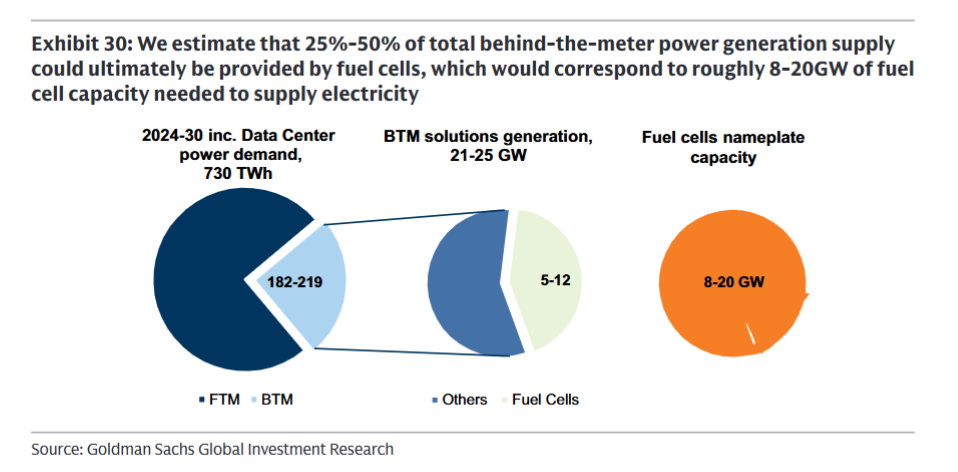
高盛:美国数据中心增量电力需求,“电网外方案”解决“1/4到1/3”,其中燃料电池满足“25-50%”
美股IPO· 2025-11-03 04:39
Core Insights - The "Behind-the-Meter" (BTM) power supply solutions are emerging as a key strategy to address the electricity consumption challenges posed by AI technologies [3][9] - Goldman Sachs predicts that by 2030, the BTM market could reach a capacity of 20-25 gigawatts (GW) to meet the increasing power demands of data centers [3][5] Group 1: Market Dynamics - AI's exponential growth is transforming data centers into significant power consumers, with a projected need for an additional 82 GW of electricity capacity in the U.S. alone by 2030 [5] - The aging electrical grid infrastructure is unable to keep pace with this demand, with new high-voltage transmission line construction dropping from an average of 1,700 miles per year (2010-2014) to just 350 miles per year (2020-2023) [6] - The median time for a project to go from application to commercial operation has reached nearly 5 years, exacerbating the urgency for alternative power solutions [7] Group 2: BTM Solutions - BTM solutions provide a crucial alternative for data centers, offering reliable, uninterrupted power independent of grid reliability issues [9] - It is estimated that from 2024 to 2030, the incremental electricity demand from data centers will total approximately 730 terawatt-hours (TWh), with BTM solutions expected to satisfy one-quarter to one-third of this demand [9] Group 3: Fuel Cell Technology - Fuel cell technology is projected to capture 25% to 50% of the BTM market, translating to an installed capacity of 8-20 GW [4][10] - Solid Oxide Fuel Cells (SOFC) are highlighted for their structural advantages over traditional gas turbines, including delivery time, noise, emissions, and flexibility [10][12] - The optimistic outlook for fuel cells in the data center market is supported by their high efficiency, fuel flexibility, and readiness for commercialization [12]



美国数据中心增量电力需求,“电网外方案”解决“1/4到1/3”,其中燃料电池满足“25-50%”
Hua Er Jie Jian Wen· 2025-11-02 11:45
Core Insights - The exponential growth of AI is transforming data centers into power-hungry entities, overwhelming aging grid infrastructure [1][2] - Goldman Sachs predicts that by 2030, "behind-the-meter" (BTM) solutions could meet 25-33% of the incremental power demand from data centers, translating to 20-25 gigawatts (GW) of installed capacity [1][3] Group 1: Power Demand and Infrastructure Challenges - The global power demand from data centers, driven by both AI and non-AI applications, is reshaping the electricity market, with an estimated need for an additional 82 GW of power capacity in the U.S. alone by 2030 [2] - The construction pace of new high-voltage transmission lines in the U.S. has significantly declined, from an average of 1,700 miles per year (2010-2014) to only 350 miles per year (2020-2023) [2] - The median time for a project to go from application to commercial operation has reached nearly 5 years, exacerbating the urgency for data center operators to seek alternative power solutions [2] Group 2: Emergence of Behind-the-Meter Solutions - BTM solutions, which allow for on-site generation and consumption of power without relying on the public grid, are emerging as a critical alternative for data centers facing grid reliability issues [3] - From 2024 to 2030, the total incremental power demand for data centers is projected to be approximately 730 terawatt-hours (TWh), with BTM solutions expected to satisfy 25-33% of this demand [3] Group 3: Fuel Cell Technology Potential - Fuel cells, particularly solid oxide fuel cells (SOFC), are anticipated to capture 25-50% of the BTM solutions market, equating to 8-20 GW of installed capacity by 2030 [4][6] - SOFCs are favored for their structural advantages over traditional gas turbines, including delivery time, noise, emissions, and flexibility, making them well-suited for data center applications [4][6]
氢能顶级盛会即将召开,国内政策也在密集出台,还有AI能源新细分加持
Xuan Gu Bao· 2025-08-19 08:07
Group 1 - The 2025 Global Hydrogen Investment Summit will be held in London on September 2-3, gathering over 800 senior executives from more than 55 countries, focusing on capital release, hydrogen trade, and AI optimization in hydrogen production [1] - Recent policies in the hydrogen sector have been intensifying, with Beijing's proposal for a hydrogen infrastructure network and Chongqing's plan for 60 new hydrogen stations, aiming for a total supply capacity of 25,000 tons per year [2][3] - The Chinese government has introduced multiple hydrogen industry policies this year, promoting high-quality development through technology breakthroughs, demonstration applications, and financial support [2][3] Group 2 - The National Energy Administration has included six hydrogen technology equipment in its list of major technological equipment, highlighting advancements in hydrogen production and storage systems [3] - The hydrogen industry is seeing a significant increase in production capacity, with over 5 million tons per year expected by the end of 2024, reflecting a year-on-year growth of approximately 1.6% [5][6] - The market for solid oxide fuel cells (SOFC) is projected to reach $7 billion in the next three years, driven by demand from data centers, emphasizing the importance of companies involved in SOFC technology [8] Group 3 - The hydrogen energy sector has experienced a surge in stock prices, with companies like Sichuan Jinding and Kangputon seeing significant gains following favorable policies for hydrogen vehicles in Shandong [9] - The hydrogen industry chain includes various companies across upstream, midstream, and downstream sectors, with a focus on green hydrogen production, storage, and transportation [11]