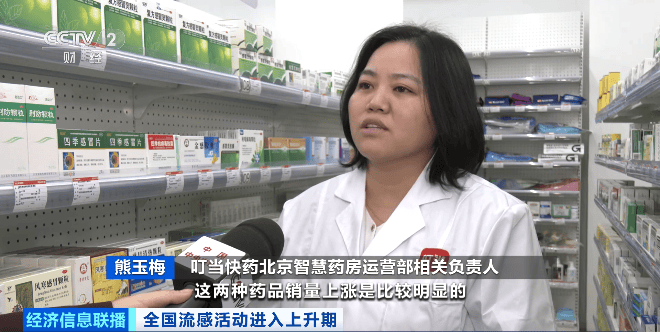
小柴胡颗粒

Search documents
白云山:25年分红金额创历史新高,期待26Q1业绩开门红-20260324
Xinda Securities· 2026-03-24 10:25
Investment Rating - The investment rating for the company is "Buy" [1] Core Insights - The company achieved a revenue of 77.656 billion yuan in 2025, representing a year-on-year growth of 3.55%, and a net profit attributable to shareholders of 2.983 billion yuan, which is a 5.21% increase year-on-year [3][4] - The company plans to distribute a cash dividend of 1.382 billion yuan, with a payout ratio of 46.32%, marking a historical high for dividend distribution [4] - The company is focusing on internationalization, research and development innovation, external growth, and market value management as part of its comprehensive strategy [3] Financial Performance Summary - In 2025, the pharmaceutical commercial revenue was 56.983 billion yuan (up 6.21% year-on-year), while the revenue from natural beverages was 9.672 billion yuan (down 0.34% year-on-year) [3] - The company’s net profit for Q4 2025 was -327 million yuan, a decrease of 1.07% year-on-year, with a revenue of 16.05 billion yuan, reflecting a 0.74% increase year-on-year [3] - The company’s gross margin for Q4 2025 was 11%, down 1.95 percentage points year-on-year, attributed to changes in revenue structure and increased expense ratios [3] Future Projections - Revenue projections for 2026-2028 are 80.929 billion yuan, 85.164 billion yuan, and 89.633 billion yuan, with year-on-year growth rates of approximately 4.2%, 5.2%, and 5.2% respectively [6] - The net profit attributable to shareholders is expected to be 3.154 billion yuan, 3.336 billion yuan, and 3.582 billion yuan for the same years, with growth rates of about 5.7%, 5.8%, and 7.4% respectively [6] - The company maintains a focus on optimizing operational quality and enhancing market value management, which supports the "Buy" investment rating [6]
白云山(600332):25年分红金额创历史新高,期待26Q1业绩开门红
Xinda Securities· 2026-03-24 09:05
Investment Rating - The investment rating for the company is "Buy" [1] Core Insights - The company reported a revenue of 77.66 billion yuan in 2025, representing a year-on-year increase of 3.55%, and a net profit attributable to shareholders of 2.98 billion yuan, up 5.21% year-on-year [3][4] - The company plans to distribute a cash dividend of 1.38 billion yuan, with a payout ratio of 46.32%, marking a historical high for dividend distribution [4] - The company is focusing on internationalization, research and development innovation, external growth, and market value management as part of its strategic deployment [3] Financial Performance Summary - In 2025, the pharmaceutical commercial revenue reached 56.98 billion yuan, an increase of 6.21% year-on-year, while the revenue from natural beverages was 9.67 billion yuan, down 0.34% [3] - The company’s net profit for Q4 2025 was -0.33 billion yuan, a decrease of 1.07% year-on-year, indicating short-term profit pressure [3] - The company’s total revenue is projected to grow to 80.93 billion yuan in 2026, with a net profit of 3.15 billion yuan, reflecting a year-on-year growth of 5.7% [6] Strategic Developments - The company has established strategic partnerships for international operations with firms in Saudi Arabia, Japan, and South Korea, among others, to enhance its global presence [3] - In terms of R&D, the company has made significant progress with several new drug projects entering critical clinical trials and approvals [3] - The company has also engaged in external growth by acquiring stakes in other firms, enhancing its market position in East China [3]
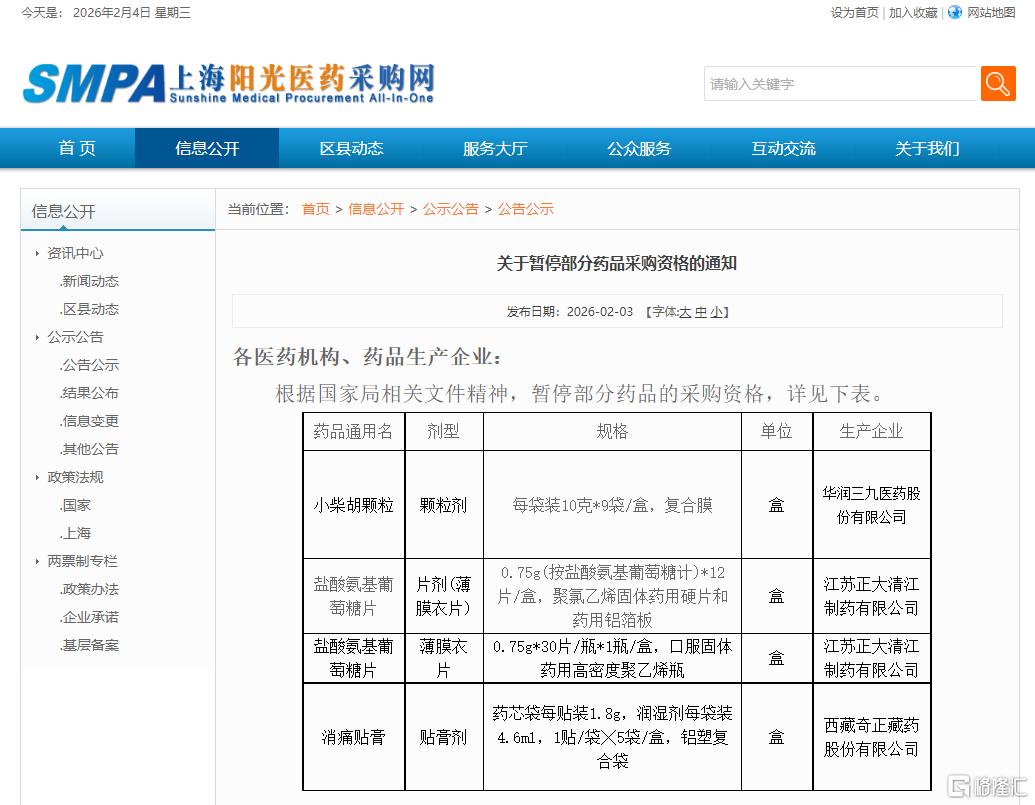
三款重磅常用药突遭停采,华润三九等老牌药企面临业绩与估值双杀!
Ge Long Hui· 2026-02-06 04:54
Core Viewpoint - The recent suspension of procurement qualifications for three major drug products will significantly impact the market strategies and sales expectations of three pharmaceutical companies: China Resources Sanjiu, Jiangsu Zhengda Qingjiang Pharmaceutical, and Tibet Qizheng Tibetan Medicine [1][3][18] Group 1: Impact on Companies - The suspension affects commonly used drugs for cold treatment, osteoarthritis, and external pain relief, disrupting the market plans of the involved companies [3][18] - China Resources Sanjiu's strategy to leverage the sales of Xiao Chai Hu Granules as a key growth driver is now hindered, requiring a reassessment of their market approach [7][18] - Jiangsu Zhengda Qingjiang Pharmaceutical holds a dominant market share of 96.54% for Glucosamine Hydrochloride Tablets, which is crucial for their revenue stability; the suspension will force them to adjust their market strategy [11][12][18] - Tibet Qizheng Tibetan Medicine's core product, Pain Relief Plaster, has been a significant revenue contributor, and the procurement halt will destabilize their market position, necessitating a reconfiguration of their promotional strategies [13][17][18] Group 2: Market Dynamics - Xiao Chai Hu Granules, a key OTC product, generated sales of 242 million yuan in the first three quarters of 2025, reflecting a year-on-year growth of 3.42% [4][5] - Glucosamine Hydrochloride Tablets achieved sales of 372 million yuan in the same period, marking it as a leading product in the osteoarthritis treatment category [10][11] - Pain Relief Plaster has consistently generated over 1 billion yuan in annual sales, with the first three quarters of 2025 alone exceeding 900 million yuan [16][17]


陕西省药品监督管理局药品“你点我检”情况公示
Zhong Guo Zhi Liang Xin Wen Wang· 2025-12-23 06:55
Core Viewpoint - The article discusses the results of the "You Point, I Test" initiative organized by the Shaanxi Provincial Drug Administration, which aims to enhance public participation in drug safety supervision and ensure compliance with safety standards [2]. Group 1: Initiative Overview - The "You Point, I Test" activity was conducted to involve the public in drug safety regulation, leading to the selection of 9 batches of drug samples for testing based on public votes [2]. - All tested drug samples met the regulatory standards, and the results have been publicly announced [2]. Group 2: Testing Results - The following drugs were tested and found compliant: - Panlong Seven Tablets from Shaanxi Panlong Pharmaceutical Group [2] - Xiao Chai Hu Granules from Jiuzhaigou Natural Pharmaceutical Co., Ltd. [2] - Amoxicillin Capsules from Zhongshan Lienpu Pharmaceutical Co., Ltd. [2] - Multi-element Tablets from Heliang (Suzhou) Pharmaceutical Co., Ltd. [2] - Anti-viral Oral Liquid from Hangzhou China Resources Laotongjun Pharmaceutical Co., Ltd. [2] - Compound Calcium Gluconate Oral Solution from Harbin Pharmaceutical Group Sanjing Pharmaceutical Co., Ltd. [2] - Xiaoyao Pills (Concentrated Pills) from Lanzhou Foci Pharmaceutical Co., Ltd. [2]
寒潮来袭 新疆乌苏市市场监管局强化药械安全风险隐患排查 保障群众健康权益
Zhong Guo Shi Pin Wang· 2025-12-12 07:49
Core Viewpoint - The article highlights the proactive measures taken by the Urumqi Market Supervision Administration to ensure the safety and quality of medical products and services during the winter season, particularly in response to the rise in respiratory infectious diseases [1] Group 1: Regulatory Actions - The Urumqi Market Supervision Administration has intensified supervision and inspection of medical institutions, clinics, and pharmacies, focusing on drugs and medical devices related to respiratory diseases [1] - Random checks, undercover visits, and follow-up rectifications have been employed to ensure compliance with regulations regarding the procurement and storage of medications [1] Group 2: Focus Areas - The inspections specifically target commonly used medications for winter flu, particularly for vulnerable populations such as the elderly and children, including drugs like Oseltamivir, Azithromycin, and Xiao Chai Hu Granules [1] - The administration checks the legality of procurement channels, the qualifications of suppliers, and the compliance of storage management and information traceability [1] Group 3: Community Impact - Residents express confidence in the quality of medications provided by local pharmacies, appreciating the guidance from licensed pharmacists [1] - The administration emphasizes its commitment to ensuring the stability of medical supplies and maintaining a safe market environment for the community during the holiday season [1] Group 4: Inspection Results - As of the report, over 80 medical institutions, clinics, and pharmacies have been inspected, with no safety risks or hidden dangers identified in the medical products [1]
流感药物需求大增
第一财经· 2025-12-04 15:00
Core Viewpoint - The demand for influenza medications has surged, with the Chinese influenza drug market fluctuating around 10 billion RMB. Oseltamivir dominates the market, led by Dongyang Sunshine Pharmaceutical, while Roche's Xofluza is the leader in new influenza drugs [3][4]. Group 1: Market Dynamics - The search volume for "Oseltamivir" on JD.com increased nearly 500 times compared to the same period last year, indicating a significant rise in demand for generic drugs [5]. - After the patent protection for Roche's original drug Tamiflu expired, Dongyang Sunshine Pharmaceutical took control of the market, generating 5.54 billion RMB in revenue from its Oseltamivir product, accounting for nearly 90% of its total revenue in 2023 [6]. - National centralized procurement policies have disrupted the existing market structure for Oseltamivir, leading to a significant price drop and increased competition from other generic manufacturers, resulting in Dongyang Sunshine's sales halving to 2.58 billion RMB in 2024 [7][8]. Group 2: Competitive Landscape - Dongyang Sunshine failed to win bids in the 11th batch of national drug procurement, which will inevitably shrink its market presence in hospitals [8]. - The overall market for antiviral drugs in China is projected to decrease from 11 billion RMB in 2023 to 8 billion RMB in 2024, with Oseltamivir accounting for about 80% of this market [8]. - The market for traditional Chinese medicine is also growing, with sales of common cold and flu medications increasing significantly, further impacting Dongyang Sunshine's market share [9]. Group 3: New Drug Developments - There is a strong consumer demand for new antiviral drugs, with purchases of Marboxil showing a remarkable increase of over 600% in a two-week period [11]. - Roche's Xofluza remains the dominant player in the innovative drug market for influenza, with a significant supply increase expected in 2024 [11][12]. - Several domestic pharmaceutical companies have received approvals for new influenza drugs in 2023, with more expected to enter the market in 2025, potentially impacting the market share of Oseltamivir [12][13]. Group 4: Future Outlook - The market share of Oseltamivir is gradually being replaced by PA proteinase inhibitors, indicating a shift in treatment preferences [14]. - Despite the anticipated rise of new antiviral drugs, Oseltamivir is expected to maintain a certain market share due to varying clinical needs and payment capabilities across different demographics in China [14].

云南省丽江市永胜县市场监督管理局2025年药品质量监督抽验公示
Zhong Guo Zhi Liang Xin Wen Wang· 2025-12-04 08:52
Group 1 - The core point of the article is that the Yongsheng County Market Supervision Administration conducted a drug sampling inspection plan for 2025, resulting in a total of 27 inspections from January to December, with a 100% pass rate and no batches failing the inspection [2][3]. Group 2 - The inspection covered various pharmaceutical products, all of which met the required standards as per the relevant health department regulations [3][4]. - Specific products inspected include traditional Chinese medicine and other pharmaceutical preparations, with detailed results showing compliance across all tested items [3][4].
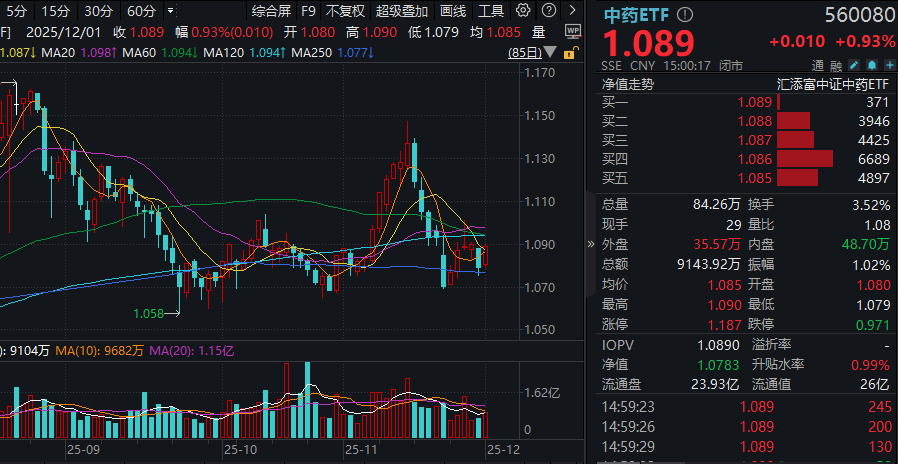
流感进入高峰期,抗流感中药销量大增!以岭药业中药创新药首发!规模领先的中药ETF(560080)放量收涨近1%,最新单日“吸金”超2400万!
Sou Hu Cai Jing· 2025-12-01 09:50
Group 1 - The core viewpoint of the news highlights the active performance of the traditional Chinese medicine (TCM) sector, particularly in the context of the flu season, with the TCM ETF (560080) rising nearly 1% and experiencing a significant increase in trading volume [1][3] - Recent data from the CDC indicates that the positive rate of flu virus tests in emergency departments nationwide has approached 45%, with some regions experiencing high levels of flu activity, leading to a surge in sales of cold-related medications [3][10] - The TCM ETF (560080) has seen a net inflow of over 24 million yuan as of November 28, with its latest scale reaching 2.581 billion yuan, leading its peers in the same category [1][3] Group 2 - The performance of individual stocks within the TCM ETF has been notable, with several flu-related stocks experiencing significant gains, such as Guangdong Wannianqing hitting the daily limit and Tai Long Pharmaceutical rising over 6% [3][4] - The TCM ETF's index has a TTM price-to-earnings ratio of 24.86, indicating it is cheaper than 79% of the time over the past decade, suggesting a favorable valuation for potential investment [5] - The TCM index has shown negative returns year-to-date, with a decline of 2.24% in 2023, and a historical trend of alternating between gains and losses over the past several years [7][8] Group 3 - The TCM industry is expected to see a short-term easing of pressure due to inventory clearance, with a positive outlook for demand recovery towards the end of the year [10] - Recent price governance initiatives across various regions aim to create a more unified and competitive market for TCM products, focusing on high-priced traditional Chinese medicines [10][11] - The ongoing price governance and centralized procurement processes are likely to reshape competition in the industry, favoring companies with strong clinical value, cost control, and market coverage capabilities [11]

“监管差”缩小 中成药行业该警醒了
Jing Ji Guan Cha Bao· 2025-11-30 05:30
Core Viewpoint - The Chinese patent medicine industry is facing increased scrutiny and regulatory challenges, particularly regarding pricing disparities and the misuse of traditional medicine prescriptions, necessitating a shift towards genuine innovation and responsible practices [1][2][3]. Group 1: Regulatory Environment - The Tianjin Medical Insurance Bureau has initiated price risk management for 230 Chinese patent medicine varieties, revealing price discrepancies as high as 3042 times among different products [1]. - The regulatory environment for Western medicine is becoming stricter, with the National Medical Products Administration (NMPA) enforcing quality and efficacy evaluations, while Chinese patent medicine companies have been able to evade similar scrutiny [2]. - There is a growing concern about the misuse of Chinese patent medicines, with some hospitals excessively prescribing these medications, leading to calls for stricter regulations on who can prescribe them [1][2]. Group 2: Industry Challenges - The Chinese patent medicine industry has rapidly developed into a market exceeding 400 billion yuan, but it has been marred by over-marketing and misinterpretation of "integrated Chinese and Western medicine" [2]. - The reliance on "micro-innovation" and "pseudo-innovation" is becoming unsustainable as regulatory standards tighten, pushing companies to seek true innovation rather than minor adjustments to existing products [2][3]. - The era of inflated pricing and high profits for Chinese patent medicines is coming to an end, prompting leading companies to explore transitions into broader health product markets [3]. Group 3: Recommendations for the Industry - Companies are advised to move away from superficial innovations and focus on developing new medicinal materials, formulations, and delivery methods to meet stricter regulatory requirements [2][3]. - A return to the principles of "differentiated treatment" in traditional Chinese medicine is recommended, with a call for the NMPA to limit the scope of indications for Chinese patent medicines to prevent misuse [3]. - The industry should shift from being solely a medical insurance product to a broader health product, targeting preventive care for populations at risk of health issues [3].
抗流感类药物和检测试剂销量明显增长 相关药品储备充裕
Sou Hu Cai Jing· 2025-11-21 15:08
Group 1 - The demand for antiviral drugs has significantly increased due to a rise in flu patients across multiple regions in the country [1] - Sales of various antiviral medications, including Oseltamivir and Mabalaosavir, have surged, with Oseltamivir's sales increasing by 237% and Mabalaosavir's by 180% in the past week [3] - Other medications such as antipyretics, cough suppressants, and nasal sprays have also seen sales increases exceeding 53% [3] Group 2 - In northern cities like Shenyang, Changchun, Xi'an, and Hohhot, the sales of specific flu medications have grown by over 1.5 times [5] - Flu test kits have experienced a tenfold increase in cities such as Beijing, Shenyang, Chengdu, and Xi'an [5] - From November 14 to November 20, the order volume for respiratory bacterial and viral testing increased by 63%, with a positive detection rate rising to 67.7% [7] Group 3 - Patients are opting for home testing services, with results available online within an average of three hours [8] - Despite the rising demand for medications, online pharmacies and brick-and-mortar stores report that drug supplies are sufficient and supply chains are operating smoothly [10]