
心相印

Search documents
福建“豪门”,打响继承之战
创业家· 2026-02-04 10:35
Core Viewpoint - The article discusses the generational transition in family businesses, particularly among Fujian entrepreneurs, highlighting the challenges faced by the second generation as they take over their family enterprises amidst a changing economic landscape and societal expectations [5][8]. Group 1: Succession Battles - The transition of leadership is becoming a reality among Fujian private enterprises, with notable examples including Xu Yangyang taking over Dali Group and Cao Hui succeeding his father at Fuyao Group [7][8]. - The second generation faces dual pressures from familial expectations and societal reputation, often leading to comparisons with their predecessors [5][9]. - The traditional method of succession in Fujian remains focused on blood relations, with the eldest son often seen as the most suitable successor [9][11]. Group 2: Individual Case Studies - Xu Yangyang's journey at Dali Group began with her education and gradual rise through the ranks, ultimately leading to her role as president after her father's retirement [16][23]. - Cao Hui's path to leadership at Fuyao Group involved significant preparation, including international education and hands-on experience in the family business [12][26]. - Xu Lianjie of Hengan Group faced challenges in finding a successor, as his sons initially showed little interest in the family business, but eventually, his eldest son Xu Qingliu took over [13][16]. Group 3: Business Performance and Challenges - Dali Group's revenue peaked at 22.294 billion yuan in 2021 but has since declined, with 2023 revenue reported at 18.86 billion yuan [22][24]. - Hengan Group's paper towel business aims for significant growth, with Xu Qingliu setting ambitious targets despite industry challenges [26]. - Fuyao Group continues to experience growth, with a reported revenue of 21.45 billion yuan and a net profit exceeding 4.8 billion yuan in the first half of 2025 [26][27]. Group 4: Cultural and Strategic Adaptations - The article highlights the importance of adapting to changing consumer preferences, with younger generations needing to innovate beyond traditional business models [24][32]. - Fujian entrepreneurs are increasingly forming family offices to manage wealth and address succession issues, reflecting a blend of traditional and modern approaches to business continuity [30][31]. - Marriages between the second generation of Fujian entrepreneurs are seen as a strategy to strengthen business alliances and create a supportive network [28][29].




福建“豪门”,打响继承之战
创业邦· 2026-02-01 10:09
Core Viewpoint - The article discusses the generational transition in family businesses, particularly among Fujian entrepreneurs, highlighting the challenges faced by the second generation as they take over leadership roles amidst changing market conditions and societal expectations [5][16]. Group 1: Succession in Fujian Enterprises - Xu Shihui, founder of Dali Food Group, has retired, passing leadership to his daughter Xu Yangyang, who has been groomed for this role for years [7][14]. - Cao Dewang, founder of Fuyao Group, has also stepped down, with his son Cao Hui taking over, marking a trend of succession among Fujian entrepreneurs [7][11]. - The transition of leadership is becoming a reality in Fujian's private enterprises, with several second-generation leaders stepping into their roles [7][8]. Group 2: Challenges Faced by Successors - The new generation faces a more challenging business environment and intense competition, along with the pressure of living up to their predecessors' legacies [16][18]. - Many successors, despite having better resources and education, struggle with the dual identity of being both children and inheritors, leading to potential conflicts [8][16]. - The decision to take over family businesses can lead to significant generational "wars," as seen in the case of Fuyao Group, where Cao Hui initially resisted taking over [11][12]. Group 3: Performance and Expectations - Dali Group's revenue peaked at 22.294 billion yuan in 2021 but has since declined, with 2023 revenue reported at 18.86 billion yuan, presenting a significant challenge for Xu Yangyang [20][21]. - Xu Yangyang aims to innovate beyond her father's established "imitator" strategy, which has become less effective in the current market [21][23]. - In contrast, Fuyao Group, under Cao Hui, is experiencing growth, with 2025 fiscal year revenue reaching 21.45 billion yuan, indicating a different set of challenges focused on maintaining market leadership [23][24]. Group 4: Strategies for Business Continuity - The article highlights the trend of inter-family marriages among Fujian entrepreneurs as a strategy to strengthen business alliances and ensure continuity [26][29]. - Establishing family offices has become a common practice among Fujian businesses to manage wealth and address succession issues proactively [27][30]. - The emphasis on collaboration and mutual support among family businesses reflects a cultural approach to navigating risks and uncertainties in the market [30][31].

福建「豪门」,打响继承之战
3 6 Ke· 2026-01-31 09:22
Core Insights - The article discusses the generational transition in family-owned businesses in Fujian, China, highlighting the challenges faced by the second generation as they take over leadership roles in a competitive and changing market environment [3][4][5]. Group 1: Leadership Transition - Xu Shihui, the founder of Dali Food Group, has retired, passing the presidency to his daughter Xu Yangyang, marking a significant leadership change in the company known for brands like "Dali Garden" and "Kebike" [3][4]. - Similarly, Cao Dewang, founder of Fuyao Group, has stepped down as chairman, with his son Cao Hui taking over, indicating a broader trend of leadership transitions among Fujian entrepreneurs [3][4]. - Other notable transitions include Xu Lianjie of Hengan Group handing over to his son Xu Qingliu, and Fu Guangming of Shennong Group passing control to his daughter Fu Fenfang [4]. Group 2: Challenges of Succession - The second generation faces intense pressure to meet the expectations set by their predecessors, often leading to comparisons in capability and performance [4][12]. - The decision to take over leadership roles is fraught with internal conflict, as many heirs express reluctance to step into their parents' shoes, preferring to pursue their own entrepreneurial paths [5][12]. - The article highlights the contrasting experiences of successors, with some like Cao Hui initially resisting the idea of taking over, while others like Xu Yangyang have been groomed for leadership from a young age [8][12]. Group 3: Market Dynamics and Performance - Dali Group's revenue peaked at 22.294 billion yuan in 2021 but has since declined, with 2023 revenue reported at 18.86 billion yuan, presenting a significant challenge for Xu Yangyang as she takes over [17][19]. - Hengan Group's Xu Qingliu aims to double the paper product business revenue target to 30 billion yuan, facing challenges such as raw material price fluctuations and industry competition [22]. - Fuyao Group, under Cao Hui's leadership, reported a revenue of 21.45 billion yuan in the first half of 2025, with a net profit exceeding 4.8 billion yuan, indicating a strong market position but also the need for continued innovation and growth [22]. Group 4: Cultural and Strategic Considerations - The article emphasizes the traditional approach of bloodline succession in Fujian businesses, where the eldest son is often seen as the most suitable successor [5][12]. - The concept of family alliances through marriage is highlighted as a strategy to strengthen business ties among Fujian entrepreneurs, reflecting a long-standing cultural practice [25][26]. - The establishment of family offices by Fujian businesses is noted as a modern approach to managing wealth and addressing succession issues, allowing for better risk management and strategic collaboration [26][28].

福建「豪门」,打响继承之战
36氪· 2026-01-31 09:08
Core Viewpoint - The article discusses the generational transition in family businesses among Fujian entrepreneurs, highlighting the challenges faced by the second generation as they take over leadership roles in a competitive and changing market environment [5][6][7]. Group 1: Leadership Transition - Xu Shihui, founder of Dali Food Group, has retired, passing the presidency to his daughter Xu Yangyang, who has been groomed for this role over the years [6][7]. - Similarly, Cao Dewang, founder of Fuyao Group, has stepped down as chairman, handing over the reins to his son Cao Hui, who has been prepared for leadership through international experience [6][10]. - The trend of generational handover is becoming more common among Fujian private enterprises, with several second-generation leaders taking charge of their family businesses [7][8]. Group 2: Challenges of Succession - The second generation faces intense pressure to meet the expectations set by their predecessors, often leading to a struggle between personal ambition and familial duty [5][16]. - The article notes that many second-generation entrepreneurs are hesitant to take over, with some preferring to pursue their own ventures instead of stepping into established family businesses [8][10]. - The transition is often marked by conflicts, as seen in the case of Cao Hui, who initially resisted taking over Fuyao but eventually agreed under his father's insistence [10][11]. Group 3: Business Performance and Strategy - Dali Food's revenue peaked at 22.294 billion yuan in 2021 but has since declined, with 2023 revenue reported at 18.86 billion yuan, indicating significant challenges for Xu Yangyang as she takes over [22][24]. - Fuyao Group, under Cao Hui's leadership, reported a revenue of 21.45 billion yuan in the first half of 2025, showing a double-digit growth, but maintaining this growth will be a key challenge [27]. - The article highlights the strategic shifts required by the new leaders, such as Xu Yangyang's attempts to innovate Dali's product lines in response to changing consumer preferences [24][22]. Group 4: Cultural and Structural Dynamics - The article emphasizes the traditional approach of family succession in Fujian, where leadership is typically passed down to the eldest son, reflecting deep-rooted cultural practices [8][10]. - The concept of family alliances through marriage is also discussed, showcasing how Fujian entrepreneurs are forming strategic partnerships to strengthen their business networks [30][31]. - The establishment of family offices among Fujian businesses is noted as a modern strategy to manage wealth and address succession issues, indicating a blend of traditional and contemporary approaches to business continuity [32][34].


恒安国际20251128
2025-12-01 00:49
Summary of the Conference Call for Hengan International Industry Overview - The consumer paper market is experiencing a slowdown in growth, but an increase in per capita usage and the penetration of high-margin products are driving price growth, leading to stable industry growth expectations [2][3] - The sanitary napkin market is seeing a decline in sales, but innovation in high-end products is pushing up unit prices, with future growth relying on high-end strategies [2][4] - The diaper market is significantly influenced by the number of newborns, necessitating differentiated products to increase average transaction value [2][4] Company Performance - Hengan International's brands, such as "Heart to Heart," hold a leading market share in the consumer paper sector, with an upward trend in the CR10 index [2][5] - The company reported sales exceeding 400 million yuan in 2024 and nearly 300 million yuan in the first half of 2025, with a significant increase in internal sales contribution [2][7] - The high-end brand Kimo has significantly boosted the diaper business, maintaining a growth rate of 20% [2][8] Product Innovation - Recent product launches include high-end items such as "Sunshine" and "Rong Lifang," which have positively impacted sales and gross margins. For instance, the price of "Sunshine" is 70% higher than traditional series [2][6] - The introduction of innovative products like "Rong Lifang," which utilizes CAD air-drying technology, has improved absorption and doubled the price compared to traditional products [2][6] Market Dynamics - The competitive landscape in the consumer paper industry remains stable, with major players maintaining their market shares while new entrants are eroding smaller brands' shares, leading to an increase in the CR10 index [5] - In the sanitary napkin sector, foreign brands are losing market share to domestic brands, which are aggressively investing in sales [5] - The diaper market is similarly affected, with significant declines in market share for foreign brands like Procter & Gamble and Kao, while domestic brands are rising [5] Cost and Profitability - Recent cost reductions are a key reason for optimism regarding Hengan International's performance in the second half of 2025. The prices of needle and broadleaf pulp are expected to decrease by 9.55% and 7.5%, respectively, which could restore profit margins by 3 percentage points [3][9][10] - The revenue structure shows that consumer paper accounts for 70% of revenue, while sanitary products account for 30%, but the profit contribution is reversed, with sanitary products contributing more [3][10] Valuation and Investment Outlook - Hengan International has a high dividend payout ratio, with a current valuation corresponding to an annual price-to-earnings ratio of approximately 11 to 12 times and a dividend yield of about 5.5% [3][11] - The company is expected to enhance its dividend levels due to short-term performance elasticity and long-term recovery expectations, making it an attractive investment in the Hong Kong stock market and the sanitary products sector [3][11]
国泰海通晨报-20251031
GUOTAI HAITONG SECURITIES· 2025-10-31 06:19
Macro Research - The report highlights the increasing divergence in the Federal Reserve's monetary policy path due to the "data fog" caused by the U.S. government shutdown and the realities of economic and inflation trends. The expectation for a rate cut in December has been adjusted downward compared to pre-meeting expectations [2][3][26] - The report anticipates a continued preventive rate cut cycle, with U.S. Treasury yields slowing down, sustained support for U.S. stocks, a fluctuating U.S. dollar index, and an ongoing long-term bull market for gold [4][27] Food and Beverage Research - Guizhou Moutai's Q3 2025 growth has slowed to flat with slight increases, impacted by price inversion in series wines and some direct sales channels. The company aims for sustainable high-quality growth and has adjusted its EPS forecasts for 2025-2027 [5][6][7] - The report indicates that Moutai's Q3 revenue was CNY 398.10 billion, a year-on-year increase of 0.3%, with net profit at CNY 192.24 billion, up 0.5%. The company is focusing on improving the quality of its financial reports and aligning with actual market demand [6][7] Paper and Light Industry Research - Hengan International is actively promoting product premiumization, with expectations for continued increases in sales prices. The decline in wood pulp costs is expected to enhance the company's profit elasticity [9][10] - The report notes that Hengan's market share has generally improved over the past decade, with a focus on increasing the penetration of high-end products to counteract price competition. The company has launched various high-end wet tissue products, contributing to revenue growth [10][12] Transportation Research - Southern Airlines reported a counter-cyclical profit growth in Q3 2025, exceeding market expectations and showing a trend of profitability. The company’s net profit for the first three quarters of 2025 was CNY 23 billion, with a year-on-year increase of over 17% [13][14] - The report emphasizes that the airline's passenger load factor reached a record high of 85.9% in Q3 2025, indicating strong demand recovery and optimistic future profitability trends [14][15]


恒安集团旗下品牌获得“2025天猫金妆奖”5个奖项
Zhong Guo Zhi Liang Xin Wen Wang· 2025-09-04 05:02
Core Insights - The annual "Tmall Golden Makeup Awards" recognized Hengan Group's brands, with "Heart to Heart" winning three awards, "Seven Degrees Space" winning one, and "An'er Kang" being named a trend-leading brand [1][2] Group 1: Awards and Recognition - Hengan Group's brand "Heart to Heart" received the "Top Brand Award," "Paper Product Award," and "Outstanding Contribution Award" [1] - "Seven Degrees Space" was awarded the "Personal Care Annual Marketing Cooperation Award" for its collaboration with Tmall [2] - "An'er Kang" was recognized as the "Personal Care Annual Trend Leading Brand," marking its significance in the adult care industry [2] Group 2: Brand Philosophy and Strategy - "Heart to Heart" emphasizes a brand philosophy of "caring for everyone around us," aiming to deepen emotional connections with consumers through warm brand activities [1] - "Seven Degrees Space" focuses on women's health during menstruation and aims to leverage its strong sales performance for future marketing initiatives [2] - "An'er Kang" maintains a commitment to professional standards in adult care, emphasizing quality and consumer trust [2] Group 3: Future Outlook - Hengan Group plans to continue focusing on its core business, enhancing brand leadership, and expanding into new health sectors such as women's health, children's health, and elderly care [2] - The company aims to improve its overall competitiveness and expand its international market presence, aspiring to become a top-tier global household goods enterprise [2]
七度空间等销量显著下跌!恒安国际上半年营收净利双下滑
Nan Fang Du Shi Bao· 2025-08-22 09:29
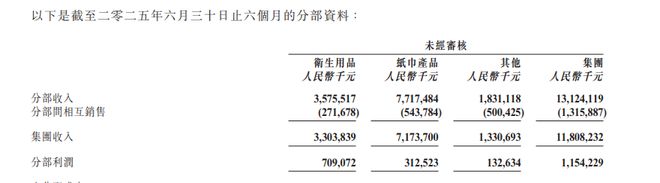
Core Viewpoint - Hengan International's sales of sanitary products, particularly under the brand Seven Degrees Space, have significantly declined in the first half of the year, leading to a decrease in both revenue and net profit for the group [1][4]. Group 1: Financial Performance - In the first half of 2025, Hengan International reported a revenue decline of 0.2% year-on-year to 11.808 billion yuan, with net profit down 2.6% to 1.373 billion yuan, and gross margin decreasing by 1% to 32.3% [1]. - The sanitary products segment saw a revenue drop of 14.4% to 3.304 billion yuan, with segment profit down 31.3% to 709 million yuan [2]. - The tissue paper segment experienced a revenue increase of 3.2% to 7.174 billion yuan, with segment profit rising by 2.0% to 313 million yuan [2]. Group 2: Market Dynamics - The sanitary products segment accounted for 28.0% of total revenue but contributed 61.04% of total profit, while tissue products made up 60.8% of revenue but only 27.1% of profit [4]. - Increased competition in the sanitary products market has led to significant challenges, with domestic brands aggressively using promotional strategies to capture market share, particularly in e-commerce channels [4]. - The rise in promotional expenses has been noted, with a double-digit percentage increase year-on-year due to competitive pressures [4]. Group 3: Product Segmentation - The company has merged its sanitary napkin and disposable diaper businesses into a single sanitary products segment for better operational management [2]. - The wet tissue segment has shown strong growth, with sales increasing by 34.7% to 797 million yuan, now accounting for 11.1% of total revenue [6]. - Hengan International plans to focus on high-margin products and expects stable growth in the high-end product segment while maintaining marketing investments [6].
一个奇葩客服,绊倒心相印
36氪· 2025-05-13 12:41
Core Viewpoint - The article discusses the challenges faced by Hengan International following the death of its founder, Xu Lianjie, and highlights the company's struggles with market competition, product controversies, and a need for strategic transformation towards high-end products [3][19][28]. Group 1: Company Challenges - Hengan International has been embroiled in controversies, including a recent incident where customer service offered "1000 yuan in ghost money" as compensation, leading to public backlash [6][7][12]. - The company has faced multiple product quality complaints, including issues with tissue paper and sanitary napkins, which have damaged its brand reputation [9][11][12]. - The company's revenue has been declining, with a reported 4.6% drop to 22.69 billion yuan and a profit decrease of 17.9% to 2.29 billion yuan in the last fiscal year [20][21]. Group 2: Market Position and Competition - Hengan International's market share has significantly decreased, with its tissue brand, "Heart to Heart," now holding only 11% of the market, lagging behind competitors like Vinda and Jieshou [20][22]. - The rise of new players in the market, such as DeYou and other niche brands, has intensified competition, particularly in specialized paper products [17][18]. - The overall market for paper products is experiencing a shift towards specialized items, with consumers increasingly favoring products tailored to specific needs [15][16]. Group 3: Strategic Transformation - Following the leadership transition to Xu Qingliu, the company aims to pivot towards high-end products and enhance its e-commerce presence [25][26]. - Hengan International has introduced new high-end product lines, including the "Fluffy Cube" tissue series, which utilizes advanced drying technology [26][27]. - The company is focusing on brand revitalization and finding new growth directions in the wake of its founder's passing [28].
恒安集团回应“心相印客服称赔冥币”:因账号异常报警获立案
Nan Fang Du Shi Bao· 2025-05-12 03:51
Group 1 - The incident involving "Heart to Heart" flagship store customer service has sparked significant public interest, with reports of a customer being insulted and offered "1000 yuan in ghost money" as compensation [1][2] - The company, Hengan Group, has confirmed that the police have initiated an investigation into the matter, and they have reached out to the affected consumer for compensation [1][2] - Initial findings indicate that there was no actual dispute between the parties involved, but the customer service account showed signs of abnormal login activity, prompting further investigation by the company's technical department [2] Group 2 - The company has stated that they take the incident seriously and are conducting an internal review, which may lead to penalties for the involved personnel [2] - The customer service representative's comments included a dismissive attitude towards complaints, suggesting that such responses were common practice within the company [1][2] - The company aims to resolve the situation and restore its brand image following the negative impact of the incident [1]
