
新型建材

Search documents
海螺创业(00586):固废增长强劲,自由现金流转正,集团增持驱动股权价值重估
Soochow Securities· 2026-03-30 08:24
Investment Rating - The report maintains a "Buy" rating for the company [1] Core Views - The company achieved a revenue of 6.548 billion RMB in 2025, representing a year-on-year growth of 4.42%, and a net profit attributable to shareholders of 2.245 billion RMB, up 11.17% year-on-year [7] - The solid waste management segment showed strong growth, with significant increases in operational efficiency and cash flow turning positive, indicating potential for dividend increases [7] - The company is expected to benefit from the increased shareholding by the parent company, which will drive a revaluation of equity value [7] Financial Summary - Revenue Forecast: - 2024: 6.271 billion RMB - 2025: 6.548 billion RMB - 2026: 6.569 billion RMB - 2027: 6.772 billion RMB - 2028: 6.999 billion RMB - Net Profit Forecast: - 2024: 2.020 billion RMB - 2025: 2.245 billion RMB - 2026: 2.495 billion RMB - 2027: 2.754 billion RMB - 2028: 2.996 billion RMB - EPS Forecast: - 2024: 1.13 RMB - 2025: 1.25 RMB - 2026: 1.39 RMB - 2027: 1.54 RMB - 2028: 1.67 RMB - P/E Ratios: - 2024: 9.33 - 2025: 8.39 - 2026: 7.55 - 2027: 6.84 - 2028: 6.29 [1][8]
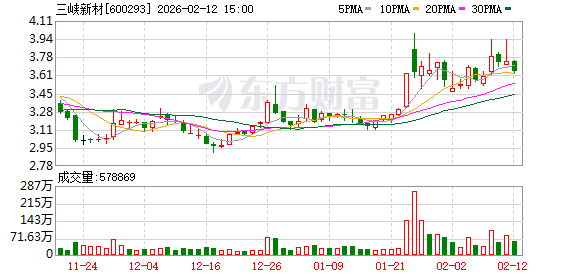
三峡新材:公司主营业务为平板玻璃及特种功能玻璃的生产和销售
Zheng Quan Ri Bao· 2026-02-12 12:16
Core Viewpoint - The company, Sanxia New Materials, focuses on the production and sales of flat glass and special functional glass, and is involved in the research and development of new building materials, but does not engage in photovoltaic glass production or related fields [2] Group 1 - The main business of the company includes the production and sales of flat glass and special functional glass [2] - The company is also involved in the research and development of new building materials [2] - The company will continue to pay attention to technological iterations and market dynamics in the photovoltaic industry [2]


三峡新材:未涉及光伏玻璃生产及光伏相关领域
Ge Long Hui· 2026-02-12 08:05
Core Viewpoint - The company, Three Gorges New Materials (600293.SH), focuses on the production and sales of flat glass and special functional glass, as well as research and development of new building materials, and does not engage in photovoltaic glass production or related fields [1] Group 1 - The main business of the company includes the production and sales of flat glass [1] - The company also specializes in special functional glass [1] - Research and development of new building materials is part of the company's operations [1] Group 2 - The company explicitly states that it does not involve itself in photovoltaic glass production [1] - There is no engagement in photovoltaic-related fields by the company [1]
三峡新材(600293.SH):未涉及光伏玻璃生产及光伏相关领域
Ge Long Hui· 2026-02-12 08:01
Core Viewpoint - The company, Three Gorges New Materials (600293.SH), focuses on the production and sales of flat glass and special functional glass, as well as research and development of new building materials, and does not engage in photovoltaic glass production or related fields [1] Group 1 - The main business of the company includes the production and sales of flat glass [1] - The company also specializes in special functional glass [1] - Research and development of new building materials is part of the company's operations [1]
建议提案办理见成效|以人民群众需求为出发点推动“好房子”建设——住房城乡建设部认真办理代表委员建议提案
Xin Hua She· 2026-02-08 07:10
Core Viewpoint - The Ministry of Housing and Urban-Rural Development is actively responding to the needs of the public by implementing the new national standard for residential projects, which enhances 14 key standards to improve housing quality and promote the construction of "good houses" [1][2]. Group 1: Policy Implementation - The new national standard for residential projects, effective since May last year, sets strict guidelines on aspects such as height, sound insulation, fire safety, and green energy efficiency [1]. - The Ministry has established a communication mechanism to incorporate suggestions from representatives and experts into policy-making, ensuring that the policies are grounded in public needs [2][4]. Group 2: Industry Feedback and Innovation - Representatives have expressed the need for better sound insulation and energy-efficient materials in housing, leading to the proposal of a national innovation platform for "good materials" [2][3]. - The Ministry has initiated 15 technology innovation platforms to support the development of high-quality products, materials, and equipment, as well as 35 key technology projects for sustainable urban development [2][3]. Group 3: Engagement with Representatives - In 2025, the Ministry handled a total of 679 suggestions and proposals from the National People's Congress, focusing on various aspects of housing and urban development [5]. - The Ministry has established a closed-loop mechanism for processing suggestions, ensuring timely communication and feedback with representatives, which includes 283 interactions [5].
倪虹同加拿大自然资源部部长蒂姆·霍奇森参观“好房子”科技展
Xin Lang Cai Jing· 2026-01-19 02:17
Core Viewpoint - The meeting between the Chinese Minister of Housing and Urban-Rural Development, Ni Hong, and the Canadian Minister of Natural Resources, Tim Hochhausen, emphasizes the commitment to enhance cooperation in the housing and urban construction sector between China and Canada, focusing on innovative building technologies and sustainable practices [1] Group 1: Event Overview - The event took place on January 16 at the Shougang International Exhibition Center in Beijing, showcasing the "Good House" technology exhibition [1] - Both ministers toured the exhibition, experiencing the benefits of smart home technology and observing various advanced construction methods and equipment [1] Group 2: Technological Insights - The exhibition featured new building materials, industrialized construction methods such as standardized, modular, digital, and prefabricated techniques, as well as smart construction technologies like 3D printing and construction robots [1] - Notable construction equipment displayed included shield tunneling machines, high-speed rail box girder transport machines, and aerial building machines [1] Group 3: Future Cooperation - Ni Hong expressed China's willingness to collaborate with Canada to implement the cooperation consensus reached by the leaders of both countries, aiming to build more "Good Houses" for the benefit of both nations [1] - Tim Hochhausen highlighted the impressive nature of Chinese technology and expressed a desire to encourage more Canadian enterprises to engage in exchanges and learning opportunities in China, anticipating fruitful outcomes in residential construction collaboration [1]
再创历史最好成绩!“泉州制造”链接全球
Sou Hu Cai Jing· 2026-01-12 22:48
Core Viewpoint - The Quanzhou Comprehensive Bonded Zone has achieved significant growth in import and export values, with a total value of 4.15 billion yuan in 2025, marking a 130% year-on-year increase, and has become a key platform for high-quality development in foreign trade and the promotion of free trade zone policies [8][11]. Group 1: Performance Metrics - The total value of bonded logistics imports and exports reached 3.78 billion yuan, up 147% year-on-year [11]. - The bonded processing sector saw an import and export value of 260 million yuan, increasing by 12% [11]. - Cross-border e-commerce bonded online shopping imports totaled 116 million yuan, a 142% increase [11]. - The bonded maintenance sector achieved an import and export value of 3.1 billion yuan, growing by 15% [11]. Group 2: Development Initiatives - The Quanzhou Comprehensive Bonded Zone has transitioned from a traditional logistics and processing model to a diversified industrial matrix, including sectors like aviation maintenance, high-end printing, and cross-border e-commerce [13]. - Key projects are being accelerated, such as the introduction of new enterprises in bonded processing, with a total planned investment of approximately 600 million yuan, expected to generate an import and export value of 500 million yuan upon reaching full capacity [16]. - The new bonded warehouse project aims to enhance service functions and is expected to achieve an import and export volume of 640 million yuan in 2025 [16]. Group 3: Strategic Focus - The zone is focusing on building a cross-border trade hub by enhancing the cross-border e-commerce regulatory center and developing a bonded cross-border logistics park [18]. - The zone aims to attract upstream and downstream enterprises in the industrial chain while promoting the transformation and upgrading of core businesses like bonded processing [18]. - The strategy includes exploring new business models such as bonded R&D to strengthen the region's open economy and enhance its role as an international cross-border trade logistics hub [18].
住建部发文!加大“好房子”供给
新华网财经· 2026-01-06 13:37
Group 1: Core Views - The Ministry of Housing and Urban-Rural Development has released guidelines to enhance housing quality, focusing on safety, comfort, sustainability, and intelligence in housing supply [2] Group 2: Key Tasks - Strengthening the evaluation of existing standards and revising residential design standards to improve housing design, materials, construction, and smart features [2] - Promoting refined and integrated housing design by optimizing layouts, improving lighting and ventilation, and enhancing space utilization and comfort [5] - Advancing the production and application of high-quality building materials, ensuring compliance with standards, and enhancing quality supervision of key materials [5] - Establishing a long-term safety management mechanism for housing throughout its lifecycle, including dynamic updates of building information and elimination of safety hazards [5] - Implementing actions to improve property service quality and expanding service offerings to include elderly care, childcare, meal assistance, and housekeeping [5] - Promoting the establishment of smart community service platforms to integrate local resources and enhance convenience for residents [5] - Gradually advancing the renovation of urban villages and old housing, focusing on energy-efficient upgrades and the creation of complete communities [5] - Encouraging methods such as trade-in, modular construction, and prefabricated renovations to support residents in updating old housing [5]

金隅集团10月15日获融资买入1925.36万元,融资余额2.93亿元
Xin Lang Cai Jing· 2025-10-16 01:20
Core Viewpoint - On October 15, Jinju Group's stock increased by 0.55% with a trading volume of 226 million yuan, indicating a low level of financing and margin trading activity [1][2]. Financing Summary - On October 15, Jinju Group had a financing buy-in amount of 19.25 million yuan and a financing repayment of 22.73 million yuan, resulting in a net financing outflow of 3.47 million yuan [1]. - As of October 15, the total balance of margin trading for Jinju Group was 295 million yuan, with a financing balance of 293 million yuan, accounting for 1.92% of the circulating market value, which is below the 10% percentile level over the past year [1]. - The company had a margin repayment of 24,700 shares and a margin sell-out of 800 shares on the same day, with a margin balance of 1.21 million yuan, also below the 30% percentile level over the past year [1]. Business Overview - Jinju Group, established on December 22, 2005, and listed on March 1, 2011, is primarily engaged in cement and ready-mixed concrete, new building materials, trade logistics, real estate development, and property investment and management [2]. - The revenue composition of Jinju Group includes 52.18% from bulk commodity trading, 31.69% from product sales, 7.68% from housing sales, and smaller contributions from decoration, leasing, property management, waste treatment, hotel operations, and interest income [2]. - For the first half of 2025, Jinju Group reported a revenue of 45.57 billion yuan, a slight year-on-year increase of 0.01%, but a net profit attributable to shareholders of -1.50 billion yuan, representing a year-on-year decrease of 85.40% [2]. Dividend and Shareholding Information - Since its A-share listing, Jinju Group has distributed a total of 7.83 billion yuan in dividends, with 1.52 billion yuan distributed over the past three years [3]. - As of June 30, 2025, the number of shareholders in Jinju Group was 108,500, a decrease of 1.92% from the previous period, with the average circulating shares per person remaining at zero [2][3]. - Among the top ten circulating shareholders, Hong Kong Central Clearing Limited held 86.91 million shares, an increase of 5.23 million shares compared to the previous period, while the Southern CSI 500 ETF exited the top ten list [3].
“十四五”期间累计改造城镇老旧小区二十四万多个
Ren Min Ri Bao Hai Wai Ban· 2025-10-16 00:01
Core Insights - The "14th Five-Year Plan" has significantly improved housing conditions in China, with over 240,000 old urban communities renovated, benefiting more than 110 million people [2][4]. Housing Development Achievements - During the "14th Five-Year Plan," approximately 5 billion square meters of new residential properties were sold, and over 11 million units of various types of affordable housing were constructed, benefiting over 30 million people [4]. - The urban living environment has been enhanced through the renovation of over 240,000 old urban communities, installation of 129,000 elevators, and the addition of over 3.4 million parking spaces [4]. Urban Renewal and Infrastructure - Urban renewal has been a key focus, with 2,387 urban village renovation projects and 175,000 units of dangerous housing being renovated [6]. - A comprehensive urban health check has been implemented in over 297 cities, identifying and addressing urgent local issues [6][7]. Construction Industry Transformation - The construction industry has seen a record total output value of 32.7 trillion yuan, with a value-added increase of 9 trillion yuan [4]. - Major projects such as the Shenzhen-Zhongshan Link and the Beijing Winter Olympics venues have showcased China's construction capabilities on a global scale [4]. Housing Quality Improvement Initiatives - The Ministry of Housing and Urban-Rural Development has introduced new standards for residential projects, including increased ceiling heights and mandatory elevator installations for buildings over four stories [9]. - A national residential design competition has been launched to promote innovative housing solutions, with nearly 2,000 entries submitted [9]. Sustainable Urban Development - A sustainable urban renewal model is being established, focusing on demand-driven projects and integrating urban health checks with renewal efforts [7]. - The government aims to enhance the quality of housing through improved standards, materials, construction practices, and maintenance [8][10].