有色金属主题ETF

Search documents
股票型ETF 重现资金净流入
Shang Hai Zheng Quan Bao· 2026-02-04 12:34
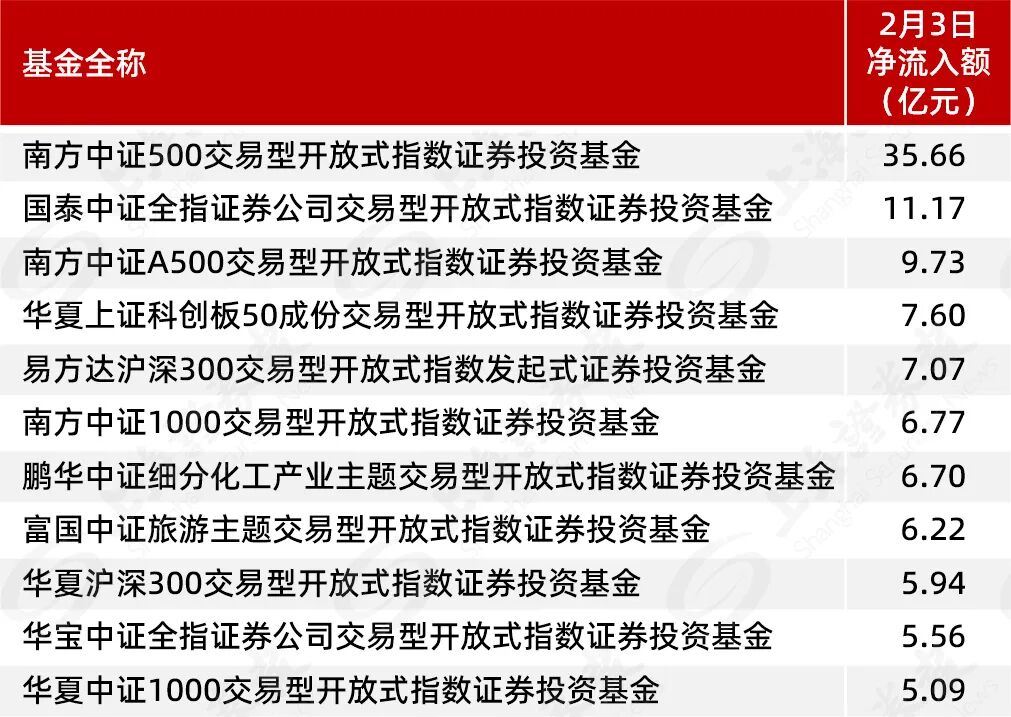
Group 1 - The core point of the article is that stock ETFs have seen a return of net inflows after experiencing significant outflows for several days, with a net inflow of 6.965 billion yuan on February 3 [1][2][3] - Multiple broad-based ETFs attracted significant capital, with the Southern CSI 500 ETF leading with a net inflow of 3.566 billion yuan, followed by several others with inflows exceeding 500 million yuan [3][4] - The total net outflow of stock ETFs from January 14 to February 3 exceeded 82 billion yuan, indicating a volatile market environment [5] Group 2 - Despite the ongoing adjustment in the Hong Kong tech sector, substantial capital has flowed into tech-themed ETFs, with the Huaxia Hang Seng Internet ETF seeing a net inflow of 911 million yuan on February 3 [7] - Year-to-date, the net inflow for the Fortune Hong Kong Internet ETF reached 6.587 billion yuan, marking it as the first tech-themed ETF to surpass 100 billion shares in total [7] - The issuance of actively managed equity funds has been robust, with several funds exceeding 7 billion yuan in issuance, indicating strong investor interest [9] Group 3 - The market outlook remains optimistic, with expectations of continued support from the Federal Reserve's easing policies, which are favorable for equity assets [9] - The focus is on technology growth sectors, with potential for significant expansion driven by industry trends and policy support [9][10]

基金早班车丨公募调研热情高涨,科技方向成核心焦点
Sou Hu Cai Jing· 2026-01-29 00:45
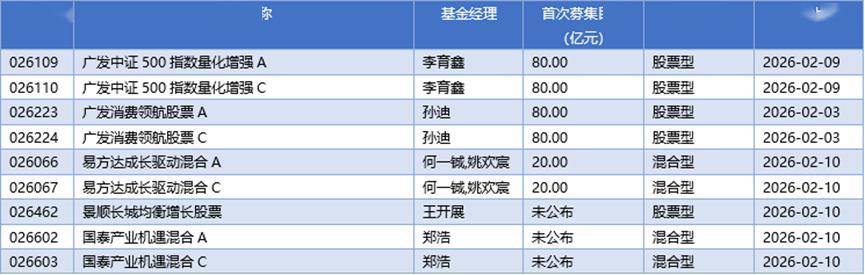
Group 1: Market Trends - In January 2026, public fund research enthusiasm surged, with a focus on technology growth sectors such as AI applications, commercial aerospace, innovative pharmaceuticals, and semiconductors [1] - Major companies like Daikin Heavy Industries, Xiangyu Medical, Haitai Ruisheng, and Aipeng Medical received significant attention from over a hundred institutions [1] - The A-share market showed mixed performance on January 28, with the Shanghai Composite Index rising by 0.27% to 4151.24 points, while the ChiNext Index fell by 0.57% to 3323.56 points [1] Group 2: Fund News - A total of 9 new funds were launched on January 28, primarily focusing on stock and mixed funds, with the Guangfa CSI 500 Index Quantitative Enhancement A aiming to raise 8 billion yuan [2] - The pace of public funds investing in Hong Kong stocks has accelerated, with 27 Hong Kong-themed funds reported as of January 28, focusing on technology, pharmaceuticals, and cyclical sectors [2] - The largest domestic gold ETF surpassed 120 billion yuan, reflecting a growing investment trend in gold and related sectors, with significant inflows into resource recovery logic [2] Group 3: Fund Launches and Dividends - New fund launches on January 28 included Guangfa CSI 500 Index Quantitative Enhancement A and C, both targeting 8 billion yuan, and several other funds with varying focuses and amounts [3] - Fund dividends were distributed on January 28, with the highest payout from Guangfa Huifu One-Year Regular Open Bond Fund at 0.4650 yuan per 10 shares [4]
四大证券报精华摘要:1月29日
Xin Hua Cai Jing· 2026-01-29 00:13
Group 1: Market Trends and Investment Strategies - The A-share market has shown a significant divergence in index performance, with the CSI 500 index rising over 15% since the beginning of the year, while the Shanghai Composite Index only increased by 0.97% [1] - Private equity firms are analyzing investment logic and potential risks due to the widening "scissor difference" between indices, indicating a structural risk accumulation driven by the preference of incremental capital and macro liquidity [1] - The gold price has surged, breaking through important thresholds of $5200 and $5300 per ounce, driven by geopolitical tensions and economic factors, leading to increased investor demand for safe-haven assets [3] Group 2: Fund and Investment Product Developments - The number of qualified investors in the Beijing Stock Exchange has surpassed 10 million, marking a significant increase and indicating a new phase in market attractiveness and investor ecosystem development [4] - The scale of gold-themed ETFs has reached nearly 380 billion yuan, with a growth of approximately 100 billion yuan since the end of last year, reflecting the rising interest in gold investments [11] - "Fixed income +" funds have seen a steady increase in scale, reaching a historical high of 2.74 trillion yuan, as investors seek stable returns amid declining interest rates [9] Group 3: Economic Performance and Sector Growth - In 2025, 18 provinces in China outperformed the national GDP growth line, with Tibet leading at a growth rate of 7%, indicating a strong regional economic performance [13] - The consumer electronics sector is expected to thrive in 2025, with 18 out of 30 companies forecasting profitability, driven by advancements in AI and other emerging technologies [6] - The public fund management industry has reached a record high in assets under management, totaling 37.71 trillion yuan, with significant growth across various fund types [8]
指数向上,个股向下!题材轮动“有点快”,还有哪些投资机会?
Sou Hu Cai Jing· 2026-01-26 06:47
Group 1 - A-shares continue to rise with increased trading volume, breaking previous highs, driven by heightened risk appetite during the spring rally [1] - Huatai Securities suggests that while strong momentum may allow for further spring market space, the trading structure is concentrated, indicating a potential shift towards rotation as some hot sectors may need to digest pressure [1] - The upcoming earnings forecast window suggests focusing on high-cost performance sectors, particularly those benefiting from external demand chain improvements and lower crowding themes, such as gaming, duty-free, batteries, engineering machinery, and agricultural chemicals [1] Group 2 - Non-ferrous metals are becoming a key focus for institutional investment, with seven non-ferrous metal-themed funds reported in the past week and significant net subscriptions exceeding 51 billion yuan for non-gold ETFs over the past year [3] - The pig farming industry is expected to see a slight recovery in sow production capacity in 2024, leading to a downward trend in pig prices in 2025, although there may still be slight profits throughout the year [3] - The industry is undergoing structural changes due to "anti-involution," with both passive and active capacity reductions expected to drive a gradual recovery in pig prices by the second half of 2026 [3] Group 3 - The industry is expected to remain in a trend of reduced demand and structural adjustment through 2026, with limited improvements in supply, demand, and profitability [5] - Focus on two main lines: differentiated production control and the potential recovery of undervalued cash flow assets, as well as the acceleration of domestic substitution in high-end steel materials benefiting leading special steel companies [5] - Southbound capital saw a record net inflow of 140.48 billion Hong Kong dollars, continuing to increase positions in the Hong Kong stock market, contributing to a strong performance in the Hang Seng Index and technology index [5] Group 4 - The short-term market trend is strong with significant new capital entering, although the market's profit-making effect remains weak [7] - The Shanghai Composite Index shows a one-sided upward trend, contrasting with regulatory "cooling" strategies, indicating potential downward pressure on the index [10] - The A-share earnings cycle may have reached a turning point, with a gradual improvement in earnings expected, making the recovery elasticity of earnings a key focus for 2026 [10]

每日市场观察-20260116
Caida Securities· 2026-01-16 05:10
Market Overview - On January 15, the Shanghai Composite Index fell by 0.33%, while the Shenzhen Component rose by 0.41% and the ChiNext Index increased by 0.56%[2] - The total trading volume on January 15 was 2.94 trillion yuan, a decrease of approximately 1.05 trillion yuan from the previous trading day[1] Sector Performance - The sectors with the largest gains included electronics, chemicals, and non-ferrous metals, while military, media, computer, and pharmaceutical sectors experienced the largest declines[1] - Major capital inflows were observed in the semiconductor, communication equipment, and consumer electronics sectors, while IT services, securities, and aerospace equipment saw significant outflows[3] Regulatory Impact - The exchange raised the margin financing ratio on January 15, indicating regulatory intent to cool down the rapid market rise[1] - The market's reduced trading volume reflects a natural response to regulatory measures, with a pause in aggressive buying rather than panic selling[1] Economic Indicators - As of the end of December, the broad money supply (M2) was 340.29 trillion yuan, showing a year-on-year growth of 8.5%[4] - The total social financing increment for 2025 was reported at 35.6 trillion yuan, an increase of 3.34 trillion yuan compared to the previous year[5] Investment Trends - There has been a notable increase in the issuance of metal-themed funds, with 7 new funds reported in the past week and a net subscription of over 51 billion yuan for metal-themed ETFs over the past year[11] - The total trading volume of ETFs reached a record high of 7487.59 billion yuan on January 15, following a previous peak of 7155.35 billion yuan on January 14[12]
有色金属主题基金成机构“新宠”
Shang Hai Zheng Quan Bao· 2026-01-14 17:47
Core Viewpoint - The non-ferrous metal sector is becoming a focal point for institutional investment, with a significant increase in the number of themed funds and net subscriptions for ETFs in this category over the past year [1][2]. Group 1: Fund Activity - In the past week, seven non-ferrous metal themed funds have been reported, with several more in the pipeline for issuance [1]. - Over the past year, non-ferrous metal themed ETFs (excluding gold) have seen net subscriptions exceeding 51 billion yuan, with 15 ETFs currently having a total scale of nearly 80 billion yuan [1][2]. - As of January 1, 2025, the total scale of non-ferrous metal themed ETFs was approximately 8.08 billion yuan, which increased to 78.81 billion yuan by January 13, 2026 [2]. Group 2: Index Characteristics - There are multiple non-ferrous metal themed indices, each with different focuses, requiring investors to carefully select ETFs based on their characteristics [1]. - The CSI Shenwan Non-Ferrous Metal Index selects 50 listed companies from the non-ferrous metal and non-metal materials sectors [1]. - The CSI Industrial Non-Ferrous Metal Index focuses on 30 larger market cap companies involved in copper, aluminum, lead-zinc, and rare metals [1]. - The CSI Non-Ferrous Metal Mining Index selects 40 companies with non-ferrous metal mineral resource reserves [1]. Group 3: Market Trends and Drivers - The recent surge in the non-ferrous metal sector is attributed to various factors, including global monetary easing and increased demand from AI data centers for copper, silver, and rare metals [2]. - Supply constraints and regional imbalances in supply and demand, along with frequent mining accidents, contribute to uncertainties in the supply side [2]. - Long-term macroeconomic logic for non-ferrous metals remains intact, with a strategy of accumulating during market adjustments recommended [2]. Group 4: Future Outlook - The current demand for non-ferrous metals is driven by emerging fields such as AI computing and robotics, which have a higher price acceptance for commodities than previously expected [3]. - Despite the strong performance of the non-ferrous sector in 2025, expectations should be moderated for 2026, although the long-term resource cycle is still ongoing [3].

基金量化观察:有色金属主题ETF持续申报,医药主题基金业绩反弹
SINOLINK SECURITIES· 2026-01-13 14:15
- The report tracks the performance of active equity and enhanced index funds, highlighting the top-performing funds in the past week, including those with the highest returns[5][6][32] - The report provides detailed statistics on the net inflows and outflows of various types of ETFs, including cross-border, commodity, stock, and bond ETFs, as well as specific sector and theme ETFs[3][13][14] - The report includes a comprehensive list of newly issued and listed ETFs, covering various themes such as non-ferrous metals, food, and technology[4][26][30] - The report tracks the performance of enhanced strategy ETFs, noting that 11 out of 54 enhanced strategy ETFs outperformed their benchmarks in the past week, with detailed performance metrics for each[24][25] - The report provides a detailed analysis of the trading activity of ETFs in the secondary market, including the top traded ETFs and their respective trading volumes and financing net purchases[15][18][20]
有色金属“开门红”,公募扎堆推新,机遇还是风险?
Di Yi Cai Jing· 2026-01-11 13:13
Core Viewpoint - The outlook for non-ferrous metals remains optimistic for 2026, with expectations of continued price increases driven by macroeconomic factors and supply-demand dynamics, despite concerns about high valuations and potential risks in the market [1][2][5]. Group 1: Market Performance and Trends - The non-ferrous metals sector has shown strong performance, with the China Nonferrous Metals Index rising over 8% since the beginning of the year, reaching a historical high of 3369 points on January 9 [1]. - In 2025, the China Nonferrous Metals Index recorded a cumulative increase of 91.67%, with leading stocks like Luoyang Molybdenum and Jiangxi Copper seeing price increases of 200.7% and 166% respectively [2]. - The futures market also reflected this trend, with LME copper futures prices increasing by over 40% in 2025, and LME tin and aluminum rising by 39% and 17% respectively [2]. Group 2: Investment Opportunities - Analysts suggest that the demand for metals such as copper and aluminum will continue to rise due to increased global electricity construction and investment in power infrastructure, which is expected to outpace GDP growth [2][6]. - The electric aluminum sector is anticipated to mirror the coal market's performance from 2022 to 2024, with limited supply and high dividend yields making it attractive for value investors [3]. - The ongoing macroeconomic environment, including potential interest rate cuts by the Federal Reserve, is expected to create a favorable backdrop for both precious and non-ferrous metals [6]. Group 3: Institutional Activity and Caution - There has been a surge in public fund applications for non-ferrous metal-themed ETFs, indicating strong institutional interest in the sector [4]. - Despite the positive sentiment, there is a growing caution among market participants regarding high valuations, with the price-to-book ratio of the non-ferrous sector rising from 2 to approximately 3.5 [6]. - Analysts recommend a balanced approach, advising against blindly chasing high valuations while recognizing the ongoing demand and investment opportunities in the sector [6][7].