碳中和ETF

Search documents
主动量化周报:标的下沉:节奏放缓,科技突围-20260118
ZHESHANG SECURITIES· 2026-01-18 13:26
Quantitative Models and Construction Methods 1. Model Name: ETF Fund Flow Model - **Model Construction Idea**: The model is designed to analyze and predict fund flows into various ETFs, identifying sectors or themes that are likely to outperform based on capital allocation trends [1][11] - **Model Construction Process**: The model tracks daily fund flow data for key ETFs, such as CSI 300 ETF, CSI 500 ETF, and thematic ETFs like Chip ETF, Carbon Neutral ETF, and Chip 50 ETF. It evaluates the net inflow or outflow of funds over specific time periods to determine investor preferences and market sentiment. For example, the model observed significant outflows from broad-based ETFs like CSI 300 ETF and CSI 500 ETF, while recommending thematic ETFs in technology sectors such as chips and carbon neutrality [1][11] - **Model Evaluation**: The model effectively identifies shifts in capital allocation, highlighting potential opportunities in technology-related sectors while cautioning against certain AI application themes [1][11] --- Model Backtesting Results 1. ETF Fund Flow Model - **Key Observations**: - Significant outflows from CSI 300 ETF and CSI 500 ETF, with daily net outflows reaching 114 billion, 715 billion, and 1,048 billion yuan on January 14, 15, and 16, respectively [11] - Recommendations for Chip ETF, Carbon Neutral ETF, and Chip 50 ETF, reflecting a preference for technology sectors like electronics and power equipment [11] --- Quantitative Factors and Construction Methods 1. Factor Name: Style Factors (BARRA Style Factors) - **Factor Construction Idea**: These factors aim to capture the performance of different market styles, such as value, growth, momentum, and size, to identify prevailing market preferences and trends [24] - **Factor Construction Process**: - Fundamental factors: Evaluate metrics like profitability and earnings growth to assess the performance of high-profitability assets relative to the market average - Transaction-related factors: Analyze metrics such as turnover rate, short-term momentum, and beta coefficients to identify stocks with potential for excess returns - Size factors: Examine the performance of small-cap stocks versus large-cap stocks, including non-linear size effects [24] - **Factor Evaluation**: The factors reveal a shift in market preferences, with high-turnover stocks reversing gains, while short-term momentum and high-beta stocks show potential for sustained excess returns. Small-cap stocks exhibit relative outperformance during the observed period [24] --- Factor Backtesting Results 1. Style Factors (BARRA Style Factors) - **Key Observations**: - Profitability-related factors showed recovery, with high-profitability assets outperforming the market average [24] - Transaction-related factors indicated a reversal in high-turnover stocks, while short-term momentum and high-beta stocks demonstrated potential for sustained excess returns [24] - Size factors highlighted the relative strength of small-cap stocks, with non-linear size factors experiencing larger drawdowns [24]
ETF市场扫描与策略跟踪:中证A500ETF合计规模近3000亿元
Western Securities· 2025-12-28 13:14
Global and A-share Market Overview - The A-share market experienced an overall increase last week, with the CSI 500 index showing the largest gain of 4.03% [12] - The Hang Seng Index in the Hong Kong market rose by 0.50% [12] - The performance of ETFs tracking the new energy sector was notably strong [12] ETF New Issuance Statistics - A total of 18 stock ETFs were reported in the A-share market last week, with 8 new stock ETFs established [17][19] - In the US market, 5 equity ETFs were newly established, including 2 active ETFs [17][23] Fund Flow in A-share Market - The top 10 ETFs with net inflows were primarily those tracking the CSI A500 index, while the top 10 with net outflows included ETFs related to the CSI 300 index, military industry, and TMT sectors [2][24] - The CSI A500 ETF saw a net inflow of approximately 106.75 million yuan, making it the leading ETF in terms of net inflow [28] - Conversely, the CSI 300 ETF experienced a net outflow of 34.08 million yuan [25] Fund Flow in US Market - In the US market, resource management-themed ETFs had the highest net inflows, while multi-tech themed ETFs saw the largest net outflows [3] - A total net outflow of 1.10 million USD was recorded for ETFs investing in A-shares and Hong Kong stocks [3] ETF Strategy Performance - The RRG ETF rotation strategy yielded a return of 3.84%, outperforming the CSI Equal Weight and CSI 300 indices by 1.66% and 1.89% respectively [4] - The 50% base + intraday momentum strategy showed varying returns across different ETFs, with the CSI 1000 ETF achieving a return of 2.05% [4]
A股ESG实践从“合规披露”迈向“主动布局”
Zheng Quan Ri Bao· 2025-11-20 16:05
Core Viewpoint - The enthusiasm for ESG (Environmental, Social, and Governance) practices in the A-share market remains strong, with 36 companies disclosing or updating their ESG management systems by November 20, indicating a shift from compliance to proactive engagement in ESG practices [1] Group 1: ESG Practice Development - A-share listed companies are increasingly integrating ESG practices across various industries, with a notable rise in the number of companies publishing sustainability reports, reaching 2,462 by April 30, 2025, a 5.72 percentage point increase from the previous year [2] - The proactive awareness of ESG among A-share companies is growing, focusing on institutional frameworks, digital capabilities, and value creation [2][3] Group 2: Institutional Framework - More A-share companies are embedding ESG principles into their strategic frameworks, establishing a three-tier governance structure that includes the board, management, and execution levels [3] - By 2025, 185 A-share companies have disclosed their ESG management systems, promoting standardization in ESG governance [3] Group 3: Digitalization and Value Creation - A-share companies are leveraging technologies like big data, AI, and blockchain to enhance their ESG management capabilities, improving accuracy and efficiency in areas such as carbon emissions accounting and supply chain risk monitoring [3] - ESG is becoming a crucial link between companies and capital, with 500 ESG-related indices in the A-share market, 91% of which have seen gains this year, indicating that companies with strong ESG performance attract more capital [4] Group 4: Market Ecosystem - The development of ESG practices is supported by a robust market ecosystem involving policies, capital, and intermediary institutions, with regulations mandating the disclosure of sustainability reports [5] - The issuance of green bonds has surged, with 316 green bonds issued this year, totaling 256.74 billion, marking a 22.48% increase in quantity and a 20.83% increase in scale compared to the previous year [6] Group 5: Future Directions - The future of ESG practices in China is expected to focus on product innovation, expanding from single tools to comprehensive solutions, and increasing participation from individual investors [7]
朝闻道20251110
Orient Securities· 2025-11-09 13:16
Market Strategy - The market is currently experiencing a volatile rotation, with a focus on defensive strategies. It is recommended to prioritize defensive tactics while considering low-value recovery opportunities in the mid-term [2][8] - The "dumbbell strategy" is suggested as a foundational approach, balancing between high dividend yield and low volatility sectors, particularly in the traditional Chinese medicine sector [8] Style Strategy - The technology growth sector is under pressure, while cyclical consumer sectors are positioned for defensive layouts. The market is seeing rapid rotation between technology growth and low-value cyclical sectors [3][8] Industry Strategy - The construction materials industry is expected to emerge from its cyclical bottom, supported by the "Construction Materials Industry Stable Growth Work Plan (2025-2026)" which provides clear policy guidance and development momentum. This plan aims to improve supply-demand relationships and restore profitability through systematic measures [4][8] - Structural opportunities in the construction materials sector include traditional leading companies with optimized supply patterns, leaders in green and emerging materials, and pioneers in digital transformation [8] Thematic Strategy - The environmental protection sector is gaining momentum, with potential for long-term driving forces. Recent climate commitments and policy changes signal a significant shift towards green and low-carbon transitions [5][8] - Relevant stocks in the environmental sector include Xuedilong (002658) and Yongqing Environmental Protection (300187), with associated ETFs such as the Environmental ETF (512580) and Carbon Neutrality ETF (159885) [8]
想要跟踪社保买基金,看这篇文章就够了!社保基金三季报全景透视来临!
Sou Hu Cai Jing· 2025-11-04 11:03
Group 1 - The core viewpoint of the article highlights the significant changes in the National Social Security Fund's (NSSF) investment strategy as reflected in its third-quarter report, indicating a strong confidence in the macroeconomic outlook and industry structural changes [2] - The total market value of NSSF's holdings increased from 663.04 billion to 840.75 billion, marking a quarter-on-quarter growth of 26.8%, driven by both market recovery and proactive increases in holdings [3] - The NSSF's industry allocation shows a diverse pattern with a focus on technology, cyclical recovery, and stable finance, with the information technology sector being the standout performer [6] Group 2 - The information technology sector saw a substantial increase in holdings from 3.08 billion shares to 5.02 billion shares, reflecting a 63% quarter-on-quarter growth, driven by the acceleration of semiconductor equipment localization and rising demand for AI computing power [6][8] - Traditional cyclical industries also demonstrated strong recovery, with the materials sector growing by 16% and the energy sector by 35%, while the financial sector maintained stable holdings with negligible changes [6] - The NSSF's investment strategy indicates an evolution towards higher growth sectors while maintaining stability in financial assets, showcasing a balance between growth and stability [8] Group 3 - The top five sectors in NSSF's holdings include industrial electrical components and equipment (6.2%), information technology electronic components (6.1%), and materials fertilizer and agrochemicals (4.9%), indicating a concentrated investment in high-growth areas [8] - The NSSF's increased allocation to traditional sectors like real estate reflects confidence in policy support, while its focus on high-growth sectors like electronics and semiconductors shows a willingness to accept higher valuations [8][15] - The article suggests that investors can learn from the NSSF's balanced allocation approach, particularly in sectors like industrial electrical components, which includes key products related to carbon neutrality [11][13]


想要跟踪社保买基金,看这篇文章就够了!社保基金三季报全景透视来临!
市值风云· 2025-11-04 10:09
Core Viewpoint - The article emphasizes the investment opportunities in three high-growth sectors as indicated by the adjustments made by the National Social Security Fund (NSSF) in its portfolio, reflecting its insights into macroeconomic trends and industrial structural changes [3]. Group 1: Portfolio Growth and Confidence - The total market value of NSSF holdings increased from 663.04 billion to 840.75 billion, marking a quarterly growth of 26.8%, driven by both market recovery and proactive increases in holdings [4]. - The NSSF's industry allocation shows a diverse strategy with a focus on "technology leadership, cyclical recovery, and financial stability" [6]. Group 2: Sector-Specific Insights - The information technology sector saw a significant increase in holdings from 3.08 billion shares to 5.02 billion shares, a remarkable growth of 63%, driven by the acceleration of semiconductor equipment localization, sustained demand for AI computing power, and a recovery in the consumer electronics inventory cycle [7]. - Traditional cyclical industries also demonstrated strong recovery, with the materials sector growing by 16% and the energy sector by 35%, while the financial sector maintained stable holdings with negligible changes [7]. Group 3: Investment Strategy Evolution - The NSSF's investment philosophy is evolving, showing a notable increase in allocation to high-growth sectors like technology and advanced manufacturing while maintaining stable financial asset allocations [9]. - The top five sectors by NSSF holdings include industrial electrical components and equipment (6.2%), information technology electronic components (6.1%), and materials fertilizer and agrochemicals (4.9%) [9]. Group 4: ETF Recommendations - Investors can consider ETFs that align with NSSF's focus, such as the Carbon Neutrality ETF and New Energy Vehicle ETF, which cover key products in the industrial electrical components sector [12]. - For the information technology sector, the Electronic ETF and Chip ETF are recommended, as they align with NSSF's investments in high-end electronic components and semiconductors [14][16]. Group 5: Agricultural and Chemical Sector Focus - The materials sector, particularly fertilizer and agrochemicals, reflects a strong emphasis on food security strategy, with relevant ETFs like the Agriculture ETF and Chemical ETF being noteworthy for investors [18][19].

香港中小上市公司协会:香港中小上市企业喜迎“十五五”新机遇
Zhi Tong Cai Jing· 2025-11-03 13:05
Core Viewpoint - The "14th Five-Year Plan" emphasizes accelerating high-level technological self-reliance and leading the development of new productive forces, indicating a strategic shift for Hong Kong's small and medium-sized listed companies towards a dual core function of "technology + capital" [1][2] Group 1: Market Context - There are approximately 2,600 listed companies in Hong Kong, with nearly 80% having a market capitalization below 5 billion HKD, highlighting long-standing issues of low valuation, weak liquidity, and financing difficulties [2][3] - The current environment presents significant structural rebound potential, as small and medium-sized companies are at a critical point of transitioning from passive survival to proactive transformation [2][3] Group 2: Transformation Directions - The "14th Five-Year Plan" outlines six definitive mainlines, providing seven transformation directions for Hong Kong's small and medium-sized listed companies [3][4] 1. **AI-Driven Industrial Upgrade**: Companies should leverage AI to achieve asset-light transformation across various sectors [3] 2. **Integration into National Unified Market**: Companies are encouraged to align with mainland standards and supply chain certifications to access broader growth opportunities [3][4] 3. **Promotion of Consumer Technology and Innovation**: There is a push for technological upgrades in sectors like elderly care, education, and culture, creating new consumption technology markets [3][4] 4. **Innovation in Mergers and Acquisitions**: Companies should utilize the flexible advantages of the Hong Kong market to engage in cross-border industrial integration [3][4] 5. **Deepening High-Level Openness and International Connectivity**: Hong Kong can leverage its position to facilitate cross-border data flow and green finance innovations [4] 6. **Participation in New Urbanization Construction**: Companies can engage in urban renewal projects in mainland China, tapping into significant investment opportunities [4] 7. **Embracing Green Finance and Zero-Carbon Economy**: Companies should promote green certification and utilize financial instruments like green bonds to broaden financing channels [5] Group 3: Steps for Transformation - The transformation process is outlined in three steps: 1. **Industrial AI Transformation**: Companies must view AI as a strategic asset and integrate it into all operational aspects [5][6] 2. **Mergers and Acquisitions**: This is seen as an effective path for scaling and enhancing innovation capabilities through horizontal and vertical integration [6] 3. **Green Transformation**: Companies should adopt green manufacturing standards and establish systems for monitoring carbon emissions to attract ESG investments [6][7] Group 4: Policy Recommendations - Seven policy recommendations are proposed to invigorate small and medium-sized listed companies: 1. **Improve M&A Regulations**: Relax restrictions on mergers and acquisitions to facilitate corporate transformation [7] 2. **Establish a Multi-Tiered Capital Market System**: Create a more inclusive capital market structure to support companies at various development stages [8] 3. **Promote Re-Industrialization and Research Commercialization**: Align capital market reforms with re-industrialization strategies to enhance industry upgrades [8] 4. **Relax Intellectual Property Financing**: Encourage financial institutions to recognize intangible assets for financing [8] 5. **Establish Development Funds and Credit Guarantee Mechanisms**: Create funds to support AI transformation and green upgrades [9] 6. **Advance Green Finance and Carbon Asset Marketization**: Develop a carbon asset trading system to incentivize green development [9] 7. **Promote Policy Coordination and Performance Assessment**: Ensure effective implementation of supportive policies for small and medium enterprises [9] Conclusion - The "14th Five-Year Plan" marks a pivotal transition for Hong Kong's economy, urging small and medium-sized listed companies to embrace transformation and innovation to thrive in the new economic landscape [10]
新能源产业链大爆发!光伏ETF涨超8%,电池50ETF、新能源ETF、创业板新能源ETF华夏、碳中和ETF涨超6%,储能电池ETF涨5.95%
Ge Long Hui· 2025-10-29 08:33
Core Viewpoint - The news highlights a significant surge in the renewable energy sector, particularly in the photovoltaic and battery industries, with various ETFs experiencing substantial gains, indicating strong market performance and investor interest in these sectors [1]. Group 1: Market Performance - The A-share market saw a strong performance with the Shanghai Composite Index closing at 4016 points, up 0.7%, while the Shenzhen Component Index and the ChiNext Index rose by 1.95% and 2.93%, respectively [1]. - The total market turnover reached 2.29 trillion yuan, an increase of 125.4 billion yuan compared to the previous trading day, with nearly 2700 stocks rising [1]. Group 2: ETF Performance - The photovoltaic ETF increased by over 8%, while other ETFs such as the Battery 50 ETF, New Energy ETF, and Carbon Neutrality ETF rose by more than 6%, and the Energy Storage Battery ETF gained 5.95% [1]. - The photovoltaic ETF tracks the CSI Photovoltaic Industry Index, focusing on leading companies across the entire photovoltaic supply chain, benefiting from global energy storage developments and domestic market trends [1]. Group 3: Industry Developments - The "14th Five-Year Plan" emphasizes the development of new energy storage, which is expected to enhance the market and pricing mechanisms for the new energy system, leading to significant growth in the storage industry [2]. - The solid-state battery technology is advancing, with companies like XINWANDA and BAK Battery showcasing innovations that improve energy density and performance, indicating a shift towards mass production and application in electric vehicles and energy storage [3][4]. - The domestic energy storage battery shipment volume increased by over 60% year-on-year in Q3, with the total shipment volume for the first three quarters surpassing 30% of last year's total, indicating strong demand and production capacity in the sector [4].

碳中和ETF(159790)翻红,同类规模第一
Sou Hu Cai Jing· 2025-10-23 06:42
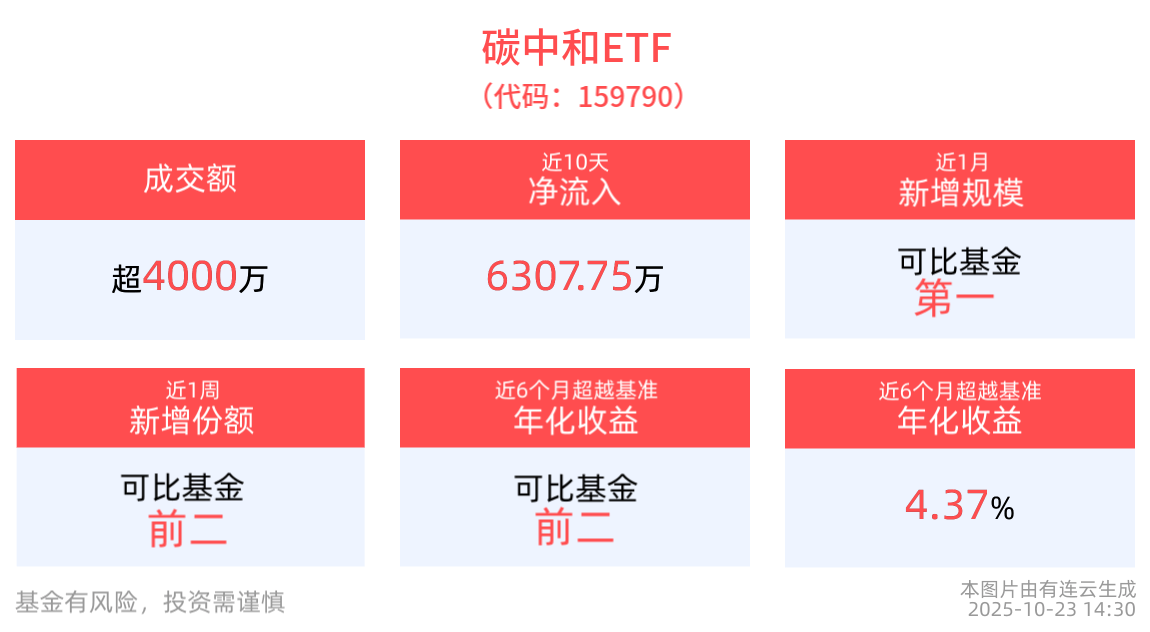
Core Insights - The Carbon Neutral ETF (159790) has shown a recent increase of 0.80%, with a price of 0.75 yuan as of October 23, 2025, and a cumulative rise of 4.33% over the past month [3] Performance Summary - The Carbon Neutral ETF has achieved a net value increase of 41.95% over the past six months [4] - Since its inception, the ETF recorded a highest single-month return of 20.96% and a maximum consecutive monthly gain of 48.28%, with an average monthly return of 6.82% during rising months [4] - The ETF's Sharpe ratio for the past year is 1.17, indicating higher returns for the same level of risk [4] - The maximum drawdown over the last six months is 7.53%, which is relatively low compared to the benchmark [4] Liquidity and Trading Activity - The ETF had a turnover rate of 2.2% with a trading volume of 46.6 million yuan on the latest trading day [3] - Over the past month, the average daily trading volume was 53.15 million yuan, ranking first among comparable funds [3] - The ETF's net inflow over the last ten trading days totaled 6.31 million yuan, with an average daily net inflow of 630.78 thousand yuan [3] Fund Size and Shares - The ETF's size increased by 106 million yuan over the past month, placing it in the top fifth of comparable funds [3] - There was a significant increase in shares, with a growth of 13 million shares over the past week [3] Fee Structure - The management fee for the Carbon Neutral ETF is 0.50%, and the custody fee is 0.10% [5] Tracking Accuracy - The ETF has a tracking error of 0.015% over the past two months, which is the highest accuracy among comparable funds [6] - It closely tracks the CSI Mainland Low Carbon Economy Theme Index, which includes companies involved in clean energy generation, energy conversion and storage, clean production and consumption, and waste management [6]
光伏反内卷再度催化,碳中和ETF(159790)翻红
Sou Hu Cai Jing· 2025-10-14 05:44
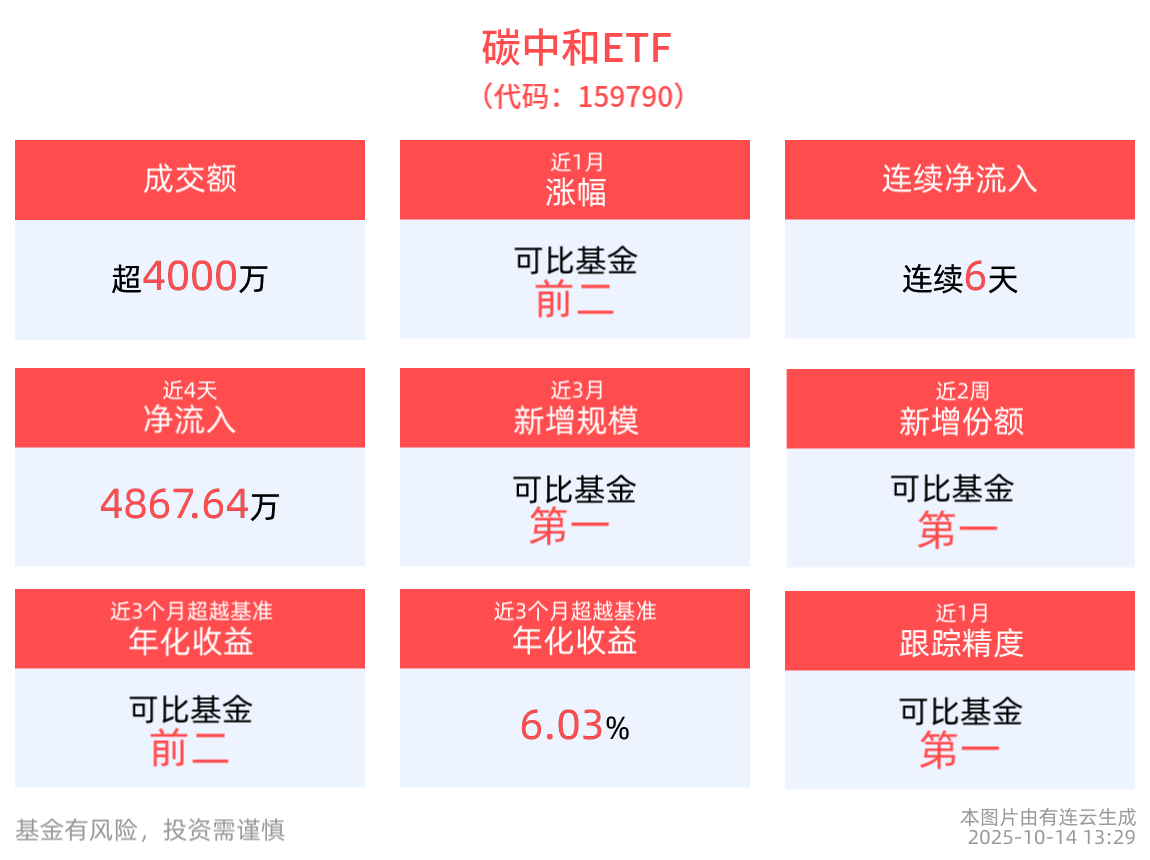
Core Viewpoint - The Carbon Neutrality ETF (159790) has shown significant growth in both value and liquidity, indicating strong investor interest and confidence in the low-carbon economy theme [3][4]. Group 1: Performance Metrics - As of October 13, 2025, the Carbon Neutrality ETF has increased by 45.69% over the past six months, ranking in the top 2 among comparable funds [4]. - The ETF's highest monthly return since inception was 20.96%, with a maximum consecutive monthly gain of 48.28% [4]. - The average monthly return during rising months is 6.82% [4]. - The ETF has outperformed its benchmark with an annualized excess return of 6.03% over the past three months [4]. Group 2: Risk and Volatility - The ETF's maximum drawdown over the past six months is 5.12%, which is lower than the benchmark's drawdown of 0.13%, indicating lower risk compared to comparable funds [4]. - The Sharpe ratio for the past year is 1.06, suggesting higher returns for the same level of risk [4]. Group 3: Liquidity and Fund Flows - The Carbon Neutrality ETF has seen a turnover rate of 2.13% with a trading volume of 46.50 million yuan [3]. - Over the past six days, the ETF has experienced continuous net inflows, totaling 67.86 million yuan, with a peak single-day inflow of 26.37 million yuan [3]. - The ETF has recorded a significant increase in shares, with a growth of 59 million shares over the past two weeks, ranking in the top 1/5 among comparable funds [3]. Group 4: Fund Management and Fees - The management fee for the Carbon Neutrality ETF is 0.50%, and the custody fee is 0.10% [4]. - The tracking error over the past month is 0.012%, which is the highest precision among comparable funds [4]. Group 5: Index Tracking - The ETF closely tracks the CSI Mainland Low-Carbon Economy Theme Index, which includes companies involved in clean energy generation, energy conversion and storage, clean production and consumption, and waste management [4].