电子ETF

Search documents
ETF复盘资讯|英伟达财报提振AI信心!创业板人工智能ETF+科创人工智能ETF默契同涨1.77%!军工ETF拾级攀升1.93%豪取五连阳
Sou Hu Cai Jing· 2026-02-26 12:37
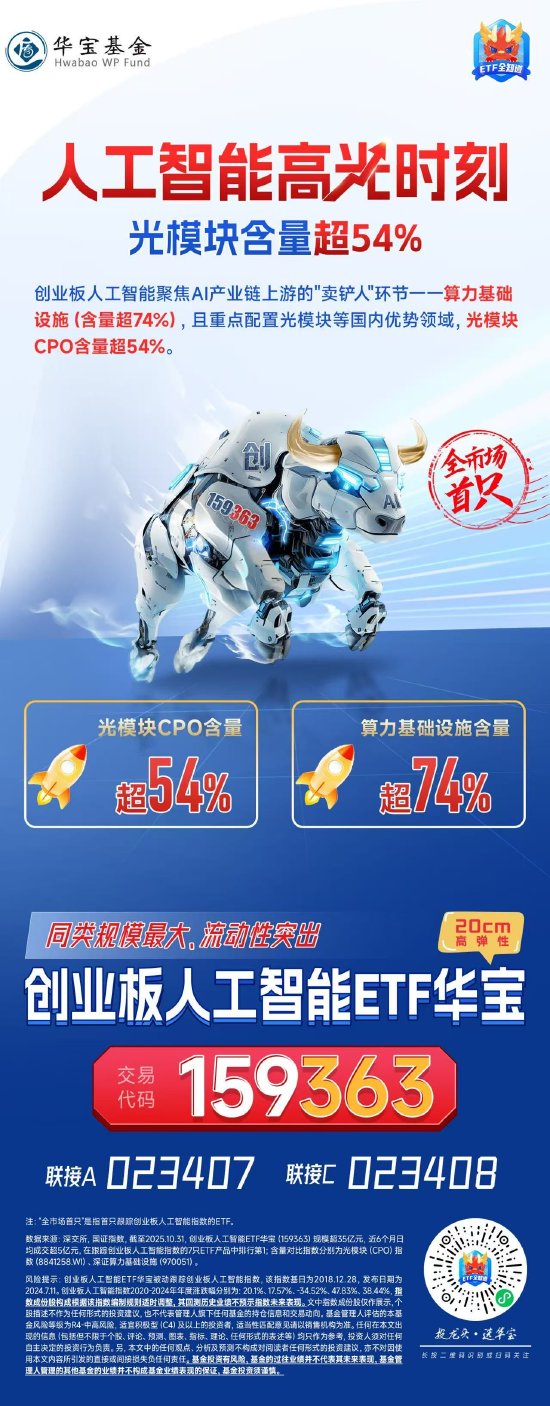
Group 1: Market Overview - The A-share market experienced a rebound with mixed performance across the three major indices, driven by Nvidia's strong earnings, which boosted the computing power sector [1] - The total trading volume in Shanghai, Shenzhen, and Beijing reached 2.56 trillion yuan, an increase of 756 billion yuan compared to the previous day [1] Group 2: Nvidia's Impact - Nvidia's earnings report exceeded market expectations, dispelling concerns about an AI bubble and confirming the exponential growth in AI computing power demand [1][10] - The AI-focused ETFs, including the ChiNext AI ETF and the Sci-Tech Innovation AI ETF, saw significant price increases of 1.77% [1][7] Group 3: Sector Performance - Over 29.3 billion yuan of capital flowed into the electronics sector, with PCB stocks experiencing a strong surge, particularly Huadian Co., which topped the A-share capital inflow list [1] - The domestic computing chip leader, Haiguang Information, is expected to see a net profit growth of up to 82% in Q1 2026, highlighting the rising demand for domestic high-end chips amid the AI wave [1][15] Group 4: Military Industry - The military sector continued its strong upward trend, with the military ETF rising by 1.93%, marking five consecutive days of gains [2][4] - Factors contributing to this momentum include developments in commercial aerospace, large aircraft production, and low-altitude economy initiatives [6] Group 5: Investment Recommendations - Analysts suggest focusing on four key areas: AI and related fields, emerging industries under the 14th Five-Year Plan, cyclical recovery sectors, and strategic resources [3] - The military ETF is highlighted as an efficient tool for investing in core military assets, covering various hot themes such as commercial aerospace and military information technology [4][6]


“马”力全开!A股开门红!“涨价”主线回归,化工ETF、有色ETF涨超3%!创业板人工智能ETF最高上探2.84%
Xin Lang Cai Jing· 2026-02-24 11:46
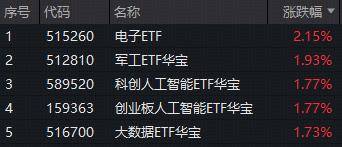
Market Overview - The first trading day of the Year of the Horse (February 24) saw A-shares open positively, with the ChiNext index rising by up to 2% and the Shanghai Composite Index closing up 0.87% [1][14] - Over 4,000 stocks in the market rose, with more than 100 stocks hitting the daily limit [1][14] - The total trading volume in the Shanghai, Shenzhen, and Beijing markets reached 2.2 trillion yuan, an increase of 219.3 billion yuan from the previous trading day [1][14] Sector Performance - The chemical sector continued to rise, with active performances in phosphate chemicals and fertilizers, leading to several stocks, including Hebang Biotechnology, hitting the daily limit [1][14] - The Chemical ETF (516020) surged by 3.42%, attracting 222 million yuan in the previous five trading days [1][14] Precious Metals and Commodities - Following the Spring Festival, the domestic market entered a peak working season, with the "golden March and silver April" period expected to see increased industrial production and infrastructure projects [3][16] - Precious metals prices surged due to rising risk aversion stemming from U.S. tariff policy disputes and geopolitical tensions, with the Precious Metals ETF (159876) rising by 3.18% and attracting a net subscription of 6 million units [3][16] - The outlook for gold demand is optimistic, with expectations of surpassing 5,000 tons globally by 2025, driven by strong investment flows and central bank purchases [7][19] Military and Aerospace Sector - The military sector showed strong performance, with the Military ETF (512810) rising by 1.16% and experiencing a premium at closing [9][21] - The domestic aviation sector is expected to accelerate, with the C919 aircraft averaging nearly 50 flights per day during the Spring Festival, a 52.6% increase year-on-year [11][24] - Geopolitical tensions, particularly between the U.S. and Iran, are expected to heighten the urgency of national defense construction in China [11][24] Investment Strategies - Analysts suggest maintaining a focus on cyclical price increases and the expansion of AI trends as the main market themes [4][17] - The investment strategy emphasizes a dual focus on technology and resource products, with technology centered on AI, new energy, and innovative pharmaceuticals, while resource products focus on precious metals and basic chemicals [4][17]

渤海证券研究所晨会纪要(2026.01.28)-20260128
BOHAI SECURITIES· 2026-01-28 00:29
Macro and Strategy Research - The profit growth of industrial enterprises in 2025 is supported by new momentum and anti-involution policies, with a marginal increase in profit growth rate by 0.5 percentage points to 0.6% year-on-year [2][3] - In December 2025, the profit of industrial enterprises increased by 5.3% year-on-year, reversing from negative to positive with an 18.4 percentage point recovery [3] - The industrial added value in December 2025 grew by 5.2% year-on-year, driven by resilient exports and high-tech industries [3] - The revenue profit margin for industrial enterprises in 2025 was 5.31%, a year-on-year decrease of 1.5%, but the decline was less severe than in the previous months [3] - Among 41 industrial sectors, 16 sectors achieved positive profit growth in 2025, with notable growth in black metal smelting, non-ferrous metal mining, and high-tech manufacturing [4] - The end of three consecutive years of negative profit growth for industrial enterprises is attributed to support from new momentum sectors and the implementation of anti-involution policies [4] Fixed Income Research - The issuance scale of credit bonds increased, with corporate bonds remaining stable and other types of bonds seeing growth [6][8] - Credit bond yields generally declined, with credit spreads for medium and short-term notes narrowing [8] - The overall market sentiment remains optimistic, with a focus on adjusting strategies in response to market fluctuations and maintaining a cautious approach to ticket strategies [8] Fund Research - The number of equity funds increased to 7,583 by the end of Q4 2025, with a total scale of 94,572.12 billion, a decrease of 277.04 billion from the previous quarter [11] - Active equity funds saw a slight decrease in positions, with a notable decline in mixed and flexible allocation funds [11][12] - The allocation in the main board decreased significantly, while the allocation in the Sci-Tech Innovation Board and Growth Enterprise Market increased [12] - The top five industries with increased holdings included non-ferrous metals and communications, while electronics and biomedicine saw a decrease [12] Industry Research - The geopolitical situation has led to strong performance in gold prices, with expectations for continued upward pressure due to uncertainties [14][15] - The steel industry is expected to see improved profitability due to steady growth policies and demand in shipbuilding and construction [15] - The copper industry is anticipated to maintain a favorable outlook, supported by supply constraints and demand from key sectors like electric power and new energy vehicles [16] - The aluminum sector is expected to benefit from improved supply dynamics and demand from the new energy vehicle sector [16] - The rare earth industry is projected to see a revaluation of related companies due to China's export control upgrades and strategic importance [17]
【早盘三分钟】1月19日ETF早知道
Xin Lang Cai Jing· 2026-01-19 01:32
Core Insights - The article discusses the current trends in the ETF market, highlighting the performance of various sectors and the influx of capital into specific ETFs, particularly those focused on technology and AI applications. Market Overview - As of January 16, 2026, the Shanghai Composite Index, Shenzhen Component Index, and ChiNext Index have ten-year price-to-earnings (P/E) percentile ranks of 99.79%, 93.82%, and 51.01% respectively, indicating a high valuation environment for the Shanghai market [14]. - The short-term market rotation shows positive performance in sectors such as electronics (+2.64%), machinery (+1.69%), and automobiles (+1.23%), while sectors like computing and media have seen declines [14][15]. Capital Flow Analysis - The top three sectors for capital inflow include electronics with a net inflow of 10.57 billion, machinery with 2.49 billion, and banking with 1.99 billion [15]. - Conversely, the sectors experiencing the largest outflows are computing (-13.66 billion), media (-9.53 billion), and non-ferrous metals (-4.74 billion) [15]. ETF Performance - The electronic ETF has shown a 6-month increase of 57.97%, while the intelligent manufacturing ETF has increased by 55.29% [15]. - The AI-focused ETF on the ChiNext has attracted significant capital, with a net inflow of 1.679 billion over the past five trading days, despite a recent 2% decline [17]. Sector Focus - The article emphasizes the potential of the AI data center industry, particularly in GPU light modules, as a key investment theme for 2026, which is being referred to as the "Physical AI Year" [17]. - The light module industry is expected to experience a high growth cycle driven by the demand for AI computing power, with major manufacturers ramping up production in mainland China and Thailand [17].

A股缩量震荡!顺周期起舞,有色ETF华宝、化工ETF逆市创新高!热门赛道遇冷,通用航空ETF华宝跌超3%
Xin Lang Cai Jing· 2026-01-15 11:31
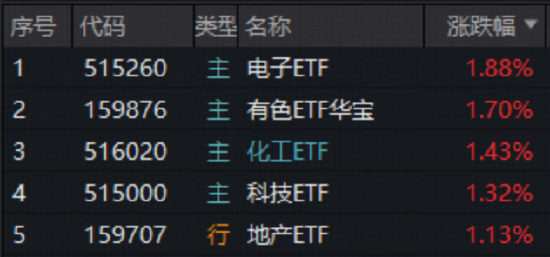
Market Overview - The A-share market experienced fluctuations on January 15, with the Shanghai Composite Index briefly falling below 4100 points before recovering at the close. The Shanghai Composite Index fell by 0.33%, while the Shenzhen Component Index rose by 0.41%, and the ChiNext Index increased by 0.56%. The total trading volume in the Shanghai and Shenzhen markets was 29.388 trillion yuan, a significant decrease of over 1 trillion yuan compared to the previous day [1][20]. Electronic Sector - The electronic sector saw a strong rally in the afternoon, with the electronic ETF (515260) rising by 1.88%. This ETF is heavily weighted in semiconductor and consumer electronics industries, and it recovered its 5-day moving average [3][23]. - The electronic sector attracted a net inflow of 16.862 billion yuan, leading all 31 primary industries in terms of capital inflow [3][23]. - Key stocks in the semiconductor sector, such as Unisoc and Huazhong Microelectronics, saw significant gains, with Unisoc hitting the daily limit of 10% [25][26]. Chemical Sector - The chemical sector also performed well, with the chemical ETF (516020) reaching a peak increase of 2.42% during the day, closing up 1.43%, marking a new three-year high [8][29]. - The basic chemical sector attracted a net inflow of 14.694 billion yuan, the highest among 30 primary industries, and has seen a cumulative net inflow of 254.049 billion yuan over the past 60 days [10][31]. - The chemical ETF has outperformed major indices since the beginning of 2025, with a cumulative increase of 48.29%, significantly higher than the Shanghai Composite Index's 22.7% and the CSI 300 Index's 20.75% [29][30]. AI and Semiconductor Trends - The U.S. government announced a 25% tariff on specific semiconductors, which may enhance domestic substitution sentiment in the market [25][27]. - The demand for AI computing power is expected to drive significant price increases in storage chips, with projections indicating a rise of up to 1800% for certain DDR chips by 2025 [27]. - The trend of "self-controllable" and AI synergy is anticipated to strengthen in the electronics industry, with a focus on domestic computing power and semiconductor equipment [27]. Investment Tools - The electronic ETF (515260) and its linked funds are effective tools for investors looking to gain exposure to core assets in the electronic sector, particularly in AI chips, automotive electronics, and 5G technologies [27]. - The chemical ETF (516020) is also highlighted as a strategic investment vehicle, covering various segments within the chemical industry, including AI computing and robotics [13][29].
天弘基金2026年投资策略会:AI非泡沫,2050年将替代99.9%白领
Sou Hu Cai Jing· 2026-01-14 01:19
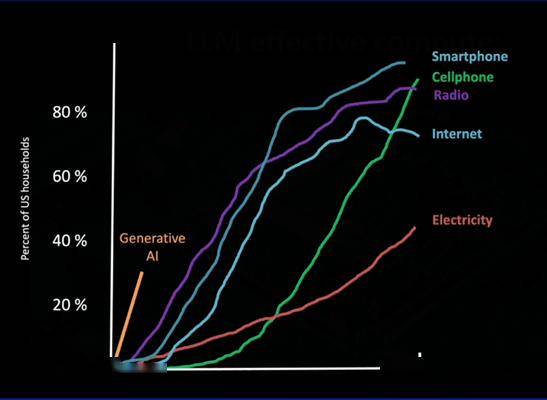
Core Viewpoint - AI is not in a bubble but is expected to replace 99.9% of white-collar jobs in the next two decades [1][5] Group 1: AI Evolution and Impact - The penetration rate of Generative AI has surpassed 30%, making it one of the fastest-adopted technologies globally [2][6] - Effective compute power is growing at an annual rate of approximately 6 to 16 times, potentially reaching 180 million times its current level in five years [3] - AI is evolving towards an "Innovator AI" stage, capable of independent work with minimal external instructions, expected to be achieved by late 2028 to early 2029 [3] Group 2: Overcoming Data Limitations - The global AI token generation is increasing at a rate of about 5 times per year, projected to reach 625 times its current scale in five years [4] - AI's ability to learn from self-generated data may help it overcome the "data wall," which refers to the limited growth of useful information on the internet [4] Group 3: AI's Role in Workforce Transformation - AI's evolution from simple chatbots to advanced reasoning and embodied intelligence indicates a shift towards "expert collaborative systems" [5][8] - By 2050, it is predicted that 90% of physical labor and 99.9% of white-collar jobs will be performed by AI, transforming human roles towards higher-level creativity and decision-making [8] Group 4: Investment Landscape and Economic Outlook - Current AI investments by major tech companies account for about 1.3% of the US GDP, with strong cash flow supporting these investments [9] - The macroeconomic environment is different from the internet bubble era, with current interest rates declining and inflation expected to stabilize around 2% [9] - Valuations of leading tech stocks are more rational compared to the peak of the internet bubble, with current P/E ratios around 30 times [9] Group 5: Future Technological Developments - Quantum computing is anticipated to be a key area of advancement, potentially enhancing computational power by millions or billions of times [10] - The next two decades may experience a "Goldilocks Economy," characterized by moderate inflation and strong economic growth [10] Group 6: Investment Strategies - The company is focusing on systematic investment strategies through index-based tools to capture technology sector growth [10][11] - A diverse range of technology-focused ETFs has been established to target high-growth sectors and capitalize on the ongoing technological transformation [10]
芯潮澎湃,电子跃升!芯片ETF天弘(159310)、电子ETF(159997)跟踪指数双双上涨,AI浪潮驱动存储量价齐升,国产存储产业链或迎黄金替代机遇
Sou Hu Cai Jing· 2026-01-06 03:07
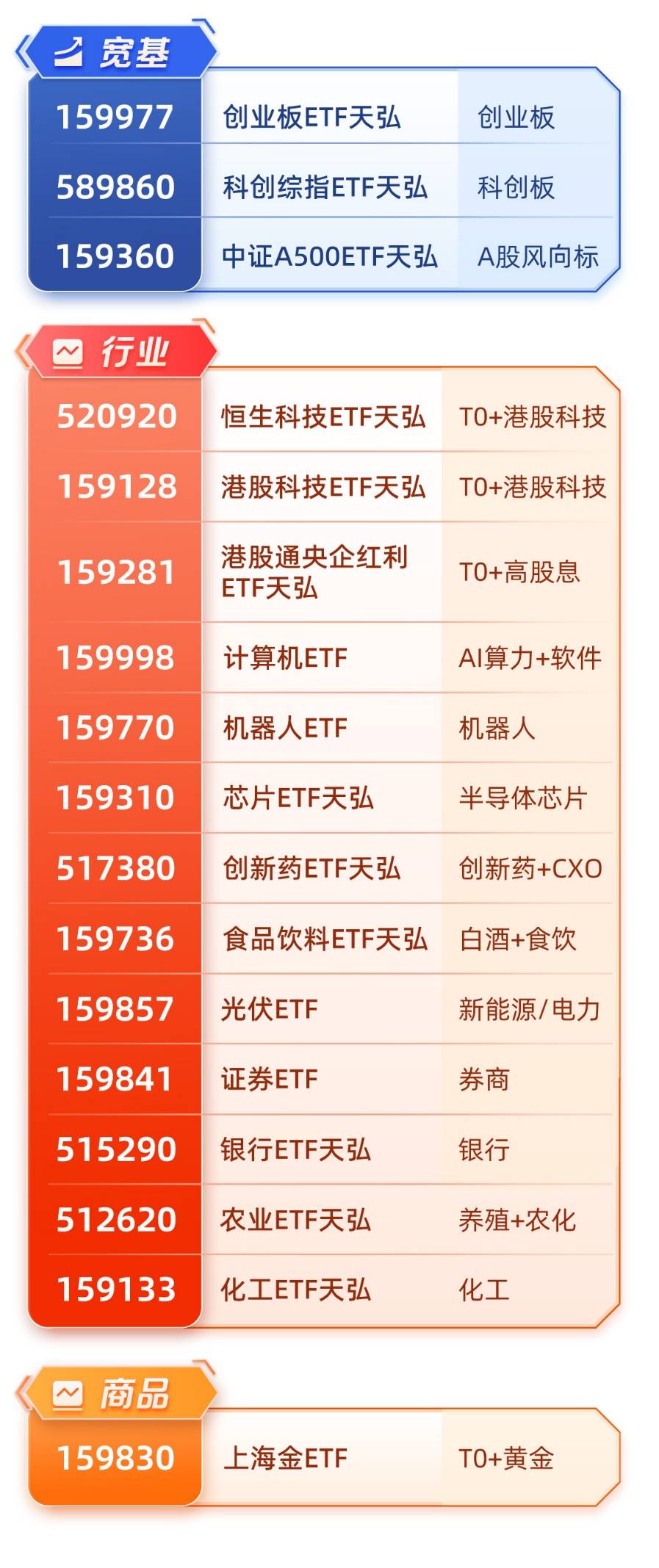
Core Viewpoint - The chip ETF Tianhong (159310) has shown significant growth, with a notable increase in trading volume and performance of its constituent stocks, reflecting a positive trend in the semiconductor industry [1][2]. Group 1: Chip ETF Performance - As of January 6, 2026, the chip ETF Tianhong (159310) recorded a trading volume of 14.2844 million yuan, with the tracked CSI Chip Industry Index (H30007) rising over 3% [1]. - The constituent stocks of the chip ETF, including Yake Technology (002409) and Zhongwei Company (688012), experienced substantial gains, with increases of 6.45% and 6.27% respectively [1]. - Over the past year, the chip ETF Tianhong (159310) has seen a growth of 318 million yuan in scale, indicating significant expansion [1]. Group 2: Electronic ETF Insights - The electronic ETF (159997) had a trading volume of 49.6088 million yuan, with the CSI Electronic Index (930652) increasing by 0.13% [1]. - Key stocks within the electronic ETF, such as Rainbow Shares (600707) and Yake Technology (002409), also showed strong performance, with Rainbow Shares rising by 9.98% [1]. Group 3: Industry Developments - Qualcomm is expanding its PC chip offerings with the new X2Plus processor aimed at mid-range laptops, enhancing its competitive position against x86 architecture [3]. - The AI wave is driving demand for memory chips, particularly in the server sector, with DRAM consumption expected to reach 66% of total capacity by 2026 [5]. - TrendForce reports a significant year-on-year increase of 171.8% in DRAM prices as of Q3 2025, indicating a supply-demand imbalance in the market [5].
【早盘三分钟】12月24日ETF早知道
Xin Lang Ji Jin· 2025-12-24 01:36
Core Viewpoint - The news highlights significant movements in various sectors, particularly focusing on the performance of ETFs and the implications of rising gold prices on the market [5][6][8]. Sector Performance - The construction materials, power equipment, and electronics sectors showed positive daily gains, with increases of +1.12%, +0.88%, and +0.58% respectively, while sectors like retail and beauty care experienced declines of -1.65% and -2.07% [3]. - The top three sectors for capital inflow were power equipment (¥3.656 billion), basic chemicals (¥1.278 billion), and construction materials (¥358 million), while the sectors with the highest outflows included defense and military (-¥5.769 billion), electronics (-¥5.504 billion), and communications (-¥4.054 billion) [3]. ETF Performance - The new materials ETF recorded a 1.19% increase, while the green energy ETF rose by 1.04%, and the smart electric vehicle ETF increased by 0.91%. The electronic ETF saw a 0.77% rise, and the non-ferrous ETF gained 0.74% [4]. - The financial technology ETF attracted significant capital, with net inflows exceeding ¥340 million over two days, indicating strong investor interest [8]. Gold Market Insights - International gold prices have surpassed $4,500, marking a historical high, which is expected to positively impact the performance of gold companies starting in 2026 [6][7]. - The outlook for the non-ferrous metals sector is optimistic, with potential for a prolonged bull market driven by various strategic metals, including lithium and copper [7]. Market Activity - A-share annual trading volume has exceeded ¥40.5 trillion for the first time, setting a new record, with expectations of continued market activity into 2025 and 2026 [8]. - The leverage funds have recently increased their positions, with the latest financing balance approaching ¥400 million, indicating a bullish sentiment among investors [8].

华宝基金:部分科技板块已经历深度调整,空间或基本到位
Sou Hu Cai Jing· 2025-12-05 06:21
Group 1 - The technology sector has undergone a month and a half of adjustments, with expectations that a bottom may be reached around mid to late November [1] - The current view is that the low points of the bottom sector are becoming clearer, allowing for gradual attention to broad technology ETF products [1] - There is ongoing debate about whether high-positioned sectors may face further declines, while the next core direction for growth remains uncertain, with opportunities primarily in low-positioned varieties [1] Group 2 - A review of the A-share and US stock markets post-November 12 indicates that major companies like Nvidia, Tesla, and Kioxia have experienced significant declines due to cooling expectations of interest rate cuts [2] - The A-share technology sector is characterized by a "top sector shrinking circle" and "bottom sector overselling," with strong fundamental companies being deeply supported while weaker sectors face continuous selling [2] - New themes such as Google's TPU computing power and AI applications are trading based on marginal information [2] Group 3 - The current situation in the technology sector suggests that short-term rebounds are primarily liquidity-driven, with limited industrial logic, indicating a general rebound without a clear industry-level focus [3] - High-positioned sectors like Zhongji Xuchuang have not seen significant declines, while low-positioned sectors such as edge chips and domestic robots have returned to early May levels, indicating deep adjustments [3] Group 4 - Google's combination of large models and chips is strong, but significant short-term price increases for companies with nearly $4 trillion in market value may be challenging [4] - The competition surrounding large models is still unresolved, and Google's TPU's cost-effectiveness is weaker than Nvidia's offerings, suggesting that the potential disruption of Nvidia by TPU is not yet fully realized [4] - The ongoing competition and uncertainty regarding TPU's impact on Nvidia will continue into the first half of 2026, requiring further observation [4] Group 5 - The current ETF allocation strategy suggests that with the US stock market showing signs of a significant rebound, the main downward trend may have ended, making broad technology ETFs more valuable [5] - The focus should be on ETFs with certain safety margins, including the Huabao AI ETF and various Hong Kong technology ETFs, as the market has reached a favorable entry point for "buying the dip" [5]
华宝基金:市场已经达到“低吸”的较好“击球点”
Xin Lang Cai Jing· 2025-12-05 04:02
Group 1 - The technology sector has undergone a one-and-a-half-month adjustment, with expectations that a bottom may be reached around mid to late November [1][10] - The low point of the bottom sector is becoming clearer, allowing for gradual attention to broad technology ETF products [1][10] - There is ongoing speculation about whether high-positioned sectors will experience further declines, while the next core direction for growth remains uncertain [1][10] Group 2 - Following the review of the A-share and US stock markets post-November 12, several companies, including Nvidia, Tesla, and Kioxia, have shown indiscriminate declines due to reduced expectations for a December interest rate cut [2][11] - The A-share technology sector is experiencing a "top sector contraction" while the bottom sector is facing overselling, with strong fundamental companies like Zhongji Xuchuang being deeply supported [2][11] - Weak sectors such as robotics and edge chips have entered a continuous oversold phase, indicating a risk-averse sell-off by investors [2][11] Group 3 - The current rebound in the technology sector is primarily driven by liquidity rather than clear industrial logic, suggesting a general rebound without a defined industry-level focus [3][12] - High-positioned stocks like Zhongji Xuchuang have not significantly declined, while low-positioned sectors such as edge chips and domestic robotics have returned to early May levels, indicating deep adjustments [3][13] Group 4 - The combination of Google's large model and chips is strong, but significant short-term price increases for companies nearing a $4 trillion market cap are challenging [4][13] - Google's v6p chip has a lower cost-performance ratio compared to Nvidia's B200, and the competitive dynamics between Google TPU and Nvidia are still unfolding [4][13] - The potential disruption of Nvidia by TPU could lead to declines in the performance of the Huabao AI ETF, indicating ongoing uncertainty in this competitive landscape [4][13] Group 5 - The current ETF allocation strategy suggests that with the US stock market showing signs of a significant bottom rebound, the configuration of broad technology ETFs has become valuable [5][14] - The focus should be on ETFs with certain safety margins, including the Huabao AI ETF, Hong Kong Information Technology ETF, and Financial Technology ETF, among others [5][14]