铁矿石期货合约

Search documents
资讯早班车-2026-02-11-20260211
Bao Cheng Qi Huo· 2026-02-11 01:32
1. Report Industry Investment Rating No relevant content provided. 2. Core Viewpoints of the Report - The economy in early 2026 shows a complex situation. The GDP growth rate slows down, and the manufacturing and non - manufacturing PMIs fluctuate. The consumer price index and producer price index have different trends, and the investment and consumption data also show certain changes. In the commodity market, there are adjustments in futures contract rules and price fluctuations in various commodities. The financial market has changes in monetary policy, bond market, and exchange rate market, and the stock market shows different trends in A - shares and Hong Kong stocks [1][38][39]. 3. Summary According to the Directory 3.1 Macro Data - GDP growth rate in Q4 2025 was 4.5%, down from 4.8% in the previous quarter and 5.4% in the same period last year [1]. - In January 2026, the manufacturing PMI was 49.3%, slightly up from 49.0% in the previous month, and the non - manufacturing PMI: business activity was 49.4%, down from 50.1% in the previous month [1]. - In December 2025, social financing scale was 2207.5 billion yuan, down from 3529.9 billion yuan in the previous month and 2853.7 billion yuan in the same period last year [1]. - CPI in December 2025 was 0.8% year - on - year, up from - 0.3% in the previous month, and PPI was - 1.9% year - on - year, up from - 2.3% in the previous month [1]. 3.2 Commodity Investment Reference 3.2.1 Comprehensive - Dalian Commodity Exchange adjusted the daily price limit and trading margin levels of various futures contracts from February 12, 2026 [2]. - Bank of China adjusted the margin ratios of gold and silver deferred contracts from February 11 [2]. - On February 10, 41 domestic commodity varieties had positive basis, and 27 had negative basis [3]. - The China Futures Association drafted a management rule for stress testing of futures companies' trading and settlement systems and solicited public opinions [3]. - Heraeus Limited was approved as an overseas standard gold ingot provider by the Shanghai Gold Exchange and can trade and deliver since February 5, 2026 [4]. - Fed officials Logan and Hamark said the Fed's policy stance was close to neutral and there might be no need for further rate cuts if inflation fell and the labor market remained stable [4]. 3.2.2 Metals - On February 11, spot gold reached $5050, up 0.53% for the day, and spot silver reached $81 per ounce, up 0.81% for the day [5]. - Chow Tai Fook may adjust the price of gold products in mid - March, with an expected increase of 15% - 30% for fixed - price products [5]. - The price of indium has reached a more than ten - year high, up more than 55% since last September [5]. - In December, Codelco's copper production increased by 3.7% year - on - year to 181,400 tons, while the copper production of Collahuasi Mine decreased by 12.1% year - on - year to 36,200 tons [6]. - As of February 10, 2026, the holdings of SPDR Gold Trust decreased by 0.34 tons to 1079.32 tons [6]. - On February 9, tin and copper inventories reached new highs, while aluminum, zinc, and lead inventories decreased [6][7]. 3.2.3 Coal, Coke, Steel, and Minerals - The White House will hold a coal - related event on Wednesday [8]. - The US Trade Representative is conducting negotiations on key minerals, including with Mexico and India, and expects to finalize an agreement with Indonesia in the next few weeks. Japan and the US will discuss a project supported by a $550 - billion investment tool [8][9]. 3.2.4 Energy and Chemicals - Zhoushan was approved to carry out the mixed - export business of marine bio - fuel oil [9]. - The US Energy Information Administration predicted that US natural gas production would reach a record high in 2026, while demand would remain stable. It also provided forecasts for oil demand and prices [9][10]. 3.2.5 Agricultural Products - Beef prices showed a slight upward trend as the Spring Festival approached. Egg prices declined due to sufficient supply and weakening demand [11]. - The US Department of Agriculture's February forecast for US soybean production, ending stocks, and yield in the 2025/2026 season remained unchanged from January [12]. - Bangladesh will purchase soybeans, wheat, cotton, and corn. Brazil's February exports of soybean meal and soybeans are expected to increase [13]. - The India Cotton Association expects the cotton supply in the 2025 - 26 season to be 42.8 million bales [14]. 3.3 Financial News Compilation 3.3.1 Open Market - On February 10, the central bank conducted 311.4 billion yuan of 7 - day reverse repurchase operations, with a net injection of 205.9 billion yuan [15]. - On February 10, the Ministry of Finance and the central bank conducted a 150 - billion - yuan central treasury cash management commercial bank time - deposit auction, with an interest rate of 1.73% [15]. 3.3.2 Important News and Information - The central bank will continue to implement a moderately loose monetary policy, use policy tools flexibly, and normalize treasury bond trading operations [16]. - The 21st session of the 14th National People's Congress Standing Committee will be held from February 25 - 26, with multiple draft laws to be reviewed [17]. - The market regulatory authority approved a batch of important national standards in various fields [17]. - Five ministries jointly issued a guide for the construction of the science and technology service industry standard system [18]. - In January 2026, investment in digital economy - related fields was active, and consumption increased [18]. - Fiscal expenditure is shifting from infrastructure to "new - quality productivity" [19]. - The focus of the real estate market in 2026 is to stabilize the market, reduce inventory, strengthen housing security, and promote urban renewal [20]. - In 2025, the national social logistics volume increased by 5.1% year - on - year, with significant growth in the logistics volume of industrial robots and new - energy vehicles [20]. - Local debt resolution is in a critical stage, and some areas have completed debt - clearing tasks [20]. - Some real - estate enterprises have new financing activities, but the financing environment has only "point - like improvement" [21]. - Banks have issued a large number of large - denomination certificates of deposit, with a short - term trend and differentiated product strategies [21]. - The wealth management scale of large - scale wealth management companies declined in January 2026, but there are positive expectations for the future [22][23]. - Small and medium - sized banks have raised deposit interest rates at the beginning of the year [23]. - Tianjin's first batch of ESG - standardized bonds for financial leasing were issued [23]. - Alphabet issued a 750 - million - pound 100 - year bond, with over 7 - fold over - subscription [24]. - According to CME's "FedWatch", the probability of the Fed cutting interest rates in March is 21.6%, and the probability of maintaining the interest rate is 78.4% [24]. - Japan's national debt reached a record high at the end of 2025 [25]. - Ray Dalio warned that the US is in the "fifth stage" of the imperial cycle and recommended holding 5% - 15% of gold in the investment portfolio [26]. - There were various bond - related events, including credit rating adjustments and disciplinary actions [27]. - Overseas credit rating agencies adjusted the credit ratings of some Chinese real - estate enterprises [28]. 3.3.3 Bond Market Summary - The inter - bank bond market showed narrow fluctuations, with government bonds performing better than policy - financial bonds. The money market interest rates mostly increased [29][31]. - The exchange - traded bond market had active trading, with some bonds rising and some falling. The convertible bond index declined [29][30]. - The yields of European and US government bonds declined [33]. 3.3.4 Exchange Rate Express - The on - shore RMB against the US dollar rose 155 points to 6.9129 at the close on February 11. The RMB central parity rate against the US dollar was raised by 65 points [34]. - The US dollar index rose slightly, and most non - US currencies fell [34]. 3.3.5 Research Report Highlights - CITIC Securities believes that the liquidity of urban investment bonds will continue to differentiate, and 3 - 5 - year urban investment bonds have high cost - performance [35]. - CITIC Securities points out that the consumption during the Spring Festival and the policy from local two sessions are the focuses in Q1, and the industrial destocking speed after March and the implementation of new industrial policies are crucial for the annual economic recovery [35]. - Xingzheng Fixed - Income suggests that investors focus on the coupon strategy for Chinese - funded US - dollar bonds in 2026 and pay attention to the yields of offshore urban investment dim - sum bonds and bonds of banks and financial services sectors [36]. - Yangtze River Fixed - Income believes that the spread changes of local bonds are affected by market trading and policies, and there are differences in liquidity and trading preferences among different provinces [36]. 3.3.6 Today's Reminder - On February 11, 280 bonds were listed, 74 bonds were issued, 75 bonds were due for payment, and 89 bonds were due for principal and interest repayment [37]. 3.4 Stock Market News - On February 11, the A - share market showed narrow fluctuations, with the Shanghai Composite Index rising 0.13%, the Shenzhen Component Index rising 0.02%, and the ChiNext Index falling 0.37%. AI application stocks and some concept stocks were active, while photovoltaic and consumer stocks were weak [38]. - The Hong Kong Hang Seng Index rose 0.58%, and AI application stocks and innovative drug concept stocks rose. Southbound funds had a small net purchase, and Tencent Holdings was sold [39]. - Foreign institutions are optimistic about Chinese assets, believing that China has a complete industrial chain, strong innovation ability, and attractive valuations [39].
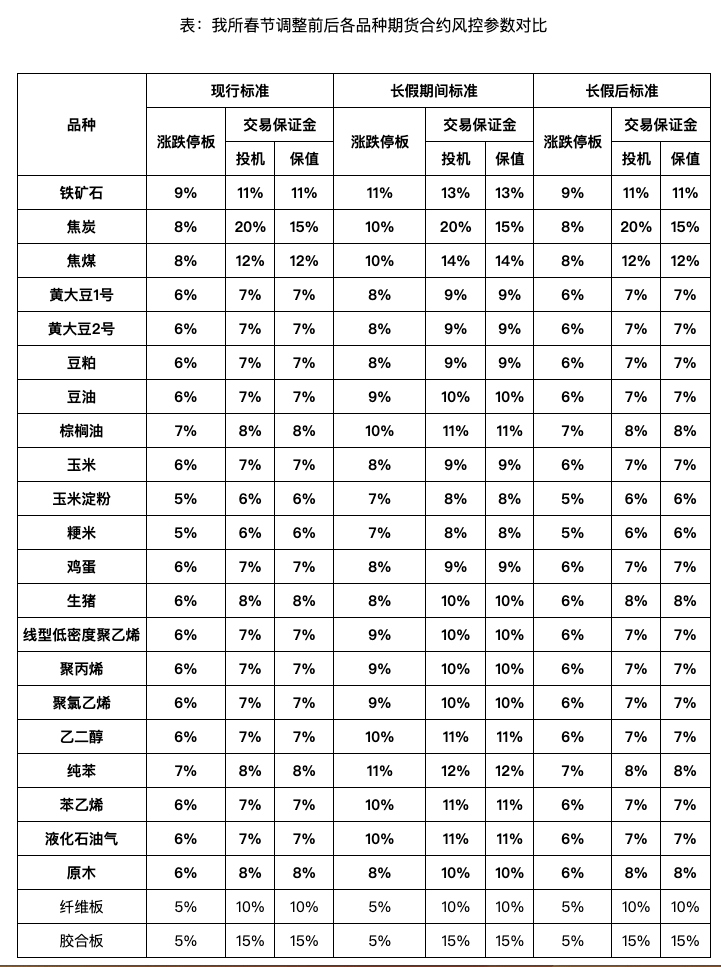
大商所公布春节假期风控安排
Qi Huo Ri Bao Wang· 2026-02-10 16:53
Group 1 - The Dalian Commodity Exchange announced adjustments to the price limit and margin levels for various futures contracts effective from February 12, 2026 [1] - Iron ore futures will have a price limit adjustment to 11% and a margin level set at 13% [1] - Coking coal and coke futures will have a price limit adjustment to 10%, with coking coal's margin level increased to 14% [1] Group 2 - Other agricultural futures such as soybeans, corn, and eggs will see price limit adjustments to 8% and margin levels set at 9% [1] - The trading margins for palm oil, ethylene glycol, styrene, and liquefied petroleum gas will be adjusted to 11% [1] - After the trading resumes on February 24, 2026, the price limits and margin levels for several futures contracts will revert to pre-holiday standards [2]
大商所:2026年春节假期调整铁矿石等相关品种期货合约涨跌停板幅度和交易保证金水平
Sou Hu Cai Jing· 2026-02-10 10:03
Core Viewpoint - The Dalian Commodity Exchange has announced adjustments to the price limit and margin levels for various futures contracts around the 2026 Spring Festival holiday, aimed at managing market risks effectively [2][3]. Group 1: Adjustments Before the Holiday - From February 12, 2026, the price limit for iron ore futures will be adjusted to 11%, with a margin level of 13% [2] - The price limit for coke and coking coal futures will be set at 10%, with the margin for coke remaining unchanged and that for coking coal adjusted to 14% [2] - For soybean and corn-related futures, the price limit will be adjusted to 8%, with a margin level of 9% [2] - Other commodities such as palm oil, ethylene glycol, and liquefied petroleum gas will have a price limit of 10% and a margin level of 11% [2] - The price limit for corn starch and japonica rice futures will be set at 7%, with a margin level of 8% [2] - The price limit for live pigs and logs will be adjusted to 8%, with a margin level of 10% [2] - The price limit for pure benzene futures will be set at 11%, with a margin level of 12% [2] - Other futures contracts will maintain their existing price limits and margin levels [2] Group 2: Adjustments After the Holiday - Trading will resume on February 24, 2026, with the price limits and margin levels for major contracts reverting to pre-holiday standards [3] - For contracts that meet the criteria for adjustment, the higher value between the specified limits will be applied [3] - Member units are advised to enhance risk management and ensure market stability [3]


大商所:2026年春节假期调整相关品种期货合约涨跌停板幅度和交易保证金水平
Sou Hu Cai Jing· 2026-02-10 09:28
Core Viewpoint - The Dalian Commodity Exchange announced adjustments to the price limit and margin levels for various futures contracts, effective from February 12, 2026, and will revert to pre-holiday standards after the trading resumes on February 24, 2026 [1][2]. Summary by Category Price Limit Adjustments - Iron ore futures price limit will be adjusted to 11% with a margin level of 13% - Coking coal and coke futures price limits will be set at 10%, with margin levels unchanged for coke and adjusted to 14% for coking coal - Soybean futures (both types), soybean meal, corn, and eggs will have a price limit of 8% and a margin level of 9% - Other commodities like palm oil, ethylene glycol, styrene, and liquefied petroleum gas will have a price limit of 10% and a margin level of 11% [1]. Margin Level Adjustments - The margin levels for corn starch and japonica rice will be set at 8% and 7% respectively - Live pigs and logs will have a price limit of 8% and a margin level of 10% - Pure benzene will have a price limit of 11% and a margin level of 12% - Other futures contracts will maintain their current price limits and margin levels [1][4]. Post-Holiday Adjustments - After the holiday, the price limits and margin levels for iron ore, coking coal, coke, soybeans, soybean meal, soybean oil, palm oil, corn, corn starch, japonica rice, eggs, live pigs, and several plastics will revert to pre-holiday standards - Other futures contracts will maintain their existing price limits and margin levels [2].
光期黑色:铁矿石基差及价差监测日报-20260210
Guang Da Qi Huo· 2026-02-10 05:31
1. Report Industry Investment Rating - No information provided 2. Core Viewpoints - The report provides daily monitoring data on iron ore basis and spreads, including futures contract prices, spreads, and basis data for various iron ore varieties [3][7][14] 3. Summary by Relevant Catalogs 3.1 Futures Contracts and Spreads - **Futures Contract Prices**: The closing prices of I05, I09, and I01 contracts are 761.5, 743.0, and 732.0 respectively, with changes of 1.0, 0.5, and -0.5 compared to the previous day [3] - **Contract Spreads**: The spreads of I05 - I09, I09 - I01, and I01 - I05 are 18.5, 11.0, and -29.5 respectively, with changes of 0.5, 1.0, and -1.5 compared to the previous day [3] 3.2 Basis - **Basis Data**: The basis data of various iron ore varieties are presented, including the current price, previous price, change, delivery cost, current basis, previous basis, and change. For example, the current basis of Carajás Fines is 58, with no change from the previous day [7] - **Basis Charts**: Charts are provided for different types of iron ore, such as Brazilian fines, Australian medium - grade fines, Australian low - grade fines, and domestic ores [9][10][11] 3.3 Exchange Rule Adjustments - **Increased Deliverable Varieties**: Four new deliverable varieties (Benxi Concentrate, IOC6, KUMBA, Ukrainian Concentrate) are added, with brand premiums of 0, effective from the I2202 contract. Additionally, four more varieties (Taigang Concentrate, Magang Concentrate, Minmetals Standard Fines, SP10 Fines) are added as deliverable varieties with brand premiums of 0, applicable to the I2312 and subsequent contracts [12] - **Brand Premium Adjustments**: Only PB Fines, BRBF, and Carajás Fines have a brand premium of 15 yuan/ton, while the rest of the deliverable brands have a brand premium of 0 yuan/ton [12] - **Quality Difference and Premium Adjustments**: The allowable range of iron grade is adjusted to ≥56%, and the allowable ranges of silica, alumina, phosphorus, and sulfur are set. The premium and discount rules for different intervals are more detailed. An X value is introduced to dynamically adjust the premium of the iron element, with different values determined based on the average settlement price of the nearest delivery - month contract [12] 3.4 Variety Spreads - **Spread Data**: The spreads between different iron ore varieties are presented, such as the spread between PB Lump and PB Fines, which is 82.0 today, an increase of 6.0 compared to the previous day [14] - **Spread Charts**: Charts are provided for different types of spreads, including lump - powder spreads, high - medium grade powder spreads, medium - low grade powder spreads, etc. [15][16][17]
瑞达期货铁矿石产业链日报-20260107
Rui Da Qi Huo· 2026-01-07 09:41
1. Report Industry Investment Rating - The report suggests a cautious and bullish stance on the iron ore market, with a reminder to pay attention to risk control [2]. 2. Core Viewpoints - The I2605 contract increased in price with rising positions. The macro - environment features a continued moderately loose monetary policy in 2026, which boosts market confidence. In terms of supply - demand, the iron ore shipments from Australia and Brazil decreased this period, while the arrivals increased. The blast furnace operating rate and molten iron output of steel mills increased slightly, and port inventories continued to rise. Although ports are in a stock - piling trend, mill inventories are at a medium - low level, with potential for future stockpiling. Technically, the 1 - hour MACD indicator of the I2605 contract shows that DIFF and DEA are rising [2]. 3. Summary of Each Section According to the Catalog 3.1 Futures Market - The closing price of the I main contract is 828.00 yuan/ton, up 27.00 yuan. The position volume is 666,581 hands, up 25,713 hands. The I 5 - 9 contract spread is 23.5 yuan/ton, up 2.50 yuan. The net position of the top 20 in the I contract is - 15,395 hands, up 4,518 hands. The Dalian Commodity Exchange warehouse receipts are 1,800.00 hands, down 600.00 hands. The Singapore iron ore main contract's quote at 15:00 is 109 US dollars/ton, up 2.53 US dollars [2]. 3.2 Spot Market - The price of 61.5% PB powder ore at Qingdao Port is 869 yuan/dry ton, up 8 yuan. The price of 60.5% Mac fines at Qingdao Port is 868 yuan/dry ton, up 7 yuan. The price of 56.5% Chaote powder ore at Jingtang Port is 771 yuan/dry ton, up 10 yuan. The basis of the I main contract (Mac fines dry ton - main contract) is 40 yuan, down 20 yuan. The 62% Platts iron ore index (the previous day) is 106.65 US dollars/ton, up 0.85 US dollars. The ratio of Jiangsu scrap steel to 60.5% Mac fines at Qingdao Port is 2.97, down 0.07. The estimated import cost is 861 yuan/ton, up 7 yuan [2]. 3.3 Industry Situation - The global iron ore shipment volume (weekly) is 3,213.70 tons, down 463.40 tons. The arrival volume at 47 ports in China (weekly) is 2,824.70 tons, up 96.90 tons. The iron ore inventory at 47 ports (weekly) is 16,721.79 tons, up 101.83 tons. The iron ore inventory of sample steel mills (weekly) is 8,946.54 tons, up 86.35 tons. The iron ore import volume (monthly) is 11,054.00 tons, down 77.00 tons. The available days of iron ore (weekly) are 22 days, up 5 days. The daily output of 266 mines (weekly) is 36.56 tons, down 0.25 tons. The operating rate of 266 mines (weekly) is 0.00%, down 58.66%. The iron concentrate inventory of 266 mines (weekly) is 0.00 tons, down 45.90 tons. The BDI index is 1,830.00, down 21.00. The iron ore freight rate from Tubarao, Brazil to Qingdao is 22.20 US dollars/ton, up 0.26 US dollars. The iron ore freight rate from Western Australia to Qingdao is 8.13 US dollars/ton, down 0.17 US dollars [2]. 3.4 Downstream Situation - The blast furnace operating rate of 247 steel mills (weekly) is 78.96%, up 0.66%. The blast furnace capacity utilization rate of 247 steel mills (weekly) is 85.28%, up 0.32%. The domestic crude steel output (monthly) is 6,987 tons, down 213 tons [2]. 3.5 Option Market - The 20 - day historical volatility of the underlying (daily) is 16.95%, up 3.10%. The 40 - day historical volatility of the underlying (daily) is 14.73%, up 2.14%. The implied volatility of at - the - money call options (daily) is 17.24%, up 0.80%. The implied volatility of at - the - money put options (daily) is 19.72%, up 2.82% [2]. 3.6 Industry News - From December 29, 2025, to January 4, 2026, the total iron ore inventory at seven major ports in Australia and Brazil was 1,158.3 tons, a week - on - week increase of 56.1 tons, showing a slight rebound. The current inventory is slightly lower than the average since the fourth quarter. On January 5, Australian iron ore producer Fenix Resources released its Q4 2025 operations update. The company shipped 1.241 million wet tons of iron ore in the quarter, breaking through one million tons in a single quarter for the first time and setting a new record [2].
【大宗周刊】依托港口场景优势,打造铁矿石期现结合新范式
Qi Huo Ri Bao· 2025-12-07 00:14
Core Viewpoint - The article discusses the critical role of Shandong Port in ensuring stable iron ore supply for China's steel industry amidst global economic changes and the industry's transformation challenges [1][2]. Group 1: Importance of Iron Ore Supply - China, as the world's largest steel producer, has a high dependence on imported iron ore, making the stability of its supply crucial for national industrial chain security and economic development [1]. - Shandong Port has become a key center for iron ore unloading, transshipment, storage, and trading, accounting for approximately 25% of the country's total iron ore imports [1]. Group 2: Financial Innovations by Gangxin Capital - Gangxin Capital, a subsidiary of Shandong Port Group, integrates physical logistics, inventory management, and risk management through futures and derivatives to create a stable and efficient iron ore supply chain service [1][2]. - The company analyzes international iron ore prices, shipping costs, and exchange rates to lock in costs for steel mills, transforming market volatility into predictable profits [2]. Group 3: Supply Chain Resilience - The model developed by Gangxin Capital allows steel mills to purchase iron ore directly from existing stock at the port, enhancing supply chain resilience and ensuring material availability without lengthy procurement processes [3]. - This approach effectively supports steel mills' low inventory strategies while maintaining supply security [3]. Group 4: Cost Optimization for Steel Mills - Gangxin Capital's pricing model allows steel mills to lock in future procurement costs while only requiring a small margin payment, significantly improving cash flow and reducing financial pressure [4]. - The "port inventory + basis point pricing" model enables steel mills to choose optimal pricing points based on market conditions, mitigating the risk of rising procurement costs [4]. Group 5: Benefits to Stakeholders - The innovative model creates a positive feedback loop, increasing throughput and inventory turnover for Shandong Port while providing steel mills with stable supply and reduced average procurement costs [5][6]. - Gangxin Capital has supplied approximately 800,000 tons of iron ore to steel mills, saving over 10 million yuan in procurement costs [6]. Group 6: Future Outlook - Gangxin Capital aims to continue serving the steel, chemical, and grain industries in Shandong and surrounding areas, adapting its successful iron ore model to other commodities [7]. - The company plans to enhance its financial toolkit and develop tailored risk management solutions for clients, reinforcing its commitment to supporting the real economy and ensuring supply chain stability [7].
黄金超买风险或得到一定的释放
HTSC· 2025-11-23 13:06
- The report introduces three quantitative models: Commodity Term Structure, Commodity Time-Series Momentum, and Commodity Cross-Sectional Inventory. These models are combined into a Composite Commodity Strategy using equal weighting of the three sub-strategies[25][26][28] - **Commodity Term Structure Model**: This model is constructed based on the roll yield factor to capture the contango and backwardation states of commodities. It dynamically goes long on commodities with high roll yields and short on those with low roll yields[26][30][33] - **Commodity Time-Series Momentum Model**: This model uses multiple technical indicators to capture medium- and long-term trends in domestic commodities. It dynamically goes long on assets with upward trends and short on assets with downward trends[26][35][36] - **Commodity Cross-Sectional Inventory Model**: This model is based on the inventory factor to reflect changes in the domestic commodity fundamentals. It dynamically goes long on assets with declining inventory and short on assets with increasing inventory[26][40][43] - **Evaluation of Models**: The Commodity Term Structure Model is noted for its strong performance, achieving a new high in net value during backtesting. The Time-Series Momentum Model has shown weaker performance recently, while the Cross-Sectional Inventory Model has demonstrated moderate gains[25][35][40] - **Backtesting Results**: - Commodity Term Structure Model: Two-week return of 2.31%, year-to-date return of 7.46%[30][33][34] - Commodity Time-Series Momentum Model: Two-week return of -0.38%, year-to-date return of -3.19%[35][36][39] - Commodity Cross-Sectional Inventory Model: Two-week return of 0.98%, year-to-date return of 5.43%[40][43][44]
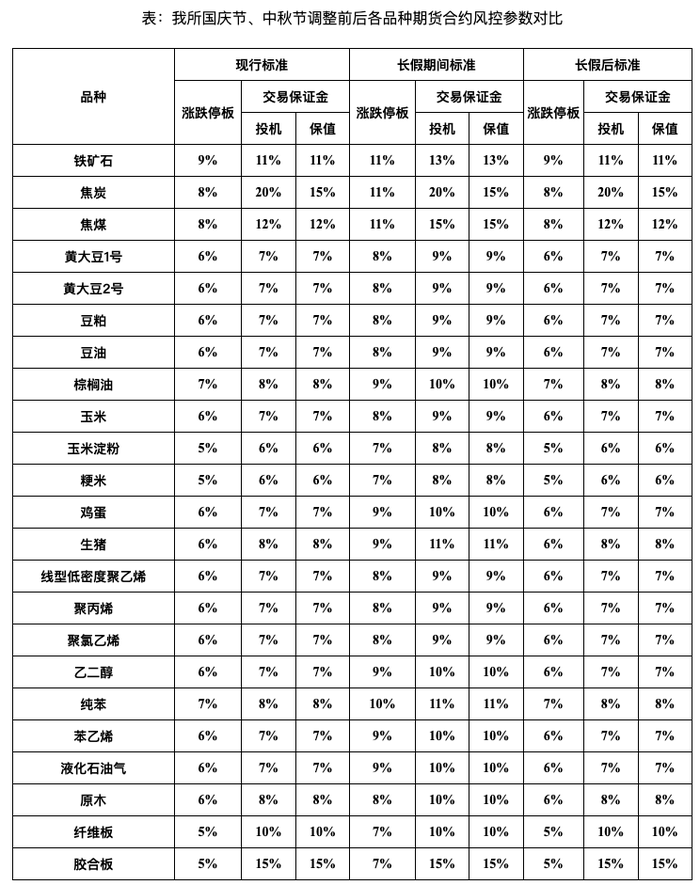
大商所:2025年国庆节、中秋节假期调整相关品种期货合约涨跌停板幅度和交易保证金水平
Sou Hu Cai Jing· 2025-09-24 11:33
Core Points - The Dalian Commodity Exchange announced adjustments to the price limit and margin levels for various futures contracts before and after the 2025 National Day and Mid-Autumn Festival holidays [1][2] Group 1: Adjustments Before the Holidays - From September 29, 2025, the price limit for iron ore futures will be adjusted to 11%, with a margin level of 13% [1] - The price limit for coking coal futures will also be set at 11%, with a margin level adjusted to 15% [1] - For soybean futures (both No. 1 and No. 2), the price limit will be 8%, and the margin level will be 9% [1] - Other commodities such as palm oil, eggs, and ethylene glycol will have a price limit of 9% and a margin level of 10% [1] - The price limit for corn starch and japonica rice will be set at 7%, with a margin level of 8% [1] - The price limit for live pigs will be 9%, with a margin level of 11% [1] - The price limit for pure benzene will be adjusted to 10%, with a margin level of 11% [1] - For fiberboard and plywood, the price limit will be 7%, with the margin level remaining unchanged [1] Group 2: Adjustments After the Holidays - Trading will resume on October 9, 2025, with the price limits and margin levels for various futures contracts returning to pre-holiday standards [2] - This includes iron ore, coking coal, and various agricultural products, which will revert to their previous price limits and margin levels [2] Group 3: Comparison of Risk Control Parameters - A detailed comparison table outlines the changes in price limits and margin levels for each commodity before, during, and after the holiday period [3][4] - The adjustments reflect a strategic response to market conditions and risk management practices as per the Dalian Commodity Exchange's regulations [4]
期货收评:多晶硅、集运盘中巨震 多晶硅企稳4.2万关口后拉升
news flash· 2025-07-16 07:05
Group 1: Black Materials Market - The black building materials market is experiencing a high-level retreat, with coking coal and coke prices dropping nearly 2% [1] - Iron ore prices have risen to a four-month high, supported by a decrease in global iron ore shipments and a decline in port inventories [3][5] - The demand for iron ore remains supported despite a decrease in pig iron production and high furnace operating rates, indicating a potential for continued price strength [5] Group 2: Polysilicon Market - Polysilicon prices have shown volatility, with a significant intraday increase of over 2%, currently reported at 43,200 yuan/ton [6] - The market anticipates potential policy changes regarding capacity exit, which could open up price levels to 45,000 yuan/ton if supported by various factors [8] - The industry is closely monitoring downstream demand and pricing dynamics, as well as upcoming policy meetings that may influence market sentiment [8][9] Group 3: Shipping and Logistics - The European shipping index saw an increase of over 8% due to geopolitical tensions in the Middle East, although it later stabilized to less than 2% [10] - The rise in the shipping index is also attributed to the recovery of the U.S. economy, which has boosted international trade demand [10] - Analysts expect the European shipping index to maintain a fluctuating upward trend, influenced by geopolitical developments and economic recovery [10]