问界 M9

Search documents
整车强势反弹-后市怎么看
2026-03-19 02:39
Summary of Conference Call Records Industry Overview - The automotive industry is experiencing a recovery in demand as of March 2026, with customer traffic nearing levels seen at the end of 2025, although still 10%-15% lower year-on-year [1][2] - The inventory pressure among leading new energy vehicle manufacturers is significant, with a combined inventory of approximately 900,000 units, and companies like BYD, Geely, and Leap Motor having inventory-to-sales ratios above 2.5 [1][3] Key Insights and Arguments - **BYD's Flash Charging Technology**: BYD's flash charging technology, which integrates "vehicle + charging pile + battery," is expected to drive monthly sales increases of 15,000 to 20,000 units for new models like the Yuan MAX [1][8] - **Xpeng's V2V22.0**: The launch of Xpeng's V2V22.0 has doubled store traffic, although order conversion rates still depend on word-of-mouth effects [1][2] - **Sales Forecasts**: Passenger car sales are expected to decline by over 10% in Q1 2026, with retail sales anticipated to remain flat or slightly decrease year-on-year due to purchasing power constraints [1][5] - **Export Trends**: Companies like SAIC, BYD, Chery, and Geely have competitive advantages in exports due to their own shipping fleets and established overseas channels [1][2] Market Dynamics - **Inventory Levels**: Major new energy manufacturers have high inventory levels, with BYD holding around 400,000 to 500,000 units, primarily in lower-end models. The inventory-to-sales ratio for BYD is expected to drop below 2.5 if March sales reach 220,000 to 250,000 units [3][4] - **Market Recovery Factors**: The recovery in the market is driven by local consumption subsidy policies and the impact of technology launch events, which have significantly increased customer traffic [2][3] - **Future Sales Expectations**: The overall passenger car market is expected to face challenges in Q1 2026, but a more vibrant market is anticipated in Q2 with numerous new product launches [5][6] Government Policies and Their Impact - The total amount for the 2026 consumer goods replacement subsidy is projected to be 250 billion yuan, which is expected to provide direct cash support for vehicle sales [6] - The extension of the personal consumption car loan interest subsidy policy may also support sales, but overall retail sales are expected to remain flat or slightly decrease [6] Competitive Landscape - **BYD vs. Geely**: BYD's rapid advancement in flash charging technology and ecosystem development is contrasted with Geely's slower progress in fast charging and energy supply networks [9][10] - **Emerging Players**: Companies like NIO and Leap Motor are highlighted as potential industry leaders due to their focus on core automotive manufacturing and competitive pricing strategies [14][15] Export Potential - **Leap Motor's Export Performance**: Leap Motor has shown strong export performance, with over 100,000 units exported, and has partnered with Stellantis for overseas expansion [15] Conclusion - The automotive industry is navigating a complex landscape of recovery, inventory management, and technological advancements, with significant implications for sales and market dynamics in 2026. The focus on new energy vehicles and competitive strategies will be crucial for companies aiming to capture market share in both domestic and international markets.

405批新车公告:800Km+竞逐升温,弗迪、宁德、中航等抓紧配套
高工锂电· 2026-03-17 10:19
Core Viewpoint - The article highlights the increasing competition in the electric vehicle (EV) market, focusing on advancements in battery technology, longer ranges, and faster charging capabilities, with a notable shift towards high-end models and significant changes in subsidy policies affecting market dynamics [1][4]. Group 1: New Vehicle Announcements - The Ministry of Industry and Information Technology announced 82 new vehicles, with 61 models equipped with LFP batteries and 18 with ternary batteries, indicating a strong presence of various battery technologies [1]. - BYD leads with 30 new models, primarily plug-in hybrid vehicles, making up 75% of its offerings in this announcement [1]. - CATL follows with new models including the D19 SUV and D99 MPV, showcasing its dual-core battery technology [2]. Group 2: Battery Technology and Performance - The latest models, such as the Huawei's AWE2026 showcased the Shangjie Z7 with a range of 905 km, indicating a trend towards higher capacity batteries [3]. - The competition among pure electric vehicles is intensifying, with ranges between 800-1000 km and fast charging capabilities exceeding 800V becoming the new standard [3]. Group 3: Market Trends and Future Projections - The proportion of B-class and above vehicles is projected to rise from 40.8% in 2023 to 51.4% by 2025, driven by new subsidy policies that favor higher-priced vehicles [4]. - By February 2026, C-class passenger vehicles are expected to account for 59% of market sales, indicating a shift towards the mid to high-end market segment [4]. - Major brands like Tengshi, Xiaomi, and BMW are launching 900 km pure electric models, primarily in the high-end segment, supported by leading battery suppliers [4].

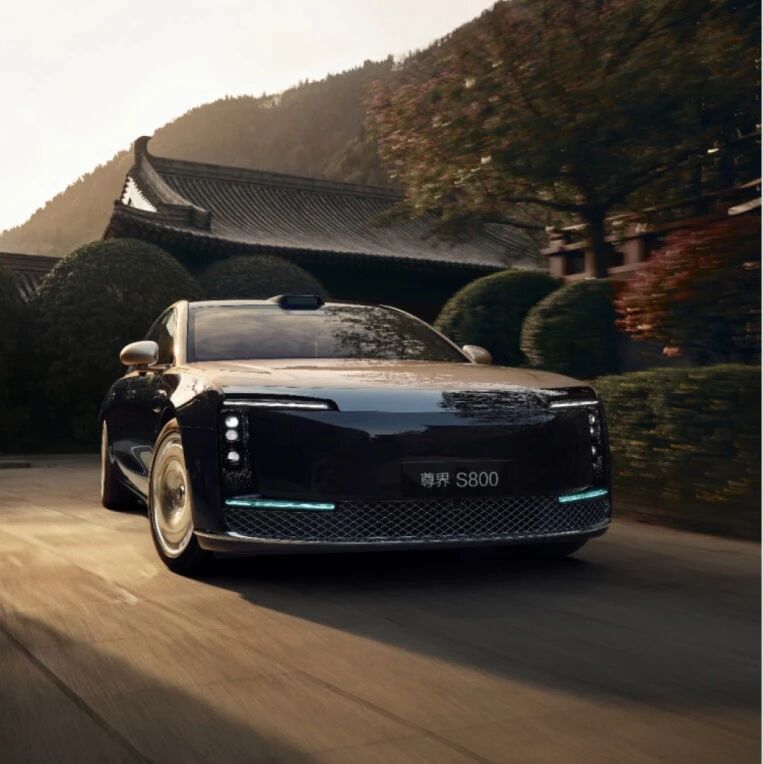
尊界 S800 首搭新一代双光路图像级激光雷达,产品体验的二次跨越
晚点LatePost· 2026-03-06 12:28
Core Viewpoint - The article highlights Huawei's advancements in the luxury automotive market, particularly through its flagship model, the Zun Jie S800, which has achieved significant sales and technological milestones, redefining competition in the ultra-luxury segment [3][12]. Group 1: Product Launch and Technology - Huawei's Hongmeng Zhixing has launched the world's highest production line laser radar with 896 lines, enhancing core perception technology [2][3]. - The new laser radar is integrated into the Zun Jie S800 and the Wenjie M9, improving perception and active safety capabilities [3][4]. - The dual-light path architecture of the new laser radar allows for independent control of wide-angle and telephoto laser reception, significantly enhancing imaging quality and detail recognition [6][8]. Group 2: Market Positioning and Strategy - The Zun Jie S800 aims to establish a technological benchmark in the ultra-luxury market rather than merely focusing on sales volume [5][12]. - The vehicle features advanced technologies such as the Huawei Tuling Longxing platform and the Angel Seat active safety system, which enhances user experience and safety [5][10]. - The Zun Jie S800 has delivered 15,000 units since its launch, indicating a strong market presence [5]. Group 3: User Demographics and Preferences - The primary user demographic for the Zun Jie S800 consists of high-net-worth males aged 40-50, many of whom have previously owned luxury brands like Rolls-Royce and Porsche [9]. - These users prioritize comprehensive driving experiences and safety over brand prestige, reflecting a shift in consumer expectations in the luxury automotive market [9][10]. Group 4: Technological Advancements and Safety Features - The upgraded ADS 4.1 system has improved safety metrics, with the average distance driven before a serious collision increasing from 7.09 million kilometers to 10.46 million kilometers, a 48% improvement [15]. - The Zun Jie S800 incorporates a comprehensive safety system that autonomously prepares for unavoidable collisions, enhancing passenger safety [10][12]. Group 5: Collaborative Ecosystem and Industry Impact - Huawei's collaboration with various automotive manufacturers has led to a transformation in China's automotive supply chain, pushing over 220 component manufacturers towards high-end production [18]. - The integration of Huawei's technology and market strategies is aimed at fostering high-quality development in the Chinese automotive industry, establishing a robust ecosystem for innovation and collaboration [17][18].
造车下半场,不再有弯道超车
晚点LatePost· 2026-02-28 10:30
Core Viewpoint - The resilience of business models is more crucial than product specifications in determining the survival quality of companies in the era of refined competition in the automotive industry [2] Group 1: Market Positioning and Brand Recognition - By 2026, the Spring Festival Gala seat has become a scarce commercial asset for the automotive industry, showcasing brands that have crossed the million sales threshold and their market ambitions [3] - Hongmeng Zhixing has transformed from a "cross-border entrant" to a "market leader," reflecting profound changes in the automotive industry's development logic [3][4] Group 2: Technological Advancements and R&D Investment - Hongmeng Zhixing possesses a unique advantage as the only automotive brand displayed and sold in Huawei stores, supported by Huawei's extensive R&D investment exceeding 50 billion yuan since 2019 in areas like assisted driving and intelligent cockpit [5] - The Tuling platform integrates multiple intelligent core components, significantly enhancing vehicle response speed and control precision, with a minimum decision chain delay of under 1 millisecond [5] - The Star River communication function showcases Huawei's deep expertise in communication, improving signal coverage by over 14% and reducing network switching delay to within 1.2 seconds [6] Group 3: Consumer Trust and Market Dynamics - The shift in consumer mindset towards cautious observation has increased the demand for brand stability and service continuity, making Hongmeng Zhixing's association with Huawei's robust business model appealing [9] - The high resale value and net promoter score (NPS) of models like the Wenjie M9 reflect consumer trust and satisfaction, driven by continuous software updates and standardized service delivery [10][11] Group 4: Sales Performance and Data Utilization - Hongmeng Zhixing achieved over 1 million deliveries in record time, with the Wenjie M7 surpassing 400,000 units and the Wenjie M8 and M9 targeting significant sales milestones [14] - The cumulative assisted driving mileage reached 7.013 billion kilometers, with a user activity rate of 98%, demonstrating the brand's data-driven growth and technological advantages [16] Group 5: Industry Impact and Ecosystem Development - The development of the flagship model, the Zun Jie S800, exemplifies a collaborative approach that has led to breakthroughs for over 200 suppliers, enhancing the local high-end manufacturing and intelligent networking industry [18] - Hongmeng Zhixing is not just creating automotive products but building a complete technology ecosystem that includes chips, operating systems, and cloud services, fostering a collaborative model that enhances the entire supply chain [22] Group 6: Future Outlook and Competitive Landscape - The automotive market is transitioning from a product-driven to a brand-driven model, with Hongmeng Zhixing establishing a comprehensive business model that emphasizes sustainable growth through a complete closed-loop system [24] - The achievement of one million sales marks a pivotal moment for the Chinese smart electric vehicle industry, indicating a shift in competitive dynamics where companies lacking systematic capabilities will struggle to compete [25]
科技大事件 丨 苹果 iPhone 18 Pro 系列起售价将与前代持平;雷军宣布初代小米 SU7 正式停产
Sou Hu Cai Jing· 2026-02-11 04:15
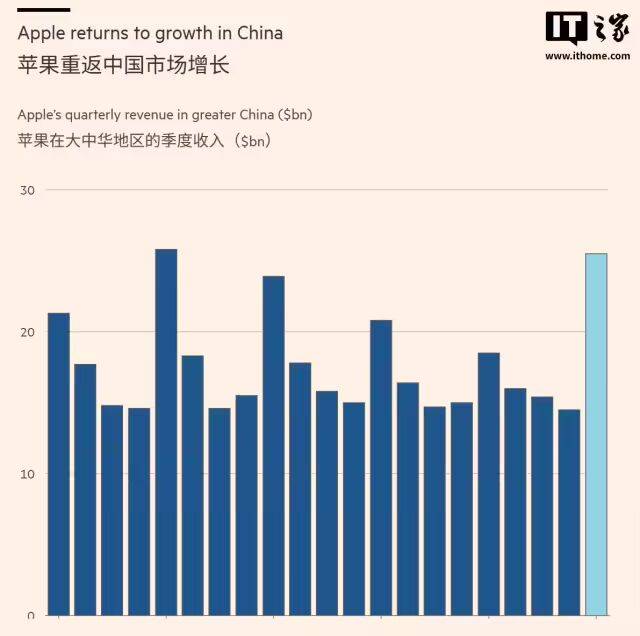
Group 1: Apple iPhone 18 Pro Series Pricing and Sales Performance - Apple plans to keep the starting price of the upcoming iPhone 18 Pro and iPhone 18 Pro Max the same as the iPhone 17 Pro series, focusing on cost control amid rising DRAM and NAND chip prices [1][2] - Analysts predict that Apple is negotiating with Samsung and SK Hynix for better memory chip procurement prices and will seek to reduce costs for other key components like displays and cameras [1][2] - The iPhone 17 series has seen a strong rebound in sales in China, ending a three-year decline, with the "Starry Orange" color variant driving significant consumer interest [1][2] Group 2: Apple Developer Commitments in Response to UK Antitrust Investigation - Apple and Google have made four commitments to third-party developers in response to the UK Competition and Markets Authority (CMA) investigation, ensuring fair and transparent app store review processes [5][6] - The commitments include fair evaluation methods for app store rankings and protection of data collected from third-party developers during the review process [6][7] - Developers will have easier access to unique iOS features to enhance interoperability, with a deadline for Apple to implement these measures by April 1 [7] Group 3: iPhone 17 Pro Max Battery Performance - Recent tests show that the iPhone 17 Pro Max has approximately three more hours of usage time on WiFi compared to 5G networks, highlighting the efficiency of WiFi [8] - The tests were conducted under simulated daily usage scenarios, indicating that the performance may vary based on location and network conditions [8] Group 4: Xiaomi SU7 Electric Vehicle Developments - The new Xiaomi SU7 electric vehicle will offer three battery options with ranges from 630 km to 902 km, reflecting significant improvements in battery technology [9][10] - The standard and Pro versions of the SU7 have upgraded to a 752V high-voltage platform, enhancing fast-charging capabilities [10] - Xiaomi's founder announced the end of production for the initial SU7 model, which saw nearly 370,000 units produced [11][12] Group 5: BYD's Legal Challenge Against US Tariffs - BYD has filed a lawsuit against the US government regarding tariffs imposed by the Trump administration, seeking a refund for taxes paid since April 2025 [13] - This marks the first legal challenge by a Chinese automaker against US tariffs, despite BYD not currently selling passenger vehicles in the US [13]

汽车行业周报:政策托底静待反弹,关注海外电动化
Guoyuan Securities· 2026-01-26 06:24
Investment Rating - The report maintains a "Recommended" investment rating for the automotive industry [6] Core Insights - The automotive market is experiencing significant negative growth, with retail sales of passenger vehicles dropping by 28% year-on-year in the first half of January 2026, and wholesale sales declining by 35% [1][19] - The report emphasizes the need for supportive policies to stimulate market recovery and highlights the potential for growth in the overseas electric vehicle market due to favorable policies in countries like Canada and Germany [3][4] - The report suggests that the domestic market may rebound following the implementation of supportive policies, which could positively impact leading brands [4] Summary by Sections Market Overview - As of January 1-18, 2026, retail sales of passenger vehicles in China reached 679,000 units, a decrease of 28% compared to the same period last year, while wholesale sales totaled 740,000 units, down 35% year-on-year [1][19] - In the same period, retail sales of new energy vehicles were 312,000 units, reflecting a 16% decline year-on-year, and wholesale sales were 348,000 units, down 23% [1][19] Policy Developments - Canada announced plans to import 49,000 electric vehicles from China, significantly reducing tariffs from 100% to 6.1% [3] - Germany introduced a new subsidy program for electric vehicles, offering up to 6,000 euros to families purchasing new electric cars, effective from January 1, 2026 [3][44] - The UK government has launched a substantial subsidy program for electric trucks, with a total budget of 318 million pounds [48] Investment Opportunities - The report highlights the potential for Chinese new energy vehicles to expand into overseas markets, driven by favorable international policies [4] - It suggests that the recovery of the domestic automotive market could benefit leading brands significantly [4]




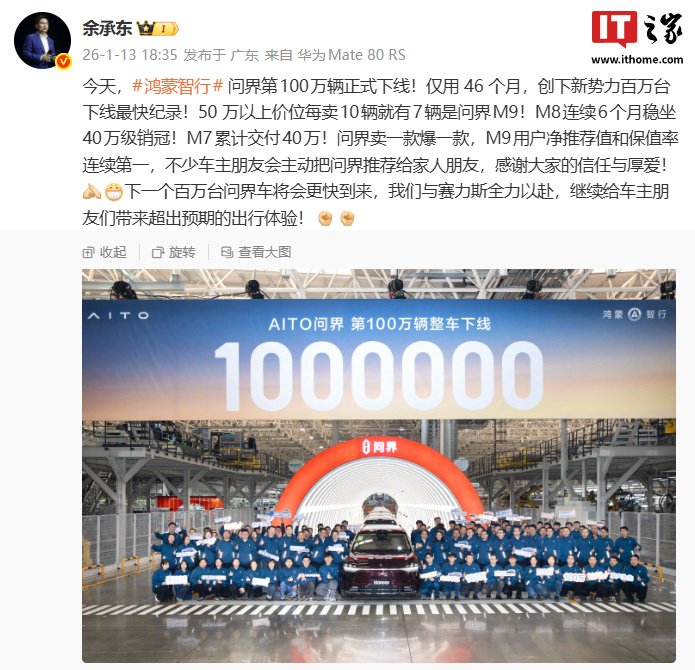
华为余承东:鸿蒙智行问界 100 万辆下线创新势力最快纪录,50 万以上每卖 10 辆有 7 辆是问界 M9
Xin Lang Cai Jing· 2026-01-13 11:27
Core Insights - Huawei's AITO brand has achieved a significant milestone with the production of its 1 millionth vehicle, setting a record for the fastest time to reach this figure among new energy vehicle manufacturers, taking only 46 months [1][6]. Group 1: Sales Performance - Among vehicles priced above 500,000, 70% of sales are attributed to the AITO M9 model, indicating strong market demand [3][8]. - The AITO M8 has maintained its position as the sales champion in the 400,000 price segment for six consecutive months [3][8]. - Cumulative deliveries of the AITO M7 have reached 400,000 units, showcasing the brand's growing popularity [3][8]. Group 2: Customer Satisfaction and Future Outlook - The AITO M9 has achieved the highest net promoter score and resale value in its category, reflecting strong customer satisfaction [3][8]. - The company anticipates that the next million AITO vehicles will be produced even more rapidly, indicating confidence in continued growth [3][8].

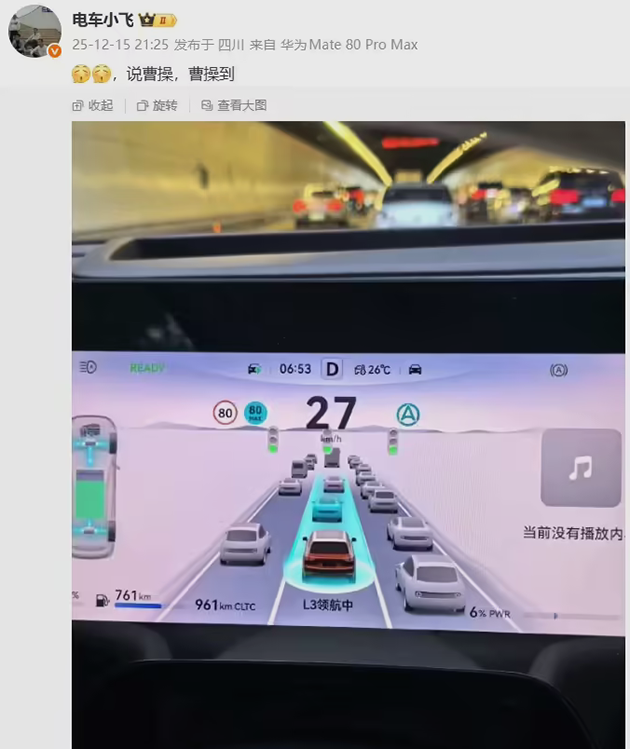
问界 M9 L3内测界面曝光 隧道+拥堵场景限速80km/h
Xin Lang Cai Jing· 2025-12-17 14:24
Core Viewpoint - The recent developments in L3 conditional autonomous driving in China, particularly involving Huawei's vehicles, signify a major step towards commercial application in the automotive industry [3][7]. Group 1: L3 Autonomous Driving Testing - Huawei's Hongmeng Zhixing has initiated L3 level conditional autonomous driving testing in collaboration with the Shenzhen Municipal Transportation Bureau and other relevant departments [3][7]. - The pilot program covers all high-speed roads in Shenzhen, totaling 1,000 kilometers, with Huawei employees participating using the 2025 model of the AITO Wenjie M9 and the AITO Zunji S800 [3][7]. Group 2: Regulatory Milestones - On December 15, the Ministry of Industry and Information Technology officially announced the first batch of L3 conditional autonomous driving vehicle permits in China, marking a transition from testing to commercial application [3][7]. - Two models suitable for urban congestion and highway scenarios will be tested in designated areas of Beijing and Chongqing [3][7]. Group 3: User Interaction Features - The L3 exclusive human-machine interaction interface of Huawei's Qian Kun Zhijia ADS has been made public, featuring a voice reminder that activates when L3 autonomous driving is engaged [3][7].
汽车行业双周报(20251124-20251207):看好高端车市场自主品牌崛起-20251210
Hua Yuan Zheng Quan· 2025-12-10 14:52
Investment Rating - The investment rating for the automotive industry is "Positive" (maintained) [1] Core Viewpoints - The market space for high-end vehicles priced above 400,000 yuan is stable, with expectations for increased penetration of new energy vehicles driven by the growth of pure electric models [4][7] - The competitive landscape shows that foreign brands dominate, but domestic brands are rapidly increasing their market share, reaching 40.9% in the high-end segment [24][26] - The competition factors are shifting from brand and performance parameters to technology attributes and emotional experiences, favoring domestic brands in the current market [30][38] Summary by Sections Market Space - The high-end vehicle market (above 400,000 yuan) has maintained annual sales between 700,000 to 1,200,000 units since 2018, accounting for over 5% of total vehicle sales [4][7] - In 2025, the cumulative sales of high-end vehicles from January to October reached 588,000 units, a year-on-year increase of 0.6% [7] - The penetration rate of new energy vehicles in this segment is expected to exceed 50% by 2026, driven by improvements in charging efficiency and infrastructure [21][24] Competitive Landscape - As of 2025, foreign brands hold a 59.1% market share in the high-end segment, with traditional brands like BBA (Benz, BMW, Audi) accounting for over 40% [24][26] - Domestic brands, led by Li Auto, NIO, and Seres, have seen their market share increase significantly since 2021, with a cumulative increase of 39.1 percentage points [24][26] Competition Factors - The automotive market is transitioning from valuing brand reputation and mechanical performance to prioritizing technological innovation and user experience [30][38] - Consumers are increasingly willing to pay for vehicles that offer superior technological features and emotional engagement, reflecting a shift in purchasing behavior [30][36] Investment Analysis - The stable market space for high-end vehicles, combined with the relatively low market share of domestic brands, presents significant growth opportunities for these companies [4][43] - The upcoming reduction in new energy vehicle purchase tax subsidies and the phasing out of trade-in incentives are expected to have a limited impact on the high-end market, enhancing profitability [43]

小米还有 3 款重磅新车要发布,更卷了
3 6 Ke· 2025-12-10 02:29
Industry Overview - The automotive industry is expected to face intense competition in 2026, characterized by price wars and a shift from growth to maintaining existing market share [2][3][10] - Policy changes are anticipated to reduce incentives, potentially weakening consumer demand and price competitiveness [2][3] Competitive Landscape - Major brands are preparing for a "sea of cars" strategy, with numerous new models set to launch, increasing competition [7][10] - Xiaomi is positioned to compete aggressively, having already delivered over 500,000 vehicles since April 2024, with a monthly delivery rate exceeding 40,000 units [12][29] Xiaomi's New Models - Xiaomi plans to release three significant new models: the YU9 (a range-extended flagship SUV), YU7 GT (a high-performance SUV), and SU7 L (a long-wheelbase executive sedan) [16][25] - The YU9 is expected to feature a length of over 5.2 meters and target family users, competing with models like Li Auto L9 and Aito M9 [19] - The YU7 GT aims for high performance, potentially exceeding 1,000 horsepower, and will compete with Tesla's Model Y performance version [21] - The SU7 L focuses on luxury and rear space, with a length surpassing 5.2 meters, drawing comparisons to the Porsche Panamera [27] Market Expectations - There is a high market expectation for Xiaomi's vehicles, with the main challenge being production capacity as the company expands its manufacturing facilities [29][31] - If Xiaomi can enhance its price competitiveness in the upcoming year, it may further solidify its position in the market [31]