
风电)

Search documents
内蒙古沙戈荒绿电涌动,“十五五”迎来新一轮特高压建设高峰
Xin Lang Cai Jing· 2026-02-15 11:47
Core Viewpoint - The Inner Mongolia Energy Bureau has received approval from the National Energy Administration for the power supply plans of the Kubuqi electricity transmission projects to Shanghai and Jiangsu, with construction expected to start by the end of 2026 [1] Group 1: Project Overview - The Kubuqi electricity transmission project to Shanghai plans to build 8 million kilowatts of solar power, 4.5 million kilowatts of wind power, 2.64 million kilowatts of supporting coal power, and 900 megawatt-hours of new energy storage, with a total investment of approximately 63.2 billion yuan [1] - The Kubuqi electricity transmission project to Jiangsu plans to build 8 million kilowatts of solar power, 4 million kilowatts of wind power, 2.64 million kilowatts of supporting coal power, and 816 megawatt-hours of new energy storage, with a total investment of approximately 64.2 billion yuan [1] - Upon completion, these projects are expected to deliver approximately 72 billion kilowatt-hours of electricity annually to the East China region, with over 60% coming from renewable energy sources [1] Group 2: Regional Energy Development - Inner Mongolia has been approved for six national-level desert renewable energy bases, with a total planned renewable energy installed capacity of 72 million kilowatts [2] - The development of large-scale wind and solar bases in desert areas will lead to a new phase of explosive growth in Inner Mongolia's UHV (Ultra High Voltage) power grid construction [2] - The State Grid Mengdong Electric Power Company plans to construct 12 UHV transmission line projects during the 14th Five-Year Plan period, which will significantly increase the external electricity delivery capacity [2] Group 3: Future Projections - After the completion of the "Six AC and Six DC" projects, along with the existing "Five AC and Three DC" lines, the total delivery capacity of Inner Mongolia's UHV power grid will reach 96.7 million kilowatts [3] - The external electricity delivery volume from Inner Mongolia is expected to exceed 1 trillion kilowatt-hours during the 14th Five-Year Plan period, with 11 provinces and cities receiving power [3] Group 4: Specific Projects and Timelines - The Kubuqi-Shanghai UHV DC transmission project, known as "Mengdian into Shanghai," is crucial for Shanghai's future economic and energy security, with an expected annual delivery of 40 billion kilowatt-hours upon full operation [4] - The Jiangsu project is expected to enhance the province's electricity balance capabilities by the end of 2027 [4] - The project to deliver electricity from the Inner Mongolia desert base to East China is included in the national power development plan, with construction expected to begin in 2025 [4]
建投能源(000600):建投能源:冀电龙头 擎势腾飞
Xin Lang Cai Jing· 2026-02-05 06:35
Core Viewpoint - The company, Jiantou Energy, has demonstrated strong performance in the thermal power sector, particularly in Hebei, benefiting from a stable pricing environment and significant cost reductions, leading to a remarkable year-on-year profit increase of 231.79% in the first three quarters of 2025 [1] Group 1: Company Performance - Jiantou Energy's strong performance in 2022 was attributed to its cost advantages and certainty in a challenging industry environment [1] - The company is expected to maintain a competitive edge in the thermal power market due to the tight supply-demand situation in Hebei, which supports regional electricity prices [2] - In the first half of 2025, the company's thermal power on-grid electricity price was 440.19 yuan per megawatt-hour, showing only a slight decrease compared to the previous year, indicating price stability [2] Group 2: Project Development - The company is advancing several thermal power projects, including the 1.32 million kilowatt Xibaipo Phase IV and the 700,000 kilowatt Renqiu Thermal Power Phase II, which are expected to enhance its installed capacity by 34% upon completion [3] - Jiantou Energy has significant renewable energy projects, with 687,000 kilowatts of photovoltaic capacity and 135,000 kilowatts of wind power capacity, which are anticipated to contribute to future growth [3] - The company has additional photovoltaic projects with a capacity of 1.91 million kilowatts in reserve, indicating strong potential for rapid growth in the renewable sector [3] Group 3: Investment Outlook - The company is expected to enter a clear growth phase in 2026, supported by a robust project pipeline and a stable pricing environment [4] - Earnings per share (EPS) forecasts for 2025, 2026, and 2027 are projected at 1.04 yuan, 0.88 yuan, and 1.09 yuan, respectively, with corresponding price-to-earnings (PE) ratios of 8.13, 9.66, and 7.75 [4] - The company has been rated "buy" based on its operational performance and development plans [4]

贺克斌:迈向碳中和,技术依赖成全球能源竞争新焦点
2 1 Shi Ji Jing Ji Bao Dao· 2025-12-18 11:56
Core Insights - The world economy is shifting from "resource dependence" on energy to "technology dependence," with key technologies determining future development [1] - China's dual carbon action is essential not only for climate change mitigation but also for addressing conventional environmental pollution, enhancing industrial upgrades, and improving economic competitiveness [1] Group 1: China's Renewable Energy Leadership - By the end of 2024, China's renewable energy installed capacity is expected to reach nearly 1.9 billion kilowatts, with energy storage capacity at 70 million kilowatts, leading globally [2] - In the first half of 2025, global renewable energy generation is projected to surpass coal power for the first time, with China contributing 55% of the new capacity [2] - China aims to peak coal and oil consumption during the 14th Five-Year Plan and has submitted its 2035 Nationally Determined Contribution (NDC 3.0), committing to a 7%-10% reduction in greenhouse gas emissions from 2030 to 2035 [2] Group 2: Key Technology Directions for Carbon Neutrality - Achieving carbon neutrality requires support from hundreds of technologies, categorized into four core areas: silicon energy, energy storage, hydrogen energy, and smart technologies [2] - China has established a leading advantage in silicon energy (solar and wind power) but faces challenges in international industrial collaboration [2] - Emerging disruptive technologies such as high-altitude wind energy, nuclear fusion, and carbon dioxide resource utilization could create new market opportunities [2] Group 3: Challenges in Global Carbon Neutrality - The transition to carbon neutrality faces three significant challenges: 1. Technological innovation, with about half of the technologies needed for the 2050 carbon neutrality goal not yet commercialized [3] 2. Supply chain and resource challenges, as demand for critical minerals (like lithium, cobalt, and rare earths) will surge, potentially leading to resource constraints and price volatility [3] 3. Regulatory and mechanism challenges, including new international coordination issues such as green trade barriers [3] Group 4: China's Path and Drivers for Carbon Neutrality - To achieve carbon neutrality, China needs to promote around 300 key technologies, with about half currently in demonstration or laboratory stages, and 70% in the industrial sector [4] - The transition from "energy consumption dual control" to "carbon emission dual control" during the 14th Five-Year Plan is a critical policy driver that will significantly impact local development and industrial layout [4] - The national carbon market is a core lever for balancing technology costs, with future carbon price increases expected to enhance the economic viability of low-carbon technologies [4]
广西能源“含绿量”持续提升
Ke Ji Ri Bao· 2025-11-08 12:39
Core Insights - Guangxi's clean energy installed capacity has officially surpassed 80 million kilowatts, marking a year-on-year increase of 32.12% [1] - Clean energy now accounts for 72.15% of all power sources in Guangxi, with clean energy generation reaching 127.71 billion kilowatt-hours, a 16.8% increase year-on-year, representing 66.3% of total electricity generation [1] - The "dual carbon" goals are accelerating the green and low-carbon transition in energy, with significant growth in new energy installations expected by 2025 [1][2] Summary by Sections Clean Energy Capacity and Generation - Guangxi's clean energy generation has reached 1277.1 billion kilowatt-hours, with a year-on-year growth of 16.8%, indicating that 3 out of every 5 kilowatt-hours generated are green power [1] - By 2025, the cumulative new energy installed capacity in Guangxi is projected to reach 17.5 million kilowatts, with annual generation expected to hit 51.29 billion kilowatt-hours, increasing its share of total generation to 26.6% [2] Innovative Projects and Development - The region is witnessing a diversified development of "green electricity+" initiatives, including distributed photovoltaic projects and floating solar power stations [2] - The Yangguang New Energy Fishery-PV Complementary Project has successfully integrated green power generation with fish farming, utilizing innovative design to enhance both energy output and aquaculture area [2] Service Optimization and Industry Growth - The Southern Power Grid Guangxi Electric Power Company has improved its new energy grid connection services, implementing a one-stop service and digital service model to enhance efficiency and reduce processing time by 70% [3] - The manufacturing of wind energy equipment has seen a significant increase, with power consumption for wind energy equipment manufacturing rising by 1,247.33 million kilowatt-hours, a 105% increase year-on-year [3] - The production of photovoltaic equipment and components has surged by over 300% year-on-year, indicating strong momentum in the industry [3]

沪指创新高,“十五五”政策点燃三大赛道!
Sou Hu Cai Jing· 2025-10-24 05:27
Core Viewpoint - The A-share market is experiencing a strong performance led by growth sectors, with significant capital inflow into technology and growth themes, while the Hong Kong market shows a mild upward trend driven by technology stocks [1][2][3] Market Overview - A-share market opened high and continued to rise, with the Shanghai Composite Index reaching a new yearly high of 3946.16 points, closing up 0.42% at 3938.98 points [2] - The Shenzhen Component Index and ChiNext Index also saw gains of 1.30% and 2.09% respectively, while the Sci-Tech 50 Index surged by 2.98% [2] - Total market turnover reached 1.24 trillion yuan, an increase of 180.8 billion yuan from the previous trading day, indicating strong investor interest in technology and growth sectors [2] - The Hong Kong market also rebounded, with the Hang Seng Index rising 0.59% to 26122.10 points, supported by technology and semiconductor stocks [2] Industry Highlights and Driving Logic - The technology growth sector in the A-share market is experiencing a comprehensive surge, driven by policy catalysts and industry cycles [3] - The storage chip sector saw a wave of limit-up stocks, driven by major companies like Samsung and SK Hynix planning to raise DRAM and NAND flash prices by 30% in Q4 [3] - The commercial aerospace sector also saw significant gains, benefiting from the strategic deployment of building a strong aerospace nation [3] - The semiconductor industry chain is performing well, with strong capital inflow across equipment, materials, and manufacturing segments [3] - The communication and defense sectors are also strong, with the communication sector up 2.80% driven by 5G-A and computing network construction expectations [3] Sector Adjustments - The cyclical and consumer sectors are experiencing adjustments, with the coal sector down 1.61% due to profit-taking and commodity price fluctuations [4] - The food and beverage sector fell by 0.96%, reflecting a slowdown in consumer recovery and reduced demand for defensive stocks [4] - In the Hong Kong market, technology stocks are the core driving force, with the Hang Seng Tech Index rising 4.77% [4] Investment Strategy Recommendations - The current market is in an active phase driven by strong policies and technology leadership, with a focus on structural opportunities in the fourth quarter [6] - Emphasis on technology growth sectors, particularly in AI and storage chips, with attention to companies benefiting from domestic substitution logic [6] - The military and aerospace sectors are highlighted for their policy certainty, with a focus on satellite manufacturing and rocket launch industries [6] - For cyclical and resource sectors, opportunities are identified in precious metals and the new energy chain, particularly lithium mining [7] Overall Market Sentiment - The market's increased volume supports the continuation of the technology growth theme, while caution is advised regarding potential over-speculation in certain stocks [8] - The technology growth sector remains a primary source of excess returns, while cyclical resource and policy-driven opportunities provide value for phased allocation [8]
浙能电力:2025年前三季度发电量同比增长4.68%
Xin Lang Cai Jing· 2025-10-16 08:15
Core Insights - The company reported a total power generation of 135.234 billion kWh and grid-connected power of 128.153 billion kWh for the first three quarters of 2025, representing year-on-year growth of 4.68% and 4.80% respectively [1] Power Generation Breakdown - Thermal power generation from Zhejiang Zheneng Leqing Power Co., Ltd. was 19.828 billion kWh, with grid-connected power at 18.907 billion kWh [1] - Photovoltaic power generation from Zhejiang Zheneng Jiaxing Power Co., Ltd. reached 39.078 million kWh, with grid-connected power at 37.071 million kWh [1] - Wind power generation from Zhejiang Zheneng Jiaxing Power Co., Ltd. totaled 10.569 million kWh, with grid-connected power at 9.956 million kWh [1]

防城港“十四五”期间GDP平均增速达8.1%
Guang Xi Ri Bao· 2025-09-13 01:51
Economic Growth - The GDP of Fangchenggang City increased from 75.2 billion in 2020 to 116.8 billion in 2024, with an average growth rate of 8.1% over the past four years, surpassing national and regional averages [1] - Per capita GDP rose from 73,000 in 2020 to nearly 110,000 in 2024, maintaining the highest level in Guangxi [1] Industrial Development - Fangchenggang has established a modern industrial system centered on steel, non-ferrous metals, energy, food and medicine, and new materials [1] - The city's steel industry output has exceeded 100 billion, making it the second city in Guangxi with a single trillion-level industry [2] - The Fangchenggang Economic Development Zone has ranked first in industrial output value in the region for nine consecutive years, with a total output value exceeding 200 billion in 2023 [1][2] Infrastructure and Connectivity - Fangchenggang is developing a modern comprehensive transportation network, enhancing its role as a key city in the Belt and Road Initiative and the Western Land-Sea New Corridor [2] - The city has 59 berths capable of handling over 10,000 tons, with port throughput expected to exceed 200 million tons by 2025 [2] - The total foreign trade import and export volume is projected to grow from 70.96 billion at the end of the 13th Five-Year Plan to 128.21 billion by 2024, with a year-on-year growth of 41.4% in the first half of this year [2] Reform and Innovation - Fangchenggang has made significant progress in reform and opening up, establishing an international medical open pilot zone and hosting major international medical innovation cooperation forums [3] - The city has implemented a cross-border medical rescue mechanism, successfully treating over 60,000 patients [3] Social Welfare - The city invested nearly 50 million in education, achieving high evaluation rates for quality and balanced compulsory education [3] - The water quality and air quality in Fangchenggang have consistently ranked high, with 100% compliance in drinking water source standards and seven consecutive years of "excellent" air quality ratings [3]
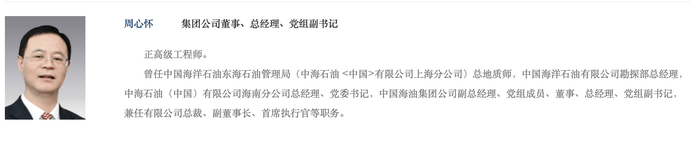
周心怀任中石油总经理,曾在中海油系统工作多年
Sou Hu Cai Jing· 2025-08-29 09:13
Core Viewpoint - China National Petroleum Corporation (CNPC) has appointed Zhou Xinhai as the new General Manager and Deputy Secretary of the Party Committee, while he has been relieved of his positions at China National Offshore Oil Corporation (CNOOC) [1] Group 1: Leadership Changes - Zhou Xinhai, born in 1970, is a senior engineer with a doctorate and has extensive experience within the CNOOC system [2] - His previous roles include Chief Geologist at CNOOC's East China Petroleum Administration and General Manager of CNOOC's Exploration Department [2] - Zhou served as CNOOC's Vice General Manager from March 2022 to March 2024, and held multiple leadership positions within the company [2] Group 2: Financial Performance - In the first half of the year, CNOOC reported revenue of 207.608 billion yuan, a year-on-year decrease of 8%, and a net profit attributable to shareholders of 69.533 billion yuan, down 13% [4] - CNPC's revenue for the same period was 1.45 trillion yuan, a decline of 6.7%, with a net profit of 84.007 billion yuan, down 5.4% [4] - CNPC's oil and gas equivalent production reached 942 million barrels, an increase of 2% year-on-year, with natural gas production and oil and gas equivalent production both hitting historical highs [4] Group 3: Renewable Energy Initiatives - CNPC's renewable energy projects include a 1.3 million kW photovoltaic project in Tarim Oilfield, generating 2.1 billion kWh of green electricity annually [4] - The Jilin Oilfield's distributed wind power project has generated over 3 million kWh, while the Daqing Lamaidian Oilfield's low-carbon demonstration area achieved over 100 million kWh of electricity generation, a 160% increase year-on-year [4] Group 4: Company Rankings - CNPC ranks third among the world's top oil companies and sixth in the Fortune Global 500 list for 2024 [4] - As of August 29, CNPC's A-share price increased by 0.93%, closing at 8.72 yuan, with a market capitalization of 1.6 trillion yuan [4]



中国核电(601985):2024年年报暨2025年一季度报点评:25Q1业绩稳定增长,装机容量有望持续扩张
EBSCN· 2025-05-02 05:13
Investment Rating - The report maintains a "Buy" rating for the company, indicating a strong growth outlook due to continuous expansion in nuclear and renewable energy generation capacity [4][6]. Core Insights - In 2024, the company achieved a revenue of 77.27 billion yuan, a year-on-year increase of 3.09%, while the net profit attributable to shareholders decreased by 17.38% to 8.77 billion yuan. For Q1 2025, revenue reached 20.27 billion yuan, up 12.70% year-on-year, with a net profit of 3.14 billion yuan, an increase of 2.55% [1][2]. - The total operational power generation in 2024 was 216.35 billion kWh, a 3.09% increase year-on-year, with nuclear power generation slightly declining by 1.80% to 183.12 billion kWh due to increased maintenance and typhoon impacts [2][3]. - The company is expanding its nuclear and renewable energy capacity significantly, with plans to commission 12 new nuclear units from 2025 to 2029 and a substantial increase in renewable energy capacity under construction [3][4]. Summary by Sections Financial Performance - The company reported a revenue of 77.27 billion yuan in 2024, with a growth rate of 3.09%. The net profit attributable to shareholders was 8.77 billion yuan, reflecting a decline of 17.38% [1][5]. - For Q1 2025, the revenue was 20.27 billion yuan, marking a 12.70% increase year-on-year, while the net profit was 3.14 billion yuan, up 2.55% [1]. Power Generation - In 2024, the cumulative operational power generation was 2163.49 billion kWh, with nuclear power generation at 1831.22 billion kWh, down 1.80% year-on-year. Renewable energy generation saw a significant increase of 42.21% to 332.27 billion kWh [2][3]. - For Q1 2025, the company generated 494.82 billion kWh from nuclear and 102.60 billion kWh from renewable sources, representing year-on-year growth of 13.30% and 38.35%, respectively [2]. Capacity Expansion - The company plans to expand its nuclear capacity with 12 new units scheduled for commissioning from 2025 to 2029. Additionally, it has 14.36 million kW of renewable energy capacity under construction, a 47.60% increase year-on-year [3][4]. - The recent approval of two new nuclear units in Zhejiang adds 2.43 million kW to the company's capacity [3]. Profitability and Valuation - The report projects a decrease in net profit estimates for 2025 and 2026 due to expected declines in long-term electricity prices, with revised net profit forecasts of 10.44 billion yuan and 11.26 billion yuan, respectively [4][5]. - The estimated EPS for 2025 is 0.51 yuan, with a corresponding P/E ratio of 18 [4][5].

福能股份(600483):火绿双翼表现优异,全年业绩稳步增长
Changjiang Securities· 2025-04-28 10:16
Investment Rating - The investment rating for the company is "Buy" and is maintained [9] Core Views - The company's thermal power business continues to improve, with a net profit of 573 million yuan from Hongshan Thermal Power and Long'an Thermal Power, representing a year-on-year increase of 22.90%. The net profit per kilowatt-hour for thermal power reached 0.078 yuan, up 0.014 yuan year-on-year. The company's new energy business also saw growth, with Funiu New Energy's net profit increasing by 14.72% and Funiu Haixia's net profit rising by 23.28% [2][6][12] - Despite a decline in investment income due to reduced contributions from the invested company Guoneng Shishi, the company achieved a total net profit attributable to shareholders of 2.793 billion yuan, a year-on-year increase of 6.47% [2][12] Summary by Sections Financial Performance - In 2024, the company reported total revenue of 14.563 billion yuan, a decrease of 0.90% year-on-year, and a net profit attributable to shareholders of 2.793 billion yuan, an increase of 6.47% [6][12] - The thermal power business achieved a net profit of 782 million yuan, up 12.64% year-on-year, driven by improved operational performance [12] - The new energy segment, particularly offshore wind power, demonstrated strong profitability, with a net profit of 1.148 billion yuan, reflecting a 23.30% increase [12] Operational Highlights - The company’s thermal power generation hours were 5,932 hours, a slight decrease of 1.36% year-on-year, while the total electricity generated was 7.37 billion kilowatt-hours, up 1.14% year-on-year [12] - The wind power utilization hours reached 3,324 hours, a year-on-year increase of 9.41%, with significant growth in both offshore and onshore wind power generation [12] Future Outlook - The company plans to distribute a dividend of 0.31 yuan per share for 2024, with a payout ratio of 30.85%. It also aims to maintain a cash dividend of at least 10% of the net profit attributable to shareholders in the first half of 2025 [12] - The forecast for earnings per share (EPS) for 2025-2027 is adjusted to 1.03 yuan, 1.04 yuan, and 1.43 yuan, with corresponding price-to-earnings (PE) ratios of 9.50, 9.38, and 6.86 [12]
