
AEB

Search documents
报告:2025年1-10月中国新能源乘用车L2级及以上辅助驾驶功能装车率达87%
Zhi Tong Cai Jing· 2025-12-18 12:45
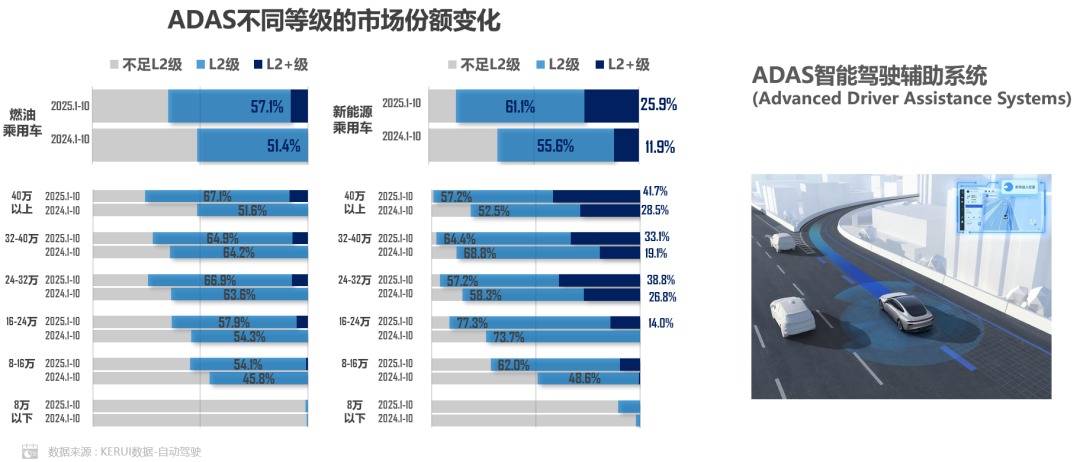
Group 1 - The core viewpoint of the report indicates that by October 2025, the installation rate of L2 and above assisted driving functions in new energy passenger vehicles will reach 87.0%, with significant growth in the market for vehicles priced below 160,000 [1] - In November 2025, sales of new energy vehicles reached 1.823 million units, a month-on-month increase of 6.2% and a year-on-year growth of 20.5%, with a penetration rate of 53.2% [4] - The market share of new energy sedans in November 2025 was 41.7%, down 4.5 percentage points year-on-year, while the share of new energy SUVs increased to 48.7%, up 2.7 percentage points [7] Group 2 - The overall installation rate of AEB (Automatic Emergency Braking) in passenger vehicles reached 67.8%, with a 78% share in the 160,000 to 240,000 price range, indicating further growth potential [9] - The installation rate of full-speed ACC (Adaptive Cruise Control) in the overall passenger vehicle market reached 62.1%, while in the new energy passenger vehicle market, it reached 71.6% [15] - The installation rate of ALC (Automatic Lane Change) is continuously increasing, primarily applied in mid-to-high-end models, with expectations for further growth as technology matures and costs decrease [17]


瑞立科密(001285.SZ):已布局满足新规要求的ESC、EBS、AEB等产品,并实现量产
Ge Long Hui· 2025-12-10 07:11
Group 1 - The core viewpoint of the article highlights that 瑞立科密 (001285.SZ) has successfully developed and mass-produced products such as ESC, EBS, and AEB that meet new regulatory requirements [1] - As a leading player in the commercial vehicle segment, the company is expected to benefit from the incremental market created by regulations, leveraging its technological, customer, and production capacity advantages [1] - The company aims to enhance product value through these developments in response to regulatory changes [1]
被车企吹上天的AES,我劝你别全信
3 6 Ke· 2025-12-08 06:19
Core Viewpoint - The automotive industry is currently engaged in a competitive marketing battle over Advanced Emergency Steering (AES) technology, reminiscent of the previous Automatic Emergency Braking (AEB) marketing wars, with companies emphasizing their unique capabilities and features to attract consumer attention [1][5][20]. Group 1: Marketing Competition - Companies are increasingly comparing their AES features, with claims of enhanced performance such as higher speed effectiveness and more complex operational environments [5][12]. - The marketing strategies have evolved to showcase AES capabilities in dramatic scenarios, such as performing evasive maneuvers or continuous obstacle avoidance, which may mislead consumers about the technology's reliability [18][20]. Group 2: Technology Evolution - AES, which stands for Automatic Emergency Steering, is an evolution from earlier Evasive Steering Support (ESS) systems that provided driver assistance rather than full automation [9][11]. - The transition to fully automated AES began in July 2024, with major brands like Li Auto and NIO introducing their versions of the technology, leading to a proliferation of marketing claims [12][20]. Group 3: Safety Concerns - The complexity of traffic scenarios makes the effectiveness of AES difficult to quantify, raising concerns about the potential for over-reliance on the technology during critical driving situations [17][20]. - The emphasis on continuous maneuvering capabilities in marketing may inadvertently promote risky driving behaviors, as the technology's limitations and the importance of driver awareness are often downplayed [18][22]. Group 4: Historical Context - The current AES marketing strategies echo the earlier AEB discussions, where the focus shifted from safety and reliability to eye-catching promotional tactics [20][22]. - Historical systems like ESS were designed with a focus on driver control and safety, contrasting with the current trend of promoting automated features without adequate consideration of their implications [22].

通用汽车、特斯拉真的能脱离中国零部件吗?
Zhong Guo Qi Che Bao Wang· 2025-11-18 07:43
Core Viewpoint - General Motors and Tesla are implementing a "de-China" strategy by instructing suppliers to eliminate Chinese-made materials and components from their supply chains by 2027, reflecting a significant geopolitical shift in the automotive industry [2][3][14]. Group 1: Company Actions - General Motors has directed thousands of suppliers globally to completely remove Chinese materials and components from their supply chains by 2027, emphasizing the need for stronger control and risk management in their supply chains [2][3]. - Tesla has followed suit, requesting its suppliers to exclude Chinese-made parts in the production of American vehicles and plans to replace all other components with those produced outside of China within the next couple of years [2][3]. Group 2: Economic Impact - General Motors has a substantial economic impact in the U.S., contributing $116.5 billion to GDP and supporting approximately 709,100 jobs, which exceeds the economic output of 13 states [6]. - In 2022, General Motors directly generated $39.2 billion in GDP, accounting for about 25% of the total GDP generated by U.S. automakers [6]. - The average total compensation provided by General Motors is approximately 39% higher than the average for transportation equipment manufacturing workers and 69% higher than the average for all U.S. workers [7]. Group 3: Industry Challenges - The complexity of automotive manufacturing, which involves around 30,000 components, makes it challenging for companies to completely sever ties with Chinese suppliers [16]. - The push for a "de-China" strategy may lead to increased manufacturing costs and operational challenges, as companies face the need to rebuild supply chains and ensure quality assurance within a limited timeframe [16][18]. - The automotive industry relies heavily on a global supply chain, and attempts to eliminate Chinese components may not be feasible without sacrificing competitive advantages [17][18]. Group 4: Geopolitical Context - The decisions by General Motors and Tesla are influenced by the current U.S.-China geopolitical tensions, particularly in light of trade restrictions and national security concerns [14][18]. - The automotive sector's reliance on Chinese materials, especially in critical areas like rare earth elements, poses a significant challenge to the feasibility of a complete supply chain overhaul [14][17]. Group 5: Market Dynamics - The market dynamics indicate that while companies may attempt to "de-China," the reality of global supply chains means that they will still depend on Chinese inputs, even if they are labeled as sourced from other countries [17][18]. - Analysts suggest that the long-term economic trend favors global cooperation over isolation, making the "de-China" strategy potentially unsustainable [17][18].


鸿蒙智行同日发布多款新车型;东风科技:东风投资将成为公司间接股东 | 汽车早参
Mei Ri Jing Ji Xin Wen· 2025-08-25 22:41
Group 1 - Hongmeng Zhixing launched multiple new models at the autumn product launch event, including the upgraded Zhijie R7 and S7, with prices ranging from 249,800 to 309,800 yuan and 229,800 to 289,800 yuan respectively [1] - The Aito M8 pure electric version was introduced with a new entry-level Max+ version priced between 359,800 and 449,800 yuan, while the new M5 Ultra version was released in a new color at a price of 229,800 yuan [1] - The event marked the largest number of new product launches for Hongmeng Zhixing, reflecting a strategy to accelerate product iteration and technological innovation in the competitive smart electric vehicle market [1] Group 2 - Dongfeng Technology announced that Dongfeng Investment will become an indirect shareholder following the merger agreement with Dongfeng Motor Group [2] - The merger is expected to enhance resource allocation and industrial synergy within the automotive sector, potentially boosting market sentiment and investment interest in the automotive industry [2] Group 3 - Contemporary Amperex Technology Co., Ltd. (CATL) established a new company focused on charging infrastructure, including charging pile sales and electric vehicle sales [3] - This strategic move aims to deepen market penetration in the electric vehicle and charging infrastructure sectors, benefiting the overall industry chain [3] Group 4 - The China Passenger Car Association reported that the overall installation rate of Advanced Emergency Braking (AEB) systems in passenger vehicles reached 64.4% in the first half of 2025, with a significant increase in the installation rate of L2-level and above driver assistance features in new energy vehicles [4] - The rising demand for intelligent and safe driving features is expected to drive growth in the automotive sector, increasing market confidence and investment enthusiasm for smart connected vehicles [4]


亚太股份(002284) - 2025年06月06日投资者关系活动记录表
2025-06-09 07:30
Group 1: Company Overview - The company does not sell AEB products separately but achieves AEB functionality through line control braking products, which began mass production in 2024 with a low sales proportion [2] - The main production bases are located in Xiaoshan, Anhui Guangde, and Huzhou Anji, with additional bases in Liuzhou, Guangzhou, and Changchun, and a project in Morocco underway [2] Group 2: Financial Performance - The increase in gross margin is attributed to the growth in domestic automobile sales and new international market projects, leading to scale effects and continuous optimization of product structure [3] - The company maintains a high capacity utilization rate, with production levels dependent on vehicle sales [3] Group 3: Future Business Development - Future growth points include expanding market coverage and promoting new automotive electronic systems, aiming for more projects [3] - The company plans to leverage its market resources and brand influence to accelerate the expansion of electronic products in overseas markets, targeting global procurement platforms like General Motors and STELLANTIS [3]

亚太股份(002284) - 2025年05月20日—21日投资者关系活动记录表
2025-05-22 07:40
Group 1: Company Overview - The company has three main production bases located in Xiaoshan, Anhui Guangde, and Huzhou Anji, with additional bases in Liuzhou, Guangzhou, and Changchun to support vehicle supply [2] - The company is actively supplying brake products to Geely and has seen significant sales growth in recent years [3] Group 2: Product Development - The company has developed a comprehensive solution for corner module technology, integrating wheel hub motors, electronic mechanical brakes (EMB), steering systems, and chassis controllers, enhancing vehicle maneuverability [4] - The company does not sell AEB products separately but enables AEB functionality through its line control braking and EMB products [5] Group 3: Financial Performance - The company's gross margin has improved due to increased domestic vehicle sales and new international projects, alongside ongoing product structure optimization and cost reduction efforts [7] - The projected sales amount for the line control braking product over its five-year lifecycle is approximately CNY 1 billion, with production expected to ramp up in Q1 2026 [8][9] Group 4: Market Strategy - The company plans to expand its market coverage and promote new automotive electronic systems, aiming to secure more projects [9] - The company is prepared to address annual price reduction demands from vehicle manufacturers by optimizing product structure and enhancing internal management [9] Group 5: Technology Roadmap - The company is developing products for both One-box and Two-Box technology routes, ensuring it can provide advanced system solutions for various customer needs in the future [9]
亚太股份(002284) - 2025年05月16日投资者关系活动记录表
2025-05-16 08:28
Group 1: Company Overview - Zhejiang Asia-Pacific Mechanical and Electrical Co., Ltd. has been focused on the automotive brake system industry since its establishment in 1979, accumulating a broad customer base including major companies like Geely, Changan, and SAIC [2][3] - The company’s line control braking products began mass production in 2024, although their current sales proportion is still low [2] Group 2: Product Offerings - The company does not sell AEB products separately but helps clients achieve AEB functionality through line control braking products [2] - The company has developed a comprehensive solution integrating wheel hub motors, electronic mechanical brakes (EMB), and chassis domain controllers, enabling independent control of vehicle systems and enhancing personalized travel options [4] Group 3: Market Expansion and Future Plans - The company is actively expanding its customer base and has entered procurement platforms for major automotive brands such as Volkswagen, General Motors, and Honda [3] - Future growth points include expanding market coverage and promoting new automotive electronic systems, aiming to secure more projects [8] Group 4: Financial Performance - The company’s gross margin has improved due to increased domestic vehicle sales and new international projects, alongside ongoing product structure optimization and cost reduction efforts [6] - A project related to line control braking products is expected to generate approximately ¥1 billion in total sales over a five-year lifecycle, with mass production anticipated in Q1 2026 [7]