ChatGPT 3.5

Search documents
上晚会、进演讲,AI竞争已经进入「大厂时间」
Tai Mei Ti A P P· 2026-01-05 00:57
Core Insights - The AI industry is increasingly dominated by large companies, with significant competition emerging between established players and startups [1][2] - Major tech firms are leveraging high-profile events like New Year's Eve celebrations to promote their AI products, marking a shift in marketing strategies [3][4] - The competitive landscape for AI startups is becoming more challenging, as they struggle to compete with the resources and ecosystem advantages of larger companies [2][6] Group 1: Industry Trends - The release of ChatGPT 3.5 in November 2022 marked the beginning of a new AI wave, making year-end a critical observation point for AI industry trends [1] - By the end of 2025, large companies have taken the lead in AI infrastructure, model development, and application promotion, changing the competitive dynamics [1][2] - Major firms are not only investing in AI technology but are also engaging in aggressive marketing strategies to capture public attention during significant events [3][4] Group 2: Company Actions - Companies like Alibaba, Tencent, and ByteDance are heavily investing in AI products, with notable launches and marketing campaigns leading to significant user engagement [6][7] - Tencent has made structural adjustments to enhance its AI capabilities, indicating a more aggressive approach in the AI sector [7] - Alibaba's financial commitment includes a strategic investment plan of 380 billion yuan, while ByteDance is expected to increase its capital expenditure to 160 billion yuan in 2026 [7] Group 3: Startup Challenges - AI startups face increasing difficulties in becoming industry leaders due to the overwhelming advantages held by large companies in terms of resources and market presence [2][6] - Some startups, like Zhiyu and MiniMax, are opting for IPOs, while others like Manus have chosen to sell to larger firms, reflecting a trend of consolidation in the industry [2][8] - The potential for smaller companies to find niche opportunities exists, as larger firms focus on more prominent market segments, leaving gaps for innovation in specialized areas [8][10]

基金观点|运舟资本周应波:市场处于“牛市中场休息”,AI迎来“Google时刻”
Xin Lang Cai Jing· 2025-12-04 11:25
Market Overview - The stock market in November experienced fluctuations, with major technology indices undergoing adjustments, including the ChiNext Index, STAR Market 50, and Hang Seng Technology Index, while the Shanghai Composite Index has largely digested the pressure above 4000 points [1][8] - Domestic industrial sectors are advancing anti-involution policies, which are expected to stabilize and rebound industrial product prices, with the PPI deflation situation likely to improve [1][8] - The demand outlook for the domestic real estate and infrastructure sectors is weak, and the trend of domestic manufacturing investment shifting overseas is expected to continue, leading to cautious capacity expansion across various industries [1][9] Real Estate Sector - The pressure of asset deflation remains significant, highlighted by the Vanke bond default event, marking the final phase of "clearing" in the real estate industry [2][9] - Since Q3, the pace of housing price declines in first- and second-tier cities has accelerated, leading to substantial pressure on residents' asset values [2][9] - The ongoing shrinkage of real estate assets is expected to continue impacting consumer growth, necessitating macroeconomic policies in 2026 to stabilize the situation [2][9] AI Industry Insights - The AI industry is currently viewed as being in the "early stage of bubble formation," with the AI technology revolution beginning with the launch of ChatGPT 3.5 at the end of 2022, expected to last for decades [3][10] - AI infrastructure is identified as a key feature of the first phase of the AI technology revolution, akin to the historical adoption of steam engines, electricity, and the internet [3][11] - The large-scale application of AI is crucial for the sustainability of AI infrastructure, with significant user bases already established, such as 800 million weekly active users for GPT and 250 million MAU for domestic platforms [4][12] Future Outlook - The market is currently in a "healthy bull market pause," where adjustments present opportunities for research and positioning for 2026 [2][10] - The "Google moment" is anticipated to be a pivotal point for AI applications, with the potential for significant economic value creation if Google can enhance user experiences through AI models [4][12] - The focus on technology innovation and industry growth is expected to yield investment returns in the long term, despite current market adjustments [5][13]
关于模型治理,中美欧的差异与共识
腾讯研究院· 2025-11-14 10:13
Core Viewpoint - The article discusses the evolving landscape of artificial intelligence governance, particularly focusing on the governance of general-purpose and frontier models in the US, EU, and China, highlighting their distinct approaches and regulatory frameworks [2][10]. Group 1: EU Governance Approach - The EU has established a complex risk governance framework categorizing AI systems into four risk levels: prohibited, high-risk, limited-risk, and minimal-risk, with stricter regulations for higher-risk categories [4]. - The EU's governance mechanism for general models distinguishes between those with and without "systemic risk," requiring all providers to disclose technical documentation and training summaries, while those with systemic risk must undergo model assessments and report significant incidents [5]. - The EU's framework is characterized by overlapping standards for models and applications, leading to a burdensome regulatory environment that may hinder innovation, prompting the EU Commission to push for simplification of related regulations [6]. Group 2: US Governance Approach - California has adopted a lighter regulatory approach with the signing of the "Frontier AI Transparency Act" (SB 53), focusing on self-regulation and limiting the scope of obligations for model developers [6]. - SB 53 targets "frontier developers" using models with over 10^26 FLOPs, with additional criteria for larger developers, thus narrowing the regulatory scope compared to the EU's broader approach [6]. - The obligations under SB 53 are minimal, primarily requiring basic transparency regarding website information and intended use, contrasting sharply with the EU's extensive documentation requirements [6]. Group 3: China's Governance Approach - China's governance strategy is application-driven, focusing on real-world issues and extending regulations from application services to model governance [7][8]. - The country has established a regulatory framework for algorithm governance, which has laid the groundwork for model governance, addressing risks associated with algorithmic recommendations and deep synthesis technologies [8]. - China's governance framework emphasizes practical measures for risk identification and management, categorizing risks into endogenous, application, and derivative risks, thus providing a clear delineation of responsibilities [9]. Group 4: Commonalities and Future Directions - Despite differing backgrounds and regulatory obligations, the US, EU, and China share a tendency towards "flexible governance" and industry-led initiatives, allowing for greater compliance autonomy [11]. - All three regions are exploring the establishment of assessment ecosystems to address uncertainties in model capabilities, with suggestions for community-driven evaluation mechanisms [11]. - Transparency has emerged as a core governance tool across the three regions, facilitating maximum control with minimal constraints, thereby fostering innovation while ensuring accountability [12].


王涵: 海外市场大跌快评
Sou Hu Cai Jing· 2025-11-06 09:55
Group 1 - The recent decline in the Nasdaq and S&P 500 indices marks the largest single-day drop in nearly a month, with six out of seven major tech companies experiencing losses [2] - The market is increasingly debating whether the U.S. stock market has entered a trend adjustment phase, driven by weakening of the two core pillars of the current bull market: expectations of U.S. technological dominance in the AI era and liquidity conditions [2] - Recent hawkish comments from Federal Reserve officials and short-term liquidity tightening due to government shutdown concerns have led to a revision of expectations for a loosening cycle [2] Group 2 - The current market turmoil may be a prelude rather than a definitive shift from bull to bear, as there is a significant likelihood that pressure from Trump will lead to further Fed actions such as rate cuts and quantitative easing [3] - Despite concerns about the profitability of high capital expenditures by AI giants, the logic of U.S. AI dominance is not immediately discredited, although mid-term fundamentals may eventually challenge this narrative [3] - The U.S. faces disadvantages in key areas critical for AI development, including energy infrastructure, talent, and data openness, which could undermine its perceived leadership in AI [3] Group 3 - Long-term, the erosion of U.S. global hegemony may lead to a scenario where a simultaneous decline in stocks, bonds, and the dollar becomes imminent [6] - The current trend of falling U.S. stocks and rising dollar value suggests that the Fed could counterbalance stock market pressures by sacrificing some dollar credibility [6] - Doubts about the U.S.'s absolute dominance and the intrinsic value of the dollar could signal a return to a "triple whammy" scenario for the U.S. markets [6]

英伟达市值突破5万亿美元,AI浪潮下超级公司影响力激增
Sou Hu Cai Jing· 2025-11-03 11:38
Core Insights - Nvidia has reached a historic milestone with a market capitalization exceeding $5 trillion, surpassing the GDP of Germany and Japan combined for 2024, making it the third-largest economy globally after the US and China [3][4] - The rapid growth of Nvidia's market value, which has increased over tenfold in just three years, is attributed to its dominance in the GPU market and the CUDA ecosystem, providing essential hardware and software support for AI development [4][5] - The AI infrastructure investment is surging, with major tech companies like Microsoft and Amazon expected to spend nearly $400 billion by 2025, a significant portion of which will be directed towards Nvidia's AI chips [5][6] Nvidia's Market Position - Nvidia's market capitalization now equals the combined value of the other nine largest chip companies, solidifying its position as the absolute leader in the semiconductor industry [4] - The company's net profit has also surged over tenfold, indicating a strong correlation between its market value and profitability, suggesting that its stock valuation remains reasonable [4][5] AI Investment Landscape - OpenAI plans to invest over $1.4 trillion in AI infrastructure over the coming years, with $500 billion earmarked for purchasing Nvidia's chips, highlighting the critical role Nvidia plays in the AI ecosystem [5][6] - Despite the massive investments in AI, the direct profitability from AI applications remains low, with OpenAI's revenue for the first half of the year at $4.3 billion against a loss of $13.5 billion [6][7] Historical Context and Comparisons - The current AI investment frenzy draws parallels to the internet bubble of the late 1990s, with significant capital flowing into AI-related ventures, raising concerns about potential market corrections [7][8] - Cisco's historical role as a "picks and shovels" provider during the internet boom mirrors Nvidia's current position in the AI sector, where demand for its products is expected to rise as the market expands [8][9] Financial Strategies and Risks - Tech companies are employing complex financing strategies, including partnerships with private equity firms to fund data center construction, reminiscent of the risky financial practices leading up to the 2008 financial crisis [10][11] - The interconnectedness of AI investments and the potential for widespread financial repercussions if a major player defaults raises concerns about the stability of the current market environment [10][11] Future Outlook - The optimism surrounding OpenAI and other tech giants is bolstered by their increasing capital expenditures, which support Nvidia's stock price growth [7][12] - The balance of power is shifting as super companies like Nvidia gain unprecedented influence, raising questions about regulatory oversight and the implications for market dynamics and public interests [12][15]


中美同意尽快举行新一轮经贸磋商;郑丽文当选中国国民党主席|南财早新闻
2 1 Shi Ji Jing Ji Bao Dao· 2025-10-18 23:19
Macro Economy - The user base for generative artificial intelligence in China reached 515 million as of June this year, with AI patent applications totaling 1.576 million, accounting for 38.58% of the global total, ranking first worldwide [2] - In the first eight months of this year, the average settlement rate for foreign trade enterprises in China was 53.7%, a slight increase of approximately 0.5 percentage points compared to the annual average of last year [2] - The Ministry of Commerce and nine other departments issued guidelines proposing 17 specific measures to promote high-quality development in the accommodation industry, including the creation of cultural theme hotels and the upgrade of facilities for the elderly [2] Investment News - UBS Wealth Management upgraded its global stock rating to "attractive," citing stronger-than-expected economic growth, easing tariff pressures, and a robust investment cycle driven by artificial intelligence. UBS also raised its rating on Chinese tech stocks to the most attractive, expressing increasing confidence in their ability to monetize AI [3] - As of June 30, 2025, approximately 30 AI-related stocks in the S&P 500 accounted for 43% of the total market capitalization, significantly up from 26% when ChatGPT 3.5 was released in November 2022 [3] - Domestic coffee machine sales in China reached 1.683 million units from January to August, marking a year-on-year increase of 75.6%. The market size for coffee machines in China is expected to reach 10.6 billion yuan by 2029, with an estimated annual compound growth rate of 28% [3] Company Movements - A representative from Wingtech Technology responded to the incident where the employee system access of its subsidiary, Anshi Semiconductor (China), was fully interrupted, stating that the accounts of the Anshi China team were suspended for unknown reasons, with partial recovery currently underway [5] - On the 18th, Air China reported an incident on flight CA139 from Hangzhou to South Korea, where a lithium battery in a passenger's carry-on luggage caught fire, but no injuries were reported, and the aircraft made an emergency landing at Shanghai Pudong Airport [5] - Honor is intensifying its AI strategy and technology, officially launching the "self-evolving AI native phone" - Honor Magic8 series, and previewing a futuristic robot phone called "ROBOT PHONE" [5]
OpenAI护城河被攻破,AI新王Anthropic爆赚45亿,拿下企业级LLM市场
3 6 Ke· 2025-08-01 12:18
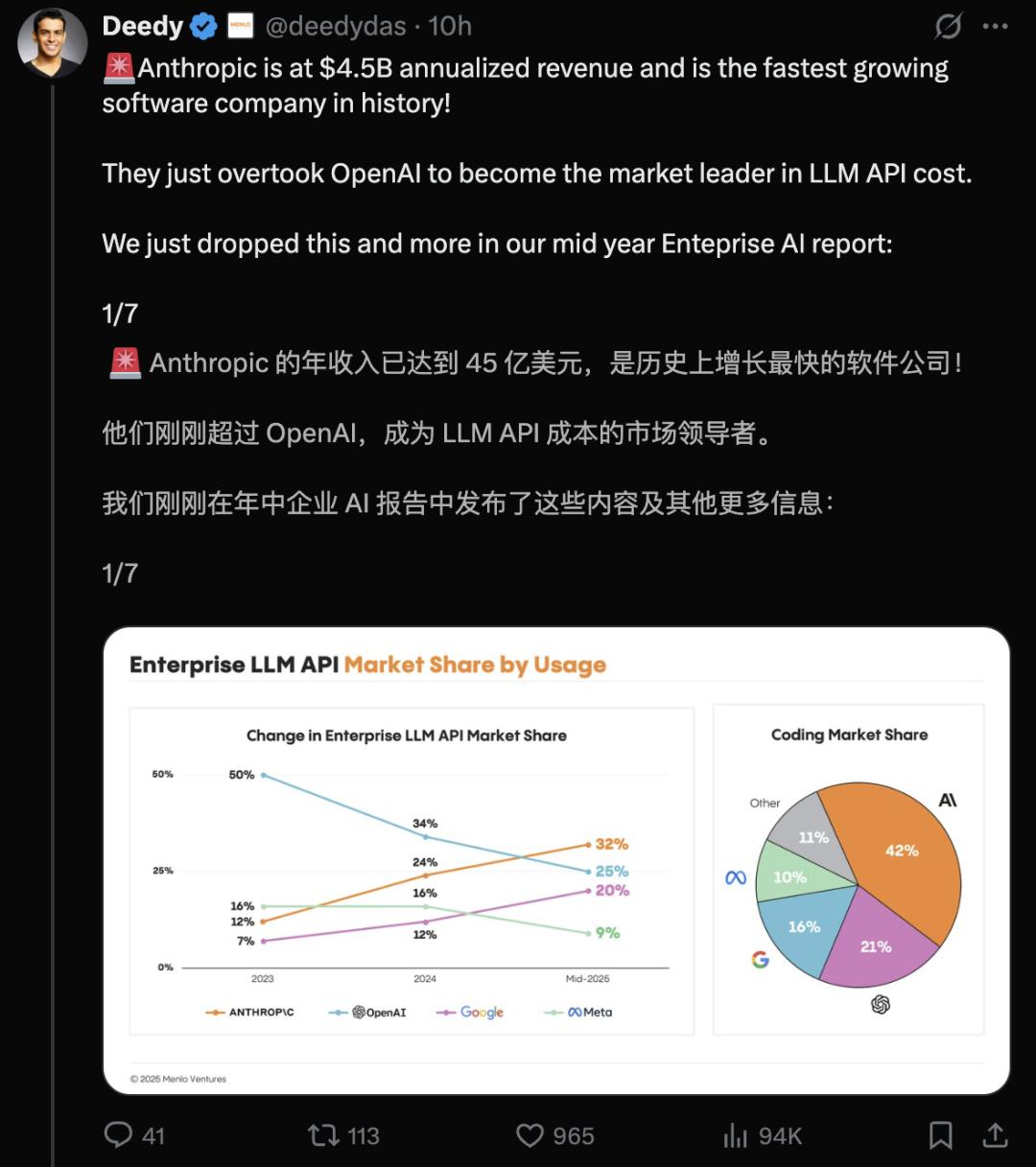
Core Insights - OpenAI's market share in the enterprise LLM sector has dramatically declined, with Anthropic surpassing it as the new leader [1][13][21] - Anthropic's annual revenue has reached $4.5 billion, making it the fastest-growing software company in history [1][4] - The shift in enterprise LLM usage indicates a significant change in the competitive landscape, with Anthropic capturing 32% of the market compared to OpenAI's 25% [13][14] Group 1: Market Dynamics - Anthropic has overtaken OpenAI in enterprise usage, marking a pivotal shift in the LLM landscape [4][10] - The enterprise spending on foundational model APIs has surged to $8.4 billion, more than double last year's total [6][9] - The report indicates that the enterprise LLM market is entering a "mid-game" phase, with new trends emerging [5][12] Group 2: Trends in LLM Commercialization - The report outlines four major trends in LLM commercialization: 1. Anthropic's usage in enterprises has surpassed that of OpenAI [4] 2. The trend of enterprises adopting open-source technology is slowing down [4] 3. Enterprises prioritize performance improvements over cost advantages when switching models [5] 4. Investment in AI is shifting from model training to practical application and inference [5][44] Group 3: Competitive Landscape - OpenAI's market share has plummeted from 50% at the end of 2023 to 25% by mid-2024, while Anthropic has risen to 32% [13][14] - Google has shown strong growth, capturing 20% of the market, while Meta holds only 9% [14][13] - The rise of Anthropic is attributed to the release of Claude Sonnet 3.5, which significantly boosted its market position [17][20] Group 4: Performance and Adoption - Code generation has emerged as a key application, with Claude capturing 42% of the developer market, compared to OpenAI's 21% [22] - Developers are increasingly focused on performance, with 66% upgrading models within their existing supplier ecosystem [36][39] - The shift in spending from model training to inference is evident, with 74% of developers in startups indicating that their workloads are primarily inference-based [44][47] Group 5: Future Outlook - The LLM market is undergoing a reshuffle, with a silent elimination process underway [50] - The report suggests that while 2023 may have belonged to OpenAI, the future remains uncertain, with potential winners yet to be determined [50]
对话“创业摆渡人”苏菂:从“屋顶种菜”到“狗头摄像”的逻辑之变
Zhong Guo Jing Ying Bao· 2025-05-18 13:08
Core Insights - The article discusses the evolution of the AI startup landscape in China, highlighting the shift from the mobile internet era to the current AI wave, characterized by higher entry barriers and increased competition among elite teams [2][4][5]. Industry Overview - There are over 1.9 million AI-related companies in China, with 80% established within the last five years, and more than 500,000 new companies added since 2024 [2]. - The AI startup environment has changed significantly, with the entry threshold moving from "light" to "heavy," requiring substantial funding and top talent for large model development [4][6]. Investment Landscape - Capital is now more focused on hard technology sectors, such as humanoid robots and upstream chip materials, rather than applications based on AI large models, which are seen as having lower success probabilities [8]. - The current investment climate demands a complete operational chain and high monetization efficiency, contrasting with the past when ideas alone could secure funding [8][10]. Entrepreneurial Challenges - Many small teams are pivoting to develop vertical applications based on large models due to the high costs associated with direct large model development [6][22]. - The number of viable startups that have survived since the initial wave of AI entrepreneurship in 2023 is reportedly low, indicating a challenging environment for new entrants [6][19]. Market Opportunities - There are emerging opportunities in localized AI applications, such as deploying AI systems in restaurants to enhance customer interaction and service [22]. - Products like integrated machines and robotic arms are gaining traction, with significant demand from educational institutions and businesses [22][23]. Talent Development - The entrepreneurial landscape has contributed to the development of a skilled workforce, with many individuals transitioning to larger companies after their startup experiences [21]. - The current environment is seen as more favorable for entrepreneurship compared to the early mobile internet days, despite the challenges [19][21].