Dojo 3

Search documents
【Tesla每日快訊】 馬斯克瘋了!Tesla+SpaceX Terafab把AI砸上太空,地球晶片廠要完蛋?🔥人形機器人賽道爆發(2026/3/23-1)
大鱼聊电动· 2026-03-23 06:03
大家好我是大鱼 马斯克刚刚 丢下震撼弹 Tesla与SpaceX 要联手打造 Terafab 这不是普通晶片厂 而是年产 1太瓦算力的怪物 80%直接 送上太空 让AI算力 像太阳能一样 无限廉价 无限供应 这一步是 把AI从地球的 牢笼释放 朝银河文明迈进 大家不要错过 今天的精彩内容 OK let's go 第一部分 Terafab震撼联手! 在刚过去的周末 马斯克突然 又丢出一记大招 让全世界下巴掉一地 下面我们就把 Tesla和SpaceX 刚刚发布的这个 重大联合声明 彻底拆开来说透 这不只是一个 晶片厂那么简单 这根本是把AI 直接送上太空的 星际级布局 先来看画面 SpaceX这次释出 的mini AI卫星 大概就这么大 看看和starship的比例 就知道散热问题 能够得到很好的解决 Elon亲口说: SpaceX很懂 在太空散热 这只是100kW 的迷你版 未来我们 预期会做到 百万瓦的等级 这个卫星用的是 Tesla的D3 (Dojo 3)晶片 专门为太空优化 能跑更热 散热器更轻 这已经不是科幻 这是马斯克 正在搭建的 星际AI基础设施 然后就是这次 声明的核心 先进技术 晶片厂 (Ad ...


计算机周观察20260125:AI板块推荐及计算机25Q4持仓分析
CMS· 2026-01-25 12:41
Investment Rating - The report maintains a "Recommendation" rating for the AI sector, indicating a positive outlook for the industry [2]. Core Insights - The report emphasizes the ongoing advancements in the AI sector, particularly in model development, computing power, and application industries, with a strong recommendation to increase allocations in key areas such as large models, AI applications, data service providers, AI infrastructure, and domestic computing power [1][6]. - The report highlights the recent IPO acceptance of Suiyuan Technology, which aims to raise 6 billion yuan for product development and business expansion, showcasing the growth potential in the AI computing space [17]. - The report notes a decrease in the market value and proportion of computer sector holdings among public funds in Q4 2025, suggesting a low allocation in the sector compared to the overall market [22][25]. Summary by Sections AI Industry Significant Developments - Anthropic launched the Claude in Excel plugin, enhancing Excel's capabilities for financial analysts by integrating AI functionalities [9]. - Tesla plans to restart its Dojo 3 AI chip project focused on space computing, indicating a shift towards high-risk, high-reward AI applications [11][12]. - Meta announced the rollout of ads on its Threads platform, leveraging AI-driven advertising systems to enhance user engagement [13]. Computer Industry Q4 2025 Institutional Holdings Analysis - Public funds held approximately 295 billion yuan in the computer sector, a decrease of about 152 billion yuan from Q3 2025, with a holding proportion of 1.50% [22]. - After excluding specific companies, the holdings in the computer sector were reported at 272 billion yuan, reflecting a continued decline in institutional investment [25]. Market Performance Review - In the third week of 2026, the computer sector experienced a slight decline of 0.30%, with notable stock performances from companies like *ST Lifan and Jinhai Xun [29].
马斯克掀桌复活Dojo 3,AI5性能暴涨50倍,1/10成本把老黄逼入死角
3 6 Ke· 2026-01-23 07:43
Core Insights - Elon Musk has announced the restart of the Dojo 3 project and the AI5 chip development, aiming to challenge Nvidia's dominance in the AI chip market [1][2][6][37] Group 1: AI5 Chip Development - The AI5 chip is not just a hardware upgrade for Tesla; it is critical for the company's survival, with Musk personally involved in its development [2] - The AI5 chip is designed to outperform Nvidia's Hopper chip, with a cost less than one-tenth of Nvidia's Blackwell and an energy efficiency three times better [3][10][12] - The AI5 chip's performance boasts a total performance increase of 50 times, with memory increased by nine times and raw computing power improved by ten times compared to the previous AI4 [10][12] Group 2: Dojo 3 Project - The Dojo 3 project aims to eliminate Tesla's dependency on Nvidia GPUs, using the AI5 chip and future iterations for its computing clusters [6][19] - The previous Dojo 1 project faced delays and challenges, leading to the decision to restart with a unified architecture that integrates the AI5 chip [19][21] - The new Dojo 3 will not use a separate D-series chip architecture, streamlining the development process [19] Group 3: Competitive Landscape - Tesla's aggressive chip development strategy includes a design cycle of approximately every nine months, contrasting with Nvidia and AMD's annual updates [7][8] - Nvidia's market capitalization has surpassed $5 trillion, positioning it as a major player in the AI industry, comparable to a global economic power [33][34] - The competition in the AI chip market is intense, with Tesla's innovations in chip design and performance being crucial for its strategic independence from Nvidia [31][36]

格林大华期货早盘提示:全球经济-20260122
Ge Lin Qi Huo· 2026-01-22 01:27
Report Industry Investment Rating - No relevant content provided Core Viewpoints - The global economy has passed its peak and is starting to decline due to the continuous wrong policies of the United States [4] - The return of the United States to the Monroe Doctrine and its global contraction will have a profound and disruptive impact on major asset classes such as the global economy, US Treasuries, US stocks, the US dollar, precious metals, and industrial metals [3] Summaries by Related Catalogs Global Economic News - Japan's fiscal crisis and Trump's actions have led to a "triple kill" in the US financial market, with some suggesting Europe may be creating market turmoil to pressure Trump [1] - Bridgewater's founder, Ray Dalio, warns that Trump's radical policies may trigger a global capital war, which could lead to inflation or currency depreciation and increase foreign investors' concerns [1] - Danish pension fund AkademikerPension plans to sell US Treasuries by the end of the month due to credit risks from Trump's policies, holding about $100 million in US Treasuries at the end of 2025 [1] - The world's largest AI open - source community Hugging Face states that DeepSeek R - 1 has broken barriers, leading to China's AI reshaping the global landscape with more model downloads than the US [1] - Tesla will restart its supercomputer project Dojo 3, marking a major shift in its chip strategy towards "space artificial intelligence computing" [1] - Japan's government bond market has crashed, forcing the Bank of Japan to consider restarting unlimited bond - buying, which may lead to the yen breaking the 160 exchange - rate line [1] - Foreign investors account for about 65% of Japan's monthly government bond cash trading volume, and more Japanese pension funds may return to Japan, impacting the US Treasury market [1] - Poland's central bank plans to buy up to 150 tons of gold, increasing its reserves to 700 tons and aiming to be among the top 10 countries in gold reserves [1] Global Economic Logic - The US's actions such as seizing control of Venezuela's oil and threatening to buy Greenland have brought great uncertainty to the global political and economic order, and it has imposed punitive tariffs on 8 European countries, with European countries planning counter - tariffs [2] - A US prosecutor has launched a criminal investigation into Fed Chairman Powell, and Nomura predicts that Fed - related uncertainties will peak from July to November 2026, potentially leading to a "flight from US assets" [2] - The Fed cut interest rates by 25 basis points in December, buys $40 billion in short - term bonds monthly, and its balance sheet is expanding again [2] - Goldman Sachs warns that the decline in Las Vegas gambling revenue is similar to the early warning signs before the 2008 financial crisis [2] - The US has released a new National Security Strategy, adjusting its economic relationship with China to revive its economic autonomy [2] - The Fed's Beige Book shows a K - shaped consumer spending pattern, with high - income consumers maintaining spending while middle - and low - income families are cutting back [2] - The Bank of Japan raised interest rates by 25 basis points, and the yield of Japan's 10 - year government bonds rose to 2.18% [2] - Google's AI infrastructure head says the company must double AI computing power every 6 months and achieve a 1000 - fold increase in the next 4 - 5 years to meet AI service demand [2] - TSMC estimates its 2026 capital expenditure to be between $52 billion and $56 billion, a 27% - 37% increase year - on - year, signaling the continued boom in AI and restoring investors' confidence in AI demand [2]

马斯克高调“复活”特斯拉Dojo3芯片项目
3 6 Ke· 2026-01-21 07:45
Core Insights - Tesla's CEO Elon Musk announced the revival of the previously shelved supercomputer project Dojo 3, marking a significant shift in Tesla's chip strategy [1][2] - The new mission of Dojo 3 will expand beyond training autonomous driving models on Earth to include "space artificial intelligence (AI) computing" [1][6] Group 1: Dojo 3 Project Overview - Dojo 3 was initially designed as a supercomputer for machine learning training, first introduced during Tesla's AI Day in 2021 [4] - The project aims to restructure its architecture and optimize costs, moving away from the complex paths of previous generations that relied on in-house D1 chips [4] - Musk hinted that the future of Dojo will involve a cluster architecture integrating numerous AI6 chips rather than developing dedicated training systems [4] Group 2: Strategic Shifts and Partnerships - Five months prior, Tesla halted the Dojo 3 project, disbanded its core team, and shifted focus to AI5, AI6, and subsequent chips, which can handle both efficient inference and core training tasks [2] - Tesla plans to increase reliance on Nvidia and other partners like AMD for computing, as well as on Samsung for chip manufacturing, rather than continuing to develop custom chips [2][5] - The AI5 chip is manufactured by TSMC and is intended to power Tesla's autonomous driving features and the Optimus humanoid robot [5] Group 3: Space AI Vision - Musk's latest statements indicate a vision for deploying AI computing centers in space, which he believes will be more cost-effective than terrestrial systems within four to five years [6][7] - The rationale includes the availability of "free" solar energy and relatively easier cooling technologies in space [6] - Musk's involvement in xAI, SpaceX, and Tesla creates a synergistic potential for these ventures, positioning Tesla as a major beneficiary if successful [6] Group 4: Challenges Ahead - Despite the ambitious goals, significant obstacles remain for establishing space-based AI data centers, including orbital debris, regulatory approvals, and international space policies [9] - Cooling high-power computing devices in a vacuum presents challenges, as temperature fluctuations in space can be extreme [9][10] - Constructing large AI data centers in geostationary orbit will require massive heat dissipation structures, which pose logistical and cost challenges [10]
马斯克再度剑指“太空AI”!科创人工智能ETF华夏(589010)开盘冲高,震荡上行
Mei Ri Jing Ji Xin Wen· 2026-01-21 05:57
Group 1 - The core viewpoint of the news highlights the performance of the Huaxia Sci-Tech AI ETF (589010), which experienced a maximum increase of 4.28% during trading, with a latest price of 1.614 yuan, reflecting a 3.00% rise from the opening price [1] - The ETF tracks 30 constituent stocks, with 21 showing gains, led by Lanjie Technology with a 13.03% increase, while a few stocks showed weakness [1] - The trading volume of the ETF reached 112 million yuan, with a turnover rate of 4.28%, indicating a high level of trading activity [1] Group 2 - Tesla's CEO Elon Musk announced the restart of the previously shelved supercomputer project Dojo 3, marking a significant strategic shift for Tesla, with the project now focusing on "space AI computing" rather than just autonomous driving model training [1] - CITIC Securities stated that the user penetration rate of AI large models is still low, indicating that the development of large models is in the early to mid-stages, and the industrialization cycle has just begun, suggesting high potential for capital expenditure growth alongside revenue increases from large models [1] - The company continues to recommend investments in the AI computing sector, including both domestic and North American computing supply chains [1][2]
马斯克,剑指“太空AI”
财联社· 2026-01-21 05:47
Core Viewpoint - Tesla is reviving its Dojo 3 supercomputer project, which was previously halted, indicating a significant shift in its chip strategy towards space AI computing [3][4][10]. Group 1: Dojo 3 Project Overview - Dojo 3 was initially designed as a supercomputer for machine learning training, with a focus on architecture restructuring and cost optimization [7]. - The project was paused five months ago due to a strategic decision to concentrate resources on AI5 and AI6 chips, moving away from developing custom chips [5][8]. - The revival of Dojo 3 is based on the successful progress of the AI5 chip design, with Tesla actively recruiting engineers for this initiative [5][8]. Group 2: Space AI Ambitions - The new mission for Dojo 3 includes advancing into "space artificial intelligence computing," aligning with Musk's vision of deploying AI computing centers in space [4][10]. - Musk believes that operating large-scale AI systems in orbit will be more cost-effective than on Earth within the next four to five years, leveraging solar energy and cooling technologies [11]. - This vision connects Tesla's various business interests, potentially positioning the company as a major beneficiary if successful [11]. Group 3: Challenges Ahead - Achieving the goal of space-based AI data centers faces significant challenges, including orbital debris, regulatory approvals, and international space policies [12]. - Cooling high-power computing devices in a vacuum presents practical difficulties, despite theoretical advantages [12][13]. - Constructing large AI data centers in geostationary orbit (GEO) is feasible but requires extensive infrastructure, which poses logistical and financial challenges [13][14].

马斯克高调“复活”特斯拉Dojo3芯片项目 再度剑指“太空AI”
Jin Rong Jie· 2026-01-21 04:30
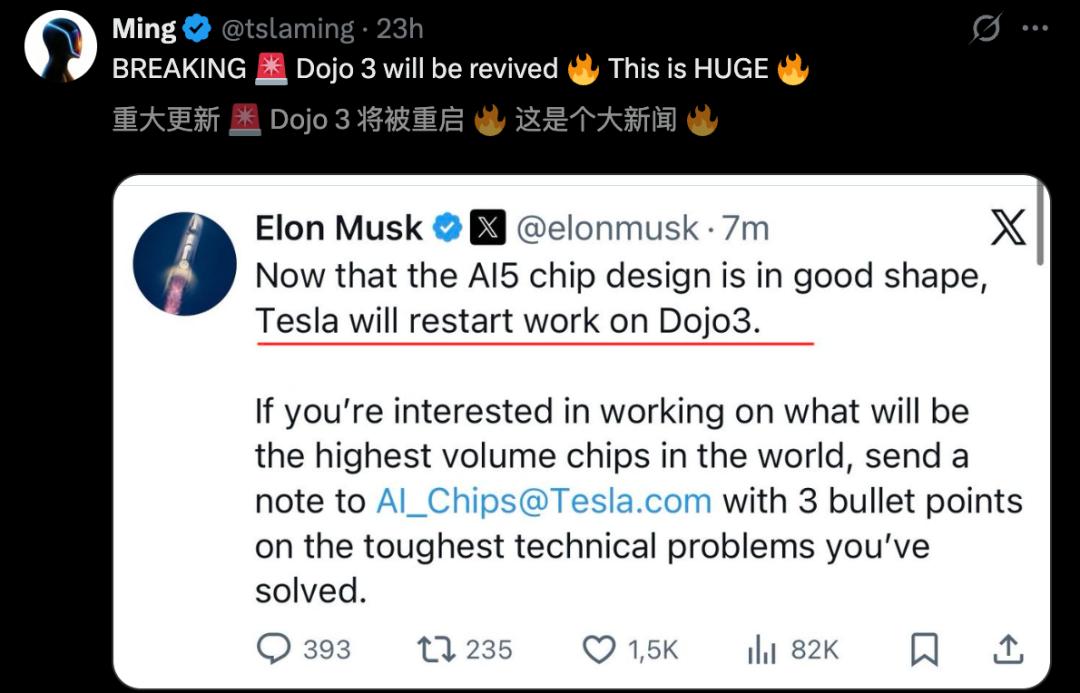
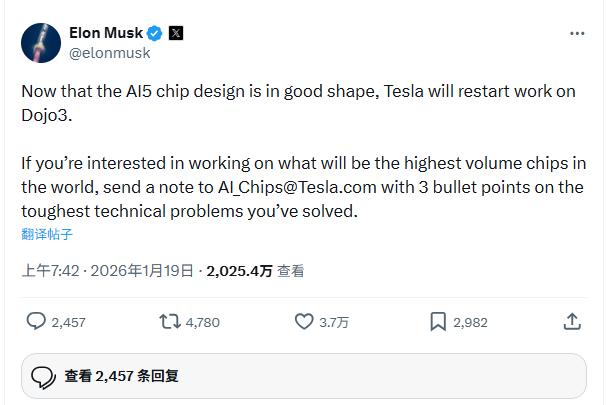
Core Viewpoint - Tesla is restarting its previously shelved supercomputer project Dojo 3, marking a significant shift in its chip strategy, with a new focus on "space AI computing" rather than just terrestrial autonomous driving model training [1] Group 1: Project Details - Dojo 3 was fully halted five months ago in August 2025, and its core mission is now expanded to include AI computing in space [1] - The decision to restart Dojo is based on the successful progress of AI5 chip design [1] Group 2: Recruitment and Vision - Elon Musk has issued a recruitment call for engineers interested in developing the world's highest output chips, asking candidates to summarize key technical challenges they have solved [1] - Musk's vision includes deploying AI computing centers in space, which he believes will be more cost-effective than operating similar systems on Earth within the next four to five years, due to "free" solar energy and relatively easy cooling technologies [1]
AI5芯片搞定,马斯克的纯自研超算Dojo 3又回来了
机器之心· 2026-01-21 04:15
Core Viewpoint - Elon Musk announced significant progress on the AI5 chip design and the restart of the Dojo 3 project, which is crucial for Tesla's AI and autonomous driving initiatives [1][4]. Group 1: Dojo Project Overview - The Dojo project was first introduced during Tesla's AI Day in 2021, aimed at creating a supercomputer for machine learning training to process data from Tesla vehicles [1]. - In July 2023, Dojo officially went into production, but it was previously halted in August 2022 due to inefficiencies in managing two different chip systems [4][5]. - Musk clarified that the decision to pause Dojo was strategic, focusing resources on the more critical AI5 chip, which is essential for Tesla's future projects [4][5]. Group 2: AI5 Chip Significance - The AI5 chip is vital for Tesla's Full Self-Driving (FSD), Cybercab, and Optimus projects, with Musk stating that its success is crucial for the company's future [5][10]. - The AI5 chip is expected to provide a 50-fold improvement over the previous AI4 chip, with production targeted for 2027 [5][11]. Group 3: Dojo 3 Developments - Dojo 3 aims to integrate 512 AI5 or AI6 chips onto a single motherboard, significantly reducing complexity and cost while maintaining high parallel computing capabilities [8][9]. - The new architecture will allow the same chip to handle both training and inference tasks, aligning with Tesla's strategy to reduce reliance on external GPU suppliers like NVIDIA [9][10]. - The Dojo 3 project is expected to accelerate the iteration of Tesla's FSD neural network models and support the training of the Optimus robot's control systems [10]. Group 4: Strategic Partnerships - Tesla has signed a $16.5 billion agreement with Samsung Electronics for the production of AI6 chips, which will bolster the scalability of the Dojo 3 project [12].

马斯克公布AI芯片路线图,并重启Dojo 3!
Sou Hu Cai Jing· 2026-01-19 04:36
Group 1 - Tesla's CEO Elon Musk announced an ambitious AI chip roadmap, planning to release new AI processors every nine months, surpassing competitors Nvidia and AMD's annual release schedule [2][3] - The strategy aims to enable Tesla to produce the world's highest volume AI chips and accelerate innovation in autonomous driving and robotics [3] - The new AI5 chip design is nearing completion, promising up to 50 times the performance of the current AI4 chip, with a tenfold improvement in performance per dollar and three times better power efficiency, specifically designed for Full Self-Driving (FSD), Robotaxi, and Optimus robots [3] Group 2 - Tesla has signed a $16.5 billion agreement with Samsung to support the development and mass production of the AI6 chip, which aims for approximately double the performance of AI5 and is expected to enter mass production by 2028 [3] - Future AI7, AI8, and AI9 chips will follow the nine-month design cycle to rapidly iterate AI technology and gain competitive advantages [3] - The vertical integration strategy is expected to optimize chip design and potentially make Tesla's chips the highest volume products globally, addressing current hardware limitations in running complex FSD models [3] Group 3 - Tesla plans to restart the development of its third-generation supercomputer Dojo (Dojo 3) as the AI5 chip design reaches a mature state, indicating a revival of the Dojo project [5] - The previous Dojo team was disbanded, and the strategy shifted towards relying on external computing resources, primarily using Nvidia's AI chips for training [5] - Dojo 3 is likely to be built around the AI5 and AI6 chips, serving as a backend computing support for Tesla's Autopilot, FSD, and Optimus machine learning models [5]