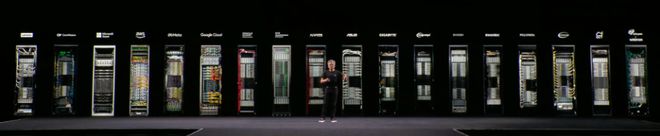
GB200 NVL72系统

Search documents
暴降 90%!英伟达 Blackwell 压缩 AI 推理成本至1/10
是说芯语· 2026-02-15 01:30
Core Insights - Nvidia has made significant progress in AI inference with its Blackwell architecture, achieving a milestone in "token economics" [1] - The company has implemented an "extreme hardware-software co-design" strategy, optimizing hardware efficiency for complex AI inference workloads, reducing the cost of token generation to one-tenth compared to the previous Hopper architecture [1] Industry Applications - Several inference service providers, including Baseten, DeepInfra, Fireworks AI, and Together AI, are utilizing the Blackwell platform to host open-source models [2] - These companies have successfully achieved cross-industry cost reductions by combining cutting-edge open-source intelligent models, Blackwell's hardware advantages, and their own optimized inference stacks [2] - For instance, Sentient Labs, focusing on multi-agent workflows, reported a cost efficiency improvement of 25% to 50% compared to the Hopper era, while companies in the gaming sector, like Latitude, have achieved lower latency and more reliable responses [2] Technical Specifications - The core of Blackwell's efficiency lies in its flagship system, the GB200 NVL72, which features a configuration of 72 interconnected chips and up to 30TB of high-speed shared memory [6][7] - This design is well-suited for the current mainstream "Mixture of Experts (MoE)" architecture, allowing for efficient splitting and parallel processing of token batches across multiple GPUs [6][7]


DeepMind内部视角揭秘,Scaling Law没死,算力即一切
3 6 Ke· 2025-12-31 12:44
Core Insights - The year 2025 marks a significant turning point for AI, transitioning from curiosity in 2024 to profound societal impact [1] - Predictions from industry leaders suggest that advancements in AI will continue to accelerate, with Sam Altman forecasting the emergence of systems capable of original insights by 2026 [1][3] - The debate around the Scaling Law continues, with some experts asserting its ongoing relevance and potential for further evolution [12][13] Group 1: Scaling Law and Computational Power - The Scaling Law has shown resilience, with computational power for training AI models growing at an exponential rate of four to five times annually over the past fifteen years [12][13] - Research indicates a clear power-law relationship between performance and computational power, suggesting that a tenfold increase in computational resources can yield approximately three times the performance gain [13][15] - The concept of "AI factories" is emerging, emphasizing the need for substantial computational resources and infrastructure to support AI advancements [27][31] Group 2: Breakthroughs in AI Capabilities - The SIMA 2 project at DeepMind demonstrates a leap from understanding to action, showcasing a general embodied intelligence capable of operating in complex 3D environments [35][39] - The ability of AI models to exhibit emergent capabilities, such as logical reasoning and complex instruction following, is linked to increased computational power [16][24] - By the end of 2025, AI's ability to complete tasks has significantly improved, with projections indicating that by 2028, AI may independently handle tasks that currently require weeks of human expertise [41] Group 3: Future Challenges and Considerations - The establishment of the Post-AGI team at DeepMind reflects the anticipation of challenges that will arise once AGI is achieved, particularly regarding the management of autonomous, self-evolving intelligent agents [43][46] - The ongoing discussion about the implications of AI's rapid advancement highlights the need for society to rethink human value in a world where intelligent systems may operate at near-zero costs [43][46] - The physical limitations of power consumption and cooling solutions are becoming critical considerations for the future of AI infrastructure [31][32]

美股三大指数集体高开,Meta大涨超5%
Ge Long Hui· 2025-12-04 14:39
Economic Indicators - The number of initial jobless claims in the U.S. last week was 191,000, the lowest level in over three years, and below expectations [1] - Over 80% of economists surveyed by Reuters expect the Federal Reserve to cut interest rates by 25 basis points in December [1] Stock Market Performance - Major U.S. stock indices opened higher, with the Nasdaq up 0.31%, the S&P 500 up 0.23%, and the Dow Jones up 0.12% [1] Company Updates - Meta's stock surged over 5% as CEO Mark Zuckerberg announced plans to cut spending on the metaverse project by up to 30% [1] - Nvidia's stock rose over 1% following the announcement that its GB200 NVL72 system can enhance the performance of open-source AI models by up to 10 times [1] - Micron Technology's stock fell by 2.1% as the company plans to exit the consumer memory business amid a global memory supply shortage [1] - Snowflake's stock dropped 9.5% due to weak earnings guidance for the current quarter, raising concerns about the profitability of its AI tools [1]


迎战TPU与Trainium?英伟达再度发文“自证”:GB200 NVL72可将开源AI模型性能最高提升10倍
硬AI· 2025-12-04 12:54
Core Viewpoint - Nvidia is facing competition from Google TPU and Amazon Trainium, prompting the company to reinforce its market position through a series of technical validations and public responses, including claims that its GPU technology is "a generation ahead" of the industry [2][5]. Group 1: GB200 NVL72 Technology Advantages - The GB200 NVL72 system can enhance the performance of leading open-source AI models by up to 10 times, addressing the scalability challenges of Mixture of Experts (MoE) models in production environments [2][9]. - The system integrates 72 NVIDIA Blackwell GPUs, delivering 1.4 exaflops of AI performance and 30TB of fast shared memory, with an internal GPU communication bandwidth of 130TB/s [9]. - Top-performing open-source models like Kimi K2 Thinking and DeepSeek-R1 have shown significant performance improvements when deployed on the GB200 NVL72 system [9][10]. Group 2: Market Concerns and Client Dynamics - Nvidia's recent technical assertions are seen as a direct response to market concerns, particularly regarding key client Meta's consideration of adopting Google's TPU for large-scale data center use, which could threaten Nvidia's dominant market share [5]. - Despite Nvidia's efforts to address these concerns, the company's stock price has declined nearly 10% over the past month [6]. Group 3: Cloud Service Provider Deployment - The GB200 NVL72 system is being deployed by major cloud service providers and Nvidia's cloud partners, including Amazon Web Services, Google Cloud, and Microsoft Azure, among others [12]. - CoreWeave and Fireworks AI have highlighted the efficiency and performance benchmarks set by the GB200 NVL72 system for MoE model services [12].

迎战TPU与Trainium?英伟达再度发文“自证”:GB200 NVL72可将开源AI模型性能最高提升10倍
Hua Er Jie Jian Wen· 2025-12-04 11:33
Core Insights - Nvidia is facing challenges from competitors like Google's TPU and Amazon's Trainium, prompting the company to undertake a series of technical validations and public responses to reinforce its AI chip market dominance [1][6] - The company claims that its GB200 NVL72 system can enhance the performance of leading open-source AI models by up to 10 times, particularly optimizing for mixture of experts (MoE) models [1][10] Group 1: Market Competition - Nvidia's recent technical validations are seen as a direct response to market concerns, particularly regarding Meta's potential shift to Google's TPU for its data centers, which could threaten Nvidia's over 90% market share in AI chips [6] - Despite these efforts, Nvidia's stock has seen a nearly 10% decline over the past month, indicating ongoing market apprehension [6] Group 2: Technical Advantages - The GB200 NVL72 system integrates 72 NVIDIA Blackwell GPUs, delivering 1.4 exaflops of AI performance and 30TB of fast shared memory, with an internal GPU communication bandwidth of 130TB/s [10] - Performance tests show that the Kimi K2 Thinking model achieved a 10-fold performance increase on the GB200 NVL72 system, with other top MoE models also experiencing significant improvements [10][11] Group 3: MoE Model Adoption - MoE models have become mainstream in advanced AI applications, with the top 10 open-source models on the Artificial Analysis leaderboard utilizing this architecture, which activates only the necessary "expert" modules for specific tasks [11] - Nvidia emphasizes that its system addresses scalability challenges of MoE models in production environments, effectively eliminating performance bottlenecks associated with traditional deployments [11] Group 4: Cloud Service Deployment - The GB200 NVL72 system is being deployed by major cloud service providers and Nvidia's cloud partners, including Amazon Web Services, Google Cloud, and Microsoft Azure [12] - Executives from CoreWeave and Fireworks AI highlight the efficiency and performance benchmarks set by the GB200 NVL72 for large-scale MoE model services [12]
英伟达官宣新合作成就:Mistral开源模型提速,任意规模均提高效率和精度
Hua Er Jie Jian Wen· 2025-12-02 20:03
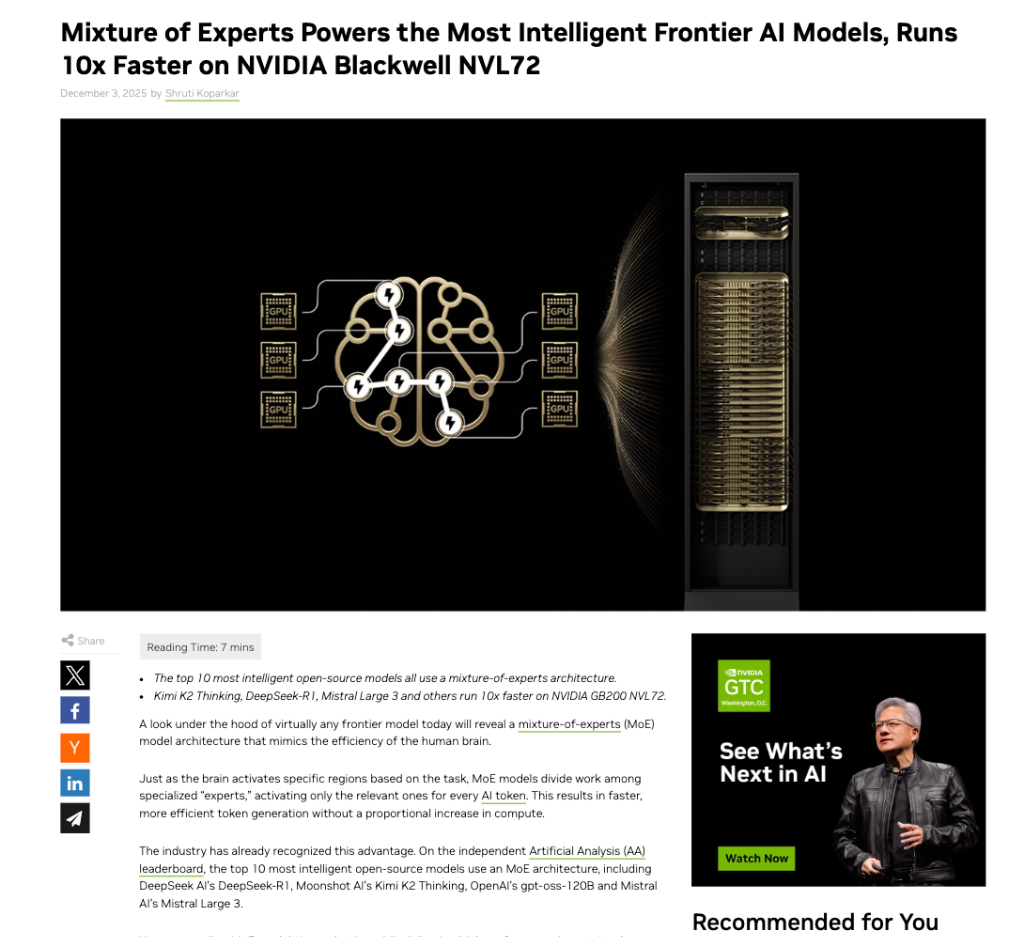
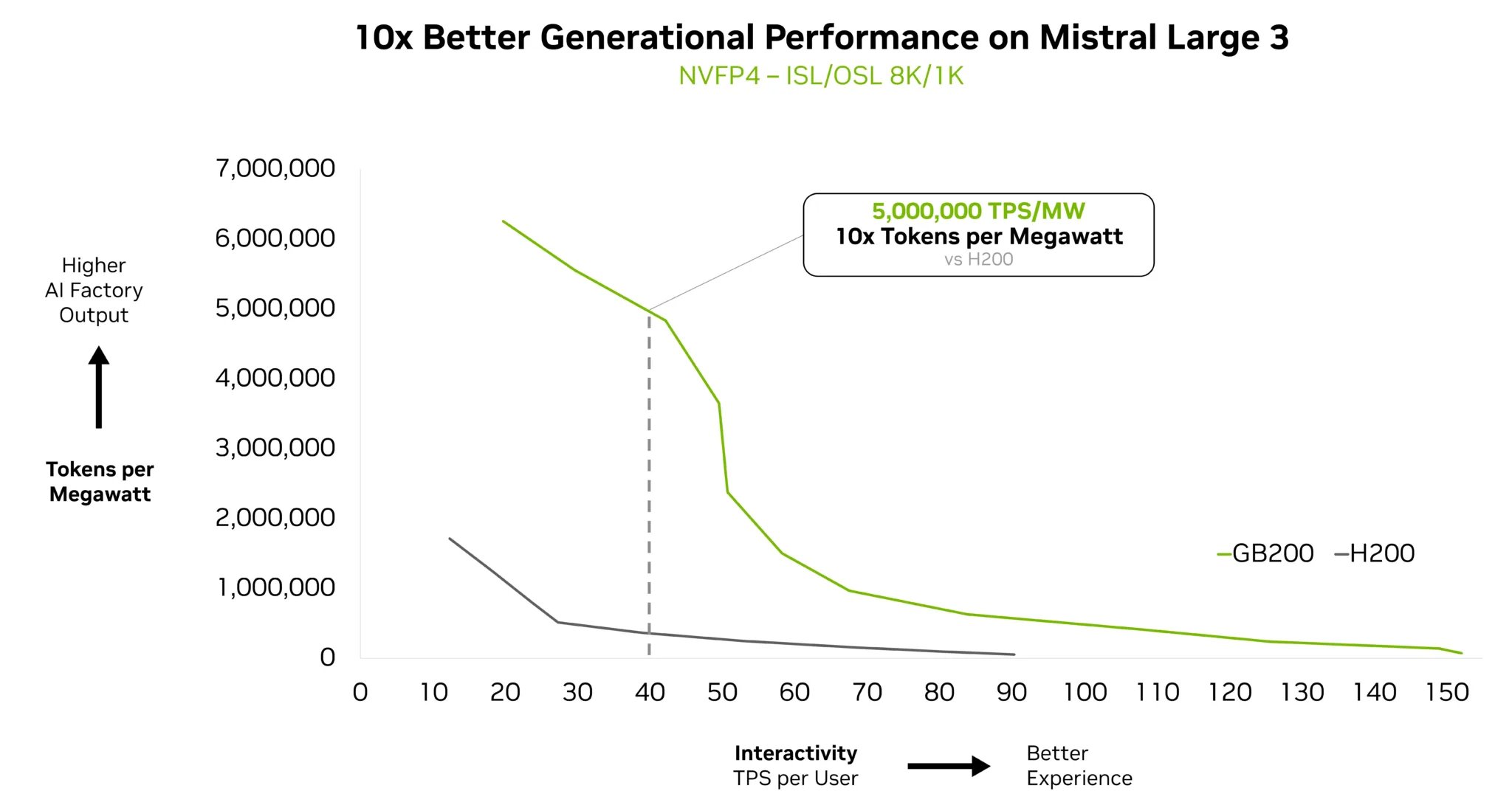
Core Insights - Nvidia has announced a significant breakthrough in collaboration with French AI startup Mistral AI, achieving substantial improvements in performance, efficiency, and deployment flexibility through the use of Nvidia's latest chip technology [1] - The Mistral Large 3 model has achieved a tenfold performance increase compared to the previous H200 chip, translating to better user experience, lower response costs, and higher energy efficiency [1][2] - Mistral AI's new model family includes a large frontier model and nine smaller models, marking a new phase in open-source AI and bridging the gap between research breakthroughs and practical applications [1][6] Performance Breakthrough - Mistral Large 3 is a mixture of experts (MoE) model with 67.5 billion total parameters and 41 billion active parameters, featuring a context window of 256,000 tokens [2] - The model utilizes Wide Expert Parallelism, NVFP4 low-precision inference, and the Dynamo distributed inference framework to achieve best-in-class performance on Nvidia's GB200 NVL72 system [4] Model Compatibility and Deployment - The Mistral Large 3 model is compatible with major inference frameworks such as TensorRT-LLM, SGLang, and vLLM, allowing developers to deploy the model flexibly across various Nvidia GPUs [5] - The Ministral 3 series includes nine high-performance models optimized for edge devices, supporting visual functions and multi-language capabilities [6] Commercialization Efforts - Mistral AI is accelerating its commercialization efforts, having secured agreements with major companies, including HSBC, for model access in various applications [7] - The company has signed contracts worth hundreds of millions of dollars and is collaborating on projects in robotics and AI with organizations like the Singapore Ministry of Home Affairs and Stellantis [7] Accessibility of Models - Mistral Large 3 and Ministral-14B-Instruct are now available to developers through Nvidia's API directory and preview API, with all models accessible for download from Hugging Face [8]
外媒关注华为上新:挑战英伟达,中国国产替代再加速
Guan Cha Zhe Wang· 2025-09-18 08:16
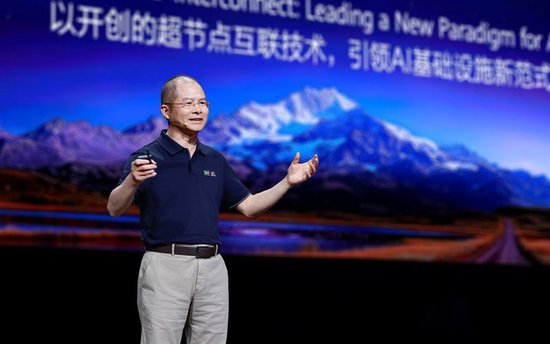
Core Viewpoint - Huawei has announced the launch of new AI chip technologies, aiming to challenge Nvidia's dominance in the market, with plans to release multiple Ascend series chips by 2028 [1][2][4]. Group 1: Product Launch and Features - Huawei's Vice Chairman Xu Zhijun revealed the upcoming Ascend 950, 960, and 970 series chips, with the Ascend 950PR expected in Q1 2026 and the Ascend 970 in Q4 2028 [1]. - The new SuperPoD nodes, based on the Ascend 950 and 960 chips, will offer unprecedented computing power, with the former supporting 8192 cards and the latter 15488 cards [1][4]. - Huawei's SuperPoD products are designed to enhance computing capabilities by bundling multiple AI chips together, positioning them as a direct competitor to Nvidia's technology [4][8]. Group 2: Strategic Implications - The launch of these chips signifies China's efforts to reduce reliance on Nvidia's AI hardware, marking a significant step towards domestic alternatives in the AI sector [2][8]. - Huawei's advancements in chip technology are seen as crucial for breaking supply bottlenecks in China's AI development, potentially enhancing the country's autonomous capabilities in AI computing [2][8]. - The introduction of the "Lingqu" interconnect protocol aims to link more computing resources, allowing for clusters exceeding 500,000 cards based on the Ascend 950 and over 990,000 cards based on the Ascend 960 [5]. Group 3: Competitive Landscape - Despite facing U.S. sanctions, Huawei is positioning itself as a leader in developing solutions that do not depend on American technology, thereby bolstering China's AI ambitions [8]. - The new technologies are viewed as an upgrade to Nvidia's NVLink, which facilitates high-speed communication between chips in servers, indicating Huawei's intent to compete effectively in the AI market [8]. - Research indicates that Huawei's products may outperform Nvidia's systems in certain performance metrics, despite the latter's advanced AI chips [8].
这些芯片,爆火
半导体行业观察· 2025-08-17 03:40
Core Insights - Data centers are becoming the core engine driving global economic and social development, marking a new era for the semiconductor industry, driven by AI, cloud computing, and large-scale infrastructure [2] - The demand for chips in data centers is evolving from simple processors and memory to a complex ecosystem encompassing computing, storage, interconnect, and power supply [2] AI Surge: The Arms Race in Data Centers - The explosion of artificial intelligence, particularly generative AI, is the strongest catalyst for this transformation, with AI-related capital expenditures surpassing non-AI spending, accounting for nearly 75% of data center investments [4] - By 2025, AI-related investments are expected to exceed $450 billion, with AI servers rapidly increasing from a few percent of total computing servers in 2020 to over 10% by 2024 [4] - Major tech giants are engaged in a fierce "computing power arms race," with companies like Microsoft, Google, and Meta investing hundreds of billions annually [4] - The data center semiconductor market is projected to expand significantly, reaching $493 billion by 2030, with data center semiconductors expected to account for over 50% of the total semiconductor market [4] Chip Dynamics: GPU and ASIC Race - GPUs will continue to dominate due to the increasing complexity and processing demands of AI workloads, with NVIDIA transforming from a traditional chip designer to a full-stack AI and data center solution provider [7] - Major cloud service providers are developing their own AI acceleration chips to compete with NVIDIA, intensifying competition in the AI chip sector [7] - High Bandwidth Memory (HBM) is becoming essential for AI and high-performance computing servers, with the HBM market expected to reach $3.816 billion by 2025, growing at a CAGR of 68.2% from 2025 to 2033 [8] Disruptive Technologies: Redefining Data Center Performance - Silicon photonics and Co-Packaged Optics (CPO) are key technologies addressing high-speed, low-power interconnect challenges in data centers [10] - The adoption of advanced packaging technologies, such as 3D stacking and chiplets, allows semiconductor manufacturers to create more powerful and flexible heterogeneous computing platforms [12] - The shift to direct current (DC) power supply is becoming essential due to the rising power density demands of modern AI workloads, with power requirements for AI racks expected to reach 50 kW by 2027 [13] Cooling Solutions: Liquid Cooling Technology - Liquid cooling technology is becoming a necessity for modern data centers, with the market projected to grow at a CAGR of 14%, exceeding $61 billion by 2029 [14] - Various types of liquid cooling methods, including Direct Chip Liquid Cooling (DTC) and immersion cooling, are being adopted to manage the heat generated by high-performance AI chips [15] - Advanced thermal management strategies, including software-driven dynamic thermal management and AI model optimization, are crucial for maximizing future data center efficiency [16] Future Outlook - The future of data centers will be characterized by increasing heterogeneity, specialization, and energy efficiency, with chip design evolving beyond traditional CPU/GPU categories [17] - Advanced packaging technologies and efficient power supply systems will play a critical role in shaping the next generation of green and intelligent data centers [17]
英伟达进击欧洲:开设AI工厂,加速量子计算
2 1 Shi Ji Jing Ji Bao Dao· 2025-06-12 00:42
Group 1 - Nvidia is launching a series of AI infrastructure collaboration plans in Europe, partnering with companies in France, the UK, Germany, and Italy [1] - Nvidia is establishing and expanding AI technology centers in Germany, Sweden, Italy, Spain, the UK, and Finland, including a cloud platform powered by 18,000 Nvidia Grace Blackwell systems in France [1][2] - The company aims to build the world's first industrial AI cloud in Germany, equipped with 10,000 Blackwell GPUs, targeting the European manufacturing sector [1][2] Group 2 - Europe is accelerating its AI development, with significant investments such as France's plan to invest €109 billion and the EU's "InvestAI plan" allocating approximately €200 billion for AI initiatives [2] - Nvidia's CEO Jensen Huang emphasizes the importance of AI as a part of infrastructure and a driver for growth in manufacturing, indicating a new industrial revolution [2][3] - The company is expanding its strategic layout in Europe to capture market opportunities amid changing trade environments and export controls in China [3] Group 3 - Nvidia's latest Blackwell architecture products are expected to achieve a performance improvement of 30-40 times in a single generation, significantly enhancing inference performance [3] - The GB200 NVL72 system is predicted to accelerate the quantum computing industry, with Nvidia leveraging this platform to enhance AI and quantum computing collaboration [5] - The global production of GB200 NVL72 racks is projected to reach 2,000 to 2,500 units by May 2025, indicating a rapid response to market demand [6]