
GaN芯片

Search documents
英诺赛科:GaN-ning动量,一步一个脚印-20260331
Zhao Yin Guo Ji· 2026-03-31 05:24
Investment Rating - The report maintains a "Buy" rating for InnoScience with a target price adjusted to HKD 75, based on a projected P/E ratio of 35 times for 2030 [1][3]. Core Insights - InnoScience reported a revenue growth of 46.4% year-on-year to RMB 1.2 billion for fiscal year 25, which was below the analyst's estimate of 9% and the Bloomberg consensus of 11% [1]. - The gross margin improved from -19.5% in fiscal year 24 to 7.3% in fiscal year 25, although it was still below the analyst's estimate by 3.3 percentage points [1]. - The company achieved a positive adjusted EBITDA for the first time, indicating a significant operational turning point [1]. - Key milestones for fiscal year 25 included collaborations with leading AI clients like Nvidia and Google, entry into humanoid robotics, and progress in automotive applications [1][2]. Revenue and Market Segmentation - The consumer market accounted for approximately 50% of total sales in fiscal year 25, down from 60% in fiscal year 24, while the industrial market rose to 43% from about 30% [2]. - Data center revenue grew by 50.2% year-on-year to RMB 63 million, representing 5.2% of total sales, and automotive business revenue more than doubled to RMB 58 million, accounting for 4.8% of total sales [2]. - The product mix is shifting, with wafer sales declining by 10% to represent 21% of total sales, while revenue from chips + ICs and modules grew by 41% and 143%, contributing 42% and 37% respectively [2]. Capacity Expansion and Strategic Positioning - The report emphasizes that capacity scale is crucial for the company's technological leadership and long-term profitability [3]. - InnoScience plans to achieve a production capacity of 80k wafers per minute by 2028, which is expected to enhance profitability through better utilization and reduced unit costs [3]. - The company is well-positioned to expand its adoption in higher-value applications due to limited competition in the pure-play GaN sector [3]. Financial Projections - Revenue projections for fiscal years 26 to 28 are RMB 2.08 billion, RMB 3.05 billion, and RMB 4.45 billion, respectively, with year-on-year growth rates of 71.5%, 46.6%, and 46.0% [4]. - Gross profit margins are expected to improve significantly, reaching 22.5% in fiscal year 26, 33.4% in fiscal year 27, and 40.5% in fiscal year 28 [4]. - The company is projected to reach a net profit of RMB 590 million by fiscal year 28, with a corresponding EPS of RMB 0.67 [4].
宏微科技:预计2025年盈利1400万元-2100万元
Zhong Guo Zheng Quan Bao· 2026-01-30 09:39
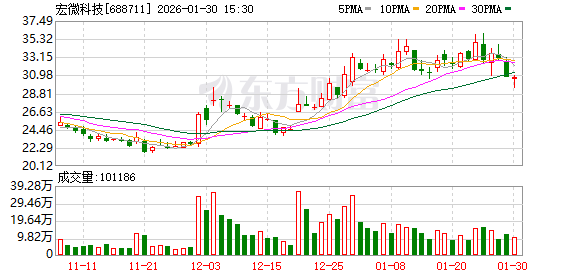
Core Viewpoint - Hongwei Technology (688711) expects a significant turnaround in its financial performance for 2025, projecting a net profit of 14 million to 21 million yuan, compared to a loss of 14.47 million yuan in the previous year [4]. Financial Performance - The company anticipates a non-recurring net profit of 8 million to 12 million yuan for 2025, improving from a loss of 33.99 million yuan in the prior year [4]. - As of January 30, the company's price-to-earnings (P/E) ratio (TTM) is estimated to be between 312.23 and 468.35 times, with a price-to-book (P/B) ratio (LF) of approximately 6.32 times and a price-to-sales (P/S) ratio (TTM) of about 4.91 times [4]. Industry Outlook - The power semiconductor industry is expected to see a recovery in 2025, driven by increased global investment in intelligent computing and rising demand for new power electronic devices in sectors such as renewable energy generation, industrial control, and AI server power supplies [15]. - The company is focusing on expanding its product offerings, including IGBT, MOSFET, FRD, SiC, and GaN products, to meet market demands and enhance its overall profitability [15]. Historical Financial Trends - Historical data indicates a trend of improving net profit and non-recurring net profit, with projections showing a significant increase in both metrics for 2025 compared to previous years [16]. - The company has experienced substantial year-on-year growth rates in net profit, with projections indicating a recovery from previous losses [16].


两大芯片巨头退出GaN 背后是中国企业成本绞杀
Xin Lang Cai Jing· 2026-01-04 05:37
Group 1 - The core point of the article highlights the exit of major players like TSMC and NXP from the GaN chip market, indicating a significant profit collapse due to increased competition and lower technical barriers, which has turned the market into a battleground for Chinese manufacturers [1][3] - TSMC, once holding 40% of the global GaN market, and NXP, which invested heavily in GaN, have faced disappointing returns as the expected recovery in RF business did not materialize, leading to a strategic withdrawal from the GaN sector [3] - The competitive landscape has shifted from technological breakthroughs to cost control, with Chinese companies able to produce GaN chips at costs over 30% lower than TSMC, prompting the latter to exit the market to avoid losses [3][5] Group 2 - Chinese companies are not merely engaging in price wars but are demonstrating systemic manufacturing capabilities, achieving over 90% capacity utilization compared to around 70% for TSMC and NXP, which significantly lowers unit costs [5] - The success of Chinese firms in the GaN market mirrors previous instances in the LED chip and CMOS sensor markets, where they leveraged scale to drastically reduce prices and drive out established competitors [5] - The current dynamics in the GaN market serve as a precursor to the future of the mature chip market, where the transition from technology barriers to cost barriers is evident, with Chinese firms poised to dominate as they build cost advantages through large-scale production and efficient supply chains [7][9] Group 3 - The ongoing changes in the GaN market reflect a broader trend in the semiconductor industry, where the market share of Chinese companies is growing at a rate of 10% annually, suggesting a potential shift towards a "China-dominated" phase in the mature chip market [7][9] - As Chinese companies solidify their position in the mature chip market, established players relying on technological barriers may either need to pivot to advanced processes or exit the market altogether, reinforcing the notion that Chinese firms excel in cost competition [9]

【公告臻选】商业航天+人形机器人+eVTOL+大飞机!公司产品已应用于商用飞机、飞行器、火箭等
第一财经· 2025-12-29 14:35
Group 1 - The article emphasizes the importance of efficiently filtering key announcements to aid investment decisions, highlighting the service "Announcement Selection" that provides deep insights into complex terms and reveals investment opportunities [1] Group 2 - On December 28, the article noted that Zhejiang Rongtai's stock rose by 3.38% after being highlighted for its involvement in humanoid robots and partnerships with multiple robotics companies, with an intraday peak increase of over 7% [2] - The article also mentioned that Yuntian Lifai's stock increased by 4.78% after being selected for a 122 million yuan project related to AI inference chips and humanoid robots, with a peak intraday increase close to 9% [2] Group 3 - The article outlines various sectors including commercial aerospace, humanoid robots, eVTOL, and general aviation, indicating that the company's products are applied in civil and commercial aircraft, rockets, and other vehicles [3] - It also highlights the defense and military sector, where the company's intelligent quadruped robots are utilized in critical scenarios such as nuclear emergency response and radiation monitoring [3] - Additionally, the article discusses advancements in third-generation semiconductors and IGBT, noting that the company has successfully developed GaN chips, which are now entering the customer introduction phase [3]
GaN,生变
半导体行业观察· 2025-12-19 01:40
Core Viewpoint - The GaN market is experiencing a dramatic shift, with major players like NXP and TSMC withdrawing from GaN-related businesses, while other companies continue to invest heavily in GaN technology, indicating a complex interplay of market demand, business logic, and technological evolution [2][4][15]. Group 1: Major Players' Withdrawal - NXP has decided to close its ECHO wafer fab in Arizona, marking its exit from the GaN-based 5G power amplifier market due to disappointing market demand and low investment returns from 5G base station deployments [6][8]. - TSMC announced plans to gradually exit the GaN foundry business by 2027, citing low profitability and intense competition from lower-cost manufacturers [9][10]. - Wolfspeed sold its GaN RF business for $125 million, focusing instead on its SiC business due to declining market share and demand in the SiC sector [12][13]. Group 2: Market Dynamics and Opportunities - Despite the withdrawal of major players, companies like Infineon, Texas Instruments, and domestic firms such as Innoscience and Sanan continue to expand their investments in GaN technology, indicating a bifurcated market landscape [2][15][20]. - The GaN market is shifting from a focus on technological advancement to a competition based on market potential, engineering capabilities, and profitable business models [15][26]. - The power GaN market is projected to grow significantly, with a compound annual growth rate of 42%, reaching approximately $3.0 billion by 2030, driven by demand in sectors like electric vehicles and data centers [26][28]. Group 3: IDM vs. Foundry Models - The competition between IDM (Integrated Device Manufacturer) and foundry models is intensifying, with IDM firms like Infineon leveraging their vertical integration to optimize product performance and reliability [31][32]. - Foundry models, while allowing for rapid market entry and lower initial capital investment, face challenges in customization and supply chain stability, especially with the exit of key players like TSMC [31][32]. - The future of GaN technology may favor the IDM model due to its advantages in cost control and supply chain stability, although foundry models will still play a role in niche markets [33][34]. Group 4: Future Pathways for GaN - The industry is undergoing a profound restructuring, moving away from blind expansion towards a focus on specific market applications and sustainable business models [36][38]. - Cost efficiency is becoming a critical competitive factor, with Chinese manufacturers adopting strategies to lower production costs through large-scale production [37]. - The GaN industry is expected to see increased consolidation, with smaller firms facing challenges in a market that favors those with scale and technological advantages [39].





路博迈集团温演道:关注港股科技市场的三条AI投资主线
Zhong Zheng Wang· 2025-12-16 13:22
Core Viewpoint - The key to uncovering AI investment opportunities in the Hong Kong stock market lies in connecting different markets while maintaining a global industrial chain perspective. The unique value of the Hong Kong market is its combination of global giants and hidden champions serving the global market [1]. Group 1: Main Investment Lines - The first line focuses on Hong Kong internet giants restructuring through AI, which are compared to US tech giants. These companies possess vast data, mature ecosystems, and strong cash flows, and their AI commercialization progress is often underestimated but is rapidly materializing [1]. - The second line highlights hidden champions benefiting from global AI demand. Hong Kong hosts companies that align with global trends and are often overlooked by investors, such as a global GaN chip supplier and a leading AI advertising platform [2]. - The third line emphasizes the acceleration of China's AI ecosystem, with Hong Kong gathering leading companies in humanoid robots and autonomous driving. These companies' technological routes are highly aligned with domestic market demands, and a global perspective remains crucial [2].
三安光电(600703.SH):湖南三安生产的GaN芯片可用于人形机器人关节及灵巧手电机领域
Ge Long Hui· 2025-12-08 07:36
Group 1 - The core viewpoint of the article highlights that Sanan Optoelectronics (600703.SH) has announced that its GaN chips produced in Hunan can be utilized in humanoid robot joints and dexterous motor fields [1]
稀土核弹炸穿光刻机命脉!阿斯麦断供反被掐脖 全链崩塌在即
Sou Hu Cai Jing· 2025-10-14 13:52
Core Viewpoint - The new Chinese rare earth regulations have created significant challenges for ASML, the leading lithography machine manufacturer, by tightening control over the supply chain and requiring approvals for any use of Chinese rare earth materials, even in minimal amounts [1][3][4] Group 1: Impact on ASML - ASML's EUV machines contain over 3,000 rare earth components, with 90% of the supply chain dependent on China, making it nearly impossible for ASML to bypass Chinese suppliers [3][4] - The new regulations require ASML to disclose the origin and processing of any rare earth components, even if they constitute only 0.1% of the total material [3][4] - ASML's clients, including major semiconductor manufacturers like TSMC and Intel, are now facing production delays and are demanding transparency regarding rare earth content in their equipment [4][6] Group 2: Broader Industry Implications - The new regulations have caused panic among European companies reliant on Chinese rare earths, such as Volkswagen and Siemens, which are critical for their electric motors and wind turbines [4][6] - The situation highlights the risks of over-reliance on a single supply chain, as companies may find themselves vulnerable to geopolitical tensions [6][7] - The ongoing conflict between technology and politics is reshaping the global supply chain, emphasizing the need for companies to adapt and seek diversified sources [6][7][8]

宏微科技: 江苏宏微科技股份有限公司关于2025年度提质增效重回报专项行动方案的半年度评估报告
Zheng Quan Zhi Xing· 2025-08-29 16:41
Core Viewpoint - Jiangsu Hongwei Technology Co., Ltd. has developed a "Quality Improvement and Efficiency Enhancement Return Action Plan" for 2025 to enhance operational quality, strengthen management capabilities, and protect investor rights [2]. Group 1: Business Focus and Core Competitiveness - The company focuses on IGBT and FRD power semiconductor chips, with self-developed chips used in its products, emphasizing the importance of domestic production in the current international climate [2]. - The company reported a net profit attributable to shareholders of 2,978,037.94 yuan, an increase of 18.45% year-on-year [3]. Group 2: Research and Development Innovation - The company has 220 R&D personnel, a 4.76% increase year-on-year, with 20.91% holding master's or doctoral degrees [3]. - R&D investment for the first half of 2025 reached 58.5661 million yuan, accounting for 8.61% of revenue, with a year-on-year increase [3]. - Significant advancements in third-generation semiconductor technologies include successful development of SiC MOSFET and SBD chips, as well as GaN chips, marking a substantial leap in technology [4]. Group 3: Fund Management and Project Development - The company plans to adjust the timeline for its convertible bond fundraising project to June 30, 2027, ensuring the safety and effective use of raised funds [5]. Group 4: Corporate Governance and ESG - The company has improved its internal governance structure and published its first ESG report, receiving a Wind A rating, indicating strong ESG management foundations [5]. Group 5: Talent Strategy and Stock Incentives - The company launched a stock incentive plan for 121 individuals, granting 2.9507 million shares, aimed at retaining and motivating key personnel [6]. Group 6: Investor Communication and Information Disclosure - The company has actively engaged in investor relations, disclosing two regular reports and 40 temporary announcements in the first half of 2025, ensuring clarity and accuracy in communication [7]. Group 7: Shareholder Returns - The company has distributed a total of 42.4917 million yuan in cash dividends since its listing in 2021, maintaining a consistent and stable profit distribution policy [8].
第三代半导体突破与战略协作升级引领 宏微科技上半年营收稳健增长
Zheng Quan Shi Bao Wang· 2025-08-28 14:11
Core Insights - The company reported a revenue of 680 million yuan for the first half of 2025, representing a year-on-year growth of 6.86%, and a net profit attributable to shareholders of 2.978 million yuan, up 18.45% year-on-year [1] - Despite signs of recovery in the power semiconductor industry, challenges such as price competition and macroeconomic fluctuations persist, but the company achieved steady revenue growth and continuous profit improvement through ongoing technological breakthroughs and market deepening [1] Financial Performance - Revenue for the first half of 2025 reached 680 million yuan, with a year-on-year increase of 6.86% [1] - Net profit attributable to shareholders was 2.978 million yuan, reflecting an 18.45% year-on-year growth [1] - R&D expenses amounted to 58.5661 million yuan, accounting for 8.61% of revenue, with a year-on-year increase of 8.64% [1] R&D and Innovation - The company has increased its R&D personnel to 220, with over 20% holding master's or doctoral degrees, and has accumulated 139 patents [1] - Significant progress has been made in core technologies such as IGBT, FRD, SiC, and GaN, with successful development of 1200V SiC MOSFET chips and GaN chips [2] - The company aims to enhance product competitiveness through technological iteration and production line optimization during the industrialization window of third-generation semiconductor devices [2] Strategic Collaborations - A five-year strategic cooperation memorandum was signed with Huahong Hongli to deepen collaboration in 12-inch wafer processes and joint development of core products [2] - Collaborations with various research institutions aim to innovate reliability testing for power devices and explore applications of SiC chips in new power systems [3] - The company is also engaging in forward-looking explorations of power semiconductors in nuclear fusion applications [3]