
NR

Search documents
格林大华期货早盘提示:白糖,红枣,橡胶系-20260331
Ge Lin Qi Huo· 2026-03-31 02:34
1. Report Industry Investment Ratings - The investment rating for the sugar industry in the agricultural, forestry, and livestock sector is "oscillating" [1]. - The investment rating for the rubber - related industry in the energy and chemical sector is "oscillating", with the synthetic rubber part being "oscillating and slightly bullish" [4]. 2. Core Views - For the sugar market, the overseas market is focused on India and Thailand's final sugar production and Brazil's new - season sugar - making process. High oil prices may lead to a higher ethanol - making ratio in Brazil, tightening sugar supply. In the domestic market, the 2025/26 sugar - making season is near the end, with a supply - demand structure that is relatively loose. However, high raw sugar prices and potential policy support provide some support for Zhengzhou sugar, which is expected to oscillate in the short term [1]. - For the rubber market, natural rubber has a mixed fundamental situation. Seasonal reduction in Southeast Asia supports raw material prices, but demand drag from some semi - steel tire enterprises and high inventory in Qingdao suppress prices. The market still has a bullish sentiment due to high raw material and synthetic rubber prices, and NR performs stronger than RU. Synthetic rubber, especially BR, is in an upward channel. High raw material costs and geopolitical conflicts keep the price rising, and it may continue to oscillate upwards in the short term [4]. 3. Summary by Relevant Catalogs Sugar Market Market Conditions - SR605 contract closed at 5441 yuan/ton yesterday with a daily decline of 0.42%, and 5431 yuan/ton at night. SR609 contract closed at 5467 yuan/ton with a daily decline of 0.36%, and 5464 yuan/ton at night [1]. - ICE raw sugar's main contract was at 15.54 cents/pound yesterday, with a daily decline of 1.33% [1]. Important Information - Guangxi's white sugar spot transaction price was 5446 yuan/ton, up 32 yuan/ton. Guangxi's sugar - making group's quotation range was 5430 - 5510 yuan/ton, up 10 - 20 yuan/ton. Yunnan's sugar - making group's quotation was 5280 - 5340 yuan/ton, with some up 10 yuan/ton. The mainstream quotation range of processing sugar factories was 5690 - 5860 yuan/ton, with individual prices up 10 yuan/ton [1]. - From the 2025/26 sugar - making season to mid - March, the cumulative crushing volume in the central - southern region of Brazil was 603.667 billion tons, a year - on - year decrease of 13.65 billion tons (2.21%). The ATR of sugarcane was 138.25 kg/ton, a decrease of 3.07 kg/ton compared to the same period last year. The cumulative sugar - making ratio was 50.61%, an increase of 2.53% compared to the same period last year. The cumulative ethanol production was 32.962 billion liters, a year - on - year decrease of 1.45 billion liters (4.21%). The cumulative sugar production was 402.5 million tons, an increase of 282,000 tons (0.71%) compared to the same period last year [1]. - In the 2025/26 sugar - making season in India's Maharashtra state, 183 out of 210 sugar mills have stopped production, and the remaining 27 are expected to stop in the next 15 days. In Uttar Pradesh, about 78 sugar mills are expected to continue production until mid - April [1]. - From March 27th to 30th, 10 more sugar mills in Guangxi stopped production. As of March 30th, the number of sugar mills that have stopped production in the 2025/26 sugar - making season in Guangxi has reached 38, more than half of the total [1]. - The white sugar warehouse receipts of Zhengzhou Commodity Exchange were 16,862 yesterday, a daily increase of 520 [1]. Market Logic - Overseas: ICE raw sugar rose and then fell. The market focuses on India and Thailand's sugar production and Brazil's new - season sugar - making. High oil prices may lead to a higher ethanol - making ratio in Brazil, tightening sugar supply. If oil prices remain high or rise, raw sugar may have more upside potential [1]. - Domestic: Zhengzhou sugar rose first and then fell. The 2025/26 sugar - making season is near the end, and the domestic supply - demand structure is relatively loose. However, high raw sugar prices and potential policy support provide some support. Technically, it is in an upward channel but faces pressure and may oscillate in the short term [1]. Trading Strategy - Temporarily observe Zhengzhou sugar and focus on short - term trading in the near future [1]. Rubber Market Market Conditions - As of March 30th, the closing price of the RU main contract was 16,540 yuan/ton, with a daily increase of 0.18%. The closing price of the NR main contract was 13,845 yuan/ton, with a daily increase of 0.80%. The closing price of the BR main contract was 17,725 yuan/ton, with a daily decrease of 0.64% [4]. Important Information - Thailand's raw material glue price was 79.5 Thai baht/kg, and cup - rubber price was 59.5 Thai baht/kg. In Yunnan, the price of glue for making whole - milk rubber was 15,000 yuan/ton, and for making concentrated latex was 15,200 yuan/ton. The price of rubber blocks in Yunnan was 13,800 yuan/ton. In Hainan, the price of glue for making whole - milk rubber was 15,000 yuan/ton, and for making concentrated latex was 16,500 yuan/ton [4]. - As of March 29th, 2026, the total inventory of natural rubber in bonded and general trade in Qingdao was 691,400 tons, a month - on - month increase of 5,800 tons (0.85%). The bonded area inventory was 120,100 tons, a decrease of 1.62%. The general trade inventory was 571,300 tons, an increase of 1.38% [4]. - The price of whole - milk rubber was 16,400 yuan/ton, 20 - grade Thai standard rubber was 2,035 US dollars/ton (equivalent to 14,087 yuan/ton in RMB), and 20 - grade Thai mixed rubber was 15,800 yuan/ton [4]. - The price difference between the RU and NR main contracts was 2,695 yuan/ton, a month - on - month decrease of 80 yuan/ton. The price difference between mixed standard rubber and the RU main contract was - 740 yuan/ton, a month - on - month decrease of 90 yuan/ton [4]. - The delivery price of butadiene in the central Shandong region was 17,900 - 18,300 yuan/ton, and the ex - tank self - pick - up price in East China was about 17,800 - 18,000 yuan/ton [4]. - The market prices of cis - butadiene rubber and styrene - butadiene rubber were stable or slightly decreased. The price of Daqing BR9000 in the Shandong market was stable at 18,000 yuan/ton, and the price of Qilu styrene - butadiene 1502 in the Shandong market fell 200 yuan/ton to 18,400 yuan/ton [4]. Market Logic - Natural rubber: It was consolidating at a high level. Seasonal reduction in Southeast Asia supported raw material prices, but some semi - steel tire enterprises' production cuts dragged down overall capacity utilization. High inventory in Qingdao suppressed prices. However, due to high raw material and synthetic rubber prices, the market still had a bullish sentiment, and NR performed stronger than RU [4]. - Synthetic rubber: BR was in an upward channel and was consolidating at a high level due to long - position reduction. High raw material costs and frequent butadiene export news increased the raw material cost of cis - butadiene rubber. Although downstream procurement was cautious, the price may still rise in the short term under geopolitical conflicts [4]. Trading Strategy - Partially take profits on NR long positions; hold BR long positions [4].
格林大华期货早盘提示:白糖,红枣,橡胶系-20260330
Ge Lin Qi Huo· 2026-03-30 05:59
Group 1: Sugar Report Industry Investment Rating - Not provided Core View - The international sugar market has a slightly surplus supply-demand structure, but the potential tightening of supply due to Brazil's new season and high international oil prices may push up the price of raw sugar. The domestic sugar market has a relatively loose supply-demand structure, but the high price of raw sugar and potential policy support provide marginal support for Zhengzhou sugar. Zhengzhou sugar is in an upward channel and is about to face a test of the pressure level [1]. Summary by Related Catalogs - **Market Review**: On Friday, the closing price of SR605 contract was 5464 yuan/ton, with a daily increase of 0.02%, and the night session closed at 5481 yuan/ton; the closing price of SR609 contract was 5487 yuan/ton, with a daily increase of 0.04%, and the night session closed at 5507 yuan/ton. The ICE raw sugar主力 contract on Friday was 15.75 cents/lb, with a daily decline of 0.63% [1]. - **Important Information**: As of March 25, 2026, in the 2025/26 sugar - crushing season, Thailand's cumulative sugar - cane crushing volume increased by 8.81% year - on - year, sugar production increased by 12.01% year - on - year. As of March 24, 2026, in the 2025/26 sugar - crushing season, in India's Maharashtra state, the cumulative sugar - cane crushing volume increased by 1927.2 tons year - on - year, and sugar production increased by about 184.98 tons year - on - year. In January - February 2026, China's cumulative sugar imports were 520,000 tons, an increase of 440,900 tons year - on - year. As of the end of February in the 2025/26 sugar - crushing season, China's cumulative sugar imports were 2.2826 million tons, an increase of 741,700 tons year - on - year. On Friday, the Zhengzhou Commodity Exchange's sugar warehouse receipts were 16,342, with a daily increase of 0 [1]. - **Market Logic**: In the external market, the ICE raw sugar has been in a high - level shock consolidation. The supply expectation has been slightly lowered, but the annual supply - demand structure is still expected to be slightly surplus. The upcoming 2026/27 sugar - crushing season in Brazil and high oil prices may lead to a shift in the sugar - making ratio towards ethanol, tightening the sugar supply. In the domestic market, Zhengzhou sugar has been in a shock - strengthening pattern, but the upward range is limited. The domestic supply - demand structure is relatively loose, but the high price of raw sugar and potential policy support provide support [1]. - **Trading Strategy**: Hold and wait for the long positions of Zhengzhou sugar. Pay attention to the pressure performance around 5500 for SR605 [1]. Group 2: Rubber Report Industry Investment Rating - Not provided Core View - The natural rubber market has a mixed fundamental situation, with support from raw material prices and new - season production, and a relatively stable demand from tire enterprises. The market has a bullish sentiment. The synthetic rubber market is affected by rising raw material costs, and although downstream procurement is cautious, it may still maintain an upward trend in the short term [4]. Summary by Related Catalogs - **Market Review**: As of March 27, the closing price of the RU main contract was 16,510 yuan/ton, with a daily increase of 0.30%; the closing price of the NR main contract was 13,735 yuan/ton, with a daily increase of 0.73%; the closing price of the BR main contract was 17,840 yuan/ton, with a daily decline of 0.75% [4]. - **Important Information**: On Friday, the price of Thai raw material glue was 77.5 Thai baht/kg, the price of cup glue was 58.75 Thai baht/kg. In Yunnan, the price of glue for making whole - milk rubber was 14,600 yuan/ton, and for making concentrated latex was 14,800 yuan/ton. As of March 22, 2026, the total inventory of natural rubber in Qingdao was 685,600 tons, a month - on - month increase of 1.18%. The price of whole - milk rubber on Friday was 16,350 yuan/ton, and the price of 20 - grade Thai standard rubber was 2020 US dollars/ton, equivalent to 13,966 yuan/ton. The price difference between RU and NR main contracts and between mixed standard rubber and RU main contract has shrunk. The price of butadiene in Shandong's central region was 18,100 - 18,300 yuan/ton, and the price of cis - butadiene rubber and styrene - butadiene rubber in the Shandong market increased [4]. - **Market Logic**: For natural rubber, it rebounded from the support level. The seasonal reduction in Southeast Asia supported raw material prices, and new - season tapping started smoothly. Tire enterprises' production was stable, and the de - stocking of dark - colored rubber was faster. The market has a bullish sentiment. For synthetic rubber, the raw material cost of cis - butadiene rubber has been rising, and although downstream procurement is cautious, it may still rise in the short term [4]. - **Trading Strategy**: Hold long positions of NR and BR [4].
2月6日国内商品期货收盘 沪银跌约15%
Sou Hu Cai Jing· 2026-02-06 07:49
Core Viewpoint - The domestic commodity futures market experienced a majority decline in closing prices on February 6, with significant drops in various metals and chemicals [2] Group 1: Price Movements - The main contracts for silver, platinum, and palladium saw declines of approximately 15%, over 7%, and more than 6% respectively [2] - Other notable declines included tin dropping over 5%, caustic soda falling more than 4%, and coking coal decreasing over 3% [2] - Additional commodities such as nickel and PVC experienced declines exceeding 2%, while pure benzene and soda ash saw drops of over 1% [2] Group 2: Price Increases - In contrast, liquefied gas and fuel oil recorded increases of over 1% [2] - Crude oil and paraxylene (PX) also saw slight increases [2]


国内商品期货收盘 沪银涨超11%
Mei Ri Jing Ji Xin Wen· 2026-02-04 07:13
Group 1 - The domestic commodity futures market closed with most commodities rising, indicating a positive trend in the market [1] - Silver prices increased by over 11%, while gold prices rose by more than 7%, reflecting strong demand for precious metals [1] - Other commodities such as platinum and palladium saw increases of over 6%, and tin prices rose by more than 5%, suggesting a broad-based rally in the metals sector [1] Group 2 - Polysilicon prices increased by over 4%, indicating a potential boost in the renewable energy sector [1] - Glass and copper prices rose by more than 3%, while styrene and European shipping rates increased by over 2%, showing strength in both construction and logistics [1] - Natural rubber (NR) and polyvinyl chloride (PVC) saw increases of over 1%, while plastic and urea experienced slight gains, reflecting stability in these markets [1] Group 3 - Conversely, egg and soybean meal prices experienced slight declines, indicating some volatility in the agricultural commodities sector [1]
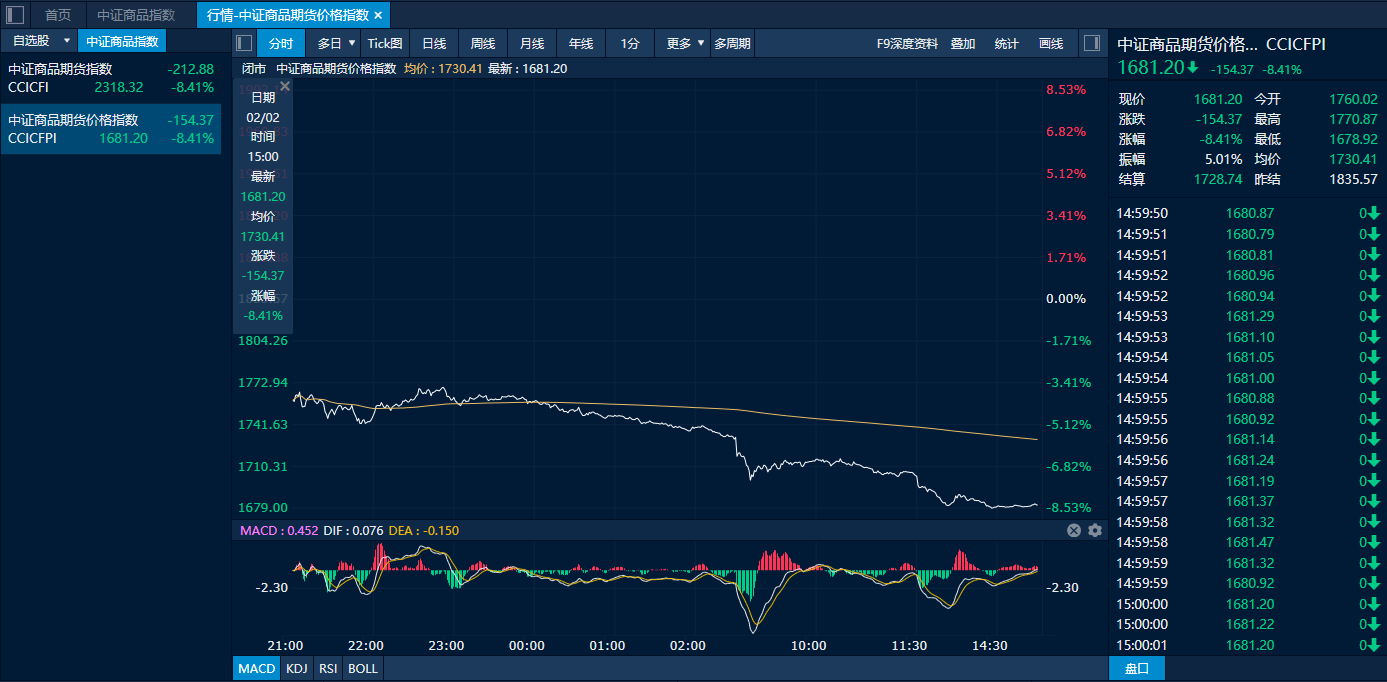
商品日报(2月2日):商品市场普遍下跌 贵金属、有色金属及原油等大面积跌停
Xin Hua Cai Jing· 2026-02-02 11:57
Group 1 - The domestic commodity futures market experienced a significant downturn on February 2, with nearly all contracts closing lower, including major contracts for silver, palladium, platinum, lithium carbonate, nickel, tin, copper, aluminum, and various oil products [1][2] - The China Securities Commodity Futures Price Index closed at 1681.20 points, down 154.37 points or 8.41% from the previous trading day, while the China Securities Commodity Futures Index fell to 2318.32 points, a decrease of 212.88 points or 8.41% [1] - The sharp decline in precious metals was attributed to a shift in market sentiment, influenced by the nomination of Kevin Warsh as the next Federal Reserve Chairman and higher-than-expected core PPI data, which reinforced expectations for a hawkish monetary policy [2][3] Group 2 - The easing geopolitical tensions, particularly regarding U.S.-Iran relations, contributed to a decline in market fears of supply disruptions, further pressuring oil prices as U.S. crude inventories increased [4] - Industrial metals also saw widespread declines, with contracts for lithium carbonate, nickel, tin, aluminum, copper, stainless steel, and aluminum alloy all hitting their daily limits [5] - In contrast, caustic soda futures rose over 2%, driven by cost support from falling liquid chlorine prices, although high inventory levels and weak demand continue to pose challenges for the sector [6]
国内商品期货早盘开盘 沪银主力合约跌停
Mei Ri Jing Ji Xin Wen· 2026-02-02 01:12
Group 1 - The core point of the article highlights a significant decline in domestic commodity futures, with most contracts experiencing drops, particularly in precious metals and base metals [1] - The main futures contracts that fell include silver, which hit the limit down, platinum down by 16%, and palladium down over 15% [1] - Other notable declines include gold and tin down over 9%, copper and international copper down over 5%, and nickel and stainless steel down over 3% [1] Group 2 - Some commodities showed slight increases, such as caustic soda rising over 2% and coking coal and soda ash increasing by over 1% [1] - Glass and coke also experienced minor gains, indicating a mixed performance in certain sectors despite the overall downturn [1]
国内商品期货夜盘开盘,沪银跌超13%
Xin Lang Cai Jing· 2026-01-30 13:26
Group 1 - Domestic commodity futures night trading opened with significant declines, including a drop of over 13% in Shanghai silver and over 8% in Shanghai tin [1] - International copper and Shanghai aluminum fell by more than 3%, while PX and NR decreased by over 1% [1]
国内商品期货夜盘开盘 沪银跌超13%
Jin Rong Jie· 2026-01-30 13:24
Group 1 - Domestic commodity futures night trading opened with Shanghai silver falling over 13% [1] - Shanghai tin dropped over 8% [1] - International copper and Shanghai aluminum both declined over 3% [1] - PX and NR also saw a decrease of over 1% [1]
Best Peptides for Anti-Aging: NAD+ Delivery Methods Compared as Telehealth Platforms Expand Access (2026 Analysis)
Globenewswire· 2026-01-10 03:25
Core Insights - Consumer interest in peptide therapy and NAD+-focused therapies is increasing as research highlights the significance of NAD+ in cellular processes [3][56] - Understanding delivery methods such as injectable, oral, and intravenous is crucial for informed decision-making among consumers [3][15] Delivery Method Characteristics - Consumers are comparing NAD+-related therapies based on administration settings, supervision requirements, and bioavailability [15] - Oral supplementation of NAD+ precursors like NMN and NR requires gastrointestinal absorption, which can vary among individuals [16][17] - Intravenous (IV) NAD+ therapy delivers the compound directly into the bloodstream, bypassing digestive processes, but typically requires in-person appointments [18][19] - Subcutaneous injections offer a middle-ground approach, allowing home administration under clinical supervision, facilitated by telehealth platforms [21] Telehealth Platforms and Prescription Therapy Access - The expansion of telehealth services has created new pathways for accessing prescription therapies that require clinical oversight [23] - Telehealth platforms operate through a three-entity model involving technology platforms, licensed healthcare providers, and compounding pharmacies [24][25] - RenuviaRX is an example of a telehealth platform that facilitates access to NAD+ injections through its infrastructure [27][28] Pricing and Availability Information - RenuviaRX lists NAD+ injection programs starting at approximately $179 per month, with additional therapies available at varying prices [31][32] - Services are currently available in 47 states, with some states having regulatory restrictions on telehealth services [32] Understanding Therapy Categories - NAD+ and its precursors relate to cellular energy pathways and repair mechanisms, often discussed alongside peptide therapies [34] - Other compounds available through RenuviaRX include Glutathione, L-Carnitine, and Vitamin B12, each with distinct characteristics and benefits [38] Consumer Considerations for Telehealth Therapy Access - Individuals interested in telehealth should assess their comfort with remote evaluations and self-administration protocols [39][40] - Those with complex medical histories or specific health conditions should prioritize in-person evaluations before considering telehealth options [41]

光大期货能化商品日报-20251231
Guang Da Qi Huo· 2025-12-31 03:29
1. Report Industry Investment Rating No relevant content provided. 2. Core Views of the Report - All the energy - chemical products covered in the report, including crude oil, fuel oil, asphalt, polyester, rubber, methanol, polyolefins, and PVC, are expected to show an oscillatory trend [1][2][4][5][6]. 3. Summary According to Relevant Catalogs 3.1 Research Views - **Crude Oil**: On Tuesday, oil prices fluctuated downward. The WTI February contract closed down $0.13 at $57.95 per barrel, a 0.22% decline; the Brent February contract closed down $0.02 at $61.92 per barrel, a 0.03% decline; the SC2602 contract closed at 437 yuan per barrel at night, down 1.6 yuan per barrel, a 0.36% decline. As of December 30, the total number of oil and gas rigs increased by 1 to 546, the highest since December 12, but still 43 less than the same period last year, a 7.3% decrease. Indian imports of Russian crude oil in December are expected to drop to about 1.1 million barrels per day, but may increase in January. Oil prices have fallen nearly 20% this year and are expected to oscillate weakly [1]. - **Fuel Oil**: On Tuesday, the main fuel oil contract FU2603 on the Shanghai Futures Exchange closed flat at 2473 yuan per ton, and the low - sulfur fuel oil contract LU2603 closed down 0.23% at 2977 yuan per ton. China's first batch of low - sulfur fuel oil export tax - rebate quotas for 2026 is 8 million tons, the same as last year. The low - sulfur fuel oil market will have sufficient supply from January to February, while the high - sulfur fuel oil market has some support. The absolute prices of FU and LU may fluctuate with oil prices, and the increase in FU warehouse receipts may put additional pressure on the market [2]. - **Asphalt**: On Tuesday, the main asphalt contract BU2602 on the Shanghai Futures Exchange closed up 1.47% at 3038 yuan per ton. The arrival of diluted asphalt at ports is currently stable, and refinery raw material supply in January is not affected by the US - Venezuela geopolitical event. Production increased slightly at the end of the year, but the production schedule for January is low. There is still some demand in the south, while the north has more inventory demand. Asphalt prices may fluctuate with oil prices and may be stronger than crude oil and fuel oil [2]. - **Polyester**: TA605 closed up 0.43% at 5144 yuan per ton, EG2605 closed up 0.79% at 3847 yuan per ton, and PX futures contract 603 closed up 0.63% at 7316 yuan per ton. The production and sales of polyester yarn in Jiangsu and Zhejiang are weak. A 200,000 - ton/year synthetic gas - to - ethylene glycol plant in Guangxi has restarted. PX faces a game between reality and expectation, and ethylene glycol is expected to oscillate after a rebound [4]. - **Rubber**: On Tuesday, the main Shanghai rubber contract RU2605 rose 5 yuan per ton to 15670 yuan per ton, the NR main contract rose 25 yuan per ton to 12690 yuan per ton, and the butadiene rubber BR main contract fell 35 yuan per ton to 11565 yuan per ton. With easing precipitation in the production areas and fading downstream tire demand, rubber prices are expected to oscillate [4][5]. - **Methanol**: On Tuesday, the spot price in Taicang was 2182 yuan per ton. Iranian plant shutdowns will lead to a decline in January arrivals, but MTO plant loads are also decreasing. Port inventories have rebounded, and methanol is expected to maintain a bottom - oscillating trend [5]. - **Polyolefins**: On Tuesday, the mainstream price of East China拉丝 was 6150 - 6300 yuan per ton. Polyolefin production will remain high, while downstream orders and starts are weakening. Polyolefins are expected to oscillate at a low level [5]. - **PVC**: On Tuesday, the PVC market prices in East China were mixed, with some prices in North China rising and those in South China stable. PVC supply remains high, domestic demand is slowing, and it is expected to oscillate at the bottom [6]. 3.2 Daily Data Monitoring - The report provides the basis price, basis rate, spot price change rate, futures price change rate, basis change, and the percentile of the latest basis rate in historical data for various energy - chemical products such as crude oil, liquefied petroleum gas, asphalt, etc. on December 31, 2025 [7]. 3.3 Market News - The US EIA inventory report shows that last week, US crude oil, gasoline, and distillate inventories all increased. As of the week of December 19, US crude oil inventories increased by 405,000 barrels to 424.822 million barrels, and Cushing crude oil inventories increased by 707,000 barrels to 21.57 million barrels. Refinery crude oil processing volume decreased by 212,000 barrels per day, and the refinery utilization rate decreased by 0.2 percentage points to 94.6%. US crude oil production decreased by 18,000 barrels per day to 13.83 million barrels per day [10]. - Under US sanctions, Indian imports of Russian crude oil in December are expected to drop to about 1.1 million barrels per day, reaching a three - year low in 2025, but are expected to increase in January [10]. 3.4 Chart Analysis - **4.1 Main Contract Prices**: The report presents historical price trends of main contracts for multiple energy - chemical products from 2021 to 2025 through various charts, including crude oil, fuel oil, low - sulfur fuel oil, asphalt, etc. [12][13][14][15][17][18][20][21][22][23][25][26][27][28][29]. - **4.2 Main Contract Basis**: It shows the historical basis trends of main contracts for different energy - chemical products, such as crude oil, fuel oil, low - sulfur fuel oil, etc. [30][31][32][35][36][37][39][40][41][42]. - **4.3 Inter - period Contract Spreads**: The report analyzes the historical spreads between different contracts for energy - chemical products, including fuel oil, asphalt, PTA, ethylene glycol, etc. [44][45][46][47][49][50][52][53][54][55][56][57][58][59]. - **4.4 Inter - variety Spreads**: It includes historical spreads and ratios between different energy - chemical products, such as crude oil internal and external spreads, fuel oil high - low sulfur spreads, fuel oil/asphalt ratio, etc. [60][61][62][63][64][65][68]. - **4.5 Production Profits**: The report shows the historical production profit trends of LLDPE and PP [69][70]. 3.5 Team Member Introduction - **Zhong Meiyan**: Serves as the assistant director of the research institute and director of energy - chemical research. With more than ten years of research experience in the futures derivatives market, she has won many awards and has rich experience in serving enterprises [74]. - **Du Bingqin**: Analyzes crude oil, natural gas, fuel oil, asphalt, and shipping. With in - depth industry research and many awards, she often publishes views in the media [75]. - **Di Yilin**: Focuses on natural rubber and polyester research. She has won several awards and is good at data analysis [76]. - **Peng Haibo**: Analyzes methanol, propylene, pure benzene, polyolefins, and PVC. With a background in energy - chemical spot - futures trading, he holds a CFA Level 3 certificate [77].