Rubin GPU芯片

Search documents
亚马逊买百万颗英伟达芯片 鸿海、广达等添利多
Jing Ji Ri Bao· 2026-03-21 23:36
Group 1 - NVIDIA is set to sell 1 million GPU chips, language processing units (LPU), and networking platforms to Amazon AWS by the end of 2027, with confirmation from NVIDIA [2] - The procurement agreement between NVIDIA and AWS has been announced, but specific financial details have not been disclosed [2] - The deal includes various NVIDIA chips, such as Spectrum Ethernet chips and the newly released Groq chip, aimed at enhancing inference efficiency [2] Group 2 - The integration of NVIDIA's Vera Rubin platform includes Rubin GPU chips, Vera CPUs, Spectrum Ethernet, NVLink switches, and BlueField data processing chips, maximizing computational efficiency [3] - The order signifies the upcoming peak delivery season for AI server manufacturing, with production expected to begin in Q3 of this year [3] - NVIDIA plans to launch an enhanced version of the Rubin Ultra GPU chip next year, which is anticipated to be part of the procurement agreement with AWS [3]



你没看错!美光:存储将缺货到2028年!
是说芯语· 2026-01-12 11:53
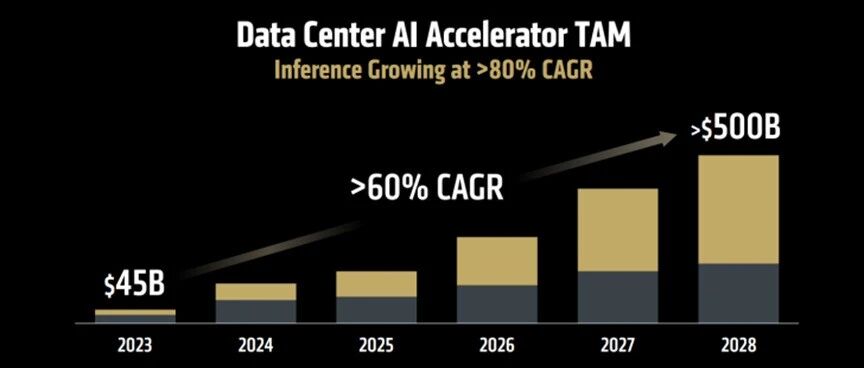
Core Viewpoint - Micron is a leading memory manufacturer facing a significant demand surge in DRAM memory due to the rise of artificial intelligence, which has led to a supply shortage affecting both consumer and data center markets [1][2][3] Group 1: Current Market Situation - The total addressable market (TAM) for data centers is rapidly expanding, with potential market size increasing from 30%-35% to 50%-60%, indicating a substantial demand for memory [2] - Micron's OEM consumer channel constitutes a significant portion of its market share, supplying major PC brands like Dell and Asus, thus maintaining a presence in the consumer market despite the exit from the "Crucial" brand [2][3] - The current supply shortage is not solely a Micron issue but a broader industry challenge, with all manufacturers struggling to meet the heightened demand [3] Group 2: Production Capacity and Challenges - Micron is facing challenges in adjusting production lines to meet varying memory module capacities, which complicates efforts to increase overall DRAM output [5][6] - The company is working to stabilize demand and production to maximize yield, as fluctuations in memory configurations can lead to reduced output [6] - Significant expansions in production capacity will not yield results until 2028 due to the lengthy process of construction and customer certification [7] Group 3: Competitive Landscape - There is increasing speculation about Chinese memory suppliers potentially filling market gaps, with Micron welcoming competition as a means to improve its own offerings [8][9] - The memory industry is experiencing a strong demand driven by AI infrastructure, which is expected to sustain high prices and profitability for manufacturers [10][13] Group 4: Future Outlook - Analysts predict that the demand for NAND flash and DRAM will continue to grow, with capital expenditures from major tech companies expected to rise significantly [14][17] - Despite the current high demand, memory manufacturers are cautious about expanding production capacity due to past experiences with market volatility [17][18]

四大芯片巨头现身联想大会,杨元庆黄仁勋宣布新合作
Guan Cha Zhe Wang· 2026-01-07 09:51
Core Insights - Lenovo and NVIDIA announced a partnership to launch the "Lenovo AI Cloud Super Factory" at CES 2026, aimed at enhancing their collaboration in AI cloud services [1][4] - The initiative is designed to empower AI cloud service providers to deploy next-generation AI workloads and applications more rapidly, emphasizing the importance of delivery speed over mere computing power in the AI era [4] Group 1: Partnership and Collaboration - The partnership between Lenovo and NVIDIA aims to expand the boundaries of AI factories to Gigawatt level, simplifying cloud infrastructure deployment with higher efficiency and predictability [4] - The collaboration will support NVIDIA's latest Vera Rubin architecture, which includes six newly designed chips, significantly enhancing training time and reducing inference token costs [4][7] Group 2: Technological Advancements - NVIDIA's new Vera Rubin architecture features a third-generation Transformer engine in its Rubin GPU, with NVFP4 inference computing power reaching 50 PFLOPS, five times that of the previous Blackwell architecture [4][7] - The design of the six new chips allows for extreme synergy, which drastically shortens the time to first token for AI deployment and enables rapid scaling to tens of thousands of GPUs [7] Group 3: Market Trends and Future Outlook - Both companies anticipate that enterprise-level AI will become a core battleground, with hybrid AI as a key breakthrough point, and AI will permeate various sectors of the real economy, presenting significant market opportunities [7] - The scale of collaboration in AI between Lenovo and NVIDIA has increased fivefold over the past few years, with expectations to double again in the next two years [7]


英伟达发布新一代GPU!
国芯网· 2026-01-06 11:32
Core Insights - Nvidia's CEO Jensen Huang showcased the new AI platform Rubin at CES, featuring six new chips including Vera CPU, Rubin GPU, NVLink 6 switch, ConnectX-9 super NIC, BlueField-4 DPU, and Spectrum-6 Ethernet switch [2] - The Rubin GPU chip is equipped with a third-generation Transformer engine, achieving a NVFP4 inference computing power of 50 PFLOPS, which is five times that of Blackwell [2] - The Rubin platform has entered full production, with products expected to be available through partners in the second half of 2026 [2] Market Demand - Huang emphasized the strong demand for the H200 AI chips in the Chinese market during his keynote speech [4] - Nvidia's CFO Colette Kress stated that the company has applied for licenses to ship H200 chips to China and is awaiting approval from the U.S. and other governments [4] - Reports indicate that Nvidia plans to deliver H200 chips to Chinese customers before the Lunar New Year holiday in mid-February 2026 [4]
黄仁勋点赞三款中国大模型,英伟达押宝物理AI
Guan Cha Zhe Wang· 2026-01-06 11:22
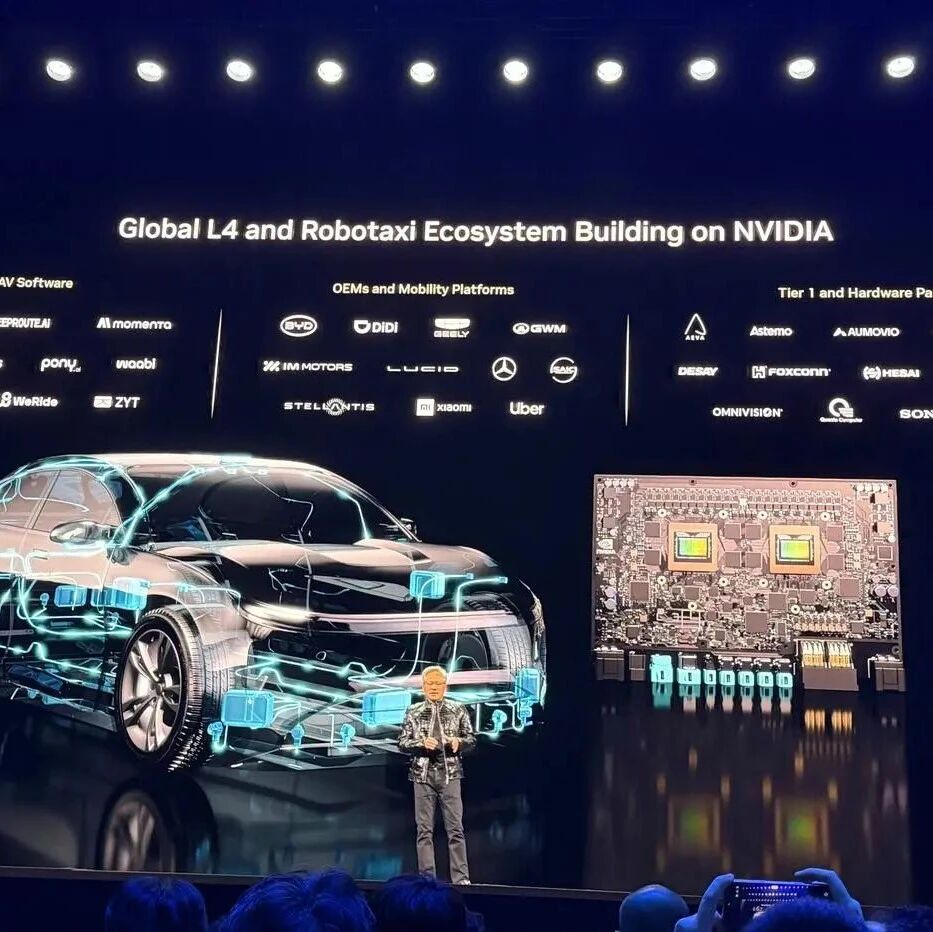
Core Insights - The CES 2026 showcased NVIDIA's strategic focus on next-generation computing platforms and advancements in physical AI, marking the first time in five years that NVIDIA did not release a new GPU at the event [2][3]. Group 1: Open Source Ecosystem - NVIDIA's CEO highlighted the significant investment of approximately $10 trillion in computing resources over the past decade, emphasizing a shift in software paradigms rather than just hardware upgrades [3]. - The presentation acknowledged the rapid development of Chinese open-source models, specifically naming Kimi K2, DeepSeek V3.2, and Qwen, which are leading the open-source ecosystem alongside OpenAI's GPT-OSS [5]. - Despite being approximately six months behind the top models, the open-source models are expected to see new iterations every six months, attracting interest from startups, giants, and researchers alike [5]. Group 2: Next-Generation Computing Platform - NVIDIA introduced the Vera Rubin computing platform, designed to accelerate AI training speeds and facilitate the development of next-generation models [7]. - The platform features a complete redesign of six chips, including Vera CPU and Rubin GPU, with the Rubin GPU achieving a performance of 50 PFLOPS, five times that of its predecessor [7][8]. - The engineering design of Vera Rubin simplifies assembly, reducing the number of cables from 43 to just six liquid cooling pipes, allowing for quicker setup times [8]. Group 3: Advancements in Physical AI - NVIDIA's CEO announced the launch of the Alpamayo open-source AI model aimed at enhancing autonomous driving capabilities, addressing complex driving scenarios through a new reasoning model [10][11]. - The Alpamayo series incorporates a "thinking chain" reasoning model, improving decision-making processes in autonomous vehicles and enhancing user trust in the technology [11]. - The first vehicles utilizing NVIDIA's technology are expected to hit the roads in the U.S. in Q1, Europe in Q2, and Asia later in the year, with interest from companies like Jaguar Land Rover and Uber [11]. Group 4: Robotics Development - NVIDIA unveiled two new open-source models for robotics, NVIDIA Cosmos and GR00T, along with a performance evaluation tool, Isaac Lab-Arena, aimed at simplifying robot training processes [12]. - The collaboration with Hugging Face integrates NVIDIA's Isaac open-source models into the LeRobot project, accelerating the development of the open-source robotics community [12]. - Companies such as Boston Dynamics and Caterpillar are developing new robots and autonomous devices based on NVIDIA's technology, indicating a significant advancement in the robotics sector [13].

第一创业晨会纪要-20260106
First Capital Securities· 2026-01-06 06:19
Group 1: Industry Overview - The CES 2026 event showcased NVIDIA's new AI platform, Rubin, featuring the Rubin GPU chip with a FP4 inference computing power of 50 PFLOPS, which is five times that of Blackwell. The platform is set to enter full production, with products expected to launch in the second half of 2026, indicating positive progress in next-generation AI chips [2] - The CES event also highlighted advancements in robotics, with NVIDIA and Qualcomm releasing robot chipsets, and Google's DeepMind collaborating with Boston Dynamics on the Atlas humanoid robot. This suggests a significant moment for the robotics sector, akin to the "ChatGPT" moment, with expectations for increased industry prosperity in chips, AI, and robotics [2] Group 2: Company Performance - Whirlpool (600983.SH), Taotao Automotive (301345.SZ), Ugreen Technology (301606.SZ), and Juxing Technology (002444.SZ) reported strong fourth-quarter performance, with year-on-year growth rates of 27%, 68%, 61%, and 19% respectively. This indicates robust export demand, suggesting that December's export growth in China is likely to remain strong [4] - Salt Lake Potash disclosed an earnings forecast for 2025, expecting a net profit attributable to shareholders between 8.29 billion to 8.89 billion yuan, representing a year-on-year growth of 77.78%-90.65%. The company’s profit growth is primarily driven by its main business, indicating high growth quality [8] - The lithium and potassium sectors are experiencing a recovery phase, with potassium fertilizer demand driven by rigid needs and supply constraints, while the lithium industry is entering a new recovery cycle due to expanding demand and supply-side adjustments [8] Group 3: Consumer Sector Developments - Meitu is advancing its transformation into an AI Agent strategy, with strong performance in 2025H1, reporting a 42.6% increase in paid users to 15.4 million and a net profit of 470 million yuan, up 71.3% year-on-year. The company is also launching a venture capital plan to incentivize employee entrepreneurship [10] - In the retail sector, Hema is shifting from broad exploration to deep operation, focusing on high-quality consumption and cost-effective offerings, with a projected revenue growth of over 40% in 2025. The company plans to open nearly 100 new stores and expand to over 50 new cities [11] - Sam's Club in China anticipates sales exceeding 140 billion yuan in 2025, driven by same-store sales growth and accelerated store openings, with a significant portion of sales coming from its private label and customized products [11]
进入全面生产阶段!黄仁勋CES上带货Rubin平台 A股供应链成关注焦点
Ge Long Hui A P P· 2026-01-06 03:31
Core Insights - NVIDIA's CEO Jensen Huang unveiled the next-generation AI platform, Vera Rubin, at CES 2026, which is described as an AI supercomputer composed of six chips [1] - The Rubin GPU features a third-generation Transformer engine with an inference performance of 50 PFLOPS, which is five times that of the previous Blackwell GPU [1] - The Rubin platform has entered full production, with products expected to be available in the second half of 2026 through partnerships [1] Industry Implications - Dongwu Securities indicates that Rubin marks a new era for high-end AI PCB materials, with M9 and Q fabric driving a surge in PCB value, highlighting companies like Shenghong Technology and Feilihua [1] - Shanxi Securities anticipates that the demand for AI servers will continue to grow strongly, as NVIDIA's GPU chips are primarily used in AI server applications, leading to ongoing technological advancements [1] - There is expected rapid growth in the demand for core raw materials such as PPO resin, hydrocarbon resin, and low-dk electronic cloth for high-frequency and high-speed copper-clad laminates [1]
英伟达一骑绝尘:算力需求强劲 市值迭创纪录
2 1 Shi Ji Jing Ji Bao Dao· 2025-10-30 23:08
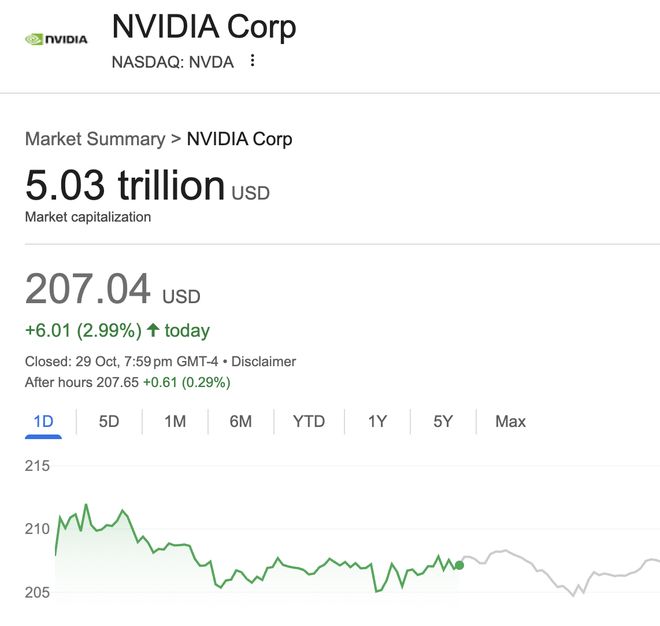
Core Insights - Nvidia has become the first company to reach a market capitalization of $5 trillion, closing at $5.03 trillion on October 29, 2023, with a stock price of $207 per share [1] - The company's market value has increased significantly from under $1 trillion two years ago, showcasing a remarkable growth trajectory [1][4] - Nvidia's CEO Jensen Huang has seen his wealth rise, ranking eighth on the Forbes billionaire list as of October 29, 2023 [1] Market Growth - Nvidia's market capitalization surpassed $1 trillion in June 2023, and it reached $2 trillion by March 2024, indicating rapid growth [2] - The company achieved a market value of $3 trillion within three months after hitting $2 trillion, and it took approximately one year to grow from $3 trillion to $4 trillion [3][4] - The leap from $4 trillion to $5 trillion was accomplished in just over three months, setting a new global record [4] AI and Semiconductor Industry Impact - Nvidia is positioned as a key player in the AI era, significantly benefiting from the demand for AI technologies since the launch of ChatGPT [5] - The company's revenue growth rate is projected to be 125% for 2023-2024, while other fabless companies are expected to see around 20% growth [6] - Nvidia's Blackwell and Rubin GPU chips are anticipated to generate over $500 billion in revenue over the next five quarters, with current orders reaching 20 million units, five times the previous generation's total [6] Client Demand and Capital Expenditure - Major cloud service providers like Amazon, Meta, Google, Microsoft, Oracle, and CoreWeave are expected to increase their capital expenditures to $632 billion by 2027 [6] - Goldman Sachs predicts that the total capital expenditure of hyperscalers will approach $1.4 trillion from 2025 to 2027, nearly tripling from the previous period [7] - Nvidia's growth has positively impacted its supply chain, with companies like Industrial Fulian experiencing significant revenue and market value increases due to AI business growth [7][8] Nvidia's Position in the Tech Industry - Nvidia is recognized as a leading provider of AI computing infrastructure, with its technology being fundamental to the current AI landscape [9] - The company has outperformed other tech giants like Microsoft and Apple, with its market value leading the "Big Tech" sector [10] - Despite facing challenges such as competition and the complexities of AI implementation, Nvidia is expected to continue innovating and leading in the tech industry [10][11]
迭创市值纪录 英伟达算力地平线一骑绝尘
2 1 Shi Ji Jing Ji Bao Dao· 2025-10-30 02:17
Core Insights - Nvidia has become the first company to reach a market capitalization of $5 trillion, closing at $5.03 trillion on October 29, 2023, with a stock price of $207 per share [3][4] - The company's market value has increased dramatically, surpassing $1 trillion in June 2023, $2 trillion in March 2024, and reaching $3 trillion in just three months [3][4] - Nvidia's CEO Jensen Huang has seen his wealth rise significantly, ranking eighth on the Forbes billionaire list as of October 29, 2023 [3] Market Performance - Nvidia's revenue growth rate for 2023-2024 is projected at 125%, significantly higher than the 20% growth seen by other fabless companies [6] - The demand for Nvidia's Blackwell and Rubin GPU chips is strong, with expected revenues exceeding $500 billion over the next five quarters and an order volume of 20 million units [6][7] - Major cloud service providers are projected to increase their capital expenditures to approximately $1.4 trillion from 2025 to 2027, nearly tripling from the $485 billion spent from 2022 to 2024 [7] Industry Impact - Nvidia's success has positively influenced the AI server and related markets, with companies like Industrial Fulian reporting significant revenue growth due to the expanding AI server market [8] - Industrial Fulian's revenue for the first three quarters of 2023 reached 603.93 billion yuan, a 38.4% year-over-year increase, with net profit growing by 48.52% [7][8] - The AI industry is experiencing a new industrial revolution, with Nvidia positioned as a key player in providing the necessary computational infrastructure [10][11] Future Outlook - Nvidia's market leadership is expected to continue, with analysts projecting a target price increase to $275, which would correspond to a market cap of $6.68 trillion [10] - The company faces challenges in AI implementation, including algorithm ecosystems, energy consumption, and regulatory boundaries, but remains focused on innovation and leadership in the tech industry [11]
COWOS,被看好
半导体芯闻· 2025-09-17 10:24
Core Viewpoint - Morgan Stanley's recent report indicates that Oracle's orders exceeded expectations, positively impacting the overall AI semiconductor market sentiment, leading to an "overweight" rating for TSMC and an increased target price for King Yuan Electronics to 188 TWD [2] Group 1: Oracle and AI Semiconductor Market - Oracle's financial performance serves as a catalyst for NVIDIA and the AI supply chain, with expectations of 28,000 NVL 72 server cabinet orders by 2026 [2] - Broadcom has secured a $10 billion customized AI chip order from a fourth cloud customer, likely OpenAI, although Morgan Stanley analysts suggest this figure may represent cabinet value rather than guaranteed revenue [2] Group 2: TSMC and CoWoS Supply Chain - TSMC's COO mentioned that semiconductor technology has entered the "Moore's Law 2.0" era, emphasizing system integration over mere chip miniaturization [2] - TSMC's CoWoS capacity is projected to reach 93 kpwm by 2026, with OpenAI accounting for a small portion of approximately 10,000 units [3] Group 3: NVIDIA and Other Collaborations - NVIDIA's Rubin GPU chip is expected to begin mass production in Q2 2026, according to supply chain surveys [3] - Google, in collaboration with Broadcom, is increasing the production forecast for its 3nm TPU v7 to 300,000 units by 2026, while the 3nm TPU v8's output forecast has been revised down to 200,000-300,000 units due to delays [3][4] Group 4: King Yuan Electronics - With the anticipated ramp-up of TSMC's CoWoS TPU, Morgan Stanley expects an upward revision in King Yuan Electronics' 2026 TPU testing volume, raising its target price from 158 TWD to 188 TWD [5]