
Jing Ji Ri Bao

Search documents
推动更加积极的财政政策精准增效
Jing Ji Ri Bao· 2026-01-20 22:43
当前,我国经济发展中老问题、新挑战仍然不少,外部环境变化影响加深,国内重点领域风险隐患较 多。从国际看,大国博弈更加复杂激烈,单边主义、保护主义抬头,关税和非关税壁垒依然存在,外需 面临较大不确定性不稳定性。需要将国际经贸中可能遇到的问题考虑得更周全些,聚精会神搞建设,练 好内功,办好自己的事。从国内看,产业结构、商业模式、人口结构、财富分配等发生显著变化,供强 需弱矛盾突出,一些领域风险尚未出清。需要在促进供需平衡上下功夫,大力提振需求,解决供需错配 问题,让需求和供给更加匹配。适应新形势新变化、积极应对风险挑战,要求我们继续实施更加积极有 为的宏观政策,包括更加积极的财政政策和适度宽松的货币政策。 财政政策是宏观调控的重要手段,通过预算、税收、政府债券、转移支付等工具组合,可以发挥扩大总 需求和定向调结构的双重优势,熨平经济周期性波动,落实国家重大决策部署,促进经济总量平衡和结 构优化。2025年中央经济工作会议提出,要继续实施更加积极的财政政策。2026年财政政策和2025年财 政政策取向一以贯之,这是以习近平同志为核心的党中央审时度势、综合考量作出的重大决策部署。我 们要推动更加积极的财政政策精准增效 ...
易地搬迁“后半篇”文章怎么做
Jing Ji Ri Bao· 2026-01-20 22:20
Core Insights - The article highlights the successful implementation of relocation policies in Guizhou, where nearly 10 million people have been lifted out of poverty through resettlement initiatives, focusing on sustainable employment and community integration [1][15] Employment and Economic Development - Guizhou has become the largest province for resettlement in China, with 1.92 million people relocated during the 13th Five-Year Plan, and 1.83 million of them settled in urban areas [1] - The average income of relocated individuals increased from 11,228 yuan in 2020 to 16,927 yuan in 2024, marking a growth of 50.76% [1] - In the Wangjia community of Tongren, the introduction of labor-intensive enterprises has created over 1,200 job opportunities, increasing average monthly income by more than 2,600 yuan [4][3] - Bijie City has established a modern textile and garment industry cluster, with over 120 textile enterprises, generating a total output value of 12.82 billion yuan in the first three quarters of 2025, a year-on-year increase of 50.33% [5][10] Community Integration and Governance - Effective community governance is essential for the integration of relocated individuals, with Guizhou focusing on building public service systems and community governance frameworks [11][12] - The establishment of community service centers and support programs has improved the living conditions and social integration of relocated populations [14][12] - Bijie has implemented a points-based governance model to encourage community participation and support for relocated individuals, allowing them to exchange points for daily necessities [12][11] Challenges and Future Directions - Despite the progress, challenges remain in ensuring job stability and addressing the needs of vulnerable groups, such as the elderly and children [10][14] - The focus is shifting towards upgrading industries and expanding income channels to ensure long-term prosperity for relocated populations [6][10] - Continuous efforts are required from the government, enterprises, and society to enhance employment quality and provide equitable development opportunities [10][15]
促进生产性服务业扩能提质
Jing Ji Ri Bao· 2026-01-20 22:12
Core Insights - The production service industry is crucial for enhancing production efficiency and supporting agricultural and industrial activities, as highlighted in the "14th Five-Year Plan" which emphasizes the need for specialization and high-end value chain extension [2][4] Group 1: Industry Development - The production service industry has seen significant growth, with revenue from large-scale enterprises reaching 119 trillion yuan in 2023, reflecting an average annual growth rate of 12.1% from 2020 to 2023, surpassing GDP growth during the same period [5] - The integration of production services with advanced manufacturing is essential for driving the transformation and upgrading of the manufacturing sector, fostering a dual cycle of service support for manufacturing and vice versa [6][7] Group 2: Technological Integration - The application of technologies such as artificial intelligence, big data, and industrial internet is enhancing the efficiency and value of production services, facilitating a more intelligent and digitalized manufacturing process [5][8] - The promotion of smart technologies and the establishment of platforms for technology transfer are critical for accelerating the transition from laboratory innovations to production applications [6][8] Group 3: Policy Recommendations - To optimize the development environment for the production service industry, it is recommended to promote the application of digital technologies, cultivate diverse service providers, and enhance policy support mechanisms [8][9] - Expanding financial incentives and tax benefits for high-end production services, while lowering market entry barriers, is essential for fostering a competitive and efficient production service sector [9]

保险业筑牢灾害安全屏障
Jing Ji Ri Bao· 2026-01-20 22:08
Core Insights - Munich Re's 2025 Natural Disaster Loss Report highlights significant economic losses due to climate change, estimating total losses at approximately $224 billion, with the insurance industry bearing around $108 billion of this amount [1] - Meteorological disasters are identified as the primary risk factor, accounting for 92% of global losses and 97% of insurance losses [1] - The report emphasizes the increasing frequency and severity of extreme weather events linked to climate change, with recent years being the warmest on record [1] Group 1: Global Impact - The report indicates that multiple natural disasters in 2025, such as wildfires in Los Angeles and hurricanes in the North Atlantic, are closely related to climate change [1] - The economic losses from natural disasters in the Asia-Pacific region reached approximately $73 billion, surpassing the 10-year average of $66 billion, while insurance losses were only about $9 billion [2] - The report notes that low-income countries have an insurance penetration rate of less than 5%, exacerbating the impact of natural disasters [2] Group 2: Regional Challenges - In China, natural disasters in 2025 primarily included floods, geological disasters, earthquakes, and typhoons, affecting over 67 million people and causing direct economic losses of approximately 241.6 billion yuan [2] - The Ministry of Emergency Management's data highlights the urgent need for the insurance industry to enhance its integrated service capabilities for disaster prevention, emergency response, and timely compensation [2] - A new policy aims to expand the coverage of catastrophe insurance to include common natural disasters, effectively doubling the basic insurance amount [3] Group 3: Insurance System Development - The establishment of a multi-layered catastrophe risk diversification system is underway, with pilot programs in over 20 provinces to strengthen disaster prevention and mitigation [3] - The report underscores the importance of a robust catastrophe insurance system in enhancing societal disaster response capabilities and risk prevention [3] - There remains significant potential for growth in both commercial and government-led catastrophe insurance in terms of coverage and depth of protection [3]
低利率环境下理财行业竞争加剧—— 多家银行和理财公司掀起降费潮
Jing Ji Ri Bao· 2026-01-20 22:02
在现阶段银行"存款搬家"的背景下,费率下调正成为承接储蓄资金的重要抓手。业内专家指出,理财公 司下调理财产品费率,是低利率环境下行业竞争加剧,为了吸引客户投资承接"存款搬家"资金,以及冲 刺"开门红"业绩的综合体现。 新年伊始,银行理财机构密集下调理财产品费率。南银理财近日发布公告,下调旗下悦稳系列产品固定 管理费与销售费率。与此同时,中原银行也公告调整旗下3款理财产品费率。苏商银行特约研究员薛洪 言介绍,多家银行和理财公司掀起阶段性降费潮,通过主动调降产品的相关费率,让利于投资者,旨在 关键时间窗口提升产品的吸引力,以吸引资金流入并扩大市场份额。 银行理财公司密集降费动作,背后是多重因素的共同驱动。薛洪言认为,直接原因是为了在年初资金充 裕的时期,积极争取投资者进行资产再配置的资金。更深层次看,这是在理财产品整体收益率面临下行 压力的环境中,机构为维持产品相对竞争力而采取的一种策略。同时,这也反映了理财市场从高速增长 进入更加注重存量竞争的阶段,机构通过价格手段来稳固或拓展自身市场地位。 近年来,我国银行理财市场快速发展,行业竞争不断加剧。截至2025年三季度末,全市场共存续产品 4.39万只,同比增加10 ...
守住公平竞争的航道
Jing Ji Ri Bao· 2026-01-20 22:02
Core Viewpoint - The antitrust investigation serves as a critical opportunity for the overall transformation of the platform economy, emphasizing the need for technological innovation to reduce costs and improve efficiency while ensuring fair profit distribution among all stakeholders in the platform ecosystem [1][4]. Group 1: Antitrust Investigation Context - The first antitrust case of 2026 targets Ctrip, with prior indications of issues such as "choose one from two" and technical price intervention being flagged by market regulators [2]. - The investigation suggests that Ctrip's business practices may have already been deemed problematic, raising concerns about potential penalties and their impact on future profitability and business models [2]. Group 2: Policy Implications - Ctrip's situation highlights a conflict between high platform profits and the "real economy first" directive, as platforms often profit from merchants rather than users, leading to a concerning trend of cost transfer from users to merchants [3]. - Ctrip's net profit for the first three quarters of 2025 reached 29 billion yuan, while the total net profit of the entire A-share tourism chain was approximately 19 billion yuan, illustrating the stark contrast between platform profits and the struggles of traditional businesses [3]. Group 3: Market Dynamics and Future Directions - The use of pricing tools by platforms like Ctrip creates a vicious cycle for merchants, forcing them into price wars that undermine profitability, which is contrary to the goal of fostering a healthy competitive environment [4]. - The investigation is not only about antitrust but also addresses the issue of "involution" in competition, aiming to create a new ecosystem where all parties can share development benefits through genuine value creation and fair profit distribution [4].

智能化迈出“破冰”行动 汽车产销再创历史新高
Jing Ji Ri Bao· 2026-01-20 19:59
Core Insights - In 2025, China's automotive industry demonstrated remarkable resilience and vitality, achieving record production and sales figures of 34.53 million and 34.40 million vehicles, respectively, marking year-on-year growth of 10.4% and 9.4% [1] - The year marked a significant shift in the market, with new energy vehicles (NEVs) surpassing 50% of domestic new car sales, establishing themselves as the mainstream product in the automotive market [2][3] - The automotive export volume exceeded 7 million units, with NEV exports reaching 2.615 million units, reflecting a strong competitive edge in international markets [11] NEV Market Dominance - NEVs accounted for 50.8% of domestic new car sales in 2025, indicating that for every two new cars sold, one was an NEV [3] - NEV production and sales reached 16.626 million and 16.49 million units, respectively, with year-on-year growth of 29% and 28.2%, maintaining a global leadership position for 11 consecutive years [3] - The competitive landscape has shifted, with domestic brands capturing nearly 70% of the passenger car market share, reversing the dominance of joint venture brands [3][4] Technological and Policy Support - The growth of NEVs is attributed to supportive policies, technological advancements, and a robust supply chain, with over 11.5 million vehicles replaced under the trade-in policy, generating sales exceeding 1.6 trillion yuan [5] - Technological innovations have led to significant improvements in vehicle performance, such as a 30% reduction in battery costs and a 40% increase in battery lifespan [6] - The establishment of a comprehensive supply chain has positioned China as a leading supplier of battery materials and power batteries globally, with 70% and 60% market shares, respectively [6] Smart Driving Developments - The approval of the first L3-level conditional autonomous driving models in December 2025 marked a pivotal moment in China's autonomous driving industry, transitioning from technology validation to mass production [7] - The penetration rate of vehicles equipped with L2-level driving assistance features reached 64%, with a year-on-year growth of 21.2% in the first three quarters of 2025 [9] - The integration of AI technologies into smart driving systems has accelerated advancements, with new models emerging that enhance driving experiences and product forms [9][10] International Expansion and Localization - In response to intensified domestic competition, Chinese automakers are accelerating their international expansion, with exports reaching 7.098 million units in 2025, a 21.1% increase [11] - Localization strategies are being implemented in key markets such as Southeast Asia and Europe, with several Chinese brands establishing manufacturing bases to enhance competitiveness [12] - Collaborations with multinational companies are facilitating the entry of Chinese automotive supply chains into global markets, strengthening China's position in the global automotive value chain [12] Market Competition Restructuring - The introduction of compliance guidelines aims to curb price wars and establish a more orderly competitive environment in the automotive industry [13] - Measures to address "involution" in the market have begun to take effect, with a shift from price competition to a focus on technology, quality, and service [13][14] - The automotive industry is transitioning from a phase of scale expansion to one of quality enhancement, necessitating a comprehensive approach to market regulation and competition [15]

成品油价,今年首次上调
Jing Ji Ri Bao· 2026-01-20 12:04
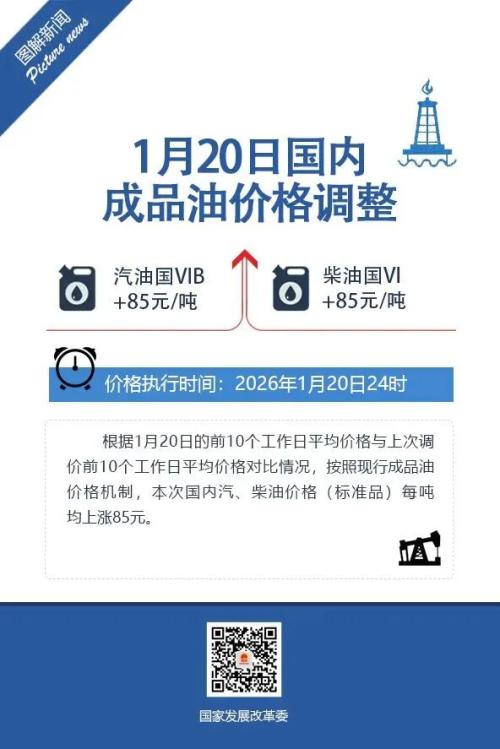
国家发展改革委发布消息,近期国际市场油价波动上升,根据1月20日的前10个工作日平均价格与上次 调价前10个工作日平均价格对比情况,按照现行成品油价格机制,自1月20日24时起,国内汽、柴油价 格每吨均上涨85元。 本轮是2026年国内成品油第二次调价,也是首次上调。折合成升价,92#汽油每升上调0.06元,0#柴油 每升上调0.07元。以油箱容量50L的普通私家车计算,加满一箱油将多花3元左右。 来源/经济日报新闻客户端(记者熊丽) 财经频道更多独家策划、专家专栏,免费查阅>> 责任编辑:小讯 国家发展改革委价格监测中心监测显示,本轮成品油调价周期内(1月6日—1月19日),国际油价先升 后降。 调价周期内,受地缘政治局势变化影响,国际油价在连续多日快速上涨后出现回落,总体水平较上一轮 调价周期上涨。其中,伊朗局势是市场主要关注点。以布伦特原油期货价格为例,其价格从期初约每桶 60美元最高升至67美元,目前,回落至64美元附近。 国家发展改革委价格监测中心预计,在全球油市供应过剩的背景下,地缘政治局势是影响国际油价震荡 运行的主要因素。短期来看,伊朗与委内瑞拉局势仍是关注焦点。伊朗国内外形势的动荡反复可能导 ...
经济日报:股价大起大落,商业航天不能被炒作带歪了
Jing Ji Ri Bao· 2026-01-20 11:16
Core Viewpoint - The commercial aerospace sector has experienced significant volatility, driven by market enthusiasm and policy support, but also faces challenges related to valuation and regulatory scrutiny [1][2]. Group 1: Market Dynamics - The commercial aerospace sector gained momentum due to clear market opportunities and supportive policies, with notable advancements in reusable rocket technology and satellite internet applications [1]. - The "14th Five-Year Plan" identifies aerospace as a strategic emerging industry, leading to increased capital activity through various local government initiatives [1]. Group 2: Valuation and Regulatory Concerns - The sector has accumulated valuation bubbles, with an average price-to-earnings ratio reaching 96 times, and some leading stocks exceeding 1,000 times, indicating a significant disconnect between earnings and valuations [2]. - Regulatory warnings from the Shanghai Stock Exchange regarding inaccurate and incomplete information disclosures have raised concerns about speculative trading, contributing to market corrections [2]. Group 3: Long-term Outlook and Investment Strategy - Despite short-term volatility, long-term factors such as policy support, technological breakthroughs, and market demand will continue to drive the industry's development [2]. - Investors are advised to adopt a long-term value investment approach, focusing on companies with core technologies and commercial potential, while avoiding those reliant on speculative trading [3].
山东为什么有个“雪窝子”
Jing Ji Ri Bao· 2026-01-20 10:28
问:近日,"山东威海深夜下起'倾盆大瓢雪'"登上热搜。不少网友直呼:"这雪景确定不在东 北?"威海一片苍茫的景象,颠覆了部分人对山东的认知。这究竟下的是什么雪? 答:山东的雪多为"冷流雪"。所谓冷流雪,也称"冷流降雪"。海上富含水汽,而且海水的水温在冬 季相较内陆的地表温度更高,所以海面上方的空气相对温暖而湿润。当冷空气南下时,海面上方的暖湿 空气升至一定高度时,就会凝结成雪花飘落下来,形成降雪。 不同于一般性降雪,冷流雪对流性、局地性明显,易出现积雪。 每年冬天,烟台、威海的降雪都以冷流雪为主,占总降雪日数的比例高达80%以上。烟台莱山机场 气象统计资料显示,当地冷流雪年平均日数达39天左右。 海滨雪城风貌 "雪窝子"是山东地区方言中对冬季降雪量显著偏大区域的形象化称谓。烟台、威海两个海滨城市, 由于冬天降雪偏多,而形成独特的海滨雪城风貌。 由于烟台、威海两地北、东、南三面环海,海洋热容量大,冬季海水温度的变化较气温及陆地的变 化要平缓得多。当南下的冷空气经过渤海海面时,与海水温度相差较大,低层空气增温、增湿,为空气 对流运动提供了条件,使之在近海面形成具有一定对流性的层积云并产生降雪。 另外,山东半岛北部 ...