Jing Ji Ri Bao

Search documents
保加利亚迈入货币一体化新阶段 ——访保加利亚经济工业部前副部长、消费者保护委员会前主席马尔加里托夫
Jing Ji Ri Bao· 2026-01-08 21:43
Core Viewpoint - Bulgaria will officially join the Eurozone on January 1, 2026, marking a significant shift in its monetary policy and enhancing its international competitiveness and trade potential with major markets like China [1][5]. Group 1: Historical Significance - The transition to the Euro represents a major historical turning point for Bulgaria, as it will completely abandon the Bulgarian Lev, which has been in circulation since 1888 [2]. - Economically, this move is not sudden; Bulgaria has been closely tied to the Euro system for over 20 years through a currency board arrangement [2]. Group 2: Consumer Challenges - The primary challenge for consumers is psychological and emotional, as the Lev symbolizes historical identity, not just a payment tool [3]. - During the one-month dual currency period, consumers can use the Lev, but merchants must provide change in Euros, which may lead to minor operational issues [3]. Group 3: Price Regulation Measures - Concerns about potential price increases due to the Euro's introduction have led to enhanced regulatory powers for the Consumer Protection Commission, which will monitor pricing practices [4]. - New legislation prohibits arbitrary price increases unless justified by objective economic reasons, with significant penalties for violations [4]. Group 4: International Trade and Status - Joining the Eurozone positions Bulgaria within a powerful economic alliance, enhancing its international standing alongside major economies like China and the U.S. [5]. - This membership is expected to improve Bulgaria's trade relations, particularly with Asian markets, by increasing trust and reducing transaction costs [5]. Group 5: Public Sentiment and Opposition - There are some public concerns and opposition regarding the Euro's introduction, often fueled by political interests exploiting irrational fears [6][7]. - However, as the implementation date approaches, negative sentiments are diminishing, with a growing recognition that the transition is proceeding without catastrophic consequences [7].
下好协调发展全国一盘棋
Jing Ji Ri Bao· 2026-01-08 21:43
在京津冀,河北、天津的居民到北京看病不用再跑手续、开证明,"刷脸结算"分秒完成;在长三角,高 铁"超级环线"串联起沪苏浙皖四地,跨城通勤人口稳定增长……回望"十四五",从交通物流的"硬联 通",到人员流动、机制保障、产业协作、公共服务的"软融合",区域协调发展更加具象,发展成果更 多更公平惠及人民群众。 下好全国一盘棋,协调发展是制胜要诀。"十五五"开局之年,"坚持协调发展,促进城乡融合和区域联 动"是经济工作重点任务之一。以制度创新打通要素流动堵点,各个区域协同融通、握指成拳,将推动 国内大循环空间更广、成色更足。 互通互融强化区域联动 2025年,一张涵盖京津冀203家热门景区的旅游联票成了三地居民旅行的新选择,域内186家景区可实现 一年内无限次游览;四川推出"百万职工游巴蜀"文旅年票,一张票就能解锁川渝两地丰富的文旅资源。 与东部地区相比,中西部高质量发展的科技支撑还有待加强。城乡之间民生保障、公共服务的"硬件差 距"虽不断缩小,但"软环境差距"依然较大。这些差距,需要通过更加精准的政策引导和不断深入的改 革举措逐步破解。 制度创新是实现区域协调发展的"金钥匙"。跨省流域生态补偿模式、京津冀的产业疏解 ...
金融对外开放不断深化
Jing Ji Ri Bao· 2026-01-08 21:43
Group 1: Financial Industry Opening and Development - The financial sector's opening is a crucial part of China's reform and opening-up strategy, with accelerated steps during the "14th Five-Year Plan" period, enhancing international competitiveness and influence [1] - Key tasks for building a strong financial nation in the "15th Five-Year Plan" include accelerating the construction of an international financial center, improving Shanghai's market price influence, and supporting Hong Kong's status as an international financial center [1][7] Group 2: Global Financial Governance Participation - The opening of the IMF Shanghai Center on December 8, 2025, signifies China's commitment to global financial governance and cooperation, enhancing macroeconomic policy coordination in the Asia-Pacific region [2] - The People's Bank of China (PBOC) is actively involved in global governance platforms to promote a fairer global financial governance structure and enhance financial stability [2] Group 3: Renminbi Internationalization - The international status of the Renminbi has steadily improved, with its weight in the IMF's Special Drawing Rights (SDR) basket increased from 10.92% to 12.28% in 2022, marking a significant milestone in Renminbi internationalization [3] - The PBOC emphasizes that the Renminbi's rise contributes to a more diversified and balanced international monetary system, enhancing global financial stability [3] Group 4: Enhancing Cross-Border Financial Services - The PBOC and other authorities have launched an action plan to improve cross-border financial services in Shanghai, focusing on enhancing settlement efficiency and optimizing risk management services [5] - The establishment of the Digital Renminbi International Operation Center in Shanghai aims to strengthen the integration of finance and the real economy through technological innovation [5] Group 5: Strengthening Hong Kong's Financial Hub - The PBOC is implementing measures to deepen financial cooperation between the mainland and Hong Kong, supporting Hong Kong's position as a major offshore Renminbi business center [7] - A funding arrangement of 100 billion Renminbi is set to provide stable and low-cost funding sources for commercial banks in Hong Kong, reinforcing its financial center status [7] Group 6: High-Level Financial Opening - The PBOC is promoting high-level financial opening, enhancing market connectivity, and optimizing mechanisms like Bond Connect and Swap Connect to facilitate foreign investment [8] - As of August 2025, foreign investment in China's bond market has significantly increased, with nearly 1,170 foreign investors participating, and total holdings reaching approximately 3.9 trillion Renminbi [8] Group 7: Financial Market Integration and Risk Management - Efforts are underway to align financial market rules with international standards, increasing the global competitiveness of Chinese bonds and enhancing their recognition as collateral [9] - The PBOC is focused on balancing financial high-level opening with risk prevention, ensuring a robust regulatory framework to support safe and stable market operations [9]
发展科技金融激发创新活力
Jing Ji Ri Bao· 2026-01-08 21:43
Core Viewpoint - The development of technology finance is crucial for promoting the mutual enhancement of technology and finance, as emphasized in China's economic planning and regulatory frameworks [1][3]. Group 1: Importance of Technology Finance - Technology finance is positioned as a key support for achieving high-level technological self-reliance and building a strong technological nation, being recognized as the foremost area in financial development [2]. - The evolution of technology finance in China dates back to 1985, with a focus on integrating financial services with technological innovation through diverse financial tools and systems [2]. - The current phase of the "14th Five-Year Plan" is critical for advancing technology finance, which aids in overcoming key technological challenges and supports the transformation of traditional industries [3]. Group 2: Policy and Structural Developments - Significant policy initiatives have been introduced to enhance financial support for technology innovation, including the establishment of a comprehensive technology finance system that aligns with national technological goals [4]. - By the end of Q3 2025, loans to high-tech enterprises reached 18.84 trillion yuan, with a loan growth rate surpassing the average for all loans, indicating a robust expansion of technology finance [4]. - The establishment of multiple technology finance reform pilot zones aims to reduce financing costs for technology enterprises and optimize the allocation of financial resources [12][13]. Group 3: Role of Patient Capital - Patient capital, characterized by a long-term investment outlook and a higher risk tolerance, is essential for supporting technology innovation, particularly in high-risk, long-cycle projects [7][8]. - The government encourages the development of patient capital through various investment vehicles, which can provide stable funding for technology projects and help bridge the gap between short-term financial returns and long-term innovation goals [9][10]. - The growth of patient capital is seen as a vital driver for directing resources towards new quality productivity and addressing the challenges faced by technology enterprises in securing financing [10]. Group 4: Challenges and Future Directions - Despite the potential of patient capital, challenges such as an imbalanced supply structure and inadequate market ecology hinder its effectiveness in supporting technology innovation [10]. - Future efforts should focus on broadening the sources of patient capital, enhancing market mechanisms, and improving incentive structures to encourage investment in technology innovation [11][16]. - The establishment of a robust policy framework and the integration of market-driven approaches are necessary to enhance the sustainability and coverage of financial support for technology innovation [16].
2026中国经济展望:用好超大规模市场这张牌
Jing Ji Ri Bao· 2026-01-08 15:35
【二〇二六中国经济展望④】用好超大规模市场这张牌 14亿多人口,全球最大规模中等收入群体,超1.9亿户经营主体……这是中国市场的超大体量。 拓展市场的创新机遇 1月5日,在零下十几摄氏度的严寒中,第42届中国·哈尔滨国际冰雪节在哈尔滨冰雪大世界启幕。 不只是哈尔滨,我国很多地方都在用新场景、新体验、新创意壮大"冰雪+",释放消费潜力。中国旅游 研究院(文化和旅游部数据中心)发布的《中国冰雪旅游发展报告(2026)》指出,我国冰雪旅游正进入持 续繁荣的新阶段。经综合测算,预计2025—2026冬季,我国冰雪旅游休闲人数将达到3.6亿人次,冰雪 旅游休闲收入有望达到4500亿元。 超大规模市场孕育了更加丰富的场景,创新机遇、发展活力就蕴藏其中。 "得益于我国市场纵深广阔,新技术新产品可以快速找到初始用户,完成从0到1的验证,并依托本土市 场规模效应和范围效应,有机会实现从1到N的持续创新。依托海量数据和应用场景,我国在人工智 能、5G、大数据应用等领域也已经形成了独特的商业优势。"国家发展改革委宏观院经济研究所副所长 郭丽岩表示,在我国市场上,从行业龙头到中小微企业、再到个体创业者,形成了广覆盖、多层级的竞 争格 ...
太空光伏是什么?为何成为头部企业前瞻布局的焦点?
Jing Ji Ri Bao· 2026-01-08 07:52
Core Viewpoint - The article discusses the emerging focus on space photovoltaic technology, highlighting its potential to meet the energy demands of future space exploration and artificial intelligence applications, as well as the strategic importance of this technology in the global energy landscape [1][4]. Group 1: Space Photovoltaic Technology Overview - Space photovoltaic refers to solar power systems installed on spacecraft or satellites, which can provide energy for these systems and potentially transmit energy back to Earth in the future [1]. - The technology is gaining attention due to the increasing demand for stable energy supply in space, driven by the growth of satellite internet, space station construction, and deep space exploration [1][2]. Group 2: Advantages of Space Photovoltaic - Space photovoltaic systems can generate energy continuously without the limitations of weather or day-night cycles, offering a significantly higher theoretical efficiency compared to ground-based systems [2]. - The technology is seen as a crucial energy support for space computing and deep space exploration, representing a new energy solution that encompasses generation, wireless transmission, and ground reception [2]. Group 3: Challenges Facing Space Photovoltaic - The technology faces significant challenges, including the need for materials that can withstand extreme space conditions, high deployment and maintenance costs, and an immature supply chain for advanced photovoltaic components [3]. - The lack of large-scale production of next-generation photovoltaic cells and the need for improved wireless energy transmission efficiency are also critical hurdles [3]. Group 4: Strategic Value of Space Photovoltaic - Space photovoltaic has the potential to transform the global energy supply structure, contributing to carbon neutrality goals and enhancing national energy security [4]. - The development of this technology could drive advancements in lightweight materials, wireless energy transmission, and robotics, fostering a cycle of innovation and industrial upgrade [4]. - Early investment in space photovoltaic infrastructure is viewed as essential for securing future energy rights in the competitive space economy [4]. Group 5: Development Pathways for Space Photovoltaic - The commercialization of space photovoltaic is expected to be a gradual process, starting with energy supply for specific space facilities, then expanding to support low Earth orbit satellite constellations, and eventually enabling large-scale energy transmission to Earth [4]. - Collaboration between state-owned enterprises and private companies is crucial for leveraging engineering capabilities and technological innovations in the development of space photovoltaic [5]. Group 6: Future Outlook - While technological breakthroughs and industry maturity will take time, the pursuit of energy freedom remains a driving force for the ongoing revolution in space photovoltaic technology [6].
史上最长春节假期!哪几天上班是3倍工资?
Jing Ji Ri Bao· 2026-01-08 04:46
共计放假9天! 相关话题引起热议↓ 元旦假期过后, 下一个令人期待的 就是史上最长的春节长假啦~ 除夕至初三是3倍工资 根据《全国年节及纪念日放假办法》规定,全体公民放假的节日中,春节放假为4天(农历除夕、正月初 一至初三)。 法定节假日为2月16日(除夕)至19日(初三),根据劳动法和《工资支付暂行规定》,用人单位安排劳动者 在这些天加班的,应按照不低于劳动合同规定的劳动者本人日或小时工资标准的300%支付劳动者工 资,且不能以补休替代。 重要提醒 根据《国务院办公厅关于2026年部分节假日安排的通知》,2026年春节放假安排:2月15日(农历腊月二 十八、周日)至23日(农历正月初七、周一)放假调休,共9天。2月14日(周六)、2月28日(周六)上班。 春节加班哪几天是3倍工资? 高速9天全免费吗? 快来了解↓ 春节加班 休息日为2月15日、2月20日(初四)至23日(初七),这5天用人单位安排劳动者加班,而又不能安排补休 的,应按照不低于劳动合同规定的劳动者本人日或小时工资标准的200%支付劳动者工资。 加班费计算方法如下: 2月16日-19日: 月工资÷21.75÷8×加班小时数×3倍。 2月15日、 ...


科技成果加速“变现” 2020年至2024年全国技术合同成交额增幅达141.7%
Jing Ji Ri Bao· 2026-01-08 04:03
日前,十四届全国人大常委会第十九次会议专门听取了科技部副部长陈家昌受国务院委托作的关于促进 科技成果转化工作情况的报告。报告显示,2020年至2024年,全国技术合同成交金额从2.83万亿元增长 至6.84万亿元,增幅达141.7%;2024年规上高技术制造业增加值较2020年增长42%,人工智能、生物科 技等前沿领域正加速形成新的经济增长点。要把科技创新这一"关键变量"转化为高质量发展的"最大增 量",关键要畅通成果转化路径。"十四五"以来,我国科技成果转化实现量质齐升,是多方合力、久久 为功的结果。 政策引导 推动科技成果加速落地为现实生产力,首要前提是破解创新链与产业链的"协同错位"问题。"科技成果 转化的难点堵点,核心在于创新链与产业链的协同不足,以及资源要素配置的精准度不够。"西安工业 大学校长姚尧指出,科研人员侧重科学问题探索,企业家聚焦产业痛点解决,双方思维"不同频"易导致 科研与产业需求脱节,部分研发成果陷入"闭门造车"的困境。 为打通这一堵点,我国持续推进制度创新,逐步构建起覆盖全链条的科技成果转化制度框架。成果使用 权、处置权和收益权逐步下放,通过明确成果完成人奖励比例、优化专利开放许可制 ...
我国现代化铁路网加快成形
Jing Ji Ri Bao· 2026-01-08 03:56
Core Insights - The article highlights the significant growth and development of China's railway network during the 14th Five-Year Plan, with a focus on the expansion of high-speed rail and the overall modernization of the railway system [1][3]. Railway Network Expansion - By the end of 2025, the total railway operating mileage reached 165,000 kilometers, with high-speed rail mileage exceeding 50,000 kilometers, marking a 12.8% and 32.98% year-on-year increase respectively [1][3]. - The railway network is projected to expand to approximately 180,000 kilometers by 2030, with high-speed rail reaching around 60,000 kilometers [3]. Investment and Infrastructure Development - In 2025, the national railway completed fixed asset investments of 901.5 billion yuan, a 6% year-on-year increase, and put into operation 3,109 kilometers of new lines, including 2,862 kilometers of high-speed rail [2]. - Key projects such as the Changgan High-Speed Railway and the Shenyang-Baicheng High-Speed Railway are underway, with a focus on enhancing logistics infrastructure and improving construction quality [2]. Passenger and Freight Transport Growth - In 2025, the national railway achieved a passenger volume of 4.255 billion, a 4.2% increase year-on-year, and a freight volume of 4.066 billion tons, marking a continuous growth for nine consecutive years [4][5]. - The peak daily passenger volume reached 23.132 million, setting a new historical record [4]. Logistics and Freight Innovations - The introduction of a new logistics service model, including a "one order" logistics package project, aims to reduce transportation time by nearly one-third and lower logistics costs for customers [5]. - The railway's logistics capabilities are enhanced through the development of container transport and the promotion of "public to rail" transportation strategies [6]. Technological Advancements - The CR450 high-speed train, capable of reaching speeds of 450 kilometers per hour, represents a significant technological achievement in railway innovation [7]. - Ongoing research in key infrastructure technologies and the application of artificial intelligence in railway operations are expected to further enhance the efficiency and safety of railway transport [8].
重庆合川:盘活资产做强产业
Jing Ji Ri Bao· 2026-01-08 03:10
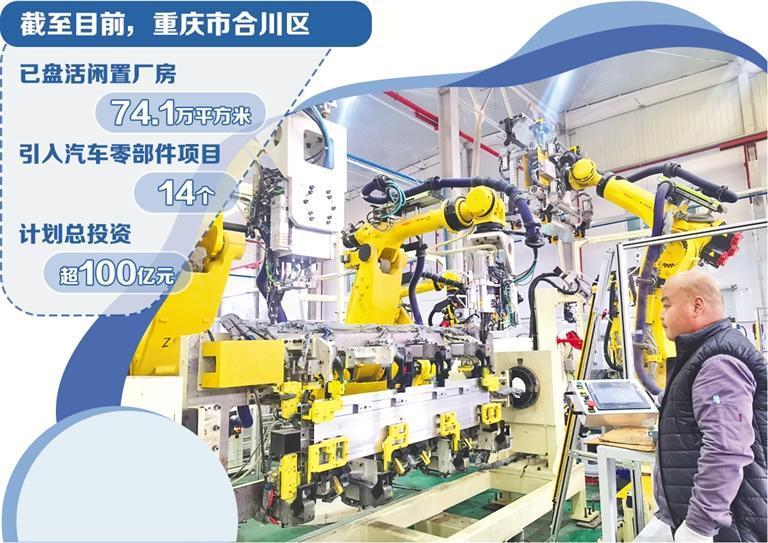
Core Viewpoint - The revitalization of idle land and factory spaces in Hechuan District has led to significant growth in the automotive parts industry, attracting numerous companies and fostering a collaborative industrial ecosystem [2][5][6] Group 1: Company Developments - Yunqi Automotive Systems Co., Ltd. established operations in Hechuan District in October 2025, utilizing over 60,000 square meters of idle factory space to set up four cold stamping production lines, which are expected to produce approximately 10 million stamped parts annually [1] - Hechuan District has successfully attracted 14 automotive parts projects with a total planned investment exceeding 10 billion yuan, revitalizing 741,000 square meters of idle factory space [5] - Chongqing Jianya Automotive Parts Co., Ltd. plans to invest an additional 2 billion yuan in idle factory space to establish a super chassis and production project for 1 million automotive parts, which is projected to generate an annual output value of 3 billion yuan upon reaching full production [5] Group 2: Industry Strategy and Growth - The district has positioned the intelligent connected new energy vehicle parts industry as a leading sector, creating Chongqing's first industrial park for this purpose and implementing a strategy of "revitalizing stock to gain development increment" [2][4] - Over 80% of the idle factories are ready for quick delivery before the investment, saving over six months in construction time for incoming enterprises [2] - A project service team has been established to ensure that enterprises can quickly settle, build, and stabilize production, while also facilitating market expansion and talent development [6]